• العربية
  • فارسی
Brand
  • Iran Insight
  • Politics
  • Economy
  • Analysis
  • Special Report
  • Opinion
  • Podcast
  • Iran Insight
  • Politics
  • Economy
  • Analysis
  • Special Report
  • Opinion
  • Podcast
  • Theme
  • Language
    • العربية
    • فارسی
  • Iran Insight
  • Politics
  • Economy
  • Analysis
  • Special Report
  • Opinion
  • Podcast
All rights reserved for Volant Media UK Limited
volant media logo

To Hurt The Regime, Activists Urge People Not To Use Iranian Banks
Iran International Newsroom
Dec 19, 2022, 13:37 GMT+0Updated: 17:54 GMT+1
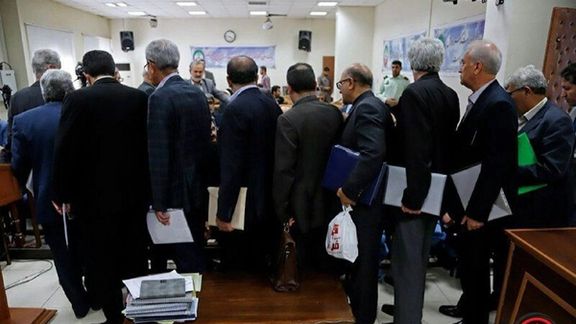
People stand in line inside a bank

More and more activists are calling on people to withdraw their money from Iranian banks as a measure to reduce the liquidity at disposal of the state. 

Iranian political activist, lawyer and Nobel Peace Prize laureate Shirin Ebadi urged people on Sunday to join the campaign of withdrawing money from banks, noting that state-controlled banks in Iran are not institutions to serve the people and only act as the economic arm of the “killing Republic” referring to the clerical regime.

"Now it has been proven to everyone that there is no will in the regime to accept the demands of the people," she said, adding that the campaign to shun banks in daily transactions can deal a "fundamental blow" to the government. 

Political activist, lawyer and Nobel Peace Prize laureate Shirin Ebadi (file photo)
100%
Political activist, lawyer and Nobel Peace Prize laureate Shirin Ebadi

This movement dubbed “Join this campaign" has been formed so that citizens can deal a major blow to the government’s repressive structures, she said.

Ebadi added that such campaigns should not be limited to banks, noting that time has come for a coordinated action against all institutions that have a part in the crackdown on the popular protests. Some activists have suggested that people should refuse to pay their utility bills and other payments to government entities.

Her remarks come as grassroot groups and activists have also announced calls for another three-day nationwide protests and strikes starting Monday, for December 19, 20, and 21. In addition to daily protests on the streets and sit-ins at universities, strikes continued among employees of many industries, particularly in the oil, gas and petrochemical sectors. 

It has become obvious for many Iranians that the banks are not able to survive if people start to use cash instead of debit cards, which have managed to keep the level of liquidity at a level that banks do not go bankrupt. 

The head of the Central Bank of Iran (CBI), Ali Salehabadi, said in addition to US sanctions on Iran, recent popular protests have encouraged capital flight from the country and contributed to the fall of the rial. But he promised to reduce the alarming growth in the money supply until March, when the Iranian calendar year ends.

As a psychological op to counter the capital drain from the banks, rumors are circulating on social media that the Islamic Republic plans to increase interest rates by five percent. However, Salehabadi said Monday that no decision has been finalized to increase the rates.

Most economist in Iran have repeatedly told the local media that there is no quick fix to the deep-rooted banking and financial problems facing the regime.

Iran’s rial was hovering near 400,000 against the US dollar on Monday, while in most of 2021 the rial was stable at around 250,000, a more than 50-percent drop in 15 months, which coincides with the presidency of hardliner Ebrahim Raisi.

The banks run by regime insider have always been under pressure to grant loans to the powerful circles or invest in state-run projects, but they prefer to avoid such financings because most of the projects in the country are not producing profits and banks would face problems redeeming their loans. 

Iran has also a problem with the demands made by the international financial watchdog, the FATF since 2017, to enact legislation against money laundering and financing of terrorism. Without this, Iran will remain blacklisted by many international financial institution

Bahaoldin Hosseini-Hashemi, an economist in Tehran, says the closing months of the year are usually when more money is printed by the CBI, because the government has to pay its end-of-year obligations. Hosseini-Hashemi drew attention to official reports showing that the CBI has printed money at a faster pace since the end of September as government debt to the bank has increased. A second challenge is presented by state or quasi-state banks, which also rely on borrowing from the CBI.


Most Viewed

Iran negotiators ordered to return after internal rift over Islamabad talks
1
EXCLUSIVE

Iran negotiators ordered to return after internal rift over Islamabad talks

2
ANALYSIS

US blockade enters murky phase as tankers spoof signals and buyers hesitate

3
ANALYSIS

Why the $100 billion Hormuz toll revenue is a myth

4

US tightens financial squeeze on Iran, warns banks over oil money flows

5
ANALYSIS

US blockade targets Iran oil boom amid regional disruption

Banner
Banner

Spotlight

  • Hardliners push Hormuz ‘red line’ as US blockade tests Iran’s leverage
    INSIGHT

    Hardliners push Hormuz ‘red line’ as US blockade tests Iran’s leverage

  • Ideology may be fading in Iran, but not in Kashmir's ‘Mini Iran'
    INSIGHT

    Ideology may be fading in Iran, but not in Kashmir's ‘Mini Iran'

  • War damage amounts to $3,000 per Iranian, with blockade set to add to losses
    INSIGHT

    War damage amounts to $3,000 per Iranian, with blockade set to add to losses

  • Why the $100 billion Hormuz toll revenue is a myth
    ANALYSIS

    Why the $100 billion Hormuz toll revenue is a myth

  • US blockade targets Iran oil boom amid regional disruption
    ANALYSIS

    US blockade targets Iran oil boom amid regional disruption

  • Iran's digital economy battered by prolonged blackout
    INSIGHT

    Iran's digital economy battered by prolonged blackout

•
•
•

More Stories

Iran Regime Uses Social Media Accounts Of Detainees To Incriminate Them

Dec 19, 2022, 12:33 GMT+0

Reports from Iran say that the regime officials use private chats, phone logs and text messages of protest detainees as incriminating evidence.

CNN on Monday quoted an Iranian woman who says she has been accused by Iranian authorities of running an anti-regime activist group on Telegram.

The woman introduced as Negin has denied the allegation, but she has told CNN she has “some friends” who were political prisoners.

“They put in front of me transcribed printouts of my phone conversations with those friends,” she said, and “questioned me on what my relationship with those people were.”

“They told me ‘Do you think you can get out of here alive? We will execute you. Your sentence is death penalty. We have evidence, we are aware of everything,’” said Negin, which is not her real name.

Negin said that she realized security agents accessed her Telegram account with a different IP address.

Iranian regime reactivated her Telegram account to see who has been in touch with her while Negin was in jail, she added.

Negin was one of hundreds of protesters detained at Iran’s notorious Evin prison in northern Tehran within the first few weeks of anti-government protests following the death of Mahsa Amini in police custody in mid-September.

The Iranian government may have used similar tactics to surveil the Telegram and Instagram accounts of Nika Shahkarami, the 16-year-old demonstrator who lost her life after a protest in Tehran on September 20.

Four Clerics Attacked in Iranian Religious City Of Qom

Dec 19, 2022, 11:24 GMT+0

Unknown people attacked four Shiite clerics with sharp objects in the religious city of Qom, with to hospitalized as similar incidents have taken place in recent months.

The public relations office of Qom University of Medical Sciences announced that the four clerics were wounded by a sharp object, but another source said they were hit by shotgun pellets.

Tasnim website quoted Qom University of Medical Sciences as saying that before noon on Sunday, unknown people injured four mullahs in “several different regions” of the city, and two of them were taken to the hospital for treatment, for injuries in the shoulder and leg.

Before the eruption of anti-regime protests in mid-September, several cases of attacks on clerics had been reported in Iran. On August 29, two who were introduced as imams of mosques in Qom, were attacked with an “iron pipe”.

Before that, a young mullah was attacked with a knife in the evening of July 28 in Karaj, west of Tehran.

On July 1, Iranian media reported that the imam of a mosque in Isfahan was attacked by an unknown motorcyclist with a firearm.

During the recent protests against clerical rulers following the death of Mahsa Amini in police custody, youth tossed turbans of many mullahs in the streets to show their anger at them.

Pussy Riot Members Detained At World Cup Final, For Protest Attempt

Dec 19, 2022, 09:17 GMT+0

Members of Russia's Pussy Riot band were detained on Sunday after trying to storm the pitch at the World Cup final in Qatar to protest the war in Ukraine, the imprisonment of Russian opposition leader Alexei Navalny and the oppression of women in Iran, activists said.

According to the Cinema for Peace Foundation, a Berlin-based charity that focuses on humanitarian and environmental issues, security detained member Nika Nikulshina, an associate of the protest group, Peter Verzilov, and a Ukrainian member of Pussy Riot.

Reuters was not able to independently verify the reports.

The activists were stopped by security forces before they could invade the pitch, Cinema for Peace said in a statement.

Jaka Bizilj, founder of the Cinema for Peace Foundation, told Reuters that Verzilov told him that he was pulled back by security forces seconds before entering the pitch.

"When I texted with Peter he was in police detention," Bizilj said.

Iran's clerical rulers have faced the biggest protests in years since September when 22-year-old Iranian Kurdish woman Mahsa Amini died in the custody of the morality police who enforce strict dress codes.

The 2018 World Cup final in Moscow was briefly interrupted when Pussy Riot activists, including Verzilov, burst onto the pitch to draw attention to human rights abuses in Russia before being hauled off by stewards.

Cinema for Peace evacuated Verzilov after the 2018 World Cup in Moscow for treatment for alleged poisoning. The foundation also brought Navalny in 2020 from Russia to Berlin for life-saving treatment after his poisoning.

Reuters Report

Iran Regime Officials Advise Students To Study In North Korea

Dec 18, 2022, 23:29 GMT+0

A top university professor in Iran has harshly criticized comments by a science ministry official regarding study opportunities for students in North Korea.

After meeting with the North Korean ambassador, the head of the Student Affairs Organization of the Ministry of Science said professors and students can take advantage of exchange programs with the isolated country.

Prof. Mehdi Zakerian said, “I have studied and lived in the United States and France, I have not been to North Korea, but I know there is not even the possibility of accessing the Internet in this country.” He was speaking to Khabaronline website in tehran.

“How is that the children of our officials study in the US and Europe, but advise other students to go North Korea to study?” he asked.

Many Iranian regime insiders have sent their sons and daughters to study and live in North America and Europe, while they continue to support the anti-West rhetoric and policies of the Islamic government. Some regime officials said in recent years that up to 4,000 family members of current or former officials live in the West.

Canada in October banned 10,000 members of Iran’s Revolutionary Guards from entering its territory and reports say that Ottawa is investigating to see if there are undesirable individuals currently living in the country.

Doctor Treating Protesters In Iran Dies In Suspicious Circumstances

Dec 18, 2022, 22:43 GMT+0
•
Maryam Sinaiee

Claims by Iranian officials that a female doctor who died with unusual injuries committed “suicide” has sparked suspicions of yet another death in custody.

The family of Dr. Aida Rostami were contacted by the local police the day after her disappearance, December 12, a source close to the family told Iran Wire Friday and that she had died in a car accident. The police said the body was at the morgue of Behesht-e Zahra Cemetery in the south of the capital Tehran.

The authorities insisted, when they handed over the body to the family, that they should bury her in their hometown of Gorgan in northeastern Iran. According to the source, the family first resisted the pressure but later accepted the request, as their daughter had previously expressed a desire to be buried in her hometown if she ever died.

The source also said medical examiners told the family, apparently in confidence, that she was not killed in a car accident, as the police had told the family, but that they were ordered not to reveal the true cause of death.

Sources close to the family have said when the they insisted to view the body, they saw various injuries and bruises, including on her genitals, and broken arms. The lids of one of the eyes of the young doctor were stitched together, apparently to conceal the removal of the eyeball.

Judiciary authorities are now offering a completely different account of the circumstances of the young doctor’s death and have arrested a young man who they claim is suspected of throwing Dr. Rostami to her death from a pedestrian overpass after a quarrel over their relationship.

State media on Sunday published a video of the unnamed man who claimed Rostami was his girlfriend and that she had thrown herself from a pedestrian bridge after he left her and that he returned to find her body on the ground.

Donya Farhadi, an architecture student, whose body was recently found ,was a protester

Authorities have explained the death of several young protesters in the past three months in similar ways, including the suspicious deaths of two teenagers in Tehran and Karaj in late September and early October. Authorities claimed Nika Shakarami and Sarina Esmailzadeh had both jumped to their deaths from the top of buildings.

The death of Aylar Haqqi (Haghi), a 23-year-old medical student, whose body was found in a construction site in Tabriz on November 15, was also explained in the same way, although her relatives claim she was shot with shotgun pellets before her injured body was thrown down from the top of a building on the site.

Families or sources close to the families of these young women have all said they were subjected to pressure and intimidation by security and intelligence forces who wanted them to validate their “scripted” accounts of their deaths.

On Friday another young woman’s body was found on the banks of Karoun River in a village near Ahvaz in southwest Iran by the locals. Authorities claim Donya Farhadi, a twenty-one-year-old student had fallen into the river from a bridge. Local sources have said on social media that the young woman was an active participant in the recent student protests.

Dr Rostami, 36, was last heard of on the evening of December 12 when she called her mother to say she was on her way to a wounded protester she was secretly treating and needed to buy more medical supplies. At that time she was in Ekbatan, a massive apartment complex in the west of Tehran, where she and her family also resided.

In the past three months Ekbatan has been one of the major hotspots of protests and frequent crackdowns by security forces who on some occasions have fired shotguns at windows indiscriminately to silence people chanting from inside their apartments every night.

An informed source told Iran International that Dr Rostami had been secretly treating protesters who feared arrest if they sought treatment for injuries and bullet wounds at hospitals, where agents usually wait to arrest protesters.