• العربية
  • فارسی
Brand
  • Iran Insight
  • Politics
  • Economy
  • Analysis
  • Special Report
  • Opinion
  • Podcast
  • Iran Insight
  • Politics
  • Economy
  • Analysis
  • Special Report
  • Opinion
  • Podcast
  • Theme
  • Language
    • العربية
    • فارسی
  • Iran Insight
  • Politics
  • Economy
  • Analysis
  • Special Report
  • Opinion
  • Podcast
All rights reserved for Volant Media UK Limited
volant media logo

Iranian Officials Appear Lost And Confused Amid Crisis
Iran International Newsroom
Dec 6, 2022, 09:15 GMT+0Updated: 17:31 GMT+1
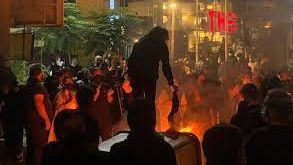
An undated photo showing protesters lighting a fire in the street and burning veils

Comments made by Iran's hardliners, amid a serious popular challenge to the regime, reveal that they still have no true grasp of what is going on in the country.

Some hardliners, like Iran's Interior Minister Ahmad Vahidi appear to be repeating what they hear from others or in the news.

Vahidi told reporters about a fact-finding committee to investigate the ongoing protests, but he said dissidents cannot be part of the investigation. He added that what the government is facing are "riots" rather than "protests".

The committee, comprised of security organizations and "independent" lawyers, will be tasked with "finding the players," among the “rioters” meaning that it is not really a fact-finding committee but a chase and crackdown group. Previously Vahidi had talked about an investigative group which was supposed to uphold the rights of those who have sustained losses during the protests.

The only thing he knew was that it is a ‘fact-finding committee’, a term he must have heard in the news from the UN about establishing an international fact-finding mission to probe into violations of human rights in Iran during the protests since mid-September.

Furthermore, he spoke about independent lawyers at a time when more than two dozen are in jail for trying to represent and help human rights activists including other lawyers.

Senior IRGC officer and interior minister Vahidi
100%
Senior IRGC officer and interior minister Vahidi

Lawmaker Shahryar Heidari of the Majles National Security Committee has told ILNA that the committee set up by Vahidi is going to be "useless".

Meanwhile, figures Vahidi presented on casualties among protesters contradicted what other officials have said. He mentioned 200 individuals who were killed "during the riots,” while IRGC's General Hajizadeh put the number of those killed at "more than 300". Human rights organizations say there are between 450-500 verified cases of deaths.

In another development, one of Vahidi’s deputies, Majid Mir Ahmadi, has made outlandish remarks about the protests in an interview. Mir Ahmadi said some "rioters" receive 500 million rials ($1400) for attacking each security officer. He added that some female protesters were assigned to offer indecent proposals to young men to spend a few nights with them if they promised to take part in the "riots".

Hassanzadeh, commander of the IRGC in Tehran
100%
Hassanzadeh, commander of the IRGC in Tehran

In yet another report, Hassan Hassanzadeh, the commander of the IRGC Headquarters in Tehran said the United States has spent 55 trillion dollars to establish media in Arab states and countries around Iran to steer the protests (It is not a typo. He really said $55 trillion).

Reformist activist Feyzollah Arabsorkhi reminded him in a tweet that the United States' annual Gross Domestic Product is only 25 trillion dollars.

This shows either the lack of basic education on the part of senior IRGC officers or their ability to utter fantastic lies.

On the more pragmatic side, Majles Speaker Mohammad Bagher Ghalibaf appears to have retreated from his idea of introducing a "new form of governance” for Iran as the reformist website Etemad Online reported. According to the website, after several highly controversial speeches that were welcomed by some optimistic Iranians, he has finally said that what he meant by new governance was a plan to abide by Iran's forgotten constitution.

While almost every official and politician praises the constitution as the ultimate guide, it appears to have been shelved after Supreme Leader Ali Khamenei took office in 1989. Two of the precepts of the constitution that are much talked about recently are articles that allow peaceful protests and holding referendum about core political disputes in the country.

This comes while conservative politician Hossein Kanani Moghaddam said in an interview that "Talking about a new form of governance without amending the constitution is a joke, particularly in a situation in which people are so pessimistic that they refuse to buy the arguments of any politician or state official."


Most Viewed

Iran International says it won’t be silenced after London arson attack
1

Iran International says it won’t be silenced after London arson attack

2
VOICES FROM IRAN

Hope and anger in Iran as fragile ceasefire persists

3

Iran halts petrochemical exports to supply domestic market

4
INSIGHT

How Tehran bends its own red lines to boost state rallies

5

US arrests Iranian national over alleged Basij-linked visa fraud

Banner
Banner

Spotlight

  • Hardliners push Hormuz ‘red line’ as US blockade tests Iran’s leverage
    INSIGHT

    Hardliners push Hormuz ‘red line’ as US blockade tests Iran’s leverage

  • Ideology may be fading in Iran, but not in Kashmir's ‘Mini Iran'
    INSIGHT

    Ideology may be fading in Iran, but not in Kashmir's ‘Mini Iran'

  • War damage amounts to $3,000 per Iranian, with blockade set to add to losses
    INSIGHT

    War damage amounts to $3,000 per Iranian, with blockade set to add to losses

  • Why the $100 billion Hormuz toll revenue is a myth
    ANALYSIS

    Why the $100 billion Hormuz toll revenue is a myth

  • US blockade targets Iran oil boom amid regional disruption
    ANALYSIS

    US blockade targets Iran oil boom amid regional disruption

  • Iran's digital economy battered by prolonged blackout
    INSIGHT

    Iran's digital economy battered by prolonged blackout

•
•
•

More Stories

Government Frustrated Over Inability To Stop Exodus Of Iranians

Dec 5, 2022, 23:47 GMT+0
•
Iran International Newsroom

Amid nationwide protests, economic hardship and uncertainty about their future, more Iranians are emigrating, with Oman as a new favorite destination. 

The accelerating exodus is not limited to medical and engineering professionals anymore as many business owners have also started to transfer their businesses to nearby countries where trade transactions are easier, especially to the Persian Gulf littoral states. 

According to a recent article in the Tehran newspaper Arman Melli, during the past year about 30,000 personnel of different medical professions, including doctors, nurses, and paramedical technicians, have applied for Certificates of Good Standing with intent to immigrate to Oman. The paper claimed that within the last four years, 16,000 general practitioners have left the country. The high number of emigrations has become so alarming that the officials of medical organizations have warned of serious shortages of doctors in the near future. 

In April, Iran's Medical Council said about 4,000 doctors have applied for Certificates of Good Standing in the previous 12 months with the intent to leave the country. Council spokesman Reza Laripour said that the annual number of such applications was less than 600 between 2013 and 2015.

Head of the Medical Council of the Islamic Republic, Mohammad Raeeszadeh, said, "The medical community faces fundamental challenges in some specialties, so that we may not have graduates in some fields in the future.” He warned of the risk of regression to 40 years ago when it had to hire foreign doctors to meet domestic needs.

Head of the Medical Council of the Islamic Republic, Mohammad Raeeszadeh (file photo)
100%
Head of the Medical Council of the Islamic Republic, Mohammad Raeeszadeh

Lack of a promising future is the main reason why professionals decide to leave. Incomes have sharply declined in the past years as Iran’s currency has lost its value by more than tenfold, and the state seems to become more inept and arbitrary in governing the country.

On the backdrop of Iranian doctors emigrating in droves, the health ministry in September increased the exit permit bond for medical, dental and pharmacy students to $5,000 per year. Deputy minister for education at the health ministry, Abolfazl Bagherifard, said that students in graduate levels should provide 1.5 billion rials ($5,000) to leave the country for a year and undergraduate levels should provide bonds worth $2,000. Students must provide an official letter of commitment to return as well as another person's guarantee by depositing a real estate bond or a bank guarantee.

Experts and social scientists in Iran and abroad have told the media that the brain drain in the past few decades, beginning with the 1980-88 war with Iraq, has been accelerated by lack of social freedoms in the clerical-dominated system, political upheavals, deterioration of the economy, and government repression.

The government has stepped up pressures and restrictions on students and graduates. Late in November, the parliament presented a proposal to ban students who participate in protests from traveling abroad for ten years. Recently, the Ministry of Science Research and Technology has also approved regulations that would increase the costs of receiving university degrees six to 10 times. 

All Iranians who study in government universities must work about twice the duration of their studies for a state institution before they can get their certificates. If they opt out of working for the government, they should pay the cost of their education to get their document. As per recent regulations, the fees to get their degrees have increased up to 10-fold. 

However, even those measures are not enough to stop Iranians from leaving the country, with many families deciding to either send their children abroad before starting university or forgetting about getting a degree altogether. Ali Sharifi-Zarchi, a professor at Tehran’s Sharif University of Technology, believes that the new measures would even accelerate emigration, saying that the new fees mean that the government is urging students to forget about Iranian universities and study abroad where they can find a job and help pay for their expenses.

Almost half of Iranian youth want to leave the country amid pessimism about their future, a recent opinion survey conducted from abroad shows.

Students Begin Three-Day Strike In Universities Across Iran

Dec 5, 2022, 20:33 GMT+0

Students at several universities across Iran went on strike Monday and protested by publishing statements in support of ongoing strikes by shop owners and businessmen.

Based on reports and videos received by Iran International Tehran students in the Faculty of Electrical Engineering of the University of Science and Technology went on strike to protest government persecution and arrest of students.

The students of Khajeh Nasir University in the capital also announced a three-day strike saying that “we all stand together for the freedom of our friends.”

At Tehran University's Faculty of Economics, students joined the three-day national strike saying it is “also an objection to professors who not only did not support the people, students and even their colleagues, but stood by the oppressor.”

Students in Esfahan, Shiraz, Rasht, Sanandaj and several others announced they will boycott classes on December 5, 6, and 7 to join the nationwide strikes.

President Ebrahim Raisi, who earlier announced he would deliver a speech at a university on Wednesday, has not revealed the name of the college yet in fear of protests and raliies which might target him.

Students have been at the forefront of demonstrations against Iran’s authoritarian regime within the past twelve weeks.

According to the US-based Human Rights Activists News Agency (HRANA) at least 18,210 protesters have been arrested including 585 students.

After A Day Of Strikes Across Iran Comes Night Of Rallies

Dec 5, 2022, 19:53 GMT+0
•
Iran International Newsroom

In cold weather and rain, Iranians poured into streets Monday evening to hold antigovernment rallies following students' sit-ins and strikes flaring up across the country. 

Iranians embarked on a three-day action on Monday with the calls focused on strikes for December 5 and 6 and rallies for December 7, Student Day in Iran, which marks the anniversary of the 1953 murder of several students at University of Tehran. It is a traditional day of nationwide rallies. To coincide with Student Day, protesters have also called for strikes by businesses and a rally towards Tehran's Azadi (Freedom) Square.

Students in many universities across Iran did not show up for classes on Monday and in some campuses, they held sit-ins and rallies to protest against the Islamic Republic and its repression machine.

Meanwhile, many shops and businesses shut their doors in a nationwide action that was so stunning that the country’s judiciary had to come up with a new propaganda line to justify the strikes. Iran's Chief Justice Gholam-Hossein Mohseni-Ejei blamed "rioters" for threatening shopkeepers. Hardliners led by the Revolutionary Guard call protesters “rioters” and “thugs”.

Emphasizing that the death sentences of several protesters have been confirmed and they will be executed soon – apparently meant to scare the demonstrators to stop their movement to oust the regime -- he added shopkeepers who close their businesses would be swiftly dealt with by the judiciary and security bodies.

Authorities also sealed a jewelry shop and restaurant belonging to Iranian football legend Ali Daei after he closed his businesses to join antigovernment strikes. Since the beginning of the uprising sparked by the death of Mahsa Amini in custody of the hijab – or the so-called “morality” police -- in mid-September, strikes have been staged in support of street protests. The authorities have kept threatening businesses that if they close in support of the protests, they will be fined, or their businesses will be sealed as punishment. 

Despite Internet restrictions in many regions of the country, social media is exploding with videos of closed shops in bazaars and markets in a lot of cities and towns. Stores were shut in Tehran's Bazaar, and other large cities such as Karaj, Esfahan, Mashhad, Tabriz, Shiraz, Bojnourd, Kerman, Sabzevar, Ilam, Ardabil and Lahijan. The list of cities goes on as more videos are still being shared online. 

The bazaar of Tabriz on December 5, 2022
100%
The bazaar of Tabriz on December 5, 2022

The strikes were especially widespread in Kurdish-majority cities. Hengaw, a Norway-based rights group which monitors abuses in Kurdish areas, reported that 19 cities had joined the strike movement in western Iran, where most of the country's Kurdish population live.

When night fell, however, the same streets that sounded so calm during the day became scenes of antigovernment protests with people chanting slogans against the regime. People in several neighborhoods in large cities, such as the capital Tehran and religious city of Mashhad, blocked roads while chanting slogans and waiting for the security forces to appear. The first rain and snowfall in many cities have led to slippery roads, which protesters relish as a hurdle for the regime’s agents riding on motorcycles. In some social media videos, shots are heard with people saying that security forces opened fire at them. 

Iranian Regime Seals Football Legend’s Business For Strikes Support

Dec 5, 2022, 17:59 GMT+0

Security forces have reportedly sealed a jewelry shop and restaurant belonging to Iranian football legend Ali Daei after he shut down his businesses to join anti-government strikes.

ISNA news agency reported Monday that the ex-footballer’s shop and restaurant in northern Tehran was shut upon official orders.

“Following the support for anti-government groups’ call on social media to disrupt peace and business of the market, a judicial order was issued to seal Noor Jewelry Gallery,” ISNA reported.

It also added that a restaurant belonging to Daei had also been ordered shut providing no further details.

Last week Daei revealed threats against him after throwing his weight behind the protests triggered by the death of Mahsa Amini in mid-September.

The nationwide protests in Iran have continued for 80 days with regime forces killing hundreds of people and detaining thousands of others, including football players and celebrities.

Earlier, Ali Daei decided not to travel to Qatar to attend the current World Cup due to the brutality and deadly force used by the government against unarmed protesters.

Many other legendary Iranian soccer players such as Mahdi Mahdavi-Kia, Karim Bagheri, Ahmad Reza Abedzadeh, etc., are supporting the protest movement.

Despite Claim Of No ‘Morality Police’, Iran's Hijab Crackdown Goes On

Dec 5, 2022, 16:14 GMT+0
•
Maryam Sinaiee

Iran's police has declined to confirm attorney general’s claim that the notorious ‘morality police’ has been disbanded, as international media trumpeted the news.

Shargh daily reported Monday that it had contacted the head of public relations of The Greater Tehran Law Enforcement, Colonel Ali Sabahi to verify the claim by Attorney General Mohammad Jafar Montazeri who suggested December 3 that the so-called morality police has been abolished, but the official refused to make any comments.

“It’s not time for us to discuss this. The Police will comment whenever it deems is necessary. Don’t tell [anyone] you have contacted us,” Sabahi told the Shargh reporter. “I’m not the attorney general, go ask him!”, he added before insulting the reporter. The newspaper said further enquiries were also ignored but threats were made, through a third party, against the newspaper, its reporters, and its managing director.

“The morality police has nothing to do with the judiciary and was shut down by the same authority that had established it,” Montazeri had said in response to a reporter at a press conference.

The only comment on Montazeri’s controversial remarks came from Iran's state-run Arabic-language TV channel, Al-Alam, on Sunday [Dec 4] which referring to international media reports on its Persian-language website wrote that officials of the Islamic Republic have not “confirmed the disbanding of the morality police patrols.”

“Some foreign media have tried to present the attorney general’s remarks as the Islamic Republic’s retreat from the matter of [compulsory] hijab and chastity due to the recent riots,” Al Alam wrote.

Meanwhile, judicial authorities shut down a children’s amusement center at a Tehran mall Sunday because its staff had flouted the hijab and published their photos on social media. Judicial authorities have also been summoning celebrities such as actress Shaghayegh Dehghan who published a photo of herself without the compulsory veil on a Tehran street.

The indirect denial by the authorities comes a day after Montazeri’s suggestion made headlines in many major international media and even made US Secretary of State Antony Blinken cautiously comment on it in an interview with the CBS.

“And so, if the regime has now responded in some fashion, to those protests, that could be a positive thing. But we have to see how it actually plays out in practice. And what the Iranian people think. This is about them, and it's up to them,” he said when asked about the reported abolishment of the morality police.

At a joint press conference with Serbian officials in Belgrade, Iran's foreign minister Hossein Amir-Abdollahian alleged that the United States “and a few western countries” were encouraging “riots and terrorism” in Iran and claimed that Iranian authorities are “listening to people’s demands and responding to them” but will not allow anyone to foment such activities. “We enjoy a strong democracy in our region,” he claimed.

Some social media users have suggested that Montazeri’s remark was a publicity stunt meant to appease protesters and keep them away from the streets during the planned three-day strikes and protests starting December 5.

Disbanding the morality police, others say, will make no difference to protesters who want nothing less than toppling the Islamic regime. As underground activists in Iran formally joined forces and issued calls for protests, their aim was clear – putting an end to the Islamic Republic.