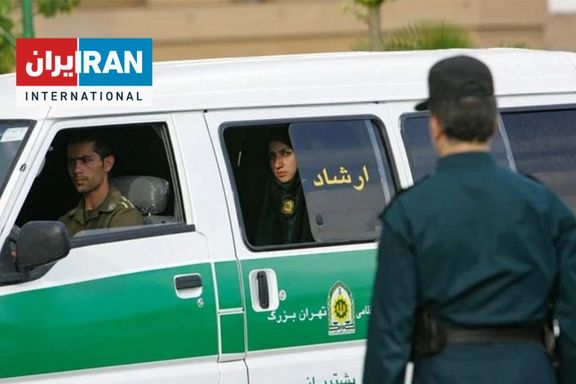
A 'hijab police' patrol van in Iran, with female enforcer seen inside
Iran's police has declined to confirm attorney general’s claim that the notorious ‘morality police’ has been disbanded, as international media trumpeted the news.
Shargh daily reported Monday that it had contacted the head of public relations of The Greater Tehran Law Enforcement, Colonel Ali Sabahi to verify the claim by Attorney General Mohammad Jafar Montazeri who suggested December 3 that the so-called morality police has been abolished, but the official refused to make any comments.
“It’s not time for us to discuss this. The Police will comment whenever it deems is necessary. Don’t tell [anyone] you have contacted us,” Sabahi told the Shargh reporter. “I’m not the attorney general, go ask him!”, he added before insulting the reporter. The newspaper said further enquiries were also ignored but threats were made, through a third party, against the newspaper, its reporters, and its managing director.
“The morality police has nothing to do with the judiciary and was shut down by the same authority that had established it,” Montazeri had said in response to a reporter at a press conference.
The only comment on Montazeri’s controversial remarks came from Iran's state-run Arabic-language TV channel, Al-Alam, on Sunday [Dec 4] which referring to international media reports on its Persian-language website wrote that officials of the Islamic Republic have not “confirmed the disbanding of the morality police patrols.”
“Some foreign media have tried to present the attorney general’s remarks as the Islamic Republic’s retreat from the matter of [compulsory] hijab and chastity due to the recent riots,” Al Alam wrote.
Meanwhile, judicial authorities shut down a children’s amusement center at a Tehran mall Sunday because its staff had flouted the hijab and published their photos on social media. Judicial authorities have also been summoning celebrities such as actress Shaghayegh Dehghan who published a photo of herself without the compulsory veil on a Tehran street.
The indirect denial by the authorities comes a day after Montazeri’s suggestion made headlines in many major international media and even made US Secretary of State Antony Blinken cautiously comment on it in an interview with the CBS.
“And so, if the regime has now responded in some fashion, to those protests, that could be a positive thing. But we have to see how it actually plays out in practice. And what the Iranian people think. This is about them, and it's up to them,” he said when asked about the reported abolishment of the morality police.
At a joint press conference with Serbian officials in Belgrade, Iran's foreign minister Hossein Amir-Abdollahian alleged that the United States “and a few western countries” were encouraging “riots and terrorism” in Iran and claimed that Iranian authorities are “listening to people’s demands and responding to them” but will not allow anyone to foment such activities. “We enjoy a strong democracy in our region,” he claimed.
Some social media users have suggested that Montazeri’s remark was a publicity stunt meant to appease protesters and keep them away from the streets during the planned three-day strikes and protests starting December 5.
Disbanding the morality police, others say, will make no difference to protesters who want nothing less than toppling the Islamic regime. As underground activists in Iran formally joined forces and issued calls for protests, their aim was clear – putting an end to the Islamic Republic.
A spontaneous protest in a Tehran neighborhood on Nov. 15, 2022
Iranian pundits increasingly point out that unlike previous protests driven by economic or electoral grievances, the current uprising demands regime change.
Reformist analyst Abbas Abdi openly said in an interview in Tehran that protests in 2009 did not call for regime change, but "the demand of current protesters is to change the regime. They do not know what will happen next, but they believe whatever that might take place will be better than the current situation."
Abdi said some of the characteristics of the current protests are that "They are deep-rooted, have taken the government by surprise, they have been continuing for a long time, and have gone further, in a way that it is impossible to return to the situation as it was before."
Abdi said that another characteristic of the movement is that the people have behaved in a way during the past 10 weeks that they can no longer retreat. They have challenged the core of the regime and Supreme Leader Ali khamenei.
He added that the main question is not, as some officials charge, that foreigners have instigated the protests. Even if we suppose that is true, it is not important who started the movement. “What is important is that it is taking place in Iran."
Abdi stressed that, "This is not a riot. This is a protest that was predicted long ago. The reason why it did not quickly follow the 2019 protests, was the coronavirus pandemic."
Iranian commentator Abbas Abdi
He added that the government was taken by surprise because it never pays attention to society. It is always watching other countries. All these youngsters in the streets have been in classrooms where teachers and headmasters have been in close contact with them. How could have they not noticed that something was going on? The reason they did not see it, is that no one in the government wishes to really see the society, even now when it is in turmoil. Even the intelligence organizations found out about the movement after they arrested the protesters."
Abdi said this comes while young people were not acting secretly. They even showed off what they are doing. He explained that generation Z is only the driving force of the movement. The other part, which is important but neglected is the silent majority that follows the movement. He said that many opinion polls the government did not allow to be published indicate that some 60 to 80 percent of the population support the youngsters in the streets although they may not be as vocal.
Silent protest by university students in the Kurdish city of Sanandaj on Nov. 15, 2022
Abdi's interview coincided with the publication of an interview with Iranian American sociologist Asef Bayat with Rouydad24news website in Iran. Bayat is the author of books such as Revolution without Revolutionaries, Street Politics, and Global Middle East, whose observations about the Arab Spring are widely acclaimed in the US academic and political circles.
He said in the interview that it is in the nature of the street that a common cause can turn a gathering of 500 individuals into a massive rally of several thousand people.
Speaking about the current Iran protests and the violence and suppression that have been going on in the streets during the past 10 weeks, Bayat said: "People do not like to be on the streets. They want to live peacefully. The reason why people take to the streets is that politics stops working. Politics means an institutional mechanism to settle political, social and economic disputes and reach a democratic agreement. When the government cannot do that and does not allow the people to have their representatives in the government, citizens tend to take part in strikes or refuse to go to classrooms. But some citizens such as those who do not have a job might take to the streets to voice their demands and to show their social power."
He went on to say, "Authoritarian governments do not tolerate protesters presence in the streets because they do not want the people to believe in their collective social force."
A reformist female politician says she urged Iran's top security official, Ali Shamkhani in a meeting on Sunday to pursue reforms and change the constitution.
Azar Mansouri, the secretary general of Unity of the Nation Party, a coalition of so-called reformists, was quoted by a local media outlet that she and others were invited by national security council secretary Shamkhani to a meeting Sunday. She did not name the other participants, but it is safe to assume many were also reformist politicians.
Mansouri said that she urged Shamkhani to start short-, medium- and long-term reforms in governance,” first by releasing all protesters who have been detained since September, followed by constitutional changes through a “founding assembly”, as a path to emerge from the current political crisis.
The female politician also demanded a policy that would end sanctions against Iran and would help end the current economic crisis, that she said could bring “40 million people” to the streets.
The Islamic Republic leaders should first acknowledge their mistakes and “bridge gaps with the people” by listening to their grievances, Mansouri told Shamkhani.
Hardliners in charge of Iran’s ruling institutions have said time and again that there could be no constitutional changes and no “retreat from principles.” Raising the specter of constitutional change and forming a potentially unpredictable assembly will certainly be viewed by regime hardliners as a challenge to the principle of having a Supreme Leader and the person of Ali Khamenei.
Secretary of Iran's Supreme National Security Council, Ali Shamkhani
Iran’s reformists are blamed by regime opponents for long pursuing the idea that the Islamic Republic can be reformed and thus giving false hope to the people. Some reformists in the past two months have acknowledged that their thinking has proven wrong, as the extent of deadly violence and untold cruelties against protesters has proven the regime incapable of reforming itself.
In fact, young protesters see little difference between regime hardliners and reformists who want to make incremental changes but keep the Islamic Republic. All slogans and announcements by protesters demand an end to clerical rule.
But according to her own account, Mansouri seems to have also said things that would be annoying to the regime. First, she upheld the memory of all those who were killed during protests since September. She also told Shamkhani that if the regime wants to hold talks with politicians as an attempt at window dressing and as a tool, the whole idea is bound to fail. Discussions to solve the political crisis should be based on “strategic rationality.”
But she was also cautious in her approach by not mentioning the absolute power Khamenei exercises or raise the issue of holding those who are responsible for the killing of hundreds of civilians responsible.
She also did not demand an immediate end to mandatory hijab, and just reminded Shamkhani that having a ‘morality police’ is a bad idea. The issue of systemic discrimination against women, she said, is an issue to be addressed in the long term.
However, she told the top security chief that Iranian women are asking “What has the Islamic society accomplished that would make us proud to use its hijab?”
Despite these remarks, many would still see reformists meeting with security officials as a non-starter, because they believe that now the regime finds itself in deep trouble and wants to save the situation. If protests end and the pressure is lifted, all talk of reform and gestures of pluralism will also end and the clerical-military rulers will go back to what they know best, monopolizing power by relying on force.
A leaked audio file from a meeting of Iranian regime insiders indicates that at least 80 people detained during nationwide protests are in danger of execution.
The recording is from a recent meeting of the Coalition Council of Islamic Revolution Forces, a conservative coalition of parties that endorsed a joint electoral list for the 2020 Iranian parliament and city council election.
The parliament, elected in a non-competitive election in February 2020, is packed with hardliners and Revolutionary Guard officers, most of whom, including its speaker Mohammad-Bagher Ghalibaf, are members of this coalition.
During the session, Gholam-Ali Haddad-Adel, the head of the coalition and a hardliner politician very close to Supreme Leader Ali Khamenei, asks the secretary, Reza Davari, to brief members about recent developments in the country. In his report, Davari said 80 people have been charged with "Moharebeh" and "corruption on earth.” Mohareb (muharib), which means warrior in Arabic is a term in Iran’s Islamic law that means an "enemy of God” or “war against God,” which carries the death penalty. “Corruption on earth” is also another term that carries the death penalty.
He said that Khamenei preferred the detained protesters be executed based on the principle of "qisas" -- or punishment in kind, which in the Islamic criminal code can be applicable in cases of bodily harm – for killing of Basij paramilitary forces. The regime has on many occasions used the Quranic principle -- similar to “an eye for an eye” or the law of talion – to execute protesters after charging them with killing security agents.
Secretary of the Coalition Council of Islamic Revolution Forces Reza Davari
Davari added that if the authorities wanted to execute the protesters based on qisas, they could only issue death sentences for about 10 people, therefore they decided to charge the protesters with “moharebeh” and “corruption on earth” that ensure the execution of more prisoners. He noted that the largest number of such indictments were issued in the provinces of Tehran, Alborz, Fars, Khorasan Razavi and Esfahan.
Any act of defiance can be arbitrarily interpreted as ‘war against god’ in a judicial system that ignores due process and is controlled by the authoritarian ruler Khamenei.
According to recent reports, at least 10 underage protesters are also facing death sentences for the “moharebeh” and “corruption on earth”. During the popular uprising in Iran, over 18,000 citizens have been arrested and it is not clear how many of them were accused of “corruption on earth” and “war against God”.
Davari went on to say that for some of the protesters arrested in Kurdish-majority cities “terrorism” charges were issued so that they could be sentenced to death.
In November, a group of 227 parliament members called on the Judiciary to issue death sentences for people arrested during the ongoing antigovernment protests.
Among other things that were discussed during the session, records of which Iran International obtained, was the brutal crackdown on protesters in Zahedan, the provincial capital of Sistan-Baluchestan, known as the Bloody Friday. It took place September 30, when security forces killed close to 100 people, including women and children. The Islamic Republic never acknowledged the killings of ordinary people and always claimed that security forces only opened fire at those who wanted to attack a police station in the city. However, in the leaked audio, Davari admitted that one of the officers who was stationed on the roof of the police building “made a grave mistake and shot at people” who were not even near the police station, killing some men, women, and children who were not even protesting.
Repeated leaks by hackers and insiders in recent days has unmasked the inner thinking and unpleasant secrets of the Islamic Republic, putting the regime in an uncomfortable situation.
Iran has executed four individuals and sentenced three others accused of working for Israel’s Mossad intelligence agency and conducting kidnappings.
According to the official news website of the judiciary, Mizan Online, the four Iranians, identified as Hossein Ordoukhanzadeh, Shaahin Imani Mahmoudabad, Milad Ashrafi Atbatan, and Manouchehr Shahbandi Bojandi, were hanged early on Sunday. Ordoukhanzadeh – the alleged main link with Mossad – had been imprisoned in Greece between 2014 and 2017 for attempting to traffic humans from Turkey to Greece.
“This morning, the sentences of four main members of the gang of mobsters related to the Zionist intelligence service were executed,” read a statement by the judiciary, adding that their sentences were carried out four days after the Islamic Republic’s supreme court upheld the penalty of capital punishment for “their intelligence cooperation with the Zionist regime [Israel] and kidnapping.” There was no recourse to appeal after the decision on Wednesday, November 30, it added.
A combo photo of the executed individuals
According to the Wednesday ruling, three other defendants were sentenced to between five and 10 years in prison for crimes against the Islamic Republic’s security, complicity in kidnapping and possession of weapons.
All the seven individuals – whom the judiciary called “thugs” with previous criminal records -- allegedly received payment in cryptocurrencies and were guided by Israeli intelligence to buy weapons and equipment, do the abductions and interrogating them, engage in destroying public and private property, theft, kidnappings, and obtaining fake confessions. They allegedly received their instructions from a Mossad operative based in Sweden. They also received training on how to destroy evidence, evade security cameras, and swap vehicles, the judiciary claimed.
Iran’s state media claimed that the group was behind the kidnapping and interrogation of Iranian "jihadist" Yadollah Khedmati.
A screen grab from Yadollah Khedmati's interrogation video. July 2022
In July, Iran International obtained video footage of an interrogation in which a man introducing himself as Yadollah Khedmati, deputy commander of the Revolutionary Guards (IRGC) Logistics, says he regrets his involvement in shipping weapons to Iran’s proxy groups in Syria, Iraq, Lebanon, and Yemen and urges other IRGC officials to avoid engagement in such activities.
According to a source, Khedmati served as the deputy of Brigadier General Ali Asghar Nowrouzi, the IRGC’s Logistics commander who is known as a close associate of the former commander of the IRGC’s Qods Force, Ghasem Soleimani. Soleimani was assassinated by the US in Baghdad in January 2020.
Khedmati also tells his interrogators about Nowrouzi’s connections with Fars Air Qeshm cargo airline. The airline has been accused of transporting weapons for Hezbollah during the civil war in Syria.
In another case, Israeli media had published a short video in which a man identified as Mansour Rasouli said he was sent to Turkey by the Revolutionary Guards (IRGC) to establish an operational network, assassinate an Israeli diplomat in Istanbul, a Germany-based US general, and a journalist in France.
A hijab police patrol with black-cladded agents stopping women in the street to demand a full headscarf
Iran’s Attorney General says the Islamic Republic has disbanded the “morality police” adding that it had nothing to do with the judiciary since its creation.
Mohammad Jafar Montazeri made the comments in a meeting Saturday, stressing however, that the judiciary continues to monitor behavioral conduct among the people, a hint that hijab rules are not scrapped and only special patrols in streets are disbanded.
It is not clear if Montazeri's remark is an official decision endorsed by other top officials or a publicity stunt to show flexibility on the part of the authorities. So far, there is no word from law enforcement that controls the hijab police, or the presidential administration.
Earlier in the week Montazeri had mentioned that the Parliament and the Supreme Council of the Cultural Revolution would announce their opinion on the issue of forced hijab within two weeks, signaling that the mandatory hijab rule might be modified or revoked.
The recent protest movement in Iran was triggered by the death of Mahsa Amini, a 22-year-old woman, when she was arrested by the ‘morality police’ for ‘improper attire.’ During the nationwide protests, women removed the mandatory hijab and set their headscarves on fire in the streets as a sign of protest.
Western governments, including the United Kingdom, the United States, and Canada, added the hijab law enforcement unit to their list of sanctioned entities.
Many women in Iran are now appearing in public without the mandatory veil and regular police is not interfering in a sign that authorities are either unwilling to risk further confrontation with the public or find it impossible to deal with so many women undermining the rule at the same time. Police forces have also become over-stretched during protests and many have resigned or have applied for early retirement.
The first woman who defiantly removed her headscarf in a main Tehran street in December 2017
The ‘morality police’ was officially launched in the summer of 2006 during the presidency of then-president Mahmoud Ahmadinejad, a conservative. Ahmadreza Radan, the former police chief of Tehran during this time described the mission of ‘morality police’ as “fighting against improper hijab.”
The apparent end of the controversial and violent institution has been announced by a top Iranian judiciary official in a situation that people on social media say the decision would not persuade them to give up protests since they have fundamental demands, including an end to the Islamic Republic.
They say the mandatory hijab itself is an apartheid policy against women which is still in force. It also symbolizes broader demands for fundamental political and economic reforms like a free and independent judiciary, freedom of speech, free elections, etc.
The Islamic Republic is far from accepting such demands because that would mean its demise if officials became accountable through democratic institutions.
While peopleon social media generally call for the ouster of the regime, it seems the end of morality police is an insufficient concession to protesters.
Iranian women’s fight against state-imposedhijab started as early as in 1979 shortly after the Islamic Republic was established. Ayatollah Ruhollah Khomeini, the first leader of the clerical regime announced immediately announced that women would be allowed in their workplaces only if they observe compulsory hijab.
Soon after his comments, thousands of Iranian women poured into the streets to protest but they were brutally suppressed by pro-regime forces that would later form the Revolutionary Guard, Basij paramilitary and the ‘morality police.’
This led to years of socioeconomic marginalization of women who rejected the imposition of compulsory hijab and a host of other discriminatory statues and practices. Many well-educated Iranian women, including doctors, nurses, and teachers, lost their jobs and a large number emigrated.