• العربية
  • فارسی
Brand
  • Iran Insight
  • Politics
  • Economy
  • Analysis
  • Special Report
  • Opinion
  • Podcast
  • Iran Insight
  • Politics
  • Economy
  • Analysis
  • Special Report
  • Opinion
  • Podcast
  • Theme
  • Language
    • العربية
    • فارسی
  • Iran Insight
  • Politics
  • Economy
  • Analysis
  • Special Report
  • Opinion
  • Podcast
All rights reserved for Volant Media UK Limited
volant media logo

UN Experts Demand Release Of Jailed Iranian Activist With Cancer

Maryam Sinaiee
Maryam Sinaiee

Iran International

Dec 3, 2022, 14:57 GMT+0Updated: 17:35 GMT+1
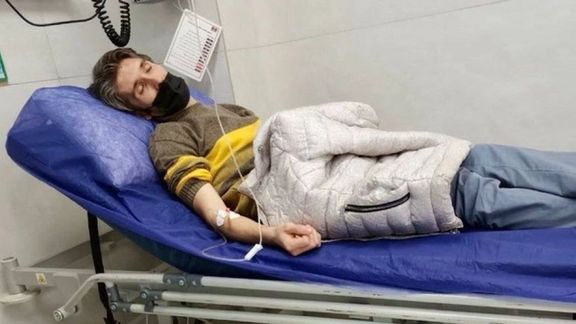
An undated photo showing human rights activist Arash Sadeghi

UN human rights experts have expressed alarm over the deteriorating health of jailed activist Arash Sadeghi, a cancer patient, and called for his immediate release.

“Arash Sadeghi suffers from life-threatening bone cancer, and he has been deprived of some medication he requires since his arrest in October,” the UN experts including Javaid Rehman, special rapporteur on human rights in Iran, said.

Sadeghi, 36, who is currently held by the intelligence ministry at its own dedicated ward at Tehran’s Evin prison, was diagnosed with bone cancer in 2018.His cancer-affected arm had to be amputated in 2019. He also suffers from various kidney and stomach problems resulting from hunger strikes.

Sadeghi was arrested on October 20 for unknown reasons during the ongoing anti-government protests that began in September and have spread to many cities and towns across the country.

Sadeghi has been in and out of prison many times since 2009 and has gone on hunger strike several times, including a 71-day hunger strike in protest to his wife’s arbitrary detention in 2016.

Iranian authorities have repeatedly denied him proper medical care outside prison, despite his physicians’ advice, including after a serious infection following a surgery to remove the tumor in his arm in 2018.

UN experts said in their statement Friday that they have sent five official letters on Sadeghi’s detention to the Iranian government between 2016 and 2020 about his arbitrary arrest and detention, violations of his right to fair trial and due process, as well as his poor detention conditions. They specifically highlighted that the activist had been deprived of medical care.

The experts have also noted that Sadeghi’s case is not an isolated one.

“We remain gravely concerned about the safety of prisoners in Iran, particularly those who have been arrested and arbitrarily detained in connection with the current wave of protests in the country,” the experts said while noting that, according to civil society organizations, by April this year 65 persons had died in detention since 2017 because they were denied access to medical care.

There are several other reports about life-threating denial of medical care for those arrested in recent protests.

The US-based Center for Iran Human Rights reported Friday that Hajir (Hazhir) Bakhishi who was arrested in protests in Tehran in September was denied access to vital medicine. The computer engineer was beaten up during his arrest and had head trauma. He has been charged with “assembly and collusion against national security” by Tehran Revolutionary Court and is held at the notorious Fashafouyeh Prison in the south of Tehran.

According to Iran Human Rights News Agency (HRANA), theater actor Nazi (Fatemeh) Habibi, is also being denied medical care. Authorities of Qarchak Prison in the south of Tehran have reportedly refused to accept medications from her family while also denying her the right to see her lawyer and pressuring her for self-incriminating “confessions”. Habibi was reportedly arrested on November 24 with several other artists for staging a street play in Tehran.

“Given the large number of allegations of torture and ill-treatment in Iranian detention facilities brought to our attention, we are fearful about the potential for irreversible health consequences for detainees, especially those being deprived of critical medical care,” the UN experts said.

Most Viewed

Ghalibaf defends Iran-US talks amid hardline backlash
1
INSIGHT

Ghalibaf defends Iran-US talks amid hardline backlash

2
ANALYSIS

From instability to influence: Pakistan’s pivotal role in US-Iran diplomacy

3
ANALYSIS

100 days on: why Iran’s January protests spread across social classes

4

War-hit homeowners feel abandoned as Iran’s reconstruction aid fades

5
INSIGHT

100 days on: the anatomy of Iran’s January crackdown

Banner
Banner

Spotlight

  • The politics of pink: how Iran uses cuteness to rebrand violence
    ANALYSIS

    The politics of pink: how Iran uses cuteness to rebrand violence

  • Bread shortages, soaring prices strain households in Iran, residents say
    VOICES FROM IRAN

    Bread shortages, soaring prices strain households in Iran, residents say

  • War-hit homeowners feel abandoned as Iran’s reconstruction aid fades

    War-hit homeowners feel abandoned as Iran’s reconstruction aid fades

  • 100 days on: the anatomy of Iran’s January crackdown
    INSIGHT

    100 days on: the anatomy of Iran’s January crackdown

  • Ghalibaf defends Iran-US talks amid hardline backlash
    INSIGHT

    Ghalibaf defends Iran-US talks amid hardline backlash

  • From instability to influence: Pakistan’s pivotal role in US-Iran diplomacy
    ANALYSIS

    From instability to influence: Pakistan’s pivotal role in US-Iran diplomacy

•
•
•

More Stories

US Envoy Slammed For Wearing Hijab In Meeting With Hezbollah Supporters

Dec 3, 2022, 11:42 GMT+0

Critics say the US ambassador in Lebanon was wrong to wear a headscarf in a meeting with Hezbollah supporters and her move weakens US support for protesting women in Iran.

Lebanese media have recently published a photo of Dorothy Shea wearing hijab during a meeting with Lebanon’s Higher Shia Islamic Council members.

One senior diplomatic source told the Washington Free Beacon that the act undermines Washington’s efforts to support Iranian protesters who are against the clerical regime.

Hezbollah is backed by Iranian regime to expand its military and ideological influence in the region.

The images raised eyebrows among some officials in the State Department. Iranian-American groups have also expressed shock over the photos of the US diplomat in a headscarf.

“What message does this send to them in this unspoken, yet highly symbolic act of submission by a US ambassador who takes on the very appearance of the oppressors? I understand that as diplomats we are supposed to be sensitive to the culture in which we work, but sometimes, events take priority,” a senior State Department official told Washington Free Beacon.

“Shame on Shea for wearing a headscarf at Lebanon's request—who we all know take their orders from Tehran as Iranian women are being killed for their courageous actions of saying no to mandatory hijab," Bryan Leib, executive director of advocacy group Iranian-Americans for Liberty, told Washington Free Beacon.

Int’l Lawyers Launch Campaign Against IRGC Members In Canada

Dec 3, 2022, 11:00 GMT+0

A group of Canadian, US and Iranian lawyers have launched a campaign to identify and take action against IRGC members and their affiliates living in Canada.

They have created a website called stopirgc.com to receive citizen reports and submit cases to government agencies and police to take action.

The Islamic Revolution Guard Corps or IRGC is the main branch of the Iranian military that defends the regime. It also controls most of the country’s military assets, including nuclear and missile programs.

Ramin Joubin, a Burnaby-based lawyer says over 100 cases in Canada are being investigated by the group.

“There are a lot of reports on family members of heads of state, or people who are high up in the current regime in Iran,” Joubin told Global News.

“They might be visiting, they might have a business, property, permanent residence or citizenship,” he added.

According to Joubin, they are also investigating cases of suspected money laundering, either from companies or individuals.

“A lot of the reports we’ve received are about business activities in Canada, but somehow bypassing sanctions and engaging in various types of money laundering.” said Joubin. “That is the biggest activity we are seeing by IRGC members and affiliates.”

In October, Ottawa barred some 10,000 IRGC members from entering Canada for life, as protests swept Iran following the death of Mahsa Amini in police custody.

Joubin, however, said the lifelong ban does not address IRGC officials, their affiliates and close family members, who already live inside the country.

Tehran Claims NATO Expansion Eastward Root Cause Of Ukraine War

Dec 3, 2022, 09:37 GMT+0

Iran’s foreign minister claims that the West accuses Tehran of supplying drones to Russia to use against Ukraine, because it wants to “legitimize” its military assistance to Kiev.

In a phone conversation with UN Secretary-General Antonio Guterres, Hossein Amir-Abdollahian said that NATO’s decision to expand eastward was wrong and that was the root cause of the Ukraine war.

However, it is not clear from Iranian media reporting how Guterres reacted to the Iranian minister’s comments and in what context he made those comments.

Earlier, Amir-Abdollahian had acknowledged that Tehran “sold very few Iranian drones in the framework of defense cooperation with Russia 11 months before the start of the Ukraine war.”

He also warned that that Tehran believes diplomacy and dialogue are the best option, but the Islamic Republic will never be “tight-handed regarding other options.”

Russia has been using Iranian drones and missiles in its air attacks against Ukraine. In October, it targeted Ukraine’s civilian energy infrastructure, plunging it into blackouts as the winter cold began.

Amid international outcry over the Islamic Republic’s supply of drones and ballistic missiles for the Russian invasion, Ukrainian President Volodymyr Zelenskiy told a meeting of UN security council November 23, that the attacks are “an obvious crime against humanity” adding that Kyiv would put forward a resolution condemning “any forms of energy terror”.

Hundreds Of Food Poisonings In Iran’s Universities Raise Alarm

Dec 3, 2022, 01:15 GMT+0
•
Maryam Sinaiee

Food poisoning affecting hundreds of Iranian university students has alarmed many who claim canteen food was deliberately contaminated to keep them out of protests.

In the past couple of days “a large number of students” at Arak Industrial University and Kharazmi University in Karaj came down with symptoms of food poisoning including diarrhea, body aches, and vomiting, the Telegram channel of a national student union said Thursday.

There were food poisoning breakouts recently at two other universities, Al-Zahra University in Tehran and Isfahan University of Technology both believed to have originated from canteens.

Calling the incidents another case of “serial food poisoning”, the channel said, authorities of Arak University attribute the illness, which has sent many to hospital since Wednesday, to some sort of virus but given a similar incident at Isfahan university of technology last week where many students got seriously ill after eating canteen food makes authorities’ explanation implausible.

Students in Iran's state universities, particularly those who live in dormitories, often eat at the canteen where food is sold at subsidized prices. Outbreaks outside the universities have not been reported.

Some social media users have claimed that students in these universities are being deliberately poisoned by the authorities because of their very active role in the protest movement. The purpose they say is to keep them away from the protests planned on the occasion of Student Day on Monday. 

Students of Isfahan University staged a protest following the incident and demanded the resignation of the university officials. “We don’t want rotten food, We don’t want murderous authorities!”, they chanted.

Health officials of Esfahan Province last week attributed the mass poisoning of to Shigella Sonnei, a bacteria that causes an infection called shigellosis with symptoms including diarrhea (sometimes bloody), fever, and stomach cramps a day or two after infection. The outbreak reportedly affected over three hundred students at the university.

The foodborne Shigella bacteria can be found in foods such as salads, meats and dairy.

The student union said Thursday so many students of Kharazmi University in Karaj had taken ill that the campus health center ran out of intravenous injection fluids for dehydration treatment and there were no beds to accommodate all patients. “The university pharmacy is closed, and female students are not allowed at this time [late evening] to leave their dormitories to seek medical care,” the student social media channel reported.

The same source said Friday students at Al-Zahra University in Tehran where a similar incident happened on November 24 were threatened by university officials not to tell anyone their illness was caused by canteen food. “The physician of the university clinic insisted that students had been infected by a foodborne virus they ate outside the university,” the channel quoted students as saying.

US Designates Iran, China For Concern Over Religious Freedom

Dec 2, 2022, 19:57 GMT+0

The United States on Friday designated China, Iran and Russia, among others, as countries of particular concern under the Religious Freedom Act over severe violations.

US Secretary of State Antony Blinken in a statement said those designated as countries of particular concern - which also include North Korea and Myanmar - engaged in or tolerated severe violations of religious freedom.

"Around the world, governments and non-state actors harass, threaten, jail, and even kill individuals on account of their beliefs," Blinken said in the statement.

"The United States will not stand by in the face of these abuses."

He added that Washington would welcome the opportunity to meet with all governments to outline concrete steps for removal from the lists.

Washington has increased pressure on Iran over the brutal crackdown on protesters. Women have waved and burned headscarves - mandatory under Iran's conservative dress codes - during the demonstrations that mark one of the boldest challenges to the Islamic Republic since the 1979 revolution.

The United Nations says more than 300 people have been killed so far and 14,000 arrested in protests.

United Nations experts have also called on Iran to stop persecution and harassment of religious minorities and end the use of religion to curtail the exercise of fundamental rights.

The Baha’i community is among the most severely persecuted religious minorities in Iran, with a marked increase in arrests and targeting this year, part of what the UN experts called broader policy of targeting dissenting beliefs or religious practices, including Christian converts and atheists.

Reporting by Reuters