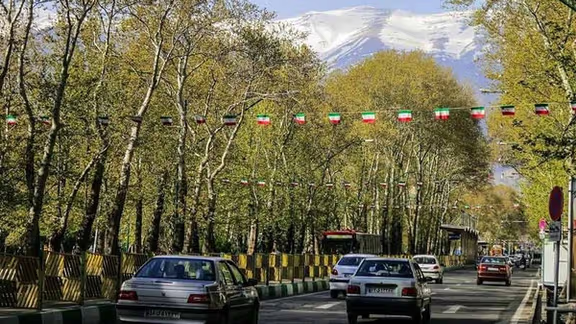
Iranian google map users could not believe their eyes when they saw the name of Tehran’s longest avenue, Valiasr, has reverted to ‘Pahlavi’, the last Dynasty in Iran.
The user-initiated change which people began noticing on Wednesday is not unprecedented. In August 2015 the name of the bustling street, which runs nearly 18 km from the south of the capital to north, reverted to Pahlavi for a short time. The state broadcaster IRIB reported the incident at the time and called it “Google’s mischief”.
Similarly, the name of Vozara hotel-apartment on Tehran’s Vozara street, now shows as Mahsa Amini Hotel Apartment, presumably because it was at the morality police headquarters on Vozara street that she had a stroke caused by blows to her head while she was being arrested. On social media there have been many calls to rename the street after her.
Google, however, may have nothing to do with the change, which supporters of monarchy in Iran have hugely welcomed. Although individual users cannot change city, town, village and street names on the maps, names can be altered using Google’s feedback feature of the maps if a large group of users report the names are wrong and suggest alternative.
Google maps may have become a new battleground where the opposition demanding regime change and the authorities and their supporters fight over street and even city names. Both sides have the means to fight the battle, but who wins will remain to be seen.
The boulevard, which is also the longest in the Middle East, has gone through several names since it was completed in 1933 after a construction period of eleven years. The tree-lined road with massive trees on both sides was originally called Pahlavi Avenue, after King Reza Shah Pahlavi, the founder of the Pahlavi dynasty.
Like many other roads and even cities and towns, the street was renamed after the Islamic Revolution in 1979. The first name chosen by revolutionaries was Mossadeq, after Mohammad Mossadeq, the former nationalist prime minister under the Shah who was venerated by many for nationalizing Iran's oil.
Two and half years after the revolution, when Islamists had consolidated their power in the country and completely driven nationalists to the sidelines, the road was once again renamed, this time to Valiasr, to reflect the change. Valiasr (vali-ye asr) refers to Imam Mahdi, an Arab descendant of Prophet Mohammad, who Shiites believers say has been in occultation since the 9th century AD.
In the coming years many other place names underwent similar changes. Most new roads, squares, and highways were named after historical and contemporary Islamic figures such as Sheikh Fazlollah [Nouri] (1843-1909).
Nouri was a Qajar period cleric and politician who was hanged as a traitor by revolutionaries during the Iranian Constitutional Revolution (1905-1911) for defending the old order and opposing constitutionalism and the establishment of a parliament. While the religious establishment venerates Fazlollah and calls him a shahid (martyr), to many ordinary Iranians to this day Fazlollah is a symbol of reactionary religious establishment because he supported the king’s coup against the constitutionalists and opposed modernization of the country.
US Special Envoy for Iran Robert Malley says President Joe Biden is prepared for a military option to prevent Iran from acquiring a nuclear weapon in case sanctions and diplomacy fail.
During an interview with Foreign Policy’s podcast Playlist released on Wednesday, Malley said that the US and Iran came very close to reaching an agreement to revive the 2015 nuclear deal – or the Joint Comprehensive Plan of Action (JCPOA) -- many times in the past two years, the latest of which was in August, but each time Iran stepped back and came up with new demands that often had nothing to do with the nuclear talks.
“We'll have the sanctions, pressure and diplomacy. If none of that works, the President has said, and, as a last resort, he will agree to a military option because if that’s what it takes to stop Iran from acquiring a nuclear weapon, that’s what will happen. But we’re not there," he said.
Defending the Biden administration’s efforts to keep diplomacy as an option and criticizing the Trump administration for its maximum-pressure campaign, he said, “We owe it to ourselves to have an honest examination of how sanctions work and how they don’t work.”
The Iranian system as a whole is divided, and not yet concluded whether they really want to come back to the deal, and so each time Tehran was presented with a deal, even about the deals that were considered fair by other parties such as Russia and China, Iran was the one that walked back.
The Palais Coburg, the venue of Iran nuclear talks in Vienna
“Iran has rejected countless opportunities to come back to the deal... We are prepared for a world with the JCPOA and without the JCPOA. We’ve continued to put pressure on Iran... We made sure there are sanctions for their support for terrorism, their human rights violations, for their ballistic missile program and for their nuclear program,” he added. “The JCPOA is not on the agenda because of Iran’s position, and we’re continuing with our policy to respond to all of Iran’s destabilizing activities.”
Malley also said reviving the deal would be dead when the non-proliferation benefits of the deal do not justify or warrant the sanctions relief that the US is ready to offer, emphasizing that the US focus and energy are not on the deal. Currently, the focus is on what is happening in Iran and its support for the Russian invasion of Ukraine.
He also talked about many troubling issues emanating from Iran, saying the US supports aspirations of the Iranian people to achieve the fundamental rights and freedoms that all peoples across the globe should enjoy. “We are mobilizing international attention, putting the spotlight on what’s happening in Iran. It’s very important that the world know at a time when the Iranian regime is trying to hide what’s happening and to distort what’s happening,” he said.
The administration has also put the spotlight on developments in Iran by sanctioning those up and down the chain who are violating the basic rights of the Iranian people, “whether it’s a top leadership or whether it’s an anonymous person in a prison,” Malley noted. “The world should know who is behind that repression.”
He also said Washington is pushing for measures against the Islamic Republic in international bodies, mentioning the resolution at the UN Human Rights Council and the move to kick out Iran from the UN Commission on the Status of Women. “It’s an aberration, a complete anomaly, that Iran would be on the commission that is supposed to defend the rights of women when they are repressing them,” he added.
The US will continue to voice its support for the Iranians who are protesting for their rights, he reiterated, saying that “it's an extraordinary page in Iran’s history that’s being written right now.”
Praising “the courage, the determination, the persistence and the creativity of Iranians, particularly women and girls,” Malley said “we’re not going to be the authors; we can be there to express support for the fundamental rights of Iranians. This page will be written by Iranians themselves. It won’t be written in Washington, in London or anywhere around the globe other than Iran.”
Also on Wednesday, The US secretary of state says that the Islamic Republic has a deeply incorrect understanding of its people and is trying to blame others for the current protests.
Recently re-elected Israeli Prime Minister Benjamin Netanyahu says the nuclear deal with Iran is dead because Tehran has shown its real face to the world by its brutal crackdown on protesters.
Netanyahu, who was speaking to Fox News DigitalWednesday, added that the end of nuclear talks with the regime has been achieved by the people of Iran themselves as they clearly say they do not want clerics.
“That's thanks to the extraordinarily brave Iranian women and men who took to the streets – who take to the streets – against this vicious, murderous, and brutal regime. And I think people ask themselves, ‘Do we want the ayatollahs, who chant death to America, to have the weapons of mass death and the ballistic missiles to deliver them to any part on Earth?’ and the answer is of course not,” explained Likud party chief.
He further added that the protests are exposing the leadership's vulnerability, stressing that “it also highlights the fact that they’re really weak – that they govern only with basically the threat of murder, and the people are showing remarkable resilience.”
Netanyahu went on to say that the political spectrum is more united against Iran now to keep the clerical regime from getting a nuclear weapon.
To do this, he noted, both “crippling sanctions” and a “military threat” are needed, and Israel is ready to act regardless of Washington’s approval, although there is more “forward-leaning American position on this matter.”
Water reservoirs in Iran are at an all-time low, threatening nationwide rationing soon, due to years of drought and resource mismanagement, local media and officials say.
Khorasan daily says the water storage of 10 important dams have decreased 25 to 75 percent in comparison to the past years.
Seventy days into autumn, statistics show that the level of precipitation has been extremely low in different provinces of Iran.
Amid popular protests and the ado for the World Cup a report on social media went unattended within the past few days: “Tehran’s dams only have water for a few days.”
Mohammad Baqerzadeh in a report on Etemad daily December 1 says if there is no drastic improvement in the situation, rationing of water would be implemented in some cities.
He says the water level at five major dams around Tehran have almost decreased 50 percent and now around half of people in the capital have turned to underground water extraction.
Firouz Qasemzadeh, a Spokesperson of Iranian Water Industry says in comparison with the long-term average of the past fifty years, there has been a 16% decrease in rainfall across Iran.
An inefficient agricultural sector, over-grazing of rangelands and forests, aggressive over-extraction of groundwater resources, and most importantly the regime’s mismanagement are among the main causes of water bankruptcy in Iran.
The US secretary of state says that the Islamic Republic has a deeply incorrect understanding of its people and is trying to blame others for the current protests.
Antony Blinken said one of the “profound mistakes” that the “regime makes is in accusing the United States or any other country” of somehow being “responsible for, instigating what’s happening. That’s not at all the case. And to misunderstand their own people is at the heart of the problem that they’re facing.”
He made the comments in an interview with CNN’sChristiane Amanpour, stressing “What’s happening in Iran is first and foremost about Iranians, about their future, about their country. And it’s not about us.”
“The regime [tries] to point the finger at others, at the United States, Europeans, claiming that we’re somehow responsible for instigating or otherwise fanning the flames of the protests. That is to profoundly, fundamentally misunderstand their own people,” underlined Blinken.
Anti-government protests in Iran began on September 16 following the death of 22-year-old Mahsa Amini in police custody.
Blinken in a separate interview with NBCalso stressed that Washington supports Iranians right to protest, saying “the most important thing that we can do is first to speak out very clearly ourselves in support of the people’s right to protest peacefully, to make their views known, and as I said, to take what steps we can take to go after those who are actually oppressing those rights, including through sanctions.”
Security forces around Sharif University on October 2, 2022
Despite repeated denials by IRGC's Fras news agency about a recent hack of its data servers, Iran's judiciary has started an investigation into damaging leaks.
Prosecutor General of Tehran Ali Alghasi-Mehr said on Wednesday that the probe into the cyberattack against Fars news, a cultural propaganda machine with close links to Iran’s Revolutionary Guard, is because a significant database of personal information of journalists and employees has been leaked.
However, it seems that the investigation has been launched because the authorities are not sure what has been hacked and what database has been breached.
A new word has been coined to refer to the large amount of data leaked from the hack: Farsgate.
A 123-page document, a copy of which Iran International obtained, is among the material the hacktivist group Black Reward uncovered. The document which includes both hearsay and excerpts from domestic and foreign-based Persian media was made in one copy only for the eyes of the IRGC chief commander Hossein Salami. Earlier in the week, Black Reward also released some audio files from a meeting between Qasem Qoreyshi, the deputy commander of the paramilitary Basij and media representatives.
Prosecutor General of Tehran Ali Alghasi-Mehr
Black Reward announced on Friday, November 25, that it had attacked the database of Fars News Agency claiming that it deleted nearly 250 terabytes of data from all the servers and computers of the website and obtained confidential bulletins sent by the news agency to the office of the Supreme Leader Ali Khamenei. The report revealed a lot of recent orders by Khameneiabout the ongoing protests that have engulfed the country since mid-September following the death of the 22-year-old Mahsa (Jina) Amini in the custody of morality police. Now, after several batches of information were leaked to the media, the authorities have started a damage control campaign to seize back the narrative, as most of the data prove that the Islamic Republic is frustrated and weary over its inability to end the protests.
The secret reports also revealed that most Iranians are getting ready for a revolution in the country as the popularity of the regime has dwindled, even among those considered supporters of the Islamic Republic. According to the documents, the level of dissatisfaction is so high that Khamenei has ordered some fundamental change in the structure of the regime in order to prevent a collapse.
The reports came as the protests in the country show no sign of ending and the movement has been spreading at universities and turning into strikes of employees in the industrial and services sectors, such as truckers.
While Iranian universities have turned into a battleground for antigovernment protests, students and professors in more than 150 universities around the world held eventsin support of the protests in Iran.
Meanwhile in Iran, Rasoul Jalili, the president of Tehran’s Sharif University of Technology, said on Wednesday that the university has increased its security staff by recruiting forces from private security companies. The measure is probably aimed at silencing those who criticize the university for allowing government security forces – especially the IRGC’s Basij paramilitary forces – to enter the campus to crack down on student rallies and sit-ins. If the measure proves successful, it can serve as a model for other universities to clamp down on students.
While Iranians have planned to hold three days of nationwide protests next week – 5-7 December – strikes by employees of industrial factories and truckers have injected fresh blood to the uprising.
Truck drivers and owners in several cities such as Esfahan, Bandar Abbas, Qazvin, and Kermanshah as well as many other western cities refrained from moving goods in support of the protests and strikes by industrial workers. Many people on social media describe the strike by the truckers as a significant blow to the Islamic Republic since it has the potential to cripple the economy. Some people say, “the truckers are leading the revolutionary uprising.”