• العربية
  • فارسی
Brand
  • Iran Insight
  • Politics
  • Economy
  • Analysis
  • Special Report
  • Opinion
  • Podcast
  • Iran Insight
  • Politics
  • Economy
  • Analysis
  • Special Report
  • Opinion
  • Podcast
  • Theme
  • Language
    • العربية
    • فارسی
  • Iran Insight
  • Politics
  • Economy
  • Analysis
  • Special Report
  • Opinion
  • Podcast
All rights reserved for Volant Media UK Limited
volant media logo

Venezuela Today, Iran Tomorrow? Leeway To Sell Oil
Iran International Newsroom
Nov 30, 2022, 19:45 GMT+0Updated: 17:44 GMT+1
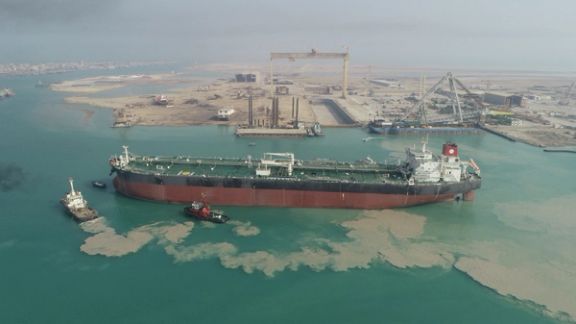
An oil tanker at a Venezuelan port in June 2022

Is a United States decision to ease oil sanctions on Venezuela a precedent for dealing with Iran? Or does it reduce pressure to get more Iranian oil to market?

A move by administration of President Joe Biden to allow Chevron, the second biggest US oil company, to export Venezuelan oil followed talks beginning Saturday in Mexico between the government of President Nicolas Maduro and the opposition. Revenues currently frozen abroad will be ringfenced by the United Nations into ‘humanitarian spending.’

Battling high inflation, alongside food and medicine shortages, the Venezuelan government has said the “kidnapped” fund would go into helping stabilize the electric grid, improve education infrastructure, and improve the response to this year’s flooding. The UN will manage a fund for over $3 billion currently held by US and European banks fearful of punitive US measures.

But the decision has been criticized on several grounds. The Boston Herald in an editorial November 28 mocked Biden’s interest in “climate-destroying fossil fuels,” suggesting he was offering the Venezuelan government “a political reward” while appeasing US “eco-progressives” over US shale production, slowing as the release of US emergency reserves eases, while the December 5 deadline for tighter Russia sanctions looms.

Venezuelan president Maduro in Tehran meeting with his Iranian counterpart Ebrahim Raisi on June 11, 2022
100%
Venezuelan president Maduro in Tehran meeting with his Iranian counterpart Ebrahim Raisi on June 11, 2022

An investigation by the Reuters news agency, in a feature published Wednesday, highlighted close links between Venezuela and Iran in cooperating to evade Washington’s eagle eye on oil transports. Reuters reported super-tanker Young Yong disguising Venezuelan oil as Malaysian oil. The vessel belongs to a company owned by a Ukrainian national also sanctioned, and is one of three tankers designated November 3 by the US for forging documents to ship Tehran’s oil and so evade US sanctions on Iran.

Gaining an economic windfall

Links between Caracas and Tehran partly explain those arguing against relaxing US pressure on Maduro government and that a double standard is at play. Eddy Acevedo, an advisor at the Wilson Centre, has argued that “both rogue regimes are looking to extract concessions in hopes of gaining an economic windfall.”

Iran and Venezuela in June signed a 20-year cooperation agreement, three years after President Donald Trump in 2019 ramped up sanctions against Venezuela after Maduro won the disputed 2018 election and four years after Trump launched ‘maximum pressure’ against Iran as he withdrew the US from the 2015 Iran nuclear agreement.

Tomas Guanipa, leader of the opposition party "Primero Justicia", after the resumption of political talks between the Venezuelan government and the opposition in Caracas, November 30, 2022
100%
Tomas Guanipa, leader of the opposition party "Primero Justicia", after the resumption of political talks between the Venezuelan government and the opposition in Caracas, November 30, 2022

The Reuters report suggested Iran had “pioneered” the use of false documents to conceal the origins of cargoes. According to the news agency, around 200 tankers, including 82 super-tankers able to carry up to 2 million barrels, have been involved in servicing both Venezuela and Iran, with the south American country exporting over 360 million barrels in the face on US sanctions since 2019.

‘Smart’ sanctions?

Documentation in the Young Yong case were supplied to Reuters by advocacy group United Against Nuclear Iran, which has since 2013 tracked Iran’s oil traffic to “disrupt…[its] attempts to generate profits from oil sales and further isolate the regime economically.”

So, what are the implications of the Venezuela decision for US Iran policy, when Biden still aims to reach diplomatic agreement to revive the 2015 nuclear agreement? Some analysts in Tehran have argued that Europe’s need for energy in the wake of sanctions against Russia, coupled with upward pressure on US gasoline prices, increased the likelihood of Washington meeting the Iranian demands of ‘guarantees’ that have reportedly stymied talks to revive the 2015 agreement, the JCPOA (Joint Comprehensive Plan of Action).

A decision to replace blanket sanctions on Venezuela with ‘smarter’ measures could create a precedent over Iran. As the Venezuela decision loomed earlier in the month, Reuters suggested the US was looking to replace hidden oil trade, a response to sanctions, with transparent transactions. But at the same time, Venezuela pumping more oil could reduce pressure on Biden to compromise with Iran.


Most Viewed

Ghalibaf defends Iran-US talks amid hardline backlash
1
INSIGHT

Ghalibaf defends Iran-US talks amid hardline backlash

2
INSIGHT

100 days after carnage: Iran economy reels from war, inflation, unemployment

3
INSIGHT

A nation in limbo: 100 days after the massacre, has the world moved on?

4
ANALYSIS

From instability to influence: Pakistan’s pivotal role in US-Iran diplomacy

5
ANALYSIS

100 days on: why Iran’s January protests spread across social classes

Banner
Banner

Spotlight

  • War-hit homeowners feel abandoned as Iran’s reconstruction aid fades

    War-hit homeowners feel abandoned as Iran’s reconstruction aid fades

  • 100 days on: the anatomy of Iran’s January crackdown
    INSIGHT

    100 days on: the anatomy of Iran’s January crackdown

  • Ghalibaf defends Iran-US talks amid hardline backlash
    INSIGHT

    Ghalibaf defends Iran-US talks amid hardline backlash

  • 100 days on: why Iran’s January protests spread across social classes
    ANALYSIS

    100 days on: why Iran’s January protests spread across social classes

  • From instability to influence: Pakistan’s pivotal role in US-Iran diplomacy
    ANALYSIS

    From instability to influence: Pakistan’s pivotal role in US-Iran diplomacy

  • A nation in limbo: 100 days after the massacre, has the world moved on?
    INSIGHT

    A nation in limbo: 100 days after the massacre, has the world moved on?

•
•
•

More Stories

US Crypto Exchange Fined Over $360K For Iran Sanctions Violation

Nov 29, 2022, 12:53 GMT+0

The US-based crypto exchange Kraken has agreed to pay over $362,000 to the government “to settle its liability” related to breaching Iran sanctions.

Based on a statement by the United States Treasury Department’s Office of Foreign Assets Control, or OFAC, “due to Kraken’s failure to timely implement appropriate geolocation tools, including an automated internet protocol (IP) address blocking system, Kraken exported services to users who appeared to be in Iran.”

Kraken is a cryptocurrency exchange and bank, founded in 2011. It is reportedly valued at $10.8 billion, as of mid-summer 2022.

As part of its settlement with OFAC, the company has also agreed to invest an additional $100,000 in certain sanctions compliance controls.

The settlement amount reflects OFAC’s determination that Kraken’s apparent violations were non-egregious and voluntarily self-disclosed.

“Between approximately October 14, 2015, and June 29, 2019, Kraken processed 826 transactions, totaling approximately $1,680,577.10, on behalf of individuals who appeared to have been located in Iran at the time of the transactions,” added the statement.

Washington imposed banking sanctions on the Islamic Republic after former president Donald Trump withdrew from the 2015 nuclear deal. However, Kraken had apparently been breaching these regulations since 2019 by permitting over 1,500 people in Iran to buy and sell crypto.

Last month, OFAC also fined Bittrex crypto company $24 million for letting clients in Cuba, Iran, Sudan, Syria and Russian-occupied Crimea to make transactions valued over $263 million.

Global Pressure On Iran Increases Incrementally As Protests Continue

Nov 29, 2022, 12:40 GMT+0

Many countries and international organizations have voiced support for protests in Iran by adopting resolutions and issuing condemnations of government violence, but people wonder about tangible actions. 

Many countries and international organizations have voiced support for protests in Iran by adopting resolutions and issuing condemnations of government violence, but people wonder about tangible actions. 

The United States Monday circulated a draft resolution on a measure to expel the Islamic Republic from the UN Commission on the Status of Women. The measure to remove Iran from the women's equality and empowerment body is scheduled to be voted on December 14. 

The Islamic Republic has just started a four-year term on the 45-member commission, which meets annually every March.

The document also denounces Iran's policies as "flagrantly contrary to the human rights of women and girls and to the mandate of the Commission on the Status of Women." Canada, New Zealand, Netherlands and the United States are behind the push.

The resolution would "remove with immediate effect the Islamic Republic of Iran from the Commission on the Status of Women for the remainder of its 2022-2026 term."

"The US and others have been actively working the phones to garner support to remove Iran from the UN Commission on the Status of Women," said a UN diplomat, speaking on condition of anonymity to Reuters. "It seems like they're making traction – including with some initially hesitant countries."

 A general view of a session of France's National Assembly in Paris (file photo)
100%
A general view of a session of France's National Assembly in Paris

Also on Monday, the French National Assembly unanimously adopted a resolution offering "support for the Iranian people" and condemning the restriction of women's freedoms and rights. This comes ahead of another meeting of EU foreign ministers to discuss new sanctions over the crackdown on protesters.

President Emmanuel Macron's Renaissance party deputy Hadrien Ghomi, himself a descendant of Iranian immigrants, said the 149 votes in favor of the motion in the National Assembly "sent a strong message" to the world. The resolution condemns in the "strongest terms the brutal and widespread repression" against "non-violent demonstrators".

French Foreign Minister Catherine Colonna said that the situation "requires action, with responsibility", adding that after two packages of sanctions already imposed at a European level, new sanctions are being prepared for the next Council of Foreign Ministers on 12 December.

But many Iranians ask if statements and resolutions are enough to pressure the theocratic regime in Tehran. More forceful steps, such as closing all European embassies in Iran or imposing more sanction to directly pressure the ruling elite are possible additional measures people mention in their social media posts.

These all came after the Geneva-based UN Rights Council last week voted to appoint an independent investigation into the Islamic Republic's deadly repression of protests, passing the motion to cheers of activists. Accused Western states of using the council to target Iran in an "appalling and disgraceful" move, Tehran said Monday that it will reject the investigation into the country's repression of antigovernment protests, like it refused to cooperate with UN human rights rapporteurs for 30 years.

Some Iranian officials have started to acknowledge some of its atrocities with Revolutionary Guards general Amirali Hajizadeh saying Tuesday that more than 300 people have been killed in the protests, acknowledging that innocent people have also been killed.

"Everyone in the country has been affected by the death of this lady [Amini]. I don't have the latest figures, but I think we have had perhaps more than 300 martyrs and people killed in this country, including children, since this incident," said Hajizadeh, head of the Guards' aerospace division. 

IRGC Man Says Qatar Helping Iran Silence Dissidents In World Cup

Nov 27, 2022, 13:28 GMT+0
•
Iran International Newsroom

Documents obtained by Iran International show Iran was coordinating secret efforts with Qatar to control who attends the World Cup and restrict any signs of dissent.

Black Reward, a hactivist group that found access to Fars News Agency files this week provided an audio tape of a meeting between a Revolutionary Guard general and a group of media managers or representatives from outfits affiliated with the IRGC about plans to use the sporting event to the benefit of the regime in Tehran.

A six-minute audio segment of a tape features General Ghasem Ghoreyshi (Qasem Qoreyshi), deputy commander of the paramilitary Basij and a group of reporters including the one from Fars News who met with him possible in the presence of other trusted reporters to discuss the latest developments including plans for the World Cup.

The meeting took place on Tuesday 15th of November.

Ghoreyshi starts by saying that “anti-revolutionaries” have bought “5,330 tickets” to the tournament and adds that “our boys have checked the list of the ticket holders and at least 500 people” are known opponents of the Iranian regime.

This is the first piece of evidence of collaboration with Qatar, showing that Iran obtained the list of ticket buyers most probably from Qatari authorities.

The Fars representative then asks the General if it is true that Iran’s intelligence ministry had asked Qatar to cancel these tickets. Ghoreyshi says that “Qatar has two different conducts with us – one is a positive response, and it has promised to do that [cancel tickets], but usually they don’t fully deliver. They told us give us the names [of unwanted people], and we will solve the issue.”

Islamic Republic officials, Basij militiamen, and pro-regime activists among "Team Melli fans" in the 2022 World Cup in Qatar (November 2022)
100%
Islamic Republic officials, Basij militiamen, and pro-regime activists among "Team Melli fans" in the 2022 World Cup in Qatar

Ghoreyshi goes on to say that Qatar also sometimes does not cooperate. At this point he mentions the example of Iran International, saying Qatar asked Iran to provide documents if it wanted the television network to be banned from the World Cup. He then complains that the host country has not still done so. The reporter interrupts telling the General that just the day before, Iran International announced that its reporters have been denied permission to cover the games. Ghoreyshi, who was apparently not aware, shows his surprise and says that Iran discussed the issue with Qatar “the day before”.

In mid-November Iran International announced that Qatar revoked permission for its reporters and TV crew to travel to the country and cover the World Cup. The denial of permission after initial agreement came without an explanation.

Ghoreyshi admits that Iran provided Qatar with “films” related to protests, as documents needed to ban Iran International. These presumably were user-generated videos from the protests that Iran International aired, as did other foreign-based Persian broadcasters.

He goes on to say that Qatar has even promised to control spectators inside the stadiums, not allowing Iranian flags other than the Islamic Republic flag to be displayed.

This is exactly what happened once the games started. During Iran’s second match against Wales on November 25, Iranian fans, who wanted to take flags other than the official one approved by the Islamic Republic to the Al Rayyan’s Ahmad bin Ali Stadium, were stopped by security officers. Many people were barred from carrying or waving Iran’s ancient flag with the Lion and Sun emblem or a simple three-color flag with the main motto of the current wave of protests – Woman, Life, Liberty. Some were even detained for hours by Qatari police.

All this was because of the regime’s concern over dissident Iranians manifesting antigovernment signs and actions that people back in Iran could see on television. Nevertheless, many did chant and boo when the Islamic Republic anthem was played in the stadiums.

This fits into the rest of the conversation in the tape obtained by hackers. The conversation between the IRGC general and reporter(s) reveals an elaborate plan by the Islamic Republic to use the World Cup event in Qatar to win political points amid popular protests.

Ghoreyshi then explains that the government is paying the expenses of its supporters to go to Qatar to attend Iran’s games and show that the Islamic Republic enjoys support.

In fact, images from the stadiums show hundreds of government officials, influential people from the regime’s inner circle, including journalists working for hardliner media in attendance.

Price Caps, Discounts, Turmoil: The Outlook For Iran’s Oil Exports

Nov 26, 2022, 19:34 GMT+0
•
Iran International Newsroom

As Iran last week began enriching uranium to 60 percent at a second site, its chief nuclear negotiator Ali Bagheri-Kani was in India talking economics.

High on the agenda for the Iranian deputy foreign minister was energy, which increasingly figures in diplomatic or ‘political’ talk as the December 5 deadline looms for an international price cap on Russian oil. Proposed by the United States through the G7, this will bar European and British services, including insurance and tankers, to any worldwide purchaser of Moscow’s crude paying above the cap.

Indian politicians are aware their country has increased oil imports from Russia this year to around 750,000 barrels a day (bpd). There is little prospect of New Delhi resuming imports of Iranian oil, which it stopped in 2019 in fear of US ‘maximum pressure’ sanctions after Washington in 2018 left the Iran nuclear deal, the JCPOA (Joint Comprehensive Plan of Action). In 2017-18, India had taken 10 percent of its oil imports from Iran.

India, which abstained on the November 17 International Atomic Energy Agency (IAEA) vote censuring Iran over its nuclear program, is among countries in the ‘global south’ uneasy over US and EU measures against Russia disrupting energy and food supplies. As Europe cuts back links with Moscow, Pakistan, another abstainer at the IAEA, is in talks with Moscow over buying oil with delayed payments.

True, Indian officials know the price cap is unlikely to choke their supply. Discussions have centered on setting it at $65-70 a barrel. The cap is likely to be above the price Russia now sells at, with benchmark Urals at $52 a barrel Thursday, Argus Media reported. The cap would therefore stem the flow only if oil prices rally.

Even so, the Russian economy is reeling from the consequences of the Ukraine war. By December 5 the EU itself will stop taking seaborne Russian oil. Russia’s exports to Europe – seaborne and pipeline – have already fallen from 3.5 million to 1.5 million bpd, and its GDP, says the International Monetary Fund, will slump 3.5 percent this year. Official figures had $14.7 billion withdrawn from Russia’s banking system in October as anxiety mounted.

A Russian armored column destroyed in Ukraine in March 2022
100%
A Russian armored column destroyed in Ukraine in March 2022

Moscow’s efforts to compensate for lost oil exports in Europe by increasing sales to Beijing have been hampered by the sluggish state of a Chinese economy under Covid restrictions. Chinese buyers have also gained a discount put by Rapidan Energy Group at around $15 a barrel.

This has hit Iran’s own sales to China. While Iranian exports have become increasingly opaque in order to hide them from US eyes, Tehran’s oil sales of 500,000-1 million barrels a day (bpd), going almost entirely to China, have been undercut by Russia.

Given the growing lack of transparency, Iran’s ministers have made vague but generally optimistic claims, often banding together crude, gas condensate, petrochemicals and petrochemical products.

Middlemen, barter, uncertain prospects

Iran’s earnings figures are further blurred by payments to middle-men and barter, as was recently highlighted by Fararu. The privately-owned website judged it “unlikely that the Iranian government has succeeded in increasing its export volume,” and chided oil minister Jawad Owji for apparently suggesting exports were somehow higher than the 2.8 million bpd before US ‘maximum pressure.’

Fararu noted that “several experts” had argued the Iranian budget for the year beginning March 2023 should assume an oil price of $40-$50 per barrel on sales of 600,000 bpd. This compares to the $70 figure underlying the 2022-3 budget, and marks a further sign of Iranian media and analysts assuming that talks to revive the JCPOA are going nowhere and that US sanctions will therefore remain at least for the medium term.

Iranian President Ebrahim Raisi has trumpeted success in surviving maximum pressure in the face of depleted foreign revenue. The economy’s halting recovery from two years of recession to low economic growth 2020-22 has been based on domestic industry benefiting from the lower rial and reduced foreign competition in the home market.

But anxieties in Iran reflect not only diminishing JCPOA prospects and the internal instability sharpened with current protests. Iran still needs foreign earnings to pay for imports and rally the rial. The shift in geopolitics and energy supplies with the Ukraine crisis, as well as a rising dollar, aligns Iran not so much with energy exporters, as with so much of Africa and poorer Middle Eastern countries facing rising inflation and uncertainty.

Azeri President Launches Broadside Against Iran

Nov 25, 2022, 20:05 GMT+0
•
Iran International Newsroom

Iran is dangerously implicated in regional tensions centered on Azerbaijan-Armenia that are exacerbated by fall-out from Russia’s war in Ukraine.

Citing Interfax Friday, Iran’s semi-official news agency ISNA reported that Azerbaijan’s President Iham Aliyev cancelled a December 7 meeting in Brussels with Armenian Prime Minister Nikol Pashinyan aimed at easing tensions after September-October clashes killed around 200 Armenian and 80 Azerbaijani soldiers.

Earlier Friday, at a Baku conference ‘Along the Middle Corridor,’ Aliyev launched a broadside against Iran, his toughest so far since relations soured over Iran’s role in the 2020 Azerbaijan-Armenia war, when adjacent Iranian military exercises followed the Azerbaijanis capturing areas around the disputed Nagorno-Karabagh enclave and along the Iran border.

Stepping Friday on ground he previously avoided, Aliyev said his government would do “our best to preserve our secular lifestyle…as well as Azerbaijanis living in Iran,” whom he called “part of our people.” The president said that in Azerbaijan 340 schools taught in Russian and ten in Georgian, while none in Iran taught in Azeri. Around a quarter of Iran’s population is Azari, with analysts and activists disagreeing over the closeness of their cultural-linguistic links to their neighbors to the north.

“We worked with three presidents of Iran, [Mohammad] Khatami, [Mahmoud] Ahmadinejad, and [Hassan] Rouhani,” Aliyev said. “For all these years there was no situation similar to the current one. Never has Iran had two military exercises near our borders within a few months. There have never been such hateful and threatening statements against Azerbaijan.”

‘Hateful statements’ referred to warnings from President Ebrahim Raisi and other leaders against any border changes or threats to Iran’s transit route to Armenia, which is vulnerable since 2020 changes. Iran carried out more military drills along the border October, when Foreign Minister Hossein Amir-Abdollahian also visited Yerevan.

Vladimir Putin meeting with the Azerbaijani and Armenian president on October 31, 2022
100%
Vladimir Putin meeting with the Azerbaijani and Armenian president on October 31, 2022

But Tehran-Baku tensions have simmered since the 2020 war, when Iran moderated its past support for mainly Christian Armenia due partly to domestic pressures from both ethnic Azeri and Shia clerics supporting fellow Muslims.

Brussels mediation meeting cancelled?

Armenia’s frustration at what they feel is a lack of support from Russia – which has been engrossed in the Ukraine war – lay behind the news early Friday that Pashinyan had involved French President Emmanuel Macron as a possible mediator to build on the current ceasefire.

This prompted Aliyev’s announcement refusing a French role – and Kremlin spokesperson Dmitry Peskov to immediately offer Moscow’s support as a broker.

Analysts generally see the Azerbaijan-Armenia balance tilting in Baku’s favor since 2020. This has come with Aliyev making statements seen as provocative in Tehran. On November 11, at a summit of Turkic states of central Asia, the president said the “geographical borders of the Turkic world are wider than the Turkic states.” In Baku, state media has recently referred to north-western Iran, where most Iranian Azari live, as ‘south Azerbaijan.’

‘Persian fascist mullah regime’

Mahmudali Chehregani, Washington-based leader of the South Azerbaijan National Awakening Movement, appeared on Azerbaijani state television November 4 to promise the end of the “Persian fascist mullah regime.” Once considered persona not grata in Baku, Chehregani has lately criticized relations between Tehran and Yerevan, the “enemy of Azerbaijanis,” and said that an Armenian consulate due in Tabriz would be “razed to the ground.”

Iran’s options are limited. In mid-November, it summoned ambassador Ali Alizadeh over “unfriendly statements” by leading Baku officials, referring for example to Aliyev November 8 warning Iran, indirectly, against further military exercises.

While Iran’s main concern is fragile land corridor to Armenia – and fears a move to connect Turkey with mainland Azerbaijan and on to central Asia – it may also see Aliyev as exploiting protests in Iran. Such edginess might explain an Iranian suggestion of Azerbaijani involvement in the October 26 attack in Shiraz claimed by the Islamic State group (Isis-Daesh).

Raisi is unlikely, as yet, to take the advice from some commentators, including Shargh newspaper November 12, to downgrade relations with Baku or introduce trade sanctions. But Iran’s recent targeting of Iranian Kurdish groups in northern Iraq may be in part a message to Baku.

Ceyhun Sadlinski at a conference organized by Azerbaijan’s Security Council, where he is first deputy chairman, said Thursday Iran’s “special services are actively carrying out intelligence and subversive activities” against Baku, the official Azerbaijani Press Agency reported. “Drastic measures” were being taken in response, Sadlinski said.