• العربية
  • فارسی
Brand
  • Iran Insight
  • Politics
  • Economy
  • Analysis
  • Special Report
  • Opinion
  • Podcast
  • Iran Insight
  • Politics
  • Economy
  • Analysis
  • Special Report
  • Opinion
  • Podcast
  • Theme
  • Language
    • العربية
    • فارسی
  • Iran Insight
  • Politics
  • Economy
  • Analysis
  • Special Report
  • Opinion
  • Podcast
All rights reserved for Volant Media UK Limited
volant media logo

EXCLUSIVE - US 'Greatly Concerned' Over Tehran's Violence Against Protesters
Iran International Newsroom
Nov 23, 2022, 19:45 GMT+0Updated: 17:59 GMT+1
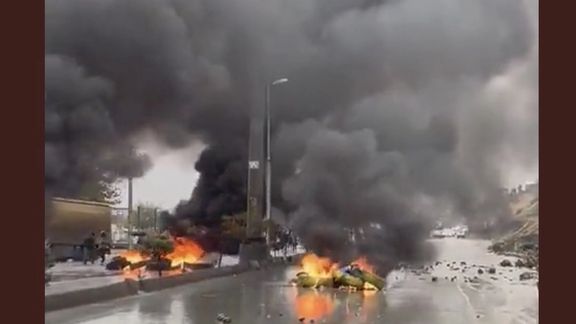
Protesters block roads in the Kurdish city of Sanandaj as security forces advance on Nov. 17, 2022

The State Department told Iran International Wednesday that the US is “greatly concerned” over the Islamic Republic’s “escalating violence” against protesters.

In response to questions sent by Iran International, the State Department said that the US is particularly worried about violence in Mahabad, a Kurdish majority city in western Iran. Government security forces escalated violence against protesters in Kurdish majority cities in the region on November 16 and since then more heavily armed units have been deployed to the region.

“Iran's leaders are blaming so-called separatists, and they continue to blame the United States, for the protests unfolding across their country. In fact, Iran's leaders have no one to blame but themselves,” the State Department said in an email.

Since the protests began in mid-September, top officials of the clerical regime have been blaming foreign “enemies” for fomenting the uprising, the biggest since the establishment of the Islamic Republic 43 years ago. After government intelligence and security forces failed to end the unrest, the government began blaming “separatists” for encouraging and supporting the protests and particularly targeted Iranian Kurds.

But the State Department said, “The regime's brutal crackdown, along with years of denying Iranians their human rights and perpetrating state-sponsored violence against women, show that Iran's leaders seem incapable of listening to their own people.”

Activists have called for large protests Thursday across the nation to support the Kurdish cities targeted by military units. Already there have been protests in other cities to condemn the violence. A significant number of Kurds in Iran are Sunnis and this week a prominent Sunni religious leader, Mawlana Abdolhamid of the Sunni Baluch population in southeastern Iran voiced support for them. The Baluch have also also brutally targeted by government forces since September 30.

“We continue to pursue accountability for those involved and support the Iranian people in their pursuit of freedom,” the State Department said.

More uranium enrichment

On the question of Iran expanding its nuclear program by more uranium enrichment at a new atomic site, the department said the US is aware of Iran’s claims that it is enriching at 60-percent and already has a large stockpile of highly enriched fissile material “for which it has no credible civilian use.”

After 18 months of negotiations to revive the Obama-era nuclear accord known as JCPOA, talks came to an impasse in August, with the US dismissing Iranian demands that it said were outside the JCPOA framework.

Last week the governing board of the International Atomic Energy Agency (IAEA) passed a resolution that censured Tehran for lack of cooperation with the UN watchdog. Iran responded by threatening “an appropriate response” and later announced it had started enrichment at its Fordow nuclear facility.

“Iran's apparent notion that it could somehow pressure the IAEA or its Member States on the issue of ongoing safeguards investigations into possible undeclared nuclear material and activities in Iran by further escalating its uranium enrichment activities is deluded,” the State Department wrote to Iran International.

The dispute with the IAEA concerns undeclared nuclear activities two decades ago, but the international watchdog is demanding clear answers from Tehran. Foreign Minister Hossein Amir-Abdollahian said Thursday that Iran expects the IAEA to shelve its investigation before a deal is made to revive the JCPOA.

“As we have made clear, Iran's continued nuclear escalations are unconstructive, and they will not provide Iran with any leverage,” the State Department told Iran International.


Most Viewed

Ghalibaf defends Iran-US talks amid hardline backlash
1
INSIGHT

Ghalibaf defends Iran-US talks amid hardline backlash

2
VOICES FROM IRAN

Bread shortages, soaring prices strain households in Iran, residents say

3
ANALYSIS

From instability to influence: Pakistan’s pivotal role in US-Iran diplomacy

4
ANALYSIS

100 days on: why Iran’s January protests spread across social classes

5

War-hit homeowners feel abandoned as Iran’s reconstruction aid fades

Banner
Banner

Spotlight

  • Is Iran entering its Gorbachev moment?
    INSIGHT

    Is Iran entering its Gorbachev moment?

  • Iran crackdown reaches cemeteries as graves of slain protesters defaced
    EXCLUSIVE

    Iran crackdown reaches cemeteries as graves of slain protesters defaced

  • Iran diplomacy wobbles as factions compete to avoid looking soft on US
    INSIGHT

    Iran diplomacy wobbles as factions compete to avoid looking soft on US

  • The politics of pink: how Iran uses cuteness to rebrand violence
    ANALYSIS

    The politics of pink: how Iran uses cuteness to rebrand violence

  • Bread shortages, soaring prices strain households in Iran, residents say
    VOICES FROM IRAN

    Bread shortages, soaring prices strain households in Iran, residents say

  • Ghalibaf defends Iran-US talks amid hardline backlash
    INSIGHT

    Ghalibaf defends Iran-US talks amid hardline backlash

•
•
•

More Stories

Activists Say Over A Dozen Killed In Iran’s Kurdish Cities

Nov 23, 2022, 17:18 GMT+0

A human rights network says over a dozen Kurdish citizens have been killed during the suppression of protests by the Iranian regime during November 19-21.

The Kurdistan Human Rights Organization in a report announced, "during the three days at least 14 Kurdish citizens have been killed in the cities of Javanrud, Piranshahr, Sanandaj, Dehgolan and Bukan” in western Iran.

Hundreds of people have also been arrested and a large number have been injured, it stated, adding that there is no information about the condition and whereabouts of many detainees.

On Tuesday, Hengaw Human Rights Organization stated that during popular protests in Kurdish cities from November 15 to 21, “at least 42 Kurdish citizens were killed by direct fire from government forces and over 1,500 people were injured.”

Last week protests were held to mark the anniversary of the November 2019 uprising in Iran as part of the ongoing nationwide protests to topple the Iranian regime, but demonstrations were met with more violence in Kurdish cities.

A series of nationwide protests in Iran, sometimes known as Bloody November, took place in 2019. Initially triggered by a 50 to 200-percent increase in fuel prices, the demonstrations quickly turned into calls for the overthrow of the government and Supreme Leader Ali Khamenei.

Oslo-based Iran Human Rights Organization in its latest report announced Tuesday that at least 416 people including 51 children and 27 women have been killed by security forces in the ongoing nationwide protests.

UK Suggests Russia Will Look For More Iran Drones

Nov 23, 2022, 16:37 GMT+0
•
Iran International Newsroom

The United Kingdom defense ministry said Wednesday that Russia had used hundreds of Iranian-made drones in Ukraine but none since around November 17.

The Ministry of Defence in London tweeted that Russia had “likely conceived of the UAV [unmanned aerial vehicles] campaign to make up for its severe shortage of cruise missiles.” Reports of the Russian forces using Iranian drones, mainly Shaheed-136, surfaced in September, but were until November denied by Tehran.

Although the use of Iranian-made drones had met with “limited success” with most of those launched neutralized, the British ministry said Moscow would “probably seek resupply” as “Russia can probably procure UAVs from overseas more rapidly than it can manufacture new cruise missiles domestically.” The drones had been both one-way or ‘kamikaze’ and reusable UAVs, the ministry said.

Some former Iranian military sources were quoted elsewhere as saying that the country can produce around 20 drones a month, which is well short of Russian’s needs.

Both sides in the Ukraine war have deployed drones, with Ukraine utilizing Turkish-made Bayraktars along with US-supplied Switchblade drones. The Russian-backed governor of Crimea province said Tuesday that five attacks, including one targeting the Balaklava power station and three on Russian naval ships, had been repelled.

The British Ministry of Defence in its tweets Wednesday said Moscow had used Iranian-made drones “largely…against tactical military targets and the Ukrainian electricity grid.” France, Germany, the United Kingdom, and the United States have condemned Russia’s deployment of Iranian drones as an alleged violation of arms-trade provisions in the 2015 Iran nuclear deal.

The aftermath of a drone hit on buildings in Kyiv on October 17, 2022
100%
The aftermath of a drone hit on buildings in Kyiv on October 17, 2022

Iran ‘Sticking to its positions’

Iranian foreign minister Hossein Amir-Abdollahian said Tuesday that Tehran had “sold very few Iranian drones in the framework of defense cooperation with Russia 11 months before the start of the Ukraine war.” Amir-Abdollahian said Iran and Ukrainian military officials had met in a third country to discuss the issue, and that “we are continuing our investigations.”

Amir-Abdollahian appeared to suggest that the Ukrainian foreign minister Dmytro Kuleba had told him by telephone that a drone captured by Ukrainian forces had Russian markings but “looks like an Iranian witness drone,” a model rendered in English as ‘Witness-136.’ This, Amir-Abdollahian argued, was “proof that Iran is sticking to its positions.”

The foreign minister said Iran was committed to diplomatic solutions both to the Ukraine war and the current stand-off in talks aimed at restoring the 2015 nuclear agreement, the JCPOA (Joint Comprehensive Plan of Action). Amir-Abdollahian reiterated Iran’s view than the International Atomic Energy Agency (IAEA) should shelve its enquiry into unexplained uranium traces found in sites not declared as nuclear-related.

‘Exchange of messages should continue’

Amir-Abdollahian suggested that while efforts continued to revive the JCPOA, differences with the US remained on three issues, on which the three European JCPOA signatories were lining up with Washington. “One of these issues is solving the remaining issues of the agency [over the uranium traces], and the other issue is related to economic guarantee,” he said, referring to Iran’s expectation of being cushioned against the economic effects of the US again leaving the JCPOA and imposing sanctions, as it did in 2018 under previous president Donald Trump.

The foreign minister said that “the exchange of messages [with the US] should continue.” American officials have in recent weeks suggested that their focus is no longer on JCPOA restoration, and along with the three European states and the European Union have imposed new sanctions on Iran over military links with Russia and its response to domestic unrest.

Workers, Employees Stage More Strikes Across Iran

Nov 23, 2022, 13:45 GMT+0

In the tenth week of antigovernment protests in Iran, workers and employees of different sectors continue their strikes and called Thursday for more nationwide action.

In the eastern religious city of Mashhad fire fighters gathered in front of the governor's office on Wednesday demanding their rights including pay increases and housing benefits.

A group of workers at Bahman Diesel Company in Qazvin near capital Tehran also went on strike to put further pressure on the government.

Based on reports received by Iran International, a group of employees of South Aluminum Company in Lamerd city of Fars province also stopped working on Wednesday.

Earlier, the Cooperation Center of Iranian Kurdistan's Political Parties called on political entities, civil activists and people from all walks of life to organize a general strike on Thursday, November 24, to show support for the Kurdish people.

In recent days, the Islamic Republic has intensified its crackdown on antigovernment protests in Kurdish areas with military vehicles deployed and live bullets used against people.

Strikes of employees and workers have always been witnessed in recent years, but they have intensified since the beginning of the nationwide uprising against the Islamic Republic.

Strikes were instrumental in the overthrow of the monarchy during the 1979 revolution. This time around protesters have urged all groups — including merchants in the bazaars, teachers and workers in the oil sector — to stage strikes in the hope that this would turn the latest unrest into a revolution and lead to the overthrow of the theocracy.

Leaked Audio: IRGC Veteran Tells Comrades What He Thinks Of Iran Protests

Nov 23, 2022, 11:04 GMT+0
•
Iran International Newsroom

In a leaked audio file, a US-based veteran IRGC commander is heard calling for monitoring to better understand the current wave of opposition against the Islamic Republic. 

Hacktivist group ‘Anonymous’ -- that has focused its cyber operations on Iran since the current wave of protests started mid-September – released Monday audio messages by someone who is claimed to be Nader Safaverdi, one of the former commanders of 5th Nasr Division. 

The unit, known as Sepah-e Nsar Corps, is one of the divisions of IRGC’s ground force was formed with recruits from northeastern Khorasan province in 1982 during the Iran–Iraq War. The unit fought in several of the important operations during the conflict and after the war was stationed in the province near the border with Afghanistan.

Safaverdi, 67, who apparently has been living in the US since 2007 or 2009, is not well-known in the media but was evidently close to Esmail Ghaani (Qaani), the current commander of IRGC’s Quds (Qods) Force -- a division primarily responsible for extraterritorial military and clandestine operations – and to Parliament Speaker Mohammad Bagher Ghalibaf (Qalibaf), both former commanders of the 5th Nasr Division. 

The files seem to be audio messages shared in a WhatsApp or Telegram group with many IRGC ranking members, as Safaverdi started his message with greetings to Seyyed Hossein Mousavi and Hadi Sa’adati, both IRGC commanders formerly serving in the 5th Nasr Division. The group is probably comprised of IRGC members hailing from Khorasan province because during his message Safaverdi once said he would be invited to their meeting if he was still in Mashhad, and referred to similar meetings organized by Abbas Shamlou, another IRGC commander that used to serve as the governor of Mashhad. 

From right to left: Nader Safaverdi, unknown, Hadi Sa’adati, Esmail Ghaani, Hossein Fazel al-Hosseini, Mohammad Bagher Ghalibaf, Mehdi Foroudi (undated)
100%
From right to left: Nader Safaverdi, unknown, Hadi Sa’adati, Esmail Ghaani, Hossein Fazel al-Hosseini, Mohammad Bagher Ghalibaf, Mehdi Foroudi sometime during the Iran-Iraq war

He urged his fellow comrades for “unbiased and clear monitoring” of the activities of foreign-based opposition figures and the protesters in provinces. He said one of the ways to understand the movement against the Islamic Republic is by heeding his advice, and that of other regime insiders who live abroad. 

Criticizing “his friends" for limiting themselves to information released by Iran International, BBC, VOA, and other dissident outlets, he said monitoring means being aware of statements released during protests against the Islamic Republic in other countries and claimed that he has access to such information. 

He mentioned the gatherings in Berlin and Canada, where 50,000 to 100,000 people held protest rallies, as the largest demonstrations against the regime. In a tone as if he is teaching something new to the group, Safaverdi said the slogans by the Iranian expatriates are not like what they have heard in the past 43 years since the Islamic Revolution. He argued that the current wave of the protests is not in support of any specific ethnicity or even the Iranian royal family. “They officially chant slogans in support of the country’s integrity,” he said. He claimed that another motto the protesters follow is distancing themselves from the older opposition groups or figures, such as Reza Pahlavi or the exiled group Mojahedin Khalq organization, known as MEK. 

He added that the closest figure to a leader the foreign-based opposition has, is Canada-based activist Hamed Esmaeilion -- who lost his daughter and wife in the downing of a Ukrainian passenger plane in January 2020 by the Revolutionary Guard. The veteran IRGC commander believes that he is the symbol of an Iranian hurt and oppressed by the regime. 

Safaverdi then mentioned the Islamic Republic’s lobby groups in the US including allegedly NIAC– or the National Iranian American Council – saying that the opposition movement has also distanced itself from such groups in a clear message that they would not negotiate with the Islamic Republic. He said that he believed NIAC was formed upon an order by Supreme Leader Ali Khamenei to follow the Islamic Republic's agenda and mentioned some examples of their long history of lobbying for Iran. For instance, he mentioned Trita Parsi, a former NIAC president, as the courier between Khamenei and former President Barack Obama. Safaverdi claimed that NIAC is being devastated by the current front of opposition as its members are even banned from attending the events against the Islamic Republic. 

Safaverdi claimed the new opposition keeps calling on world bodies and countries to increase diplomatic pressure on Tehran, adding that anyone who supports lifting the sanctions on the Islamic Republic or negotiating with the regime has no place in the current opposition, which has a global consensus.

He also claimed that the new opposition has a wide range of influence both inside and outside the country, from students to teachers and professors, from NASA scientists to employees of Google and Facebook, noting that these new faces have not been identified before the current wave of protests. 

He urged his fellow group members to deliver his points to the authorities, including Ghalibaf and President Ebrahim Raisi – also hailing from Mashhad – calling himself an “American gladiator” who is spending every minute of his days on the issues about the Islamic Republic. Safaverdi said he had never seen such a universal unity and consensus behind a cause before the current wave of the protests in Iran. He also inadvertently praised the main motto of the protests – Women, Life, Liberty -- as something that resonates with all the people of the world. 

Note: NIAC denies it is affiliated with the Islamic Republic or acts as a lobby group for the Iranian government.

Research Finds It May Be Too Late To Quell Iran Uprising

Nov 23, 2022, 08:55 GMT+0
•
Iran International Newsroom

A think tank close to Iran's security council has concluded that protests over the years have become more serious and more frequent as grievances went unanswered.

The research conducted by the National Security Monitor magazine for its September-October 2022 issue, says the current uprising is pluralist, has major objectives to change the bigger picture in Iran, is cyberspace-based, and does not seem to be backed by any institution.

The magazine is believed to be close to the Islamic Republic's Supreme National Security Council.

The research further found that collective reactions to events relating to the protests spread quickly although there seems to be no formal organization and leadership for the movement.

Other findings of the research include the fact that the uprising aims to bring about fundamental changes in Iran's political establishment, is backed by various layers of socio-political groups while also enjoying wholehearted support from the Iranian opposition abroad.

The government policy of suppressing protests by force and then failing to address the underlying problems has led to a worsening situation after each round of unrest and today, it might have become too late to come to peace with the disgruntled masses.

The study also found that although previously major protests occurred almost once in every decade [like the protests by the student movement in 1999 and the post-election unrest in 2009],during the past five or six years the interval between various protests have become shorter and they have occurred every one or two years. Soon, major protests may take place in Iran once in every two to three months, the study predicted.

Protesters in the central city of Arak torch a motorcycle used by security forces. Oct. 29, 2022
100%
Protesters in the central city of Arak torch a motorcycle used by security forces. Oct. 29, 2022

The conclusions corroborate the attestations of individual social scientists and political activists who have generally attributed the protest in Iran to promises that have not been met for a long time and demands that have been ignored by several governments during the past 40 years.

Meanwhile the study also observed that the driving force behind the current movement are youngsters born after the second half of the 1990s. This part of the findings also corroborate with what Iranian sociologists and political activists have said or written during the past two months.

The main problem of the new generation appears to be lack of social freedoms within an Islamic system and general hopelessness about the future.

As this study and several Iranian sociologists have observed, the disillusioned new generation of Iranians is fed up with senseless and inefficient bureaucracy and at the same time does not believe in the outdated and meaningless ideology the Islamic Republic has been propagating during the past four decades.

Generally, according to this research, the current movement in Iran is marked by a generation gap, fluctuating at times between activism and mutiny, not being mainly about economic demands, changing mood between anger and hope, using opportunities provided by events, and a horizontal steering structure [lack of formal leadership].

Meanwhile, according to the study the way the Iranian government has been handling the protests have not changed during the past four decade. It is common knowledge that the government's first and only solution to any crisis like the current uprising is handling it violently. At times, such as during the protests against rising fuel prices in 2019, Iranian government forces have killed hundreds to silence uprisings. But this way of handling crises, coupled with failure to address systemic problems is only a temporary solution and protests flare up as soon as another event triggers a new round of protests. What triggered the current wave of protests in Iran was the murder of a young woman in mid-September while she was in morality police custody.





