• العربية
  • فارسی
Brand
  • Iran Insight
  • Politics
  • Economy
  • Analysis
  • Special Report
  • Opinion
  • Podcast
  • Iran Insight
  • Politics
  • Economy
  • Analysis
  • Special Report
  • Opinion
  • Podcast
  • Theme
  • Language
    • العربية
    • فارسی
  • Iran Insight
  • Politics
  • Economy
  • Analysis
  • Special Report
  • Opinion
  • Podcast
All rights reserved for Volant Media UK Limited
volant media logo

Protesters In Iran Torch Khomeini’s Museum, Seminary In Qom
Iran International Newsroom
Nov 18, 2022, 10:55 GMT+0Updated: 17:38 GMT+1
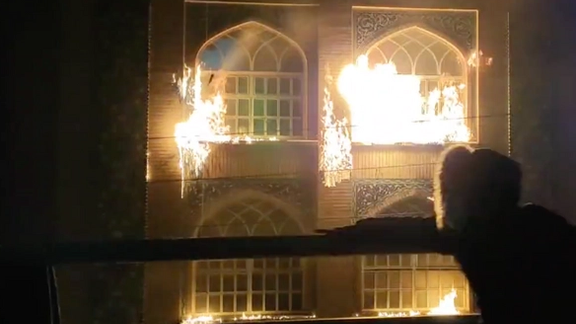
A seminary in flames in the Shiite religious center of Qom on Nov. 18, 2022

During intense unrest Thursday night, antigovernment protesters set fire to the house and museum of Ayatollah Ruhollah Khomeini, the founder of the Islamic Republic.

This was the ultimate act of defiance against the clerical regime that has failed to control nationwide protests since mid-September. The demonstrations have turned into a popular movement, reaching the farthest corners of the country, that simply aims to overthrow the Islamic Republic.

The demonstrations Thursday night commemorating those killed by government forces in the past few days drew into the night while protesters set fire to government buildings and seminaries.

In Khomein, the birthplace of Ayatollah Khomeini, people attacked and torched his family house which was turned into a museum in recent years. This unprecedented act of defiance became a sensation on Persian social media, with tens of thousands of people watching and sharing the video of the incident.

Videos show angry demonstrators also set fire to a seminary in the religious city of Qom near Tehran, as young people have targeted clerics in the street for verbal abuse and flipping their turbans off their heads.

Stones and Molotov Cocktails have become the main weapons for protesters who pelt anti-riot forces and set fire to large government propaganda banners in the streets. They also attack police stations and more often torch buildings used by the Revolutionary Guard’s Basij militia, who play a major role in attacking and killing protesters.

Government media said Friday that three Basij militiamen were killed Thursday in the religious city of Mashhad, while videos emerged showing other government agents wounded and running naked in the streets.

Overnight protests were also staged in scores of cities including Mashhad, Shahrekord, Masal, Sanandaj, Esfahan, Arak, Yazd, Saqqez, Lahijan, Bandar Abbas, Bijar, and Kermanshah. The geographic distribution of these cities covered from the northeast to the south and west of the country, with large protests also in central Iran.

Anit-regime slogans were chanted in tens of neighborhoods in capital Tehran.

Security forces fired live rounds and tear gas in several cities to crack down on the protesters.

In Bukan, people attacked government buildings torching a justice ministry office.Protesters in Rasht, also set fire to the office of a member of parliament.

Angered by killing of a 10-year-old child in Izeh in the oil-rich Khuzestan province, activist groups have called for mass protests across 20 cities on Friday.

According to Oslo-based Iran Human Rights Organization, at least 342 people including 43 children and 26 women had been killed by security forces in the ongoing nationwide protests until Wednesday.

Thousands have also been arrested in the last two months, with some being at risk of receiving death sentences for security-related charges.

Friday is expected to be another intense day of protests, as anonymous activists have called for continuing nationwide demonstrations until Monday, November 21.


Most Viewed

100 days after carnage: Iran economy reels from war, inflation, unemployment
1
INSIGHT

100 days after carnage: Iran economy reels from war, inflation, unemployment

2
INSIGHT

Ghalibaf defends Iran-US talks amid hardline backlash

3
INSIGHT

A nation in limbo: 100 days after the massacre, has the world moved on?

4
ANALYSIS

From instability to influence: Pakistan’s pivotal role in US-Iran diplomacy

5
ANALYSIS

100 days on: why Iran’s January protests spread across social classes

Banner
Banner

Spotlight

  • War-hit homeowners feel abandoned as Iran’s reconstruction aid fades

    War-hit homeowners feel abandoned as Iran’s reconstruction aid fades

  • 100 days on: the anatomy of Iran’s January crackdown
    INSIGHT

    100 days on: the anatomy of Iran’s January crackdown

  • Ghalibaf defends Iran-US talks amid hardline backlash
    INSIGHT

    Ghalibaf defends Iran-US talks amid hardline backlash

  • 100 days on: why Iran’s January protests spread across social classes
    ANALYSIS

    100 days on: why Iran’s January protests spread across social classes

  • From instability to influence: Pakistan’s pivotal role in US-Iran diplomacy
    ANALYSIS

    From instability to influence: Pakistan’s pivotal role in US-Iran diplomacy

  • A nation in limbo: 100 days after the massacre, has the world moved on?
    INSIGHT

    A nation in limbo: 100 days after the massacre, has the world moved on?

•
•
•

More Stories

Government Forces Attack Iranian Mourners In Tabriz

Nov 18, 2022, 10:43 GMT+0

Security forces have attacked people attending the funeral ceremony of a 23-year-old woman who was killed by regime forces in the northwestern city of Tabriz.

People chanted slogans at the clerical regime during the burial ceremony of Aylar Haqqi on Friday morning in the presence of a large crowd of mourners in Tabriz cemetery.

Aylar Haqqi, a medical student had reportedly taken refuge in a building during Wednesday demonstrations, where the regime agents found her and pushed her from the top of the building. A rebar pierced through her abdomen and out from her back. However, the regime announced she had died after falling into a construction dig.

Meanwhile, some sources quote a relative of Aylar saying she has been killed by direct fire of security forces, but in order to deliver her body to her parents security agents forced them to say she died after falling from top of a building.

Reports on social media say another young person named Ali Araghi was also killed in Tabriz on Wednesday night.

Meanwhile, an anonymous group called Freedom-seeking Revolutionaries of Azarbaijan in a statement called on people in all cities of the province to take to streets every day beginning Friday.

According to Iran Human Rights Organization, security forces had killed at least 342 people, including 43 children and 26 women as of Wednesday. There is no new estimate for the past two days of intense protests.

British Premonition: 1988-Style Carnage May Reoccur In Iran

Nov 18, 2022, 09:55 GMT+0
•
Iran International Newsroom

Iran was a hot topic at a session of the UK House of Commons Wednesday with many lawmakers concerned about the impending executions of detained prisoners.

A wide range of Iran-related topics were discussed during the session, including how the UK can help support the protesters, prevent the Islamic Republic from another round of mass executions like the ones in 1988, and how to deal with the threats posed by Iran’s Revolutionary Guard both in the region and inside the UK. 

The threats against Iran International and BBC Persian journalists were also mentioned by Conservative MP Bob Blackman, Shadow Minister for the Middle East and North Africa Bambos Charalambous, Parliamentary Under-Secretary of State for Americas and Caribbean David Rutley, and Shadow Minister of State for Security Holly Lynch.

The MPs were concerned that President Raisi, who is one of the main culprits behind the 1988 prisoner massacre that led to the killing of thousands, will orchestrate a similar carnage in cooperation with the IRGC and the judiciary. 

Supreme Leader Ali Khamenei (right) and President Ebrahim Raisi
100%
Supreme Leader Ali Khamenei (right) and President Ebrahim Raisi

The MPs referred to the death sentences handed to several protesters this week and expressed concerns that a similar fate will be expected for a large number of protesters, particularly following a call by 227 Iranian parliamentarians who are pushing for the death penalty. Moreover, calls for proscription of the IRGC are getting stronger in the British political sphere as they are the main force that would go on with the purge. 

So far, nearly 400 protesters have been reported dead – including about 50 children – and over 15,000 have been detained since the current wave of protests engulfed Iran following the death in custody of 22-year-old Mahsa Amini, it was said. However, the figures are likely much higher, but the authorities do not release any data and obscure the ways for human right groups to obtain information.

Blackman said, “Contrary to the reports that the Minister mentioned, the reports I have are that more than 60,000 people have been arrested.” He added that “President Raisi, was responsible as the prosecutor in Iran for 30,000 executions of political prisoners in 1988, so the direction from the top is very clear... We are also aware that sentencing and executions are beginning in Iran, and that many thousands of people may end up being executed.”

Rutley argued that the threats to press freedom in Iran, now extended to the UK, were a sign of the regimes growing weakness in the face of ‘grassroots’ protests.

Describing the level of violence against protesters as “utterly appalling,” Rutley said, “The UK opposes the death penalty in all circumstances, but it is all the more abhorrent when those sentenced are being arrested for standing up for their rights.”

He added that “the frequency of these death sentences is only likely to increase as the regime processes the thousands of arrests that have been made during the protests. The Iranian judicial system is notorious for its lack of transparency and process, and this barbarism is just one of many threatening and intimidating techniques that the regime has rolled out in response to the protests.”

Blackman was another MP that asked the government to proscribe the IRGC as a terrorist group, but Rutley reiterated the government’s position of not commenting on potential proscriptions.

Speaking on behalf of the opposition, Charalambous and Lynch asked about the steps the UK Government is taking to protect journalists and UK nationals critical of the regime. In response, Rutley reiterated his previous points about summoning the Iranian Chargé d’affaires and the support being provided by the police. 

Citing a report from MI5 of 10 assassination attempts on British residents this year, Lynch called for measures to remove the Islamic Republic-linked actors from the UK

She also asked what steps the government was taking to remove actors linked to the Iranian government from the UK citing a report from MI5 of 10 assassination attempts on British residents this year. Rutley’s response cited the Foreign Secretary’s warning to the Islamic Republic’s chargé d’affaires and promised that the Government would continue to monitor the situation.

Other contributors to the debate repeated Bob Blackman’s request about the need to proscribe the IRGC and for the Government to do more to support the protesters. Rutley’s responses made clear the Government’s support for the protesters, but they did not announce much by way of new measures.

Exclusive: Document Shows Iran’s Army Worries About Loyalty Of Troops

Nov 17, 2022, 21:26 GMT+0

A new document received by Iran International shows that Iranian Army staff and their families have been supporting the popular antigovernment protests since September.

In a letter issued by a high-ranking army commander, he demanded daily reports on the arrest of army personnel and their families during protests, as well as paying attention to "subversive actions" against military facilities.

Hossein Safaralizadeh, commander of an army base in the southern city of Shiraz, has also mentioned that the army’s inspectorate has also warned other commanders in three provinces of Esfahan, Yazd and Charmahal-Bakhtiari to follow up on such cases on daily basis.

This letter may suggest that the number of army personnel who are showing sympathy toward the protest movement, or family members participating in protests is on the rise and top military officials are concerned about it.

“The presence of army personnel and their families in riots, their arrest by the security, writing anti-government slogans on the walls of the barracks, and the amount of possible damage to the barracks and army housing units must be reported daily… through text, phone, or reports,” reads the letter.

Iran’s traditional Army, as distinct from the Revolutionary Guard, is widely criticized for not acting against the brutality of Basij militiamen, IRGC forces, and police who are ruthlessly killing innocent people during the uprising.

Analysts believe that, in the past years, the Islamic Republic has provided key positions of the army to the members of the Revolutionary Guard to eliminate the possibility of forming an opposition within the army.

As Government Kills More Children In Iran, Funerals Fuel Protests

Nov 17, 2022, 21:08 GMT+0
•
Iran International Newsroom

Thursday was the third day of pre-announced nationwide protests in Iran, with numerous mourning ceremonies held for those killed in recent days. 

In the past three days, the grassroot nature of the protests manifested itself in small towns, where people were almost unstoppable and brought the security forces to their knees. 

Government forces have killed nearly 350 people since the protests began following the death in custody of 22-year-old Mahsa Amini in mid-September, and each death has fueled more protests since holding mourning ceremonies and funeral services is culturally important for Iranians.

sanandaj (November 17)
100%

No day passes without some event in honor of one or more protesters in cities across Iran. In addition, hundreds of families also hold ceremonies for their loved ones who were killed three years ago during the November 2019 unrest when security forces began firing at people from the first day of protests, killing at least 1,500 citizens. Every one of these ceremonies is an opportunity for people to hold gatherings and express their resentment against the regime. Thursday was no exception as many funerals and mourning gatherings morphed into protest rallies. 

Another new low for the clerical regime is killing children, whose deaths enrage Iranians even more and their funerals and mourning ceremonies bring out larger crowds. According to human rights groups, over 40 children were already killed by government agents until this week when security forces killed several more. Some children take part in the protests but many simply happen to be in the wrong place at the wrong time, when riot police or government vigilantes open fire.

Mourning ceremonies for a 10-year-old boy in the city of Izeh, in Khuzestan province, was one of the main events of the Thursday protests in several cities, as social media exploded with depictions inspired by his death. 

In addition to pockets of protests in large cities, which have been scenes of protests and clashes during the past two months, more protesters turned out in towns with less than 50,000 population, blocking streets, chanting antigovernment slogans and setting fire to government buildings. 

Law enforcement forces in small cities normally tend not to respond violently to the protesters because people in such cities usually know each other’s families. Many of the people who are now members of Basij paramilitary forces are cracking down on people who used to be their classmates or neighbors while they were growing up. Therefore, the regime transfers forces from other cities, but the strategy is only partially useful because outside forces do not know the localities as well as its residents, so they are easily outsmarted by the protesters, making towns fall under the control of the people. 

On Thursday, some towns were scenes of clashes that earlier were not hotbeds of protests. Semirom and Khorasgan in Esfahan province, Paveh and Sarpol-e Zahab in Kermanshah, Khomein in Markazi Province, Eyvanki in Semnan, Khonj in Fars, Qorveh in Kordestan, Khoy in West Azarbaijan, Sarableh in Ilam, and Masal in Gilan were some of the small cities and towns whose residents held remarkable protest rallies on Thursday. 

The cities that have become well-known for the bravery of their citizens were also among the places of biggest demonstrations. People on social media say Sanandaj witnessed its largest rally in the past two months.

Strikes, Protests Continue In Iran To Mark ‘Bloody November’

Nov 17, 2022, 13:12 GMT+0

Small businesses in Iran are still on strike for the third consecutive day with shops kept closed in different cities to show solidarity with the uprising against the Islamic Republic.

Reports say bazaars and markets of Tehran, Mashhad, Kermanshah, Shiraz, Arak, Qazvin, Kerman, and many other cities were closed on Thursday.

Workers in some large government-owned companies, such as steel and oil producers are also on strike.

Massive strikes come in response to calls published on the anniversary of the massacre of protesters in November 2019.

A series of nationwide protests in Iran, sometimes known as Bloody November, took place in 2019. Initially triggered by a 50 to 200-percent increase in fuel prices, the demonstrations quickly turned into calls for the overthrow of the government and Supreme Leader Ali Khamenei. According to a report by a rights group, at least 3,000 protesters were killed by the Islamic Republic security forces from November 15 to 17, and nearly 20,000 arrested. Reuters at the time reported 1,500 deaths.

Grassroot groups last week called for protests across the country for November 15, 16, and 17.

Videos from the western city of Bukan show that people held a protest rally in front of the municipality of the city on Thursday after the funeral of Mohammad Hassanzadeh and Salar Mojaver, who were killed by regime forces Wednesday. There have also been reports that people attacked the municipality building.

According to reports, security forces attacked people during the funeral ceremony firing live rounds and tear gas.

In Sanandaj, the capital of Kordestan province, the protesting people also gathered at a cemetery to mark the fortieth day after the death of some demonstrators chanting slogans such as “Death to the dictator”.