• العربية
  • فارسی
Brand
  • Iran Insight
  • Politics
  • Economy
  • Analysis
  • Special Report
  • Opinion
  • Podcast
  • Iran Insight
  • Politics
  • Economy
  • Analysis
  • Special Report
  • Opinion
  • Podcast
  • Theme
  • Language
    • العربية
    • فارسی
  • Iran Insight
  • Politics
  • Economy
  • Analysis
  • Special Report
  • Opinion
  • Podcast
All rights reserved for Volant Media UK Limited
volant media logo

Iran Nuclear Program In Focus As US, Allies Search For Options
Iran International Newsroom
Nov 11, 2022, 18:14 GMT+0Updated: 17:20 GMT+1
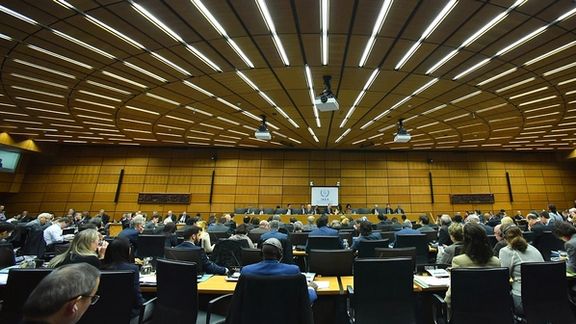
IAEA Board of Governors

With the dust still settling after United States and Israeli elections, next week may open a new phase of controversy in Iran’s nuclear program.

The November 24-26 board meeting of the United Nations’ International Atomic Energy Agency (IAEA) will likely see a fresh resolution censoring Tehran over restricted access to agency inspectors. Reports emerged Friday that the United States, France, Germany, and the United Kingdom, were circulating to the board’s 35 member-states a draft resolution calling it “essential and urgent” for Iran to address agency unease.

IAEA concerns are twofold. Firstly, as highlighted by the resolution, Tehran has not satisfied the IAEA over uranium traces found in sites used for pre-2003 nuclear work. There is little expectation of a breakthrough in meetings with Iranian officials planned for later this month.

Ned Price, the US State Department Spokesman, Thursday accused Iran of “foot-dragging.” Tehran has demanded the IAEA drop questions over the uranium traces to help talks, currently frozen, to restore the 2015 Iran nuclear agreement, the JCPOA (Joint Comprehensive Plan of Action), which the US left in 2018.

US State Department Spokesperson Ned Price (file photo)
100%
US State Department Spokesperson Ned Price

The agency’s second main area of concern is Iran’s reducing since February 2021 IAEA general access to the nuclear program, which is now broadly as required under the Nuclear Non-Proliferation Treaty rather than as enhanced by the JCPOA.

This downgraded access, coupled with the issue of uranium traces, has led agency director-general Rafael Mariano Grossi to warn he may no longer be able to verify the peaceful nature of Iran’s nuclear program. A report circulated Thursday to IAEA member states noted that “the longer the current situation persists the greater such uncertainty becomes.”

The agency monitors Iran’s uranium stockpiles, which it currently reports at 3,674kg, way above the 267kg JCPOA cap, including 62kg enriched to 60 percent, close to 90 percent ‘weapons grade.’ But Iran’s removal of monitoring equipment in factories where it makes centrifuges, machines that enrich uranium, has stymied the agency’s ability to judge the overall program. While access to such factories is not required under Iran’s NPT commitments, knowing the number and type of centrifuges Iran has ready and waiting is crucial to assessing how quickly the program can expand.

While Price said Thursday the US was consulting its “European partners,” options for effective action appear limited. The IAEA board passed a resolution June censoring Iran over the uranium traces, and it far from clear what a new resolution might achieve. The draft text, as reported by Reuters Friday, says Iran should “act to fulfil its legal obligations and... without delay…provide all information, documentation, and answers” required by the IAEA, as well as “access to locations and material…[and the] taking of samples…”

Unlike 2006, when the IAEA referred Iran to the United Nations Security Council over its atomic program, Russia and China would no longer back the move. Both hold UNSC vetoes and see the US as primarily responsible for the JCPOA’s demise.

Even though decisions over JCPOA restoration rest with President Joe Biden, JCPOA critics in the US may feel emboldened by the swing away from the Democrats in the November 8 Congressional elections, even if control of both the House of Representatives and the Senate remains unclear.

‘Acting with judgement’

The looming return to office in Israel of Benjamin Netanyahu after November 1 Knesset elections is another complication. Outgoing prime minister Yair Lapid developed a good relationship with the Biden administration although critical of efforts to revive the JCPOA, whereas Netanyahu previously identified with President Donald Trump. Outgoing Defense Minister Benny Gantz Wednesday talked up work done by the outgoing administration in preparing for military strikes on Iran, suggesting Netanyahu would now “act with judgement.”

While the Ukraine crisis, Iran’s wave of internal protests, and Tehran’s growing links with Moscow have all brought the US closer to the three European JCPOA signatories – France, Germany, and the UK – Biden’s alternatives appear limited.

Given “Iran’s dangerous proliferation of weapon systems to Russia,” Price said Thursday the US would “continue to vigorously enforce all US sanctions on both the Russian and Iranian arms trade.” He conceded that while Washington was “looking at all appropriate tools” for dealing with Iran, it was already “very heavily sanctioned, to say the least…for the full range of their nefarious activities.”


Most Viewed

Iran negotiators ordered to return after internal rift over Islamabad talks
1
EXCLUSIVE

Iran negotiators ordered to return after internal rift over Islamabad talks

2
INSIGHT

Iran's digital economy battered by prolonged blackout

3
ANALYSIS

US blockade enters murky phase as tankers spoof signals and buyers hesitate

4
ANALYSIS

Why the $100 billion Hormuz toll revenue is a myth

5

US tightens financial squeeze on Iran, warns banks over oil money flows

Banner
Banner

Spotlight

  • Hardliners push Hormuz ‘red line’ as US blockade tests Iran’s leverage
    INSIGHT

    Hardliners push Hormuz ‘red line’ as US blockade tests Iran’s leverage

  • Ideology may be fading in Iran, but not in Kashmir's ‘Mini Iran'
    INSIGHT

    Ideology may be fading in Iran, but not in Kashmir's ‘Mini Iran'

  • War damage amounts to $3,000 per Iranian, with blockade set to add to losses
    INSIGHT

    War damage amounts to $3,000 per Iranian, with blockade set to add to losses

  • Why the $100 billion Hormuz toll revenue is a myth
    ANALYSIS

    Why the $100 billion Hormuz toll revenue is a myth

  • US blockade targets Iran oil boom amid regional disruption
    ANALYSIS

    US blockade targets Iran oil boom amid regional disruption

  • Iran's digital economy battered by prolonged blackout
    INSIGHT

    Iran's digital economy battered by prolonged blackout

•
•
•

More Stories

Islamic Republic Warns UN’s Guterres Against Meeting Over Protests

Nov 11, 2022, 13:15 GMT+0

Amid international concerns over the Islamic Republic’s violent crackdown on dissent, its foreign minister has warned the UN Human Rights Council over organizing any session to discuss the situation. 

In a phone conversation with UN Secretary General Antonio Guterres Thursday night, Foreign Minister Hossein Amir-Abdollahian warned of the “negative consequences” of the UNHRC’s “political measure” on cooperation between the Islamic Republic and the West, referring to calls for a special meeting over the deadly clampdown on the current protests across Iran. 

Alleging that the Islamic Republic has "deeply exercised restraint" in the ongoing unrest – which has left over 300 protesters dead and about 15,000 detained, he told the UN chief that such a meeting should be held for countries that "promote violence and terror."

“The UN Human Rights Council should hold sessions for governments that are encouraging violence and terror, not for the Islamic Republic of Iran which is a true defender of human rights and has exercised great restraint during recent riots,” he said. 

Amir-Abdollahian added that “Contrary to the UN Charter, a few Western countries exploited the peaceful demands in Iran and encouraged violence and offered tutorials on building weapons and Molotov cocktails on media and social networks which led to the killing of police and insecurity in Iran.”

Iranian officials have been accusing “enemies” of fomenting protests, but so far have not presented any evidence.

He also claimed that “technical” negotiations between Iran and the International Atomic Energy Agency (IAEA) are at “appropriate” levels, despite remarks by the head of the UN’s nuclear watchdog. Rafael Mariano Grossi said Wednesday Iran did not offer anything new during a recent meeting in Vienna to resolve major differences.

IRGC Chief Says ‘Scared’ Enemies Asking Iran Not To Attack Them

Nov 11, 2022, 11:16 GMT+0

Commander of Iran's Revolutionary Guard Hossein Salami has threatened the Islamic Republic's “enemies,” claiming that they are frightened and on alert mode. 

Salami made the remarks during a ceremony to commemorate the 11th death anniversary of Hassan Tehrani Moqaddam, one of Iran’s earliest missile architects, who was killed when a huge explosion rocked a missile base 30 miles from Tehran in November 2012.

Moghaddam was among 17 top IRGC officers killed that day, in what many believed was an operation by Israeli intelligence. The incident was so shocking that even Supreme Leader Ali Khamenei attended the funeral at the time.

Salami said that "the enemies" are sending regular messages to Iran, pleading not to be targeted by a military response, without specifying which enemies. “Now it is a number of days that enemies do not have peace and are on alert. 

Since popular protests began in Iran, the clerical regime has threatened Western countries and Saudi Arabia, claiming they are behind the unrest. The IRGC commander added, “Those sitting in glass houses in Riyadh, Tel Aviv, New York, and Paris are designers of riots.”

Salami added that “we targeted the anti-revolution [groups] in the Iraqi Kurdistan region, held a major military drill along Aras River, launched a satellite-carrying rocket, tested Bavar 373 missile system with a range of 300km, and we announced yesterday that we have developed a new missile that no missile defense system is able to confront it.”

“Enemies should know that if they targeted one of us, we will target all of them,” referring to the killing of IRGC’s Quds (Qods) commander Qasem Soleimani. “You targeted our Qasem but we will target all of you and expel you from the region,” he maintained. 

German Politician Calls For Sanctions On 227 Iranian Lawmakers

Nov 10, 2022, 21:57 GMT+0

A German member of European Parliament has vehemently slammed Iranian lawmakers for demanding the execution of protesters, saying all these MPs must be sanctioned.

Hannah Neumann said during a parliament session on Thursday said that people of Iran are being brutally suppressed by their own regime “and it is not accepted by us.”

“Protesters are beaten-up, raped and killed in the streets and in prisons, not by criminals but by those who claim to be the government of this wonderful country,” she added.

Speaking during a session she went on to say that out of the 290 members of the Iranian parliament 227 called on the country’s judiciary to severely punish protesters and political prisoners, including with issuing death sentences.

Neumann called on her colleagues in the European Union to send a very strong signal that such moves are not accepted.

100%

She also urged them to impose targeted sanctions against these 227 Iranian lawmakers.

Neumann stated that the EU is right now preparing a sanctions package to be issued by the Foreign Affairs Council next Monday, but “this package has only 31 individuals,” so a debate must be held to include all these Iranian parliamentarians.

A group of 227 parliament members in Iran called on the Judiciary Sunday to issue death sentences for people arrested during the ongoing antigovernment protests.

In a statement that was read out in the Iranian parliament on Sunday, the lawmakers called the protesters ‘Mohareb’ -- which literally means warrior in Arabic, but in Islamic law or sharia it means ‘enemy of God’ that carries the death penalty.

UN Nuclear Chief Says Concerns Over Iran Growing

Nov 10, 2022, 20:04 GMT+0
•
Iran International Newsroom

Raphael Mariano Grossi, head of the UN’s International Atomic Energy Agency (IAEA), has highlighted growing attention and unease over Iran’s nuclear program.

Speaking on the sidelines of the United Nations COP27 climate gathering in Egypt, Grossi referred to Tehran’s claim earlier Thursday that it had developed a hypersonic missile, which could travel at over five times the speed of sound.

“We see that all these announcements increase the attention, increase the concerns, increase the public attention to the Iranian nuclear program,” Grossi, the IAEA director-general told the AFP news agency.

Under the terms of the 2015 Iran nuclear deal, which the United States left in 2018 imposing stringent sanctions, Iran was prohibited from developing missiles designed to carry nuclear warheads. But concerns over Iran’s general missile capacity, an option attractive partly due to Iran’s lack of an effective air-force, has increased with the expansion of the nuclear program since 2019.

With talks to revive the 2015 agreement, the JCPOA (Joint Comprehensive Plan of Action) apparently suspended since the summer, two IAEA reports to member states Thursday highlighted Tehran’s continued nuclear progress.

While Iran’s stocks of all enriched uranium had gone down in three months by 267kg to 3,674kg – still way above the JCPOA limit of 267kg – the uranium stock enriched to 60 percent, close to the 90 percent considered ‘weapons grade,’ rose by nearly 6.7kg to 62.3kg. Experts say Iran, with further enrichment, has enough material for a bomb, a step it says it has no intention of taking.

Cascade of Iranian centrifuges enriching uranium to higher purity. File photo
100%
Cascade of Iranian centrifuges enriching uranium to higher purity

A second IAEA report said agency inspectors would visit Iran during November to discuss uranium traces found at Iranian sites linked to nuclear work carried out before 2003. The report said the agency expected “to start receiving …technically credible explanations…including access to locations and material…”

Iran has since February 2021 reduced the IAEA’s access to that required under the Nuclear Non-Proliferation Treaty, citing the killing of a scientists and attacks on its atomic facilities widely attributed to Israel. The agency’s first report Thursday noted that reduced access was having a “significant impact” on the IAEA’s verification work and that “the longer the current situation persists, the greater such uncertainty becomes.”

‘Stabilize the current crisis’

Iranian leaders have demanded the IAEA drop its probe into the uranium traces before the JCPOA can be restored. Next week sees the quarterly meeting of the IAEA board. In June the 35-member board passed a resolution, against Russian and Chinese wishes, censuring Iran over what the agency has called a lack of cooperation in explaining the uranium traces.

There was optimist about a new deal in August when the European Union presented a compromise draft document. Iran responded to the proposal with demands that the US found beyond the JCPOA and talks entered an impasse, Since then Russia has begun using Iranian-made drones against Ukraine, further souring the mood in the West.

Warning Wednesday of a need to “stabilize the current crisis before it is too late,” the Washington-based Arms Control Association called for “reciprocal, confidence-building steps, ”by the US and Iran “to prevent further escalation, reduce the risk of proliferation, and decrease the chances of miscalculation.” The association suggested that enhanced monitoring “would be an ideal starting point.”

Hossein Mousavian, former Iranian nuclear negotiator and security official, in a piece for Middle East Eye published Tuesday, called for renewed efforts to salvage the JCPOA and said that a US or Israeli military attack could push Iran into developing a nuclear weapon..

Australian FM Slams Crackdown On Iranian Protesters

Nov 10, 2022, 17:05 GMT+0

Australia’s foreign minister Penny Wong has condemned the deadly and disproportionate use of force against protesters in Iran.

In a statement on Thursday, Wong said the Australian government has been “alarmed” by reports that hundreds of people have been killed and many more injured, including dozens of children, as a result of the “heavy-handed” measures Iranian authorities have implemented to crack down on ongoing protests.

She added that Australia supports the right of the Iranian people to protest peacefully and “calls on Iranian authorities to exercise restraint in response to ongoing demonstrations.”

“Iran's human rights record has been a longstanding and serious concern for Australia, and we have repeatedly raised our concerns with Iran in Canberra, Tehran, and multilateral forums,” she went on to say.

She also reiterated that Australia joined Canada and New Zealand in expressing grave concerns about the situation in Iran to the United Nations Security Council, including Iran's position on the UN Commission on the Status of Women.

“Australia stands with Iranian women and girls in their struggle for equality and empowerment, and we will continue to call on Iran to cease its oppression of women. We are committed to promoting gender equality, women's empowerment, and ending violence against women and girls worldwide,” reads her statement.

Earlier, Australian Prime Minister, Anthony Albanese condemned the crackdown by Iranian authorities and urged the Islamic Republic to respect the rights of protesters.