• العربية
  • فارسی
Brand
  • Iran Insight
  • Politics
  • Economy
  • Analysis
  • Special Report
  • Opinion
  • Podcast
  • Iran Insight
  • Politics
  • Economy
  • Analysis
  • Special Report
  • Opinion
  • Podcast
  • Theme
  • Language
    • العربية
    • فارسی
  • Iran Insight
  • Politics
  • Economy
  • Analysis
  • Special Report
  • Opinion
  • Podcast
All rights reserved for Volant Media UK Limited
volant media logo

Iran Arrests Sister Of Executed Wrestler, Makes False Accusation
Iran International Newsroom
Nov 10, 2022, 11:59 GMT+0Updated: 17:36 GMT+1
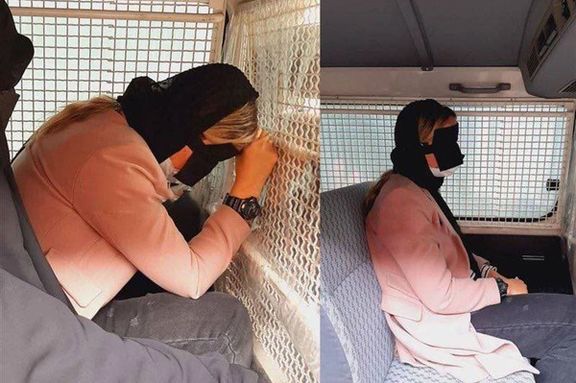
Elahm Afkari being taken to a detention center, November 9, 2022

Iran’s Fars news agency close to the Revolutionary Guard claimed Thursday that Iranian intelligence has arrested a person “who is an agent” of Iran International.

A short alert said that Elham Afkari was detained as she tried to “flee the country” as well as her husband and three-year-old daughter. She was accused of fomenting the current popular protests.

Afkari is the sister of Iranian wrestler Navid Afkari who was executed in September 2020, after participating in protests and being accused of killing a government employee. His execution led to strong domestic and international condemnations.

Two of Afkari’s brothers are still in prison serving a jail term of 66 years between the two and the family has been persecuted for more than four years. Navid and his two brothers were subjected to extensive torture in prison.

Iran International, a London-based Persian broadcaster, reacted to the news by tweeting that Elham Afkari never “worked for or collaborated” with the network.

It also condemned the coverage of the news by Reuters and Aljazeera Arabic for repeating “the Islamic Republic’s sheer lies” regarding Afkari’s arrest.

The Iranian government has arrested an estimated 15,000 protesters since mid-September when demonstrations started after a young woman, Mahsa Amini, was killed in ‘morality police’ custody. Iranian lawmakers and officials have threatened many detainees with the death penalty.

An undated photo of the Afkari brothers before their ordeal began, Navid is seen on the left
100%
An undated photo of the Afkari brothers before their ordeal began, Navid is seen on the left

The Islamic Republic’s Judiciary is not independent and both prosecution and judges answer to the same bureaucracy that closely collaborates with intelligence services. The accused usually are denied the chance to choose their own attorneys and have little access to their case files. In cae of political prisoners, such as detained protesters, trials are generally unfair.

Iranian officials and government-controlled media have repeatedly accused foreign-based Persian media for fomenting the unrest, without presenting any credible proof. Three influential networks are based in London and provide news and views to audiences in Iran who have long been denied access to free media. Besides Iran International, Islamic Republic officials have also accused the BBC Persian service of agitating during the protests.

Tehran has accused foreign “enemies”, meaning the United States and its allies of being behind the protests, although numerous rounds of demonstrations have taken place since 2017 by various social and labor groups.

In desperation to prove foreign conspiracies, the Islamic Republic may arrest more people and activists, and accuse them of collaborating with Iran International or other media outlets.


Most Viewed

Iran negotiators ordered to return after internal rift over Islamabad talks
1
EXCLUSIVE

Iran negotiators ordered to return after internal rift over Islamabad talks

2
ANALYSIS

US blockade enters murky phase as tankers spoof signals and buyers hesitate

3
ANALYSIS

Why the $100 billion Hormuz toll revenue is a myth

4

US tightens financial squeeze on Iran, warns banks over oil money flows

5
ANALYSIS

US blockade targets Iran oil boom amid regional disruption

Banner
Banner

Spotlight

  • Hardliners push Hormuz ‘red line’ as US blockade tests Iran’s leverage
    INSIGHT

    Hardliners push Hormuz ‘red line’ as US blockade tests Iran’s leverage

  • Ideology may be fading in Iran, but not in Kashmir's ‘Mini Iran'
    INSIGHT

    Ideology may be fading in Iran, but not in Kashmir's ‘Mini Iran'

  • War damage amounts to $3,000 per Iranian, with blockade set to add to losses
    INSIGHT

    War damage amounts to $3,000 per Iranian, with blockade set to add to losses

  • Why the $100 billion Hormuz toll revenue is a myth
    ANALYSIS

    Why the $100 billion Hormuz toll revenue is a myth

  • US blockade targets Iran oil boom amid regional disruption
    ANALYSIS

    US blockade targets Iran oil boom amid regional disruption

  • Iran's digital economy battered by prolonged blackout
    INSIGHT

    Iran's digital economy battered by prolonged blackout

•
•
•

More Stories

Iran Claims To Have Developed A Hypersonic Missile

Nov 10, 2022, 10:01 GMT+0

Iran has built a hypersonic ballistic missile, the Revolutionary Guard’s aerospace commander claimed Thursday, in remarks likely to heighten concerns about Iran’s missile program.

"This missile has a high speed and can maneuver in and out of the atmosphere. It will target the enemy's advanced anti-missile systems and is a big generational leap in the field of missiles," commander Amir-Ali Hajizadeh was quoted as saying.

Hypersonic missiles can fly at least five times faster than the speed of sound and on a complex trajectory, which makes them difficult to intercept. So far, only Russia, Iran's close military ally, has developed such weapons.

However, there have been no reports of such a missile being tested by Iran and, while the Islamic Republic has developed a large domestic arms industry in the face of international sanctions and embargoes, Western military analysts say Iran sometimes exaggerates its weapons capabilities.

Concerns about Iran's ballistic missiles did however contribute to a US decision in 2018 under then-President Donald Trump to pull out of the nuclear pact that Tehran signed with world powers on 2015.

Last week, Iran said it tested the Ghaem 100, its first three-stage space launch vehicle, which would be able to place satellites weighing 80 kg (180 pounds) in an orbit 500 km (300 miles) from the earth's surface, according to state media.

The United States has called such actions "destabilizing" as it believes space launch vehicles could be used to transport a nuclear warhead.

With reporting by Reuters

Iranian FM Holds ‘Urgent’ Meeting With His Predecessors

Nov 10, 2022, 09:27 GMT+0

Iran’s Foreign Minister Hossein Amir-Abdollahian says he held a meeting with his four predecessors, including Mohammad Javad Zarif, without disclosing any details.

In a tweet late on Wednesday the Iranian top diplomat said, “in a friendly meeting I hosted the former foreign ministers of the Islamic Republic of Iran Kamal Kharazi, Manuchehr Mottaki, Ali Akbar Salehi and Mohammad Javad Zarif.”

Further he added that “We are determined to accomplish the objectives of the diplomacy in realizing the greatest interests of the nation by relying on collective wisdom.”

However, Amir-Abdollahian did not mention anything about the agenda of the meeting and the issues raised.

Some Iranian dailies, however, called the meeting “an urgent” one not giving any other details.

The meeting comes as negotiations to revive 2015 nuclear deal are in a deadlock, with the United States openly stating that the talks are not its focus at the moment.

The recent protests that have swept the country are having an undisputable impact on the chances of the revival of the JCPOA as it is getting more difficult for Washington and the West to negotiate with the Islamic Republic when anti-regime demonstrators are subjected to a brutal cracked down in the streets.

The United States and its European allies have warned Tehran to respect fundamental human and civil rights of the protesters and are threatening more sanctions.

It seems that the incumbent minister is seeking help from his predecessors to get the regime out of the impasse, but major policies in Iran are set by Supreme Leader Ali Khamenei.

Security Forces Killed At Least 328 During Iran Protests

Nov 9, 2022, 21:57 GMT+0

A human rights group says security forces have killed at least 328 people in Iran’s antigovernment protests ignited by death of a 22-year-old woman in custody of hijab police in September.

The US-based Human Rights Activists News Agency (HRANA) said Wednesday that at least 50 minors were among the casualties.

The new numbers cover the period between September 17 and November 8.

The group added that at least 41 government agents, including the Revolutionary Guards, paramilitary Basij forces and police, have also been killed during the unrest.

While the Islamic Republic has not provided accurate figures of those detained in the recent protests, HRANA says nearly 15,000 people are estimated to have been arrested, with the identity of 1,928 confirmed. About 431 of the detainees are students, it added.

According to HRANA over 877 city and university protest gatherings have been held in 137 cities and 136 universities during the period, while protest rallies show no sign of abating in what has become the boldest challenge to Iran's clerical regime since the Islamic revolution of 1979.

The Oslo-based Iran Human Rights Organization (IHR) said November 6 that at least 304 protesters, including 41 children and 24 women have been killed in the current protests.

Protesters have been killed in 22 provinces, with the most reported in Sistan and Baluchistan, Mazandaran, Tehran, Kordestan and Gilan respectively, says IHR.

‘Made In Iran’ Russian Drones Have American, Canadian Parts

Nov 9, 2022, 19:55 GMT+0
•
Iran International Newsroom

Russia’s use of military drones in Ukraine has highlighted the ready availability of the low-cost weapons and their growing use in conflicts.

Quebec-based Bombardier Recreational Products (BRP) has expressed surprise that engines made by Rotax, its Austrian subsidiary, were reportedly found in Iranian-made drones shot down in Ukraine. The company’s logo has featured in photographs of drone wreckage.

BRP spokeswoman Biliana Necheva said in a statement November 4 that the company had not supplied engines to Iran since 2019 and that “none will be sold moving forward.” She suggested that Iran might have used counterfeit engines or stolen them.

After a Rotax engine was apparently found in a Mohajar-6 drone shot down by Ukrainian forces and displayed on CNN in October, BRP stated October 21 it had not given authorization to distributors to “supply military UAV manufacturers in Iran or Russia.”

But United States-funded Radio Free Europe has reported that Mahtabal, Iranian distributor for Rotax engines, was advertising sales and a repairs service as recently as December 2020. RFE said one camera in the shot-down Mohajar-6 was produced by Hong Kong-based RunCam Technology, which has two authorized Iranian dealers. Another camera resembled a model produced by Sierra-Olympic Technologies, based in the US state of Oregon, or a cheaper Chinese version, while microchips featured the logos of the California-based Linear Technology Corporation.

An Iranian Shahed-136 drone used as suicide weapons by Russia against Ukrainian civilian targets
100%
An Iranian Shahed-136 drone used as suicide weapons by Russia against Ukrainian civilian targets

‘Countries with unclear usage’

While Rotax engines are used in snowmobiles, watercraft and civilian airlines, they also figure in the United States MQ-1 Predator drone, Israel’s Heron drones, and some Russian drones. Drone output has surged in the Middle East in recent years, with the main producers Israel and Turkey.

In 2020, it emerged that Rotax engines were being used in Turkish Bayraktar TB2 drones being used by Azerbaijani forces against Armenia – which led the company to say it would stop exports of Rotax 912 engines to “countries with unclear usage.” The manufacturer has claimed Ukraine’s use of the Bayraktar would boost worldwide sales.

Iran has developed a program of drones, or UAVs (unmanned aerial vehicles), given it lacks an effective air force due to international sanctions. While Iranian officials and commanders have celebrated this as an achievement of domestic production, Iran has copied when advantageous.

Iran’s Shahed-129 drone, in production since 2013, has been widely reported to have a Rotax 914 engine. A decade ago, there were reports that had Iran copied aspects of a US drone it had shot down.

The engine of an Iranian drone shot down in Ukraine. October 6, 2022
100%
The engine of an Iranian drone shot down in Ukraine. October 6, 2022

Tehran has developed skills in obtaining technology when barred by sanctions. “Exporters will look at the request coming from the [United Arab Emirates] or another third country…when really the end user is in Iran,” Daniel Salisbury, a senior research fellow with the Department of War Studies at King’s College London, recently told RFE.

Cost-effective alternative

While Ukraine has in the current conflict used both Turkish and US drones, as well as making its own, Russian military commanders have generally been skeptical over the usefulness of drones.

Russia’s Forpost, a surveillance drone that is a licensed version of the Israeli IAI Searcher II, has been deployed in Ukraine, but Moscow has faced problems with its stealth drones. Ukraine has argued that Iranian drones are a cost-effective alternative to missiles while Kyiv has also used Tehran’s supply to lobby successfully for better US air defenses.

After conceding Saturday that it had supplied drones to Russia, albeit before the current phase of conflict and specifically for use in Ukraine, Iran continues to stress both its links with Moscow and desire for a negotiated peace.

After meeting with Russian Security Council Secretary Nikolai Patrushev in Tehran Wednesday, Iran’s top security official Ali Shamkhani called for deeper ties in energy, transport and banking. He said they had discussed resisting “western interference” in internal affairs and that Iran would back “any initiative that leads to a ceasefire.”

US President Extends Emergency State Concerning Iran

Nov 9, 2022, 13:13 GMT+0

US President Joe Biden has extended the state of emergency regarding Iran for another year, which would keep US sanctions imposed following the 1979 hostage crisis still in effect.

Joe Biden renewed the emergency with respect to Iran, pursuant to the International Emergency Economic Powers Act.

Biden said on Tuesday that “Our relations with Iran have not yet normalized, and the process of implementing the agreements with Iran, dated January 19, 1981, is ongoing. Biden said in a statement published on the White House website, “For this reason, the national emergency declared on November 14, 1979, and the measures adopted on that date to deal with that emergency, must continue in effect beyond November 14, 2022.”

The national emergency was announced when radical students in Tehran seized the US embassy and took hostage dozens of diplomats, staff and guards.

The decision by then-president Jimmy Carter was meant “to deal with the unusual and extraordinary threat to the national security, foreign policy, and economy of the United States constituted by the situation in Iran.”

The extension of the state of emergency in relation to Iran comes at a time when negotiations to revive the 2015 nuclear agreement have stalled, with the White House saying it is no longer focused on that.

The suppression of the current antigovernment protests in Iran as well as regime’s deployment of drones to Russia to be used in Ukraine war have also triggered a new wave of sanctions against the Islamic Republic.





