• العربية
  • فارسی
Brand
  • Iran Insight
  • Politics
  • Economy
  • Analysis
  • Special Report
  • Opinion
  • Podcast
  • Iran Insight
  • Politics
  • Economy
  • Analysis
  • Special Report
  • Opinion
  • Podcast
  • Theme
  • Language
    • العربية
    • فارسی
  • Iran Insight
  • Politics
  • Economy
  • Analysis
  • Special Report
  • Opinion
  • Podcast
All rights reserved for Volant Media UK Limited
volant media logo

Iran's Judiciary Vows Harsh Sentences For Protesters
Iran International Newsroom
Nov 8, 2022, 11:05 GMT+0Updated: 17:33 GMT+1
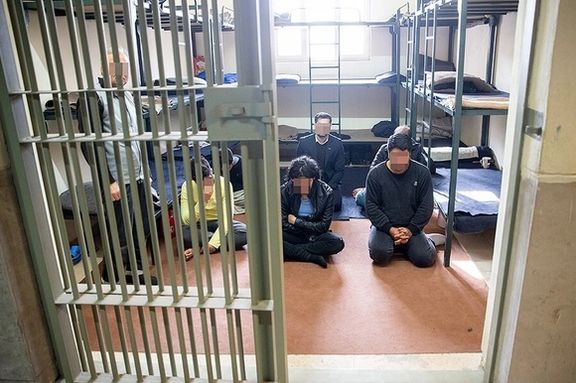
Undated photo of political detainees in an Iranian prison

After a threat by hardliner lawmakers last week asking that protesters be sentenced to death, Iran's Judiciary Tuesday signaled its intention to do just that.

Judiciary spokesman Masoud Setayeshi said that courts will deal firmly with anyone who causes “disruptions or commits crimes” during the ongoing wave of antigovernment protests.

The Judiciary’s statement is ominous for many activists because there are no independent courts in Iran. Both prosecutors and judges answer to the same Judiciary controlled by hardliners. In most political trials also, there is no due process of law, no freedom to choose defense lawyers and little access to case files.

Iran’s Judiciary can frame people for crimes they did not commit, as multiple cases have demonstrated in the past. It can defy what “disruption” means and sentence any protester to death for causing an ill-defined act of disruption.

One of the biggest challenges to Iran's clerical leaders since the 1979 Islamic Revolution, the seven-week-old demonstrations have persisted despite a deadly crackdown and severe warnings from security forces.

More than 1,000 people have been indicted in connection with what the government calls "riots".

"Now, the public, even protesters who are not supportive of riots, demand from the judiciary and security institutions to deal with the few people who have caused disturbances in a firm, deterrent and legal manner," judiciary spokesman Masoud Setayeshi claimed.

Iranian riot police vehicles seen in Tehran on October 3, 2022
100%
Iranian riot police vehicles seen in Tehran on October 3, 2022

Another keyword in this statement is “riots”. The regime calls the protesters rioters, without ever having issued a demonstration permit to anyone other than its loyal followers. ‘Reformist’ parties that are not opposed to the Islamic Republic asked for an official permit to gather in September and received no answer.

Anti-government demonstrations erupted in September after the death of a Kurdish woman Mahsa Amini, who had been detained by morality police for allegedly flouting the Islamic Republic's strict dress code imposed on women.

The activist HRANA news agency said that 318 protesters had been killed in the unrest as of Saturday, including 49 minors. Thirty-eight members of the security forces had also been killed, it said.

State media said last month that more than 46 members of the security forces, including police officers, had been killed. Government officials have not provided an estimate of any wider death count.

Center for Human Rights in Iran, a Norway-based human rights organization also expressed concern last week regarding the fate of detained protesters saying, “dozens of them have been charged with the security-related accusation of ‘moharebeh’ (fighting God) and ‘corruption on earth’ which carry the death penalty.”

Iranian leaders have again accused enemies including the United States of fomenting the unrest. More than 220 hardline Iranian lawmakers who urged the judiciary to "deal decisively" with the perpetrators followed the same unsubstantiated argument that protesters are either foreign agents or have been “deceived” by them.

The US State Department once again rejected the accusation on Monday. Spokesperson Ned Price told reporters, “The fact is that Iran – its government is facing problems that are fundamentally of its own making. This is – these protests are so powerful because they are fundamentally not about us. They’re not about any external actor. They are about the legitimate, they’re about the genuine, they’re about the heartfelt aspirations of the Iranian people.”

People from all walks of life have taken part in the protests, with students and women playing a prominent role, waving and burning headscarves.


Most Viewed

Ideology may be fading in Iran, but not in Kashmir's ‘Mini Iran'
1
INSIGHT

Ideology may be fading in Iran, but not in Kashmir's ‘Mini Iran'

2
INSIGHT

Hardliners push Hormuz ‘red line’ as US blockade tests Iran’s leverage

3
VOICES FROM IRAN

Hope and anger in Iran as fragile ceasefire persists

4

US sanctions oil network tied to Iranian tycoon Shamkhani

5

Iran halts petrochemical exports to supply domestic market

Banner
Banner

Spotlight

  • Hardliners push Hormuz ‘red line’ as US blockade tests Iran’s leverage
    INSIGHT

    Hardliners push Hormuz ‘red line’ as US blockade tests Iran’s leverage

  • Ideology may be fading in Iran, but not in Kashmir's ‘Mini Iran'
    INSIGHT

    Ideology may be fading in Iran, but not in Kashmir's ‘Mini Iran'

  • War damage amounts to $3,000 per Iranian, with blockade set to add to losses
    INSIGHT

    War damage amounts to $3,000 per Iranian, with blockade set to add to losses

  • Why the $100 billion Hormuz toll revenue is a myth
    ANALYSIS

    Why the $100 billion Hormuz toll revenue is a myth

  • US blockade targets Iran oil boom amid regional disruption
    ANALYSIS

    US blockade targets Iran oil boom amid regional disruption

  • Iran's digital economy battered by prolonged blackout
    INSIGHT

    Iran's digital economy battered by prolonged blackout

•
•
•

More Stories

Many Call For Dialogue In Iran But Khamenei Camp Not Moved

Nov 8, 2022, 08:50 GMT+0
•
Iran International Newsroom

Iranian hardliners in control of parliament and government mostly advocate a harsh response to protests but even among them there are some who call for dialogue.

On the same day when 227 members of Iran’s parliament (Majles) called for death sentence for those arrested during recent protests, Iran's Minister of Tourism and Cultural Heritage, Ezzatollah Zarghami, advocated dialogue between the government and the protesters, highlighting some chaos and indecision in the ruling circles.

Speaking in a meeting with Sharif University students Sunday, Zarghami, a former Revolutionary Guard (IRGC) officer who was once Iran's culture minister and the head of the country's state television, admitted that "Some of the approaches of Iranian officials are wrong but they fear the regime will face a serious danger if they put a step back from their position.”

Referring to the news of young Iranian knocking Shiite clerics' turbans off their heads, Zarghami said these are low-income clerics who are paying for the luxurious lifestyle of rich mullahs.

He insisted that Iran needs reforms and many members of the elite have warned the government about this. "Many others warned about the morality police and said what they were doing was wrong," he said.

Public statements by many officials, such as Zarghami, show they are still stuck in the perception that if hijab enforcement is relaxed, protests will end, but what protesters say in the streets is that they have passed that stage and want the regime to fall.

Zarghami at Sharif University on Nov. 7, 2022
100%
Zarghami at Sharif University on Nov. 7, 2022

Zarghami who has been active on social media for years, acknowledged that Iranians no longer trust the official media, and journalist do not write some of what is going on in the society, fearing government reprisal. He admitted that "You cannot say anything [in Iran] if there is no social media."

He criticized officials, without naming anyone, for failing to understand the people and their anger, and said he himself was frustrated because of the way his candidacy in the 2021 presidential election was handled.

In one of the most controversial comments he made in the presence of the students, he said: "When you look at some financial corruption cases, you will see that individuals from all parts of the establishment are involved in it."

But why Zarghami can say these things and get away while other officials do not? Perhaps one of the reasons is that others have no ambition for the future and simply wish to protect what they have. But Zarghami, more likely, still wants to be Iran's next president and having smelled the need for change, he probably thinks the regime will have no choice other than surrendering to some of the protesters' demands. By trying to talk to Sharif University Students who have been in the forefront of the protests, he is touting himself as the man who can make peace with Iran's angry young men and women. But the question is to what extent hardliners in the core of the regime, and students in the forefront of protests, would listen to him.

Reformist cultural activist Hadi Khaniki has likened the need to hold dialogue with the youth to chemotherapy to cure a cancer patient. "It is painful and hard, but it might have some good effect," Khaniki told Etemad Online website. A cancer patient himself, Khaniki said: "The country has a cancer which has its roots among top-level officials and if no one pays any attention to that, the cancer will spread to the other parts of the system.

In another development, Hassan Khomeini, the ambitious grandson of Ayatollah Ruhollah Khmomeini, the fundamentalist founder of the Islamic Republic suggested in an interview Etemad Online that "The government had better begin to listen to the people." He said if the situation develops into a deadlock, our only way out would be to seek democratic solutions. He ignored the fact that he has got his position of wealth and power through non-democratic ways, in a hereditary system.

Iran’s 52nd Day Of Unrest: Arrests, Mournings, And Civil Disobedience

Nov 7, 2022, 23:00 GMT+0
•
Iran International Newsroom

Monday was the 52nd day of the protests sparked by the death in custody of Mahsa Amini, with protests and strikes reported from her hometown as well as other Kurdish cities. 

The Kurdish-majority city of Marivan was still the scene of sporadic clashes between people and security forces for the second day following the death of Nasrin Ghaderi -- a PhD candidate in philosophy who died on Saturday after being beaten by security forces with batons during protests in Tehran -- while residents in the provincial capital of Kordestan, Sanandaj, were also out on streets chanting antigovernment slogans. 

The situation was also tense in the city of Siahkal, in the northern province of Gilan, where security forces used pellet guns and tear gas to prevent people from holding a gathering to mark the death of Erfan Zamani, a 23-year-old protester who was killed by security forces three days ago in another city of province. Despite heavy rain, a large number of people had gathered in the city for the mourning ceremony. 

In large cities, such as the capital Tehran, pockets of protests were reported but most of the gatherings were focused on civil disobedience against the clerical regime.

Citizens of some of Tehran’s neighborhoods as well the nearby city of Karaj have kept the protests going with whatever they can, be it chanting slogans from their roofs and windows, long honks from their cars and even singing the songs that have been spreading on social media since the beginning of the protests.

In Tehran, protesters were also giving out candies to women who had unveiled in public along short notes that read "Thanks for making the city beautiful with your hair. Woman, Life, Freedom."

In Rasht, Qazvin and Tehran people expressed their support for the protests with writing slogans on the walls, hanging banners with supportive messages from overpasses or burning pictures and statues of Islamic Republic figures or symbols, such as Supreme Leader Ali Khamenei or IRGC commander Qasem Soleimani killed in a targeted US air strikes in Iraq in 2020.

On Monday night, the Islamic Republic's security forces also blocked the roads to Bushehr's international airport in southern Iran and used tear gas and pellet guns against people who sought to give a hero's welcome to members of Iran's beach soccer team after their moves in solidarity with protesters. Some players of the national squad hail from the city of Bushehr. 

People in large cities have also started hanging puppets of mullahs from the pedestrian bridges as a symbolic threat against the clerics. A new trend that has been growing across the country is flipping the turbans of the clergy as they walk in streets. 

Social media users also launched an online petition, calling on Twitter to ban Khamenei from the platform. For 43 years, the Islamic Regime in Iran, led by Khamenei, has overseen the brutal and systemic persecution of its own people, torturing, raping, and killing civilians who oppose the regime, read the petition. 

Earlier in the day, the country’s hardliner chief Justice Gholam-Hossein Mohseni-Ejei vowed to intensify the punishment of those arrested during the protests following a call by the parliament members who have urged the judiciary to issue death sentences for the protesters. 

Iran Summons Norway Envoy Over Parliament Speaker’s Remarks

Nov 7, 2022, 20:28 GMT+0

Iran’s Foreign Ministry has summoned the Norwegian ambassador over remarks made by the country’s parliament speaker criticizing the Islamic Republic over ongoing protests.

The Norwegian envoy to the Islamic Republic, Sigvald Tomin Hauge, was summoned by the ministry in protest to the “unacceptable statements” of the Speaker of the Parliament of this country against Iran.

Masud Gharahkhani, an Iranian-born lawmaker, and president of Norway’s parliament expressed solidarity with anti-government protests in Iran on Friday in an interview with Iran International.

“You’ve been in power for 44 years, enough is enough,” he addressed the Islamic Republic and its Supreme Leader Ali Khamenei in a message during his interview.

Iran called his remarks “interventionist” saying such statements are “unacceptable”.

This is the second time Iran summons Norway’s envoy over Gharahkhani’s remarks since September.

Meanwhile, an Iranian member of the Swedish parliament published a video on his Instagram page asking Iranian leaders Ali Khamenei, President Ebrahim Raisi and the IRGC commander Hossein Salami to pack their luggage and prepare to travel to the International Court of Justice in The Hague to be held accountable for their crimes.

Alireza Akhundi further called on the Iranian army to join the people and support the protesters.

According to the Norway-based Iran Human Rights Organization, at least 304 people have been killed during the recent protests that began across Iran after the killing of 22-year-old Mahsa Amini by police in custody.

Iran Arrests Foreign Tourists For Photos During Protests

Nov 7, 2022, 17:38 GMT+0

The Islamic Republic has arrested many foreign tourists who took photographs from the ongoing protests in Iran.

The chairman of the board of Iran's Tourist Guide Association said on Monday that the detainees have been taking photos “out of curiosity.”

Mohsen Haji Saeed expressed regret over this approach by the Islamic Republic, saying “all the tourists, who are seen in the wrong places, are not necessarily spies.”

He made the comments in a meeting of several lawmakers with tourism activists on Sunday in Tehran.

“Those who are responsible to provide security in the country should be told that the security of tourists and its international repercussions are important,” added Haji Saeed, highlighting that this issue has become a vital demand for tourism and lawmakers should help change “the wave that has been generated against Iran” in other countries in recent months.

These statements were made as the government has not published any information about tourists being arrested in recent protests.

Iran’s Intelligence Ministry announced the detention of nine non-Iranian citizens from Germany, Poland, Italy, France, the Netherlands and Sweden on September 30. Then the ministry called the antigovernment protests in Iran "riots" alleging the arrested were "on the stage or behind the scenes" of the recent protests.

According to ISNA News Agency, the impact of the protests on the tourism industry in Iran was one of the topics raised in this meeting.

Iran's Faces More Economic Problems In Coming Months

Nov 7, 2022, 17:26 GMT+0
•
Mardo Soghom

As antigovernment protests continue in Iran, the government will face a multitude of additional economic problems and energy crisis in the coming months.

The most urgent problem is a fast-falling national currency that began to nosedive in early November, dropping to historic lows almost on daily basis. The US dollar has risen from 295,000 rials to 365,000 in two months. But that is just an early signal of what is to come.

The retail sector is having its own multiple problems. First, during protests people are buying less, as recently the garment industry complained of very low sales to consumers who are in no mood to go shopping.

Second, a draconian denial of access to the Internet by the government, to contain the protests, has badly hurt hundreds of thousands of small businesses dependent on sales through social media.

Third, Iranian consumers have begun boycotting large retailers and businesses believed to be controlled by the Revolutionary Guard and other regime entities, as another tool in their civil disobedience movement.

Digikala, "Iran's Amazon" faces a public boycott over protests
100%
Digikala, "Iran's Amazon" faces a public boycott over protests

Digikala, Iran’s Amazon, and Mihan dairy and food company have been targeted by activists on social media, who tell the people not to enrich the government’s suppression machine. In a matter of days, there are signs of lower sales by both companies, which sponsored appeals from their workers who asked the public not to harm their livelihoods.

Fourth, and the perhaps the most predictable is a looming shortage of natural gas in the winter, as pressure in Iran’s South Pars maritime fields in the Persian Gulf are gradually falling. The country has failed to secure capital and western technology to improve drilling and pumping system to boost production.

Iran has the world’s second largest natural gas reserves after Russia with almost 30 trillion cubic meters of potential supply, but it needs to invest $50 billion and use special technology only a few western firms can provide to keep its level of daily production at around 700 million cubic meters.

A production platform in Iran's South Pars gas fields
100%
A production platform in Iran's South Pars gas fields

The former head of the national gas company, Hamidreza Eraghi told ILNA news website in Tehran on November 7, that this winter the country might be forced to buy gas from Turkmenistan to be able to supply electricity and keep industries in business. Already, in the past few years as consumption has risen, there have been both shortages of electricity and gas. The government sells energy at ridiculously cheap rates and consumers have no incentive to save, with usage fast increasing each year.

There are also ongoing strikes in the oil and gas sectors in solidarity with nationwide protests, which will further hurt production.

What Iran needs most is imported technology for horizontal drilling for gas, Eraghi said, and this winter imports should increase to prevent an industrial shutdown.

The government has periodically highlighted the need to boost prices to lower consumption, but that would anger a public that has become impoverished in the past four years after the United States imposed sanctions on Iran’s oil exports. Already, with nationwide antigovernment protests raging, the government has no way to increase energy prices.

Ordinary Iranians have fallen victim to high inflation rate for years. No one knows exactly what the current annual inflation rate is, but if one would believe the government, it is at least 40 percent, with food prices having risen by 100 percent in the past 12 months. The falling national currency will accelerate inflation as Iran imports a significant part of its food and raw materials.

With a convergence of so many negative economic developments there is very little the regime can do to stop the protesters, who openly say they want to get rid of the Islamic Republic, not only for its economic mismanagement but also for its draconian denial of social freedoms.






