• العربية
  • فارسی
Brand
  • Iran Insight
  • Politics
  • Economy
  • Analysis
  • Special Report
  • Opinion
  • Podcast
  • Iran Insight
  • Politics
  • Economy
  • Analysis
  • Special Report
  • Opinion
  • Podcast
  • Theme
  • Language
    • العربية
    • فارسی
  • Iran Insight
  • Politics
  • Economy
  • Analysis
  • Special Report
  • Opinion
  • Podcast
All rights reserved for Volant Media UK Limited
volant media logo

Iranians Mark Protest Deaths By More Demonstrations
Nov 8, 2022, 23:02 GMT+0Updated: 07:55 GMT+0
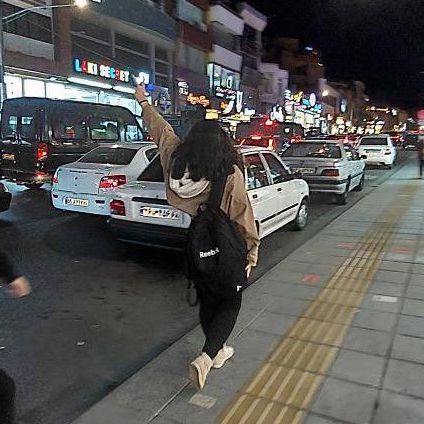
A girl who has unveiled in public in the city of Karaj, near capital Tehran

The uprising of Iranians against their clerical government continued Tuesday with protest rallies held by students and calls for nationwide demonstrations on Wednesday.

The mourning ceremony for Nasrin Ghaderi turned into a scene of protest in the western city of Marivan where residents chanted anti-regime slogans.

Ghaderi, 35, who was a philosophy doctoral candidate in Tehran died on Saturday after being beaten by security forces with baton during Friday’s protests.

A video received by Iran International shows a girl cutting her hair at the grave of this young woman, as a symbolic act against forced hijab.

Iran's official news agency IRNA has dismissed media reports that Ghaderi was killed with baton strikes, saying she was "living her normal life" when her family suddenly lost touch with her, and once their son-in-law broke into her residence in Tehran, they found her dead.

In the meantime, several calls for protest have been issued for Wednesday in Zahedan and other cities on the occasion of the 40th day after “Bloody Friday of Zahedan”.

The Bloody Friday in Zahedan, the provincial capital of Sistan and Baluchestan took place September 30, when security forces killed at least 93 people, and injured hundreds more. Zahedan is one of the few Sunni-majority cities in predominantly Shiite Iran.

Videos received by Iran International also show students in various Iranian universities, including Beheshti, Sharif, Kordestan Medical Sciences and Babol Noshirvani staged sit-ins on Tuesday.

Amid high inflation and an economic crisis, a group of retired teachers and civil servants gathered in front of the Planning and Budget Organization in Tehran to demand their unpaid pensions and benefits.

100%

Another video shows a protester setting fire to a Qassem Soleimani banner. Soleimani, commander of the Revolutionary Guards (IRGC) extra-territorial Quds Force, was killed in Baghdad along with nine others in 2020 by a drone strike ordered by then-President Donald Trump.

The Islamic Republic and its supporters have portrayed Soleimani as a beloved hero, but protesters who want to topple the regime regard him as a war criminal who was responsible for killing both Iranians and others, such as Syrians during that country’s civil war.

Since September, people have destroyed Soleimani’s statues and pictures including in his hometown to show anger at regime’s propaganda.

A hardliner member of the Islamic Republic parliament called the move an “anarchic hate crime” that is becoming a public issue, he said.

Ali Asghar Annabestani said Tuesday that “the enemy has very cleverly turned people's protests into an anarchist riot, and protesters break all the boundaries that can be sacred for human society.”

“The people and government do not tolerate doing this to a national hero, so the security organizations must step in and prevent such acts. Destroyers should be identified and punished and then introduced to all people,” added the MP.

In another development, Zahra Rahnavard, the wife of dissident figure Mirhossein Mousavi, in a message demanded the release of imprisoned students and an end to threats, suspensions and expulsions of schoolchildren. Stating that “protest is the nation's right,” she added “Respect the youth, don't kill the nation's children and listen to the nation's voice.”

Zahra Rahnavard’s husband Mirhossein Mousavi, who has been under house arrest since February 2011, was Iran’s Prime Minister from 1981 to 1989. He was a candidate in the disputed presidential election in 2009 and challenged the results leading large protests for months before he was arrested and put under house arrest without a trial. His wife Zahra Rahnavard and another candidate Mehdi Karroubi suffered a similar fate as all three were accused of “sedition” against the regime.

Reports say after darkness fell on Tuesday, people in Tehran began chanting slogans on rooftops and at their windows, while people in the flashpoint Kurdish city of Sanandaj in the west took to the streets lighting fires and chanting antigovernment slogans.



Most Viewed

Hardliners push Hormuz ‘red line’ as US blockade tests Iran’s leverage
1
INSIGHT

Hardliners push Hormuz ‘red line’ as US blockade tests Iran’s leverage

2

Iran International says it won’t be silenced after London arson attack

3
VOICES FROM IRAN

Hope and anger in Iran as fragile ceasefire persists

4

US sanctions oil network tied to Iranian tycoon Shamkhani

5

Iran halts petrochemical exports to supply domestic market

Banner
Banner

Spotlight

  • Hardliners push Hormuz ‘red line’ as US blockade tests Iran’s leverage
    INSIGHT

    Hardliners push Hormuz ‘red line’ as US blockade tests Iran’s leverage

  • Ideology may be fading in Iran, but not in Kashmir's ‘Mini Iran'
    INSIGHT

    Ideology may be fading in Iran, but not in Kashmir's ‘Mini Iran'

  • War damage amounts to $3,000 per Iranian, with blockade set to add to losses
    INSIGHT

    War damage amounts to $3,000 per Iranian, with blockade set to add to losses

  • Why the $100 billion Hormuz toll revenue is a myth
    ANALYSIS

    Why the $100 billion Hormuz toll revenue is a myth

  • US blockade targets Iran oil boom amid regional disruption
    ANALYSIS

    US blockade targets Iran oil boom amid regional disruption

  • Iran's digital economy battered by prolonged blackout
    INSIGHT

    Iran's digital economy battered by prolonged blackout

•
•
•

More Stories

Over A Dozen Attorneys Detained During Protests In Iran

Nov 8, 2022, 19:57 GMT+0

Iran’s security forces have arrested at least 13 Iranian lawyers who are still in custody since the beginning of 2022 protests in September.

The latest attorney authorities detained is Mostafa Nili, who represented many civil and political activists as well as several protesters. He was arrested Monday by the IRGC Intelligence Organization (SAS).

His sister, Fatemeh Nili wrote in a tweet that the Iranian solicitor has been arrested in Tehran’s Mehrabad Airport on Monday.

Mostafa Nili is one of the human rights defenders in Iran who has been detained several times. He was released on December 27 last year after four months and four days in detention.

His arrest last year came after he and four other attorneys and civil activists started efforts to file a complaint against the authorities of the Islamic Republic for their mismanagement during the COVID pandemic, but intelligence arrested all of them before they could file the complaint.

Last week, forty Iranian lawyers issued a statement saying most people no longer want the Islamic Republic and called on their peers to speak up and defend the people.

In their statement about the ongoing protests, the attorneys said that confronting “the illegitimate power [of the government] and its decisions and laws” is the right of the people adding that “at the moment our concern is freedom and judicial justice.”

In the past years, Iran's judiciary and security agencies imprisoned many human rights defenders and lawyers, including Abdul Fattah Soltani and Nasrin Sotoudeh.

Islamic Republic Discriminating Against Women For 43 Years: Sunni Cleric

Nov 8, 2022, 17:35 GMT+0

The outspoken Sunni Imam of Zahedan says women, ethnic and religious groups, and minorities have faced discrimination after the establishment of the Islamic Republic in 1979.

In a meeting with female students from Sistan and Baluchestan Province, Molavi Abdolhamid said “Without women, we cannot build the country and society.”

Referring to the popular uprising in the last 50 days, he said this movement was staged by “women” and is the result of their dissatisfaction with “discrimination and inequality and the harsh behavior of the government.”

“If women were not frustrated, hungry, and humiliated, and their freedom and rights were respected, there would be no need for compulsory hijab and morality police,” added the Sunni cleric.

On Friday, Molavi Abdolhamid called for an internationally monitored referendum, saying by killing and suppressing citizens the government cannot push back a nation.

He also confirmed the “martyrdom of at least 16 people” last week in a Sunni-majority town and dozens of more injuries while teenagers and young people were chanting slogans and throwing stones at governor’s office in the city of Khash, but they were “directly targeted by live rounds.”

The Islamic Republic has upped the ante against the Sunni religious leader of Zahedan for his harsh criticism of the brutal and non-democratic approach of the government to protests.

Tasnim News Agency, affiliated to the Islamic Revolutionary Guard Corps (IRGC), called Molavi Abdolhamid the source of insecurity in Sistan and Baluchestan, telling him to ask his “dictator Saudi friends to hold a referendum.”

Tossing Turbans Of Clerics Becomes A New Protest Act In Iran

Nov 8, 2022, 16:32 GMT+0

The newest manifestation of protests in Iran is flipping turbans of the clergy, something profoundly worrisome for Islamic Republic’s authorities as well as Muslim clerics abroad. 

Tossing the turbans of clergymen as they are walking in streets is now part of the current wave of antigovernment protests across Iran, which started as a reaction to the death of 22-year-old Mahsa Amini in custody of hijab police. Younger Iranians tired of government attempts to force them to observe the mandatory Islamic dress code and a restricted lifestyle, began protests and disobedience in mid-September. 

100%

In recent weeks, people have started knocking off or stealing the turbans worn by clerics as they are traditionally seen as the symbols of the Islamic Republic, no matter their political inclination.

100%

Turbans as well as other Islamic attires have been used in Iran even before the Islamic Revolution but the styles and quality of the cloth used changed with the advent of the Islamic Republic and the rise to power of the mullahs. One of the new fashions is called crown-style turban, in which the front side of the turban is a bit elevated. 

100%

There are some people on social media – even from the anti-regime camp – that describe the move as not totally civil and against personal freedoms, but most are of the opinion that this is only a show of defiance against the country’s strict rules that justify violence against women deemed as loosely veiled in public. 

100%

Ironically, in a society where women felt insecure over their appearance, it is time that mullahs understand how women felt for the past 40 years, proponents of ‘turban tossing’ say. Some argue that if the mullahs were arrested violently on streets, taken to a detention center humiliated and threatened, and were not allowed to leave, that is when they would better feel how women were treated on streets by the ‘morality police’ all these years.

Masih Alinejad, one of the first Iranian anti-hijab activists, says that clerics had it coming after harassing women in public over hijab for years.

Some of the protesters are even having fun with it, creating a fake federation for it and calling it a new sport. They even went so far that they came up with different categories and scoring criteria for the sport such how long the turban stays in the air and how far it goes before hitting the ground.

The twitter account of the ‘federation’ now has over 30 thousand followers, so it is safe to say that this is becoming a popular sport. Some social media users say Supreme Leader Ali Khamenei is the final target in the game of turban tossing. 

Iran's ruler Ali Khamenei (file photo)
100%
Iran's ruler Ali Khamenei

The phenomenon has forced many clerics to tie their turbans under their chins or use other head coverings to keep them on their heads as they walk in the streets. People are making fun of that too with new fake inventions that can help the clergy keep their turbans in place. 

100%
100%

This new addition to the ongoing protests has caused a stir among regime officials and has even made Iraqi Shia cleric and politician Muqtada al-Sadr worried that the trend may spread to his side of the border as a form of protest against Islamic autocracy. He released a statement to condemn the act after many Iraqi young people started to dare their friends on social media to flip some turbans. 

Iraqi Shia cleric Muqtada al-Sadr (file photo)
100%
Iraqi Shia cleric Muqtada al-Sadr

Something has changed in Iran with the death of Mahsa Amini. People are less and less afraid of the regime. A common scene on the streets is now a woman who has unveiled in public because she is tremendously courageous and a cleric who has removed his turban out of fear. 

100%


Oil, Steel Industry Workers Join Strikes In Iran

Nov 8, 2022, 14:58 GMT+0

Reports say employees of Iran’s Oil Ministry in tens of oil rigs in the south have gone on strike to show anger at government mismanagement and unfair wages.

Civil rights activist, Atena Daemi, said in a tweet on Tuesday that in the first step the workers of at least 37 rigs in a symbolic action refused to receive food at canteens.

In their notes put on plates, they warned the regime officials that “the hard winter is coming” probably implying the government would be in trouble during winter to provide natural gas and diesel while they stop working.

Meanwhile, videos published on social media show the workers at Esfahan Steel Company, which is Iran's third largest steel producer, have joined the nationwide strikes.

Hundreds of striking employees have been arrested in the past few weeks while many are threatened with being fired or replaced by other workers if they do not break their strikes.

In the meantime, many Iranians on social media have warned merchants at grand bazaars to join the strikes to cripple the government which has been violently cracking down on protesters seeking social and political liberties for over 50 days now.

People say if the guilds and merchants do not go on strike, they will boycott their goods and products.

People were observing a “general strike” in Mahsa Amini’s hometown of Saqqez, and some other cities mainly in the Kurdish regions where retailers have closed their shops several times in protest to government brutality.

Online Businesses Call On Iran’s Gov’t To Lift Internet Ban

Nov 8, 2022, 13:12 GMT+0
•
Iran International Newsroom

Iranian online business owners have called on authorities to remove restrictions on Internet that it almost fully shut down since antigovernment protests started in mid-September.

In a letter to President Ebrahim Raisi on Sunday, over 1,200 Iranian business owners and people working in the field of information technology urged the lifting of restrictions and the release of imprisoned IT activists. The signatories are members of 13 associations and trade unions.

Criticizing the recent disruptions and extensive restrictions, these activists on Sunday reminded Ebrahim Raisi of his campaign promise to offer “access to free Internet.”

Since the current wave of protests has begun following the death in custody of 22-year-old Mahsa Amini, the government has blocked popular social media apps including WhatsApp and Instagram, and also cut access to the Internet for long hours every day to prevent circulation of information.

The signatories of the appeal also criticized limitations on social communication tools and cracking down on the activists in this field, adding that such measures have led to "public dissatisfaction" in addition to endangering the livelihood of millions of people.

The signatories of the letter also asked the government to restore “lost public trust” by “freeing the people who have been arrested simply because of their activities in this industry.”

Within the past weeks, in addition to the detention of many protesters and political activists, several well-known IT activists have been apprehended without any specific charges. 

On Monday, Kaivan Jamebozorg, a board member of the Tehran IT Trade Union Organization, said there is currently no such thing as the Internet in the country but a “warped and unstable network” that cannot be relied on for business. 

He noted that the digital economy is far beyond the contours of online businesses and has an important potential as a driving force for the development of the economy in general, as well as social and cultural spheres of the country, therefore the lack of free access to the Internet and international platforms will render the national network ineffective. "This network will be futile and useless without a stable internet and free access to it by people and businesses," he said, referring to the government’s plans to establish a domestic intranet network under its control. 

Recently, Iran's Chamber of Commerce announced that every hour of internet interruption has an economic loss of about $1.5 million, which is equivalent to $36 million a day.

The curfew-style shut down of the internet has also begun to show its highly damaging impact on several industries including food, medicine, and steel production, damaging the production cycle and its destructive effect on the livelihoods of millions.

While Iranian hardliners say restrictions on Internet access will remain in place as long as street protests and strikes continue, Vahid Jalalzadeh, the chairman of the National Security Committee of the Iranian parliament, said in October that the Islamic Republic will provide Iranians with access to the Internet if European countries cut off “anti-Iran” networks in cyberspace. 

Late in September, Iran’s foreign ministry had summoned the British ambassador in Tehran over what it called “a hostile atmosphere” created by London-based Persian media outlets. There are three London-based major Iranian satellite TV channels beaming programs into Iran; Iran International TV, Manoto TV and BBC Persian.

The US Senate Foreign Relations Committee is now considering a bill to support global Internet freedom, following government disruption of access in Iran amid protests.

Authorities disrupt the Internet to prevent news of unrest reaching the rest of the country and abroad, and to prevent protesters from galvanizing support in nearby regions.