• العربية
  • فارسی
Brand
  • Iran Insight
  • Politics
  • Economy
  • Analysis
  • Special Report
  • Opinion
  • Podcast
  • Iran Insight
  • Politics
  • Economy
  • Analysis
  • Special Report
  • Opinion
  • Podcast
  • Theme
  • Language
    • العربية
    • فارسی
  • Iran Insight
  • Politics
  • Economy
  • Analysis
  • Special Report
  • Opinion
  • Podcast
All rights reserved for Volant Media UK Limited
volant media logo

Dissident Figure Warns Of Khamenei's Son Succeeding His Father
Iran International Newsroom
Aug 9, 2022, 19:19 GMT+1Updated: 17:37 GMT+1
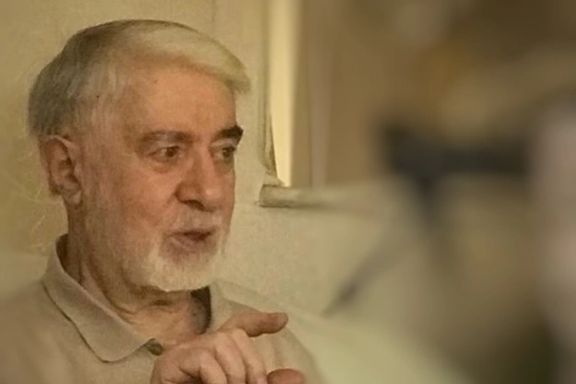
Iranian dissident figure and former prime minister Mir Hossein Mousavi

Iranian dissident figure Mir Hossein Mousavi has warned the nation over the introduction of hereditary leadership, referring to current ruler Ali Khamenei’s son.

Mousavi (Musavi), 81, who has been under house arrest since February 2011, was Iran’s Prime Minister from 1981 to 1989. He was a candidate in the disputed presidential election in 2009 and challenged the results leading large protests for months before he was arrested and put under house arrest without a trial. His wife Zahra Rahnavard and another candidate Mehdi Karroubi suffered a similar fate as all three were accused of “sedition” against the regime.

Although he had a sizable following at the time, support for him was almost non-existent during several waves of nationwide protests since December 2017.

In a statement released by Kaleme website, Mousavi referred to rumors about Khamenei’s son being groomed to succeed his father, and said, “Have the 2500-year-old monarchies returned to power that we are talking about Khamenei’s son’s succession?”

Rumors about Mojtaba Khamenei’s ambitions have been circulating in Iran since 2005 when he was first accused of rigging the presidential election in a bid to bring like-minded politicians to power. No official statement has ever been made by Mojtaba or others at Khamenei’s office about the idea of his succession. However, Mousavi asked: “Why they do not deny the rumors if they are not thinking of Mojtaba’s rise to the throne?”

Mojtaba Khamenei (R) with former IRGC commander Qasem Soleimani. Undated
100%
Mojtaba Khamenei (R) with former IRGC commander Qasem Soleimani. Undated

During the past years there have also been rumors about Mojtaba’s involvement in financial corruption cases involving the IRGC. The rumors also charged that he supervised the IRGC intelligence when Hossein Ta’eb, who was recently fired by Khamenei, headed the organization.

Former state television chief Mohammad Sarafraz wrote in his memoires extensively about Mojtaba’s and Ta’eb’s involvement in financial corruption. Mojtaba is a stealthy figure who is hardly seen in any high-profile political gathering. Nonetheless, he is believed to be Khamenei’s most influential offspring.

Meanwhile, Mousavi criticized Khamenei for Iran’s intervention in Syria and charged that the Islamic Republic has committed “stigmatic crimes” in the Middle East and has created a tragedy for a nation overwhelmed by poverty, hunger and dictatorship.

Mousavi further accused Khamenei of supporting the oppressive Syrian regime in the name of protecting Islamic sanctities. “The regime has even changed the title of Arab Spring to Islamic Awakening and has made words devoid of meaning,” he said.

Mousavi reminded Khamenei that protesters in recent years have been chanting slogans such as “Leave Syria alone and think of us” and “Neither Gaza nor Lebanon, Long live Iran.” He further warned Khamenei that “It would be a grave mistake to manipulate other nations’ aspirations.”

Many social media users in Iran characterized Mousavi’s statement as “brave”. At the same time many others said Mousavi’s slogan of “Returning to the golden age of Imam Khomeini” only reminds of his silence in the face of Khomeini’s documented order to kill thousands of political prisoners in Iranian jails in 1988.”


Most Viewed

Iran negotiators ordered to return after internal rift over Islamabad talks
1
EXCLUSIVE

Iran negotiators ordered to return after internal rift over Islamabad talks

2
INSIGHT

Iran's digital economy battered by prolonged blackout

3
ANALYSIS

US blockade enters murky phase as tankers spoof signals and buyers hesitate

4
ANALYSIS

Why the $100 billion Hormuz toll revenue is a myth

5

US tightens financial squeeze on Iran, warns banks over oil money flows

Banner
Banner

Spotlight

  • Hardliners push Hormuz ‘red line’ as US blockade tests Iran’s leverage
    INSIGHT

    Hardliners push Hormuz ‘red line’ as US blockade tests Iran’s leverage

  • Ideology may be fading in Iran, but not in Kashmir's ‘Mini Iran'
    INSIGHT

    Ideology may be fading in Iran, but not in Kashmir's ‘Mini Iran'

  • War damage amounts to $3,000 per Iranian, with blockade set to add to losses
    INSIGHT

    War damage amounts to $3,000 per Iranian, with blockade set to add to losses

  • Why the $100 billion Hormuz toll revenue is a myth
    ANALYSIS

    Why the $100 billion Hormuz toll revenue is a myth

  • US blockade targets Iran oil boom amid regional disruption
    ANALYSIS

    US blockade targets Iran oil boom amid regional disruption

  • Iran's digital economy battered by prolonged blackout
    INSIGHT

    Iran's digital economy battered by prolonged blackout

•
•
•

More Stories

With Media In Tehran Under Pressure, Iran International At Top Spot

Aug 9, 2022, 16:55 GMT+1
•
Iran International Newsroom

Foreign based broadcasters dominate the news and information market in Iran, with Iran International TV leading the way, a newspaper in Tehran said Monday.

Shargh Daily, a reformist and relatively independent newspaper in an article urging the government to be more tolerant of media and criticism pointed out that currently four major international broadcasters are the most popular sources of news and information for the people in Iran.

The BBC Persian Service, Iran International, Manoto and the Voice of America are influential the article said, “with Iran International getting ahead by employing anchors and journalists who left Iran and having an impact on public opinion in the country.”

The article, penned by Ghader Bastani and coinciding with Iran’s ‘Journalist Day’ has urged the government to give freedom to media “as the most effective way to fight corruption and improve government efficiency.” Increasing pressures on journalists and the closure of many independent publications have pushed many talented reporters to leave Iran, Shargh has argued. These journalists have gone to work for foreign-based Persian media and have become opponents of the Islamic Republic, it said.

In fact, government media outlets and those controlled by pro-government conservative groups are not considered as reliable sources of news and foreign-based media have stolen the spot, Shargh said, and urged the government to encourage and help “professional journalism.”

Iran International is the newest member of foreign-based Persian broadcasters. It was established in May 2017 and last year an opinion survey conducted among Iranians showed that it has gained the largest percentage of news audience in Iran.

A poll conducted by Gamaan polling agency in the Netherlands in 2021 found Iran International TV (33% audience) and Manoto TV (30%), both based in London, as the most popular media outlets in Iran.

The poll with a representative sample of over 27,000 individuals, 92 percent of those who took part said they get their news and information about Iran and the world from social media, 41% from satellite television stations, 32% from news websites and 14% from the Iranian state television on a daily basis.

Iran has one of the world’s worst media and internet censorships, with tens of thousands of websites blocked since the early 2000s and most social media platforms banned. In the absence of free media and the very high level of censorship, many Iranians turn to social media for political news and information.

Some 60 percent of those contacted by Gamaan said they never watch the news on the Iranian state-run television, the agency said, adding that generalization of the results of the survey to the general public are valid by a 95% coefficient.

Those taking part in the survey were literate Iranians over 19 years of age, representative of 85 percent of the adult population in Iran.

According to the findings of the survey, 33% respondents in the poll said they watch the Iran International TV daily. This makes the network the most popular Persian speaking foreign based news channel in Iran.

Next on the popularity ladder were Manoto TV with 30%, BBC Persian TV with 17%, both London-Based, as well as Jam TV, based in Turkey, with 16.5%, followed by the Iranian state TV at 16 percent, the Washington-based VOA TV also known as PNN with 11 percent popularity.

Reformist Blames Hardliners For An ‘Explosive Situation’ In Iran

Aug 9, 2022, 09:41 GMT+1
•
Iran International Newsroom

A reformist figure in Tehran says some Iranian hardliners are reactionary elements who even do not listen to the advice of Supreme Leader Ali Khamenei.

Gholamreza Ansari said in an interview with the Iranian Labor News Agency (ILNA) that these reactionaries have created a situation in which social crises could explode like grenades at any moment.

He was referring to a serious economic crisis triggered by US sanctions and the failure to reach a nuclear deal that could free Iran of the economic pressure.

Ansari, who has post-graduate degrees both in sciences and social sciences held various government positions during reformist governments and was an ambassador to Turkmenistan.

He argued that the reactionary elements also known as "the concerned groups" entrenched themselves in ultraconservative governments of Presidents Mahmoud Ahmadinejad and Ebrahim Raisi.

One example of these reactionaries, routinely singled out by critics is Iran's Housing Minister Rostam Ghasemi, who during religious mourning events this week suddenly spoke against nuclear talks to restore the Iran nuclear deal. Ghasemi used religious rhetoric to emphasize intransigence rather than compromise.

In an August 7 tweet, Ghasemi likened the United States to Shemr, the man who beheaded the Shiite Imam Hussain in the year 680 AD, while also likening Iran to Imam Hussain. He quoted Supreme Leader Ali Khamenei and President Ebrahim Raisi as having said that the United States is not trustworthy as a partner to any agreement.

Rostam Ghasemi, a hardliner politician and minister of roads and urban development
100%
Rostam Ghasemi, a hardliner politician and minister of roads and urban development

On the previous day, the reformist daily Sharq quoted Ghasemi as having said based on the same analogy: "The Shiites of Hussain will not forget their mission with the Joint Comprehensive Plan of Action (JCPOA)” offered by evil forces.

Subsequently, former Central Bank Governor Abdolnasser Hemmati reminded Ghasemi that he is no longer Iran's oil minister, the post he used to hold under President Ahmadinejad. Other social media users told Ghasemi that as Iran's housing minister he is no position to intervene in the nuclear dossier. Others warned Ghasemi that while the rest of the government is working hard to reach a deal with the United States, he should not speak against an agreement.

In his interview with ILNA, Ansari pointed out that the reactionaries derail government policies with their hollow slogans. This comes while most of the hardliner politicians who belonged to "the concerned group," including ultraconservative lawmaker Javad Karimi Ghoddousi have sometimes paid lip service to a nuclear deal that the hardliners desperately need for lifting US sanctions.

Ansari accused the hardliner group of spreading their hallucinations and superficial ideas about the affairs of the state instead of offering real solutions to the country's problems. At the same time, they try to force others who have a solution out of the political realm.

He said this group which has the upper hand in the current government cannot even solve a problem as simple as providing bread for the nation, charging that lack of coordination among the members of this group and Raisi's economic team has further exacerbated the crisis Iran faces.

"With their wrong policies and lack of coordination those who had promised to solve all of the country's economic problems overnight, and turn Iran into another Japan, have created serious problems and challenges for the nation," Ansari said. He added that "Instead, they have given way to the presence of unqualified individuals in the government and paved the way for corruption, smuggling and offering exclusive concessions to the group's members."

Iranian Lawmakers Want To Limit Prenups For Women

Aug 8, 2022, 22:18 GMT+1

A motion to amend laws regarding payment of ‘mehrieh’ (pre-nups for brides) in Iran has sparked controversy that it could benefit men but be detrimental to women.

The motion signed by fifty lawmakers will likely be given priority in parliament. If turned into law, men will no longer be prosecuted by law for not paying the mehrieh if they do not have the means to pay and their assets cannot be frozen by the court to make them pay.

Mehrieh (affection) is assets (usually gold coins) the husband agrees to give the wife in a prenuptial agreement if they divorce or whenever the wife demands it.

For many Iranian women, this could mean getting a divorce becomes potentially harder as according to Iran's Sharia-based laws of matrimony, only men have the right to divorce. Some women use their mehrieh to encourage their husbands to divorce them by forsaking it altogether instead of demanding payment or by asking for a smaller sum if he agrees to the divorce.

Fatemeh Ghasempour, chairwoman of the Women’s Faction in the parliament, is among the critics of the proposed law. “Prosecution of men [who refuse to abide by their mehrieh pledge] will be impossible if the motion passes,” she said adding that the law would encourage more men to refuse to pay and deprive women of mehrieh as leverage in getting a divorce.

Mehrieh can be in the form of money, property, jewelry, or whatever the bride-to-be demands, even a flower when a future wife wants to make a statement about her love and devotion.

Payment, whether large or small in value, is required by the Sharia law and its amount and form are stated in Iranian marriage certificates.

In Iran mehrieh was traditionally paid in cash or in the form of land or other property, but in the past few decades gold coins issued by the government have become the normal form of mehrieh. The value of the coins naturally fluctuates.

Families negotiate the amount of mehrieh before the wedding, much like lawyers in the West negotiate pre-nups.

The number of coins demanded by the bride’s family often has religious significance. Many brides ask for fourteen coins to represent the 12 Shia imams plus the Prophet and his daughter Fatima. But the number can also be representative of the future bride’s year of birth or any given number such as 100 or 1,000. A woman born in 2001 (1380 in the Persian calendar) may demand 1380 Bahar-e Azadi coins the total value of which amounts to over $660,000 in the Iranian market now.

If the parliamentary motion passes, the state will also charge a tax, payable by both sides, at the time of registration of the marriage depending on the value of the pledged gift. The mehrieh tax is meant to lower the astronomically high mehrieh many women and their families demand from grooms these days.

It is not clear if the motive behind the new law is to make marriage easier. After all, the parliament is dominated by hardliners loyal to Supreme Leader Ali Khamenei who has repeatedly called for Iran’s population to increase to 150 million.

Mehrieh debts have landed thousands of men who refused to pay in jail over the years, both before and after divorce. Based on current laws, courts will make men pay in monthly installments if they claim they cannot pay the total all in one go.

Iran’s Nuclear Negotiators Attend Religious Mourning Ceremony In Vienna

Aug 7, 2022, 12:34 GMT+1

Members of Iran’s negotiating team who are in the Austrian capital for a last-ditch efforts to revive the 2015 nuclear deal have attended a Shiite religious mourning ceremony in Vienna.

The twitter account of the Islamic Republic’s embassy in Austria published photos of Tehran’s lead negotiator Ali Bagheri-Kani at the mourning ceremonies of the Islamic month of Muharram. The event was held at Vienna’s Islamic center of Imam Ali, a Shiite mosque. 

The highlight of the month-long ceremonies of Muharram are the Days of Tasu'a and Ashura, the anniversary of the slaying of Shiite Imam Hussein and his 72 companions by his rivals to the leadership of Muslims. Ceremonies have been held for centuries in Iran and among Shiites in other countries, marking the event in the 680 AD battle of Karbala, in present-day Iraq, and have gained greater state support since the 1979 Islamic Revolution.

100%

This round of the Vienna talks reportedly focus on a text circulated in late July by Josep Borrell, the European Union foreign policy chief, to bridge gaps between the United States and Iran over how the Joint Comprehensive Plan of Action -- or JCPOA -- can be revived. It is unclear how specific are proposals in Borrell’s text and how far he outlines a process.

European officials have presented a tough face to reporters gathered outside the Palais Coburg hotel in Vienna, insisting that the current talks will not be “reopening” negotiations, and urging Tehran not to make “unrealistic demands.”

Loyal Critics Lash Out At Iran’s Raisi On His First Anniversary

Aug 7, 2022, 09:08 GMT+1
•
Iran International Newsroom

President Ebrahim Raisi's critics and political allies alike voiced their disappointment over his performance as he started his second year in office this week.

Some, like lawmaker Mansoor-Ali Zarei, representing Sari, were still hopeful about the government's success and promised "good things to happen in the next month or two. "However, knowing how limited the government’s capabilities and options are, he said, "If this is not accomplished, we will increase our supervision over the administration."

Others, such as member of parliament (Majles) Rahmatollah Norouzi were so disappointed that said: "The Majles is planning to reduce its cooperation with the government," adding that "The Majles is planning to impeach several of Raisi's cabinet ministers."

Most of the complaints made by both groups were about Raisi and his ministers' broken promises and their inability to solve the country's economic problems. Meanwhile, the spokesman for the parliament's Economic Committee Gholamreza Marhab reiterated that US sanctions on Iran are unprecedented in modern history, and the government should try to improve its performance to compensate for the damage.

While acknowledging that the deadlock over the revival of the 2015 nuclear agreement was a major obstacle to this, like most Iranian politicians, he repeated the formulaic rhetoric that the country's economy should not be tied to the problems resulting from the nuclear issue.

Criticism of Raisi and his cabinet began a few weeks after he assumed office in August 2021 and gained momentum earlier this year, but confidence of even his supporters was shaken when a decision by the government in early May led to a sudden jump in food prices.

Iranian lawmaker Mansoor-Ali Zarei
100%
Iranian lawmaker Mansoor-Ali Zarei

Raisi decided to eliminate a key subsidy for food imports, and this led to an across-the-board jump in prices.

An infographic published by Etemad Online website on August 6 indicated that the price of cooking oil has increased by 367 percent in the past year, rice by 200 percent, yogurt by 185 percent, pasta by 168 percent, cheese by 133 percent, butter by 120 percent, eggs by 114 percent, sugar by 102 percent, poultry by 101 percent.

Meanwhile the Tehran Chamber of commerce announced in a new report that meat and rice consumption in Iran has dropped dramatically during the same period.

MP Zarei said it is a shame that Iran has so many economic problems while it owns seven percent of the world's resources and has only one percent of the world population. He added that despite all the economic problems, the members of Raisi's economic team have still not learned to speak in one voice after one year in office.

Norouzi, the lawmaker for Golestan Province also criticized the government for giving a 10 percent pay rise to a small part of workers in Iran while the overall inflation rate in the country is more than 50 percent.

He said, "the Majles has serious criticism of the government's one-year performance, and we expect Raisi to work hard to improve the nation's livelihood."

He added that Iranians are in a very difficult situation and government ministers need to come up with practical plans to solve their problems. He pointed out that costs of housing, meat, dairy products, rice and all other essential commodities have risen dramatically during the one year Raisi and his colleagues were in office.

Norouzi warned that the Majles should put an end to its hesitations and take strict measures against the government if it fails to deliver.