• العربية
  • فارسی
Brand
  • Iran Insight
  • Politics
  • Economy
  • Analysis
  • Special Report
  • Opinion
  • Podcast
  • Iran Insight
  • Politics
  • Economy
  • Analysis
  • Special Report
  • Opinion
  • Podcast
  • Theme
  • Language
    • العربية
    • فارسی
  • Iran Insight
  • Politics
  • Economy
  • Analysis
  • Special Report
  • Opinion
  • Podcast
All rights reserved for Volant Media UK Limited
volant media logo

Regime Insider Warns Of 'Bloody Confrontations’ In Iran
Iran International Newsroom
Nov 7, 2022, 09:06 GMT+0Updated: 17:54 GMT+1
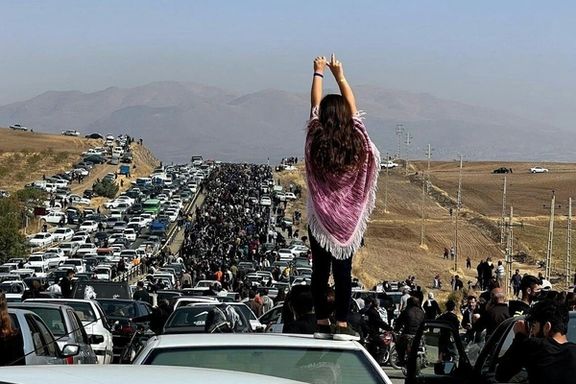
Protest in the Kurdish city of Saqqez on October 26, 2022

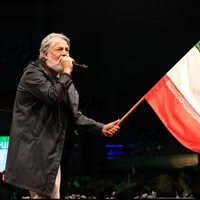
Former government spokesman Ali Rabiei has warned that there might be "bloody confrontations" ahead as Iran's nationwide uprising rages on for seven weeks.

Rabiei, a long-time member of the Islamic Republic's intelligence community, wrote in a commentary in the reformist Etemad newspaper that some officials and political groups have marginalized "moderates" to facilitate Iran's destruction by those who keep creating fault-lines in the Iranian society.

Already, security forces have killed more than 300 protesters according to human rights monitoring groups, among than more than 40 children.

He argued that some "are exerting maximum pressure to disrupt the efforts of mediators between the government and the protesters. He said that there has been a security approach in the government aimed at systematically weakening the civil society and influential reference groups.

Rabiei was obviously referring to Iranian hardliners who attempt to get rid of all their political rivals and to monopolize power within Iran's ultraconservatives. Rabiei pointed out: "The political participation of various political groups and parties was extremely limited in two consecutive elections. As a result, the ballot box lost its function of creating mediators who played as go-betweens among various generations and their demands."

The former government spokesman, an experienced operator, was referring to the elimination of so-called ‘reformists’ from centers of power in the last two years. Since late 1990s the ‘reformists’ were urging rational and relatively moderate policies by the regime, but were gradually pushed aside by hardliners enjoying the support of the Revolutionary Guard and Supreme Leader Ali Khamenei.

Former government spokesman, Ali Rabiei
100%
Former government spokesman, Ali Rabiei

Rabiei said that the government refused to pay attention to warnings about the Iranian society's vulnerabilities. He warned that throughout the course of history the absence of mediation between the government and the people has brought the two face to face in bloody loggerheads. He warned that without the moderates, there will be no way for even minimal understanding between the government and the masses.

Meanwhile, he also pointed out the dangerous situation resulting from the weakening of national media. In series of tweets, reformist commentator Ahmad Zeidabadi also noted the perils of Iranian media losing their role as the point of reference for the nation.

Zeidabadi wrote that Iranian officials have failed to understand that they have lost the "media war" to foreign-based Persian speaking media. He pointed out that Iranians find the state television reliable only when it tells the time. Otherwise, the state TV has said so many lies that its viewers cannot believe anything broadcast as news. Viewers will not believe the state TV even when it makes a point that is absolutely true, said Zeidabadi.

Meanwhile, understanding the need to change this situation, some Iranian officials speak of need for a change. Majles Speaker Mohammad Bagher Ghalibaf has said: "I hope security will be completely restored in the country soon, so that legitimate and necessary changes would begin to establish a new kind of governance in economic, social and political areas within the frameworks of the Islamic Republic." Social media users reminded him that only two weeks agio, he publicly and officially called for harsher measures against the protesters. They told him that the government should first change its behavior if it wants to reduce tensions.

This comes while Rahim Mohammadi, the representative of the Iranian Sociological Association has acknowledged in a speech at the Tehran Bar Association that the current protest ‘movement’ has become a household word and future change in governance will be unavoidable..

He said "The right to protest, non-violent struggle, and holding dialogue for public good" are some of the essential parts of this movement. He said its other characteristic is that Iranians are talking about their common dreams. Mohammadi added that old forms of government in Iran are outdated, and Iranians are currently looking for a new form of government based on their rights, their freedom, and their aspirations.


Most Viewed

Iran negotiators ordered to return after internal rift over Islamabad talks
1
EXCLUSIVE

Iran negotiators ordered to return after internal rift over Islamabad talks

2
ANALYSIS

US blockade enters murky phase as tankers spoof signals and buyers hesitate

3
ANALYSIS

Why the $100 billion Hormuz toll revenue is a myth

4

US tightens financial squeeze on Iran, warns banks over oil money flows

5
ANALYSIS

US blockade targets Iran oil boom amid regional disruption

Banner
Banner

Spotlight

  • Hardliners push Hormuz ‘red line’ as US blockade tests Iran’s leverage
    INSIGHT

    Hardliners push Hormuz ‘red line’ as US blockade tests Iran’s leverage

  • Ideology may be fading in Iran, but not in Kashmir's ‘Mini Iran'
    INSIGHT

    Ideology may be fading in Iran, but not in Kashmir's ‘Mini Iran'

  • War damage amounts to $3,000 per Iranian, with blockade set to add to losses
    INSIGHT

    War damage amounts to $3,000 per Iranian, with blockade set to add to losses

  • Why the $100 billion Hormuz toll revenue is a myth
    ANALYSIS

    Why the $100 billion Hormuz toll revenue is a myth

  • US blockade targets Iran oil boom amid regional disruption
    ANALYSIS

    US blockade targets Iran oil boom amid regional disruption

  • Iran's digital economy battered by prolonged blackout
    INSIGHT

    Iran's digital economy battered by prolonged blackout

•
•
•

More Stories

Tehran Residents Hold Protests Backing Kurdish, Baluch Cities

Nov 6, 2022, 22:38 GMT+0

The nationwide antigovernment protests in Iran continued Sunday with intense clashes in the Kurdish-majority city of Marivan following the death of another young Kurdish woman. 

Following the funeral service for Nasrin Ghaderi -- a PhD candidate in philosophy who died on Saturday after being beaten by security forces with batons during Friday protests in Tehran -- the outraged citizens in the city of Marivan held rallies and chanted slogans against the Islamic Republic’s ruler, Ali Khamenei. Kurdish cities in western Iran have been a hotbed of anti-government protests after Mahsa Amini, who was also Kurdish, was killed by police in mid-September.

Nasrin Ghaderi (file photo)
100%
Nasrin Ghaderi

Until well into the night, the streets of Marivan were scenes of clashes while continuously shots were heard in videos posted on social media, while protesters set fire to tires and city trash cans as their only weapon against government forces. In some videos, people are also seen hurling stones at the city hall. 

People in other Kurdish cities, such as Kermanshah and Sanandaj, were also out in the streets, chanting antigovernment slogans. 

Other cities throughout the country, from the northeastern cities of Mashhad and Sabzevar to the southwestern city of Ahvaz as well as the central city of Esfahan (Isfahan) and capital Tehran were also scenes of protest rallies or clashes between people and security forces. 

In one video from Ahvaz, a young man is seen setting fire to a base of Basij paramilitary forces and fleeing while waving the victory sign. 

Fars news agency, affiliated with Iran’s Revolutionary Guard, said earlier in the day that the IRGC’s Intelligence Organization had identified and dismantled “a terrorist team” backed by a European country in Ahvaz, the capital of the southwestern oil-rich Khuzestan Province.

People in many neighborhoods of the capital also held protest rallies, chanting slogans such as “This is the year of blood, When Seyyed Ali will be gone” and “Death to dictator,” referring to Supreme Leader Ali Khamenei. In a video, people are seen saving one protester from agents who want to arrest him. 

People in Tehran also expressed support for the citizens of Kurdish cities as well as the southeastern province of Sistan and Baluchestan after at least 16 people were killed by security forces on November 4. The provincial capital Zahedan is the city where the bloodiest crackdowns have been taking place since the start of the current wave of protests with security forces frequently using assault rifles to quash the rallies. 

According to Tasnim news, a media outlet with links to the IRGC, protesters in Khash, another city in the province with a high number of casualties – most of them children – fought back with guns and killed a regime agent. 

Sistan and Baluchestan is a Sunni-majority province in predominantly Shiite Iran. Zahedan, close to Iran's southeastern border with Pakistan and Afghanistan, is home to a Baluch people estimated to number up to two million. They have faced discrimination and repression for decades, according to human rights groups.

Schoolgirls during the protests in Zahedan (November 6, 2022)
100%
Schoolgirls during the protests in Zahedan

Molavi Abdolhamid, the religious leader of Iran’s Sunni Baluch population, called for an internationally monitored referendum on Friday, saying by killing and suppression the government cannot push back a nation. Earlier in October he blamed Iran's ruler Ali Khamenei for the Bloody Friday killings September 30 and called for accountability.

The Islamic Republic has killed over 300 including 41 children and 24 women since then during protests. 

Concurrent with the protests on the streets, students at many universities also held protests on Sunday while strikes take place in dozens of industrial centers across the country.


Islamic Republic Suffered Blow From Protests - Official

Nov 6, 2022, 20:48 GMT+0

A top aide to Supreme Leader Ali Khamenei says the Islamic Republic’s establishment is still undefeated but it has received a blow from the protest movement.

Rasool Sanaei-Rad said during a TV program Saturday that “We must accept the differences and open a space for dialogue through free-thinking platforms… but in the first step, our actions must be aimed at suppressing riots.”

He divided the opposition into “domestic” and “foreign” saying the establishment must have self-restraint dealing with those opponents not serving foreign interests.

He also added that the Islamic Republic is “flexible” against the domestic opposition because they are like “our children”.

“Today, we are dealing with a multi-dimensional and multi-layered social phenomenon... we have overlooked excessive use of cyberspace by young people and teenagers during the COVID pandemic” claimed the deputy of the Political Ideological Bureau of the Commander-in-Chief.

The Political Ideology Bureau is part of Khamenei's extensive office, and responsible for “policy-making, coordination, inspection and supervision of the affairs and duties of the representative of the Supreme Leader in the Iranian Armed Forces.” The head of the Bureau, appointed by the Supreme Leader, is currently a mid-ranking cleric, Ali Saeedi, Khamenei's former representative in the Islamic Revolution Guards Corps.

Sanaei-Rad’s claim about “self-restraint and flexibility” is made while the Oslo-based Iran Human Rights Organization has reported that at least 304 people, including 41 children and 24 women, have been killed by government forces during the last 50 days of protests.

Student Protest Movement In Iran Shows Defeat Of Regime Ideology

Nov 6, 2022, 20:28 GMT+0
•
Iran International Newsroom

An expert says antigovernment protests and strikes at Iran’s universities and schools show the regime's failure to instill its ideology in over four decades.

Azadeh Davachi, a researcher at, in an interview with Iran International November 6 said acts of protest and slogans by students since September have refuted the ideology the Islamic Republic attempted to teach youngsters throughout 43 years of its existence.

“What the Islamic Republic wanted to inculcate in students’ minds through the schoolbooks have resulted exactly in the opposite. Students remove headscarves and tear down the photos of regime leaders in classrooms. Despite so much crackdown and threats, girls enter school without hijab, chant slogans, record it using cell phones and publish the videos on social media. This means a heavy defeat of the Islamic Republic’s ideology,” underlined the pundit.

Schoolchildren in Iran kept up with daily protests on Sunday chanting slogans and staging strikes to show anger at government crackdown against older protesters.

University students insist they will go to campuses despite all the restrictions imposed but will stage strikes there and not attend classes.

Students at almost all universities in Tehran as well as in some other cities have called for sit-ins and strikes demanding the immediate release of their peers detained earlier.

Security forces have beefed up measures in recent days at campuses to search students when they enter and take away their mobile phones not to let them record videos.

Protest at Tehran Sciences University on October 25, 2022
100%
Protest at Tehran Sciences University on October 25

Many students have been arrested since the beginning of anti-regime protests in September. Some are kidnapped by security forces, and often nobody knows their whereabout for days.

In an appalling move, Tehran University of Arts has announced that all drama graduate students will be suspended and cannot take the final exams.

However, students emphasize that they will not stop their strikes until their demands are met. Several professors have also announced that they will refuse to teach until the dismissal of students is canceled and they return to classes.

Davachi believes that the perseverance of students in holding strikes and protests 50 days into the nationwide demonstrations is of great significance, as social and civic movements in Iran have always depended on student movements.

This researcher at Deakin University of Melbourne told Iran International that an important factor differentiating this movement with previous ones is that the slogans are more radical at universities and schools.

“Student actions can strengthen other civic movements and reinforce the popular protest movement. Students’ slogans this time is very similar to those of people on the streets. Therefore, students and older protesters are somehow supporting each other,” added Davachi.

She went on to say that the demands made by students is what the youths want as they are a large group among Iran’s population.

She further noted that the clerical rulers assumed they have raised a new generation at schools who are very committed to their values, but the recent events at universities and schools proved exactly the contrary.

Women play a very significant role in the protest movement, she reiterated, saying “if the uprising of the nation against the regime proves victorious, women will not let their demands be marginalized like in the 1979 revolution and they will play a very crucial role in a free Iran.”

Hardliners Blame Iran's Top Security Man For Not Crushing Protests

Nov 6, 2022, 17:36 GMT+0
•
Maryam Sinaiee

Hardliners are blaming the secretary of Iran's Supreme National Security Council (SNSC) Ali Shamkhani for failure to suppress protests and demanding his removal.

In video-taped remarks released on the internet Sunday, former lawmaker Hamid Rasaei, a hardliner cleric, claimed all security bodies he has spoken to “point in the direction of the secretary of the Supreme National Security Council” as the culprit when it comes to failure in suppressing the protests.

Rasaei also accused President Ebrahim Raisi of not taking timely action and constantly postponing Shamkhani’s replacement.

Shamkhani has kept a very low profile since the protests began. There were rumors among the political elite in Tehran that Major General Mohammad Bagheri, chief of staff of the Armed Forces, would soon replace Shamkhani as the Secretary of the SNSC, an informed source told us recently.

The demand for Shamkhani’s removal from office may be an indication of serious incongruities among the Islamic Republic’s many intelligence and security bodies vis-à-vis protesters.

So far, the IRGC has not resorted to large scale operations against protesters as it did in November 2019 when it immediately used lethal military force, killing at least 1,500 and arresting thousands within a few days.

This time the IRGC has only deployed its plainclothes agents in the field, leaving the official handling of the protests to the police and its special forces. There has also been less use of assault rifles against protesters, but shotguns and beatings have claimed the lives of at least 318 so far according to Human Rights Activists News Agency (HRANA).

Hamid Rasaei, a hardliner cleric and politician
100%
Hamid Rasaei, a hardliner cleric and politician

The protests should have ended after Commander of the Revolutionary Guards (IRGC) Major General Hossein Salami’s warning last week that demonstrators should cease and desist, Rasaei insisted in his remarks.

In his speech on October 29 Salami had accused the US, Israel, and European powers of fomenting unrest in Iran. “Stay away from the streets,” he told the Iranians in a threating tone.

Rasaei demanded that the incumbent Secretary of the SNSC and former President Hassan Rouhani who appointed him to the post in 2013 be held to account for the “current circumstances”. He also criticized Shamkhani for his “inefficacy” in suppressing the November 2019 protests in an optimal manner and demanded accountability about allegations of financial corruption against him and his family members.

The secretary of the SNSC is appointed by the president with the consent and express approval of Supreme Leader Ali Khamenei, who also appoints the SNSC secretary as his own representative in the council. Shamkhani has held both positions since 2013.

“Tolerance and dallying are enough,” lawmaker Hossein Jalali told the SNSC and security bodies in a speech in the parliament Sunday where some other ultra-hardliner lawmakers blasted Shamkhani and other security and judicial bodies for indecisiveness. They also demanded that some protesters to receive the death penalty.

Jalali also referred to Molavi Abdolhamid, the leader of Sunni Baluch community, in his speech and alleged that Shamkhani has failed to act against him because “he has given priority” to his “friendship” with former reformist President Mohammad Khatami.

“Preserving the regime is the highest priority, even more important than preserving the life of the 12th Imam of Shiites who is believed to be in occultation,” he told Shamkhani. Many can consider this remark as religious sacrilege since the hidden Imam is supposed to be represent the continuation of Prophet Mohammad’s rule.

Shamkhani, an admiral of the Navy, served as defense minister in Khatami’s first cabinet (1997-2001). Despite having run against the president in the 2001 elections, Khatami reinstated him in his second cabinet, but their relations soured considerably.

Iranian Lawmakers Urge Judiciary To Sentence Protesters To Death

Nov 6, 2022, 15:10 GMT+0
•
Iran International Newsroom

A group of 227 parliament members in Iran has called on the Judiciary to issue death sentences for people arrested during the ongoing antigovernment protests.

The parliament, elected in a non-competitive election in February 2020, is packed with hardliners and Revolutionary Guard officers.

In a statement that was read out in the parliament on Sunday, the lawmakers called the protesters ‘mohareb’ -- which literally means warrior in Arabic, but in Islamic law or sharia it means ‘enemy of God’ that carries the death penalty. They also compared the protesters to members of ISIS, who "attack people's lives and property..."

The Iranian regime has so far charged several people with ‘moharebeh,’ “corruption on earth,” “assembly and collusion against national security” and “confrontation with the Islamic Republic” for participating in the protests.

Describing the current wave of popular protests as “riots,” the MPs claimed that “the US and other enemies” are inciting violence, organizing rallies, and providing financial support and weaponry to commandeer the protests. They also said “thugs and mobs” have killed tens of people and disrupted the security of the country.

Echoing the Islamic Republic’s propaganda line, the lawmakers said that “the enemies have been defeated in Iraq, Syria, Palestine, Lebanon and Yemen” therefore they organized the “riots” as a reaction to “victories of the Islamic Republic.”

Without mentioning any individuals or groups, the hardline lawmakers also asked the judiciary to take legal actions against “the politicians who incited the rioters.”

Mohammd Bagher Ghalibaf, parliament speaker in an undated phot with IRGC's Qasem Soleimani
100%
Mohammd Bagher Ghalibaf, parliament speaker in an undated phot with IRGC's Qasem Soleimani

Earlier in the parliament session, Speaker Mohammad Bagher Ghalibaf (Qalibaf) said that main elements of Mossad, CIA and their allied groups are behind the unrest in the country.

Late in October, hardliner MP Mohammad Esmail Kowsari, also a high ranking IRGC officer, implicitly threatened that the government will respond differently to the ongoing protests from now on.

While protests continue across Iran, the Islamic Republic’s Judiciary has also announced that it has indicted over 1,000 people who were arrested during the demonstrations.

Authorities have been claiming that “separatists” and “instigators” are behind the efforts to overthrow the government and break Iran into areas controlled by ethnic groups, a claim routinely denied by Iranians on streets and social media.

The claim that protests are instigated by foreign enemies was first made by Supreme Leader Ali Khamenei and loyal officials now repeat his conspiracy theory.

President Ebrahim Raisi on October 25 accused “enemies of the Islamic Republic” of fomenting the protests, echoing what Khamenei said a day earlier. Parliament Speaker Mohammad-Bagher Ghalibaf in turn vowed that parliament would take action to change the ways of the morality police in a bid to calm the protesters.

“Death sentences against people for exercising their right to freedom of expression, after the killings of peaceful protesters, abductions and gunning down children, and other atrocities, indicate a government that is out of control and willing to quash protests at any cost,” said a statement by Center for Human Rights in Iran.

The Norway-based human rights organization also expressed concern regarding the fate of the detained protesters saying, “dozens of them have been charged with the security-related charges of ‘moharebeh’ and ‘corruption on earth’ which carry the death penalty.”

The Islamic Republic’s history and current evidence indicate that they intend to use the death penalty as a tool of political repression to intimidate their opposition.

Earlier in November, 40 Iranian lawyers issued a statement saying most people no longer want the Islamic Republic and called on their peers to speak up and defend the people.

Iran has been gripped by protests since the death in custody of Mahsa Amini, a 22-year-old Iranian of Kurdish origin who had been arrested on September 13 for allegedly breaching the Islamic dress code and died three days later from severe head trauma. Protests spread fueled by public outrage over a crackdown that led to the deaths of other young men, women, and children. Now in their seventh week, the protests show no sign of ending.