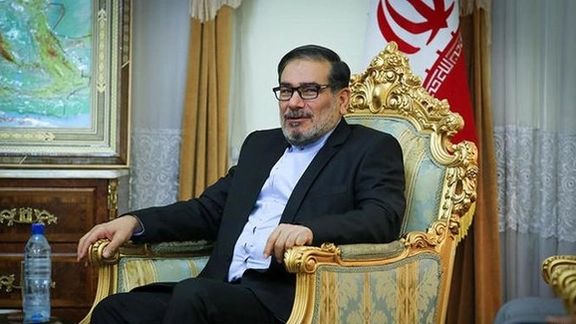
Supreme National Security Council Secretary Ali Shamkhani
Hardliners are blaming the secretary of Iran's Supreme National Security Council (SNSC) Ali Shamkhani for failure to suppress protests and demanding his removal.
In video-taped remarks released on the internet Sunday, former lawmaker Hamid Rasaei, a hardliner cleric, claimed all security bodies he has spoken to “point in the direction of the secretary of the Supreme National Security Council” as the culprit when it comes to failure in suppressing the protests.
Rasaei also accused President Ebrahim Raisi of not taking timely action and constantly postponing Shamkhani’s replacement.
Shamkhani has kept a very low profile since the protests began. There were rumors among the political elite in Tehran that Major General Mohammad Bagheri, chief of staff of the Armed Forces, would soon replace Shamkhani as the Secretary of the SNSC, an informed source told us recently.
The demand for Shamkhani’s removal from office may be an indication of serious incongruities among the Islamic Republic’s many intelligence and security bodies vis-à-vis protesters.
So far, the IRGC has not resorted to large scale operations against protesters as it did in November 2019 when it immediately used lethal military force, killing at least 1,500 and arresting thousands within a few days.
This time the IRGC has only deployed its plainclothes agents in the field, leaving the official handling of the protests to the police and its special forces. There has also been less use of assault rifles against protesters, but shotguns and beatings have claimed the lives of at least 318 so far according to Human Rights Activists News Agency (HRANA).
Hamid Rasaei, a hardliner cleric and politician
The protests should have ended after Commander of the Revolutionary Guards (IRGC) Major General Hossein Salami’s warning last weekthat demonstrators should cease and desist, Rasaei insisted in his remarks.
In his speech on October 29 Salami had accused the US, Israel, and European powers of fomenting unrest in Iran. “Stay away from the streets,” he told the Iranians in a threating tone.
Rasaei demanded that the incumbent Secretary of the SNSC and former President Hassan Rouhani who appointed him to the post in 2013 be held to account for the “current circumstances”. He also criticized Shamkhani for his “inefficacy” in suppressing the November 2019 protests in an optimal manner and demanded accountability about allegations of financial corruption against him and his family members.
The secretary of the SNSC is appointed by the president with the consent and express approval of Supreme Leader Ali Khamenei, who also appoints the SNSC secretary as his own representative in the council. Shamkhani has held both positions since 2013.
“Tolerance and dallying are enough,” lawmaker Hossein Jalali told the SNSC and security bodies in a speech in the parliament Sunday where some other ultra-hardliner lawmakers blasted Shamkhani and other security and judicial bodies for indecisiveness. They also demanded that some protesters to receive the death penalty.
Jalali also referred to Molavi Abdolhamid, the leader of Sunni Baluch community, in his speech and alleged that Shamkhani has failed to act against him because “he has given priority” to his “friendship” with former reformist President Mohammad Khatami.
“Preserving the regime is the highest priority, even more important than preserving the life of the 12th Imam of Shiites who is believed to be in occultation,” he told Shamkhani. Many can consider this remark as religious sacrilege since the hidden Imam is supposed to be represent the continuation of Prophet Mohammad’s rule.
Shamkhani, an admiral of the Navy, served as defense minister in Khatami’s first cabinet (1997-2001). Despite having run against the president in the 2001 elections, Khatami reinstated him in his second cabinet, but their relations soured considerably.
Hardliners pack Iran's parliament, many officers of the IRGC. July 12, 2020
A group of 227 parliament members in Iran has called on the Judiciary to issue death sentences for people arrested during the ongoing antigovernment protests.
The parliament, elected in a non-competitive election in February 2020, is packed with hardliners and Revolutionary Guard officers.
In a statement that was read out in the parliament on Sunday, the lawmakers called the protesters ‘mohareb’ -- which literally means warrior in Arabic, but in Islamic law or sharia it means ‘enemy of God’ that carries the death penalty. They also compared the protesters to members of ISIS, who "attack people's lives and property..."
The Iranian regime has so far charged several people with ‘moharebeh,’ “corruption on earth,” “assembly and collusion against national security” and “confrontation with the Islamic Republic” for participating in the protests.
Describing the current wave of popular protests as “riots,” the MPs claimed that “the US and other enemies” are inciting violence, organizing rallies, and providing financial support and weaponry to commandeer the protests. They also said “thugs and mobs” have killed tens of people and disrupted the security of the country.
Echoing the Islamic Republic’s propaganda line, the lawmakers said that “the enemies have been defeated in Iraq, Syria, Palestine, Lebanon and Yemen” therefore they organized the “riots” as a reaction to “victories of the Islamic Republic.”
Without mentioning any individuals or groups, the hardline lawmakers also asked the judiciary to take legal actions against “the politicians who incited the rioters.”
Mohammd Bagher Ghalibaf, parliament speaker in an undated phot with IRGC's Qasem Soleimani
Earlier in the parliament session, Speaker Mohammad Bagher Ghalibaf (Qalibaf) said that main elements of Mossad, CIA and their allied groups are behind the unrest in the country.
Late in October, hardliner MP Mohammad Esmail Kowsari, also a high ranking IRGC officer, implicitly threatened that the government will respond differentlyto the ongoing protests from now on.
While protests continue across Iran, the Islamic Republic’s Judiciary has also announced that it has indicted over 1,000 people who were arrested during the demonstrations.
Authorities have been claiming that “separatists” and “instigators” are behind the efforts to overthrow the government and break Iran into areas controlled by ethnic groups, a claim routinely denied by Iranians on streets and social media.
President Ebrahim Raisi on October 25 accused “enemies of the Islamic Republic” of fomenting the protests, echoing what Khamenei said a day earlier. Parliament Speaker Mohammad-Bagher Ghalibaf in turn vowed that parliament would take action to change the ways of the morality police in a bid to calm the protesters.
“Death sentences against people for exercising their right to freedom of expression, after the killings of peaceful protesters, abductions and gunning down children, and other atrocities, indicate a government that is out of control and willing to quash protests at any cost,” said a statement by Center for Human Rights in Iran.
The Norway-based human rights organization also expressed concern regarding the fate of the detained protesters saying, “dozens of them have been charged with the security-related charges of ‘moharebeh’ and ‘corruption on earth’ which carry the death penalty.”
The Islamic Republic’s history and current evidence indicate that they intend to use the death penalty as a tool of political repression to intimidate their opposition.
Earlier in November, 40 Iranian lawyers issued a statement saying most people no longer want the Islamic Republicand called on their peers to speak up and defend the people.
Iran has been gripped by protests since the death in custody of Mahsa Amini, a 22-year-old Iranian of Kurdish origin who had been arrested on September 13 for allegedly breaching the Islamic dress code and died three days later from severe head trauma. Protests spread fueled by public outrage over a crackdown that led to the deaths of other young men, women, and children. Now in their seventh week, the protests show no sign of ending.
Outraged by the killing of a Kurdish female university student, the people of the western city of Marivan have poured into streets chanting “Death to Khamenei.”
Iranian Ph.D. candidate Nasrin Ghaderi, 35, who was studying philosophy in Tehran died on Saturday after being beaten by security forces with baton during Friday protests.
Under the regime's pressure, however, her father announced she died of flu and an underlying disease.
Videos on social media show Nasrin's body has been laid to rest in the city of Marivan in western Iran amid tight security both at the cemetery and the victim’s family home.
Iran's official news agency IRNA has dismissed media reports that Nasrin was killed with baton strikes, saying she was "spending her normal life" when her family suddenly lost touch with her, and once their son-in-law broke into her place of residence in Tehran, they found her dead.
Reports received by Iran International say gunshots were heard in Marivan and clashes were underway between protesters and security forces in several districts of the city.
Kurdish cities in western Iran have been the center of anti-government protests after Mahsa Amini, who was a Kurdish girl, was killed by police in custody in mid-September.
The Islamic Republic has killed over 300 including 41 children and 24 women since then during protests to say that Mahsa Amini has not been killed by police.
Germany and eight other EU member states plan to impose a new set of sanctions on individuals and organizations helping the Islamic Republic in its crackdown on dissent.
Accordingto a reportby German magazine Der Spiegel on Saturday, a package containing 31 proposals was introduced in Brussels on November 2, targeting individuals and institutions in the security sector as well as companies responsible for suppression of the current wave of protests, ignited by the death in custody of 22-year-old Mahsa Amini.
Measures include the freezing of assets and travel bans, the magazine said without disclosing its sources, adding that the new punitive measures have a good chance of being approved by EU foreign ministers at their upcoming meeting slated for November 14.
Ties between the Islamic Republic and the West are increasingly strained with Germany being among the first that started evacuating the families of the personnel of its embassy in Tehran and the teachers of German-run schools.
Germany's government on Thursday urged its citizens to leave the country or risk arbitrary arrest and long prison terms there.
Late in October, German Foreign Minister Annalena Baerbock saidthat her country and the European Union were examining whether to classify Iran’s Revolutionary Guard as a terrorist organization for its use of violence in the protests.
In mid-October, the EU sanctioned eleven Iranian individuals and four organizations for their role in the death of Mahsa Amini and the crackdown on the ongoing protests. These are the first and so far only EU sanctions over the ongoing protests.
Medical doctors protesting in Tehran on October 26, 2022
Several senior members of the Iranian American Medical Association have announced their resignation over the IAMA's refusal to support antigovernment protests.
In a letter obtained by Iran International, the group criticized the IAMA’s Board of Trustees and the Board of Directors for their lack of action in support of the Iranian protesters, on the pretext that the IAMA must remain 'apolitical'. The five signatories all are past or former officers of IAMA’s leadership.
The doctors argued that “defending basic human rights, social justice or public health issues are not political matters,” announcing their decision to disassociate themselves from the “dominating leadership” of IAMA.
"In recent turmoil in Iran where people are fighting for their basic human rights, and our medical and dentist colleagues in Iran are shot at, injured, detained and a few, so far, have lost their lives, we need to show our solidarity as a medical community," read the letter.
They said the Association should never be “silent or indifferent” in the face of the Islamic Republic’s human rights violations, particularly pertaining to public health, adding that there is “a strong resistance from a fraction of the Board members, particularly, from the founder” for taking any action. They said the members want to support their fellow physicians in their basic rights to protest in Iran but “the same fraction preferred to look another way.”
“We will start a new Medical and Dental organization, which, beside the scientific activities, humanitarian tasks, it can also give us the freedom and space to stand for human rights activities and social justice anywhere in the world, including the US and Iran, without fear of stigma,” they said, welcoming all healthcare professionals who share their visions to join them. “We must stay united and focus on the issues that our birthland is suffering from right now.”
Doctor Parisa Bahmani killed by security forces in Iran
Referring to the ongoing crackdown on the uprising, ignited by the death in custody of 22-year-old Mahsa Amini, they said “our birthland Iran, needs us, the brave people of Iran need us, the physicians and dentists in Iran need us, so, we must do something and will do our best to help them, to raise their voices inside and outside Iran and show our solidarity with them.”
Late in September, the IAMA issued a statement saying that the association will no longer be silent in the face of appeasement of and association with “this evil regime,” announcing the firing of Dr. Mortazavi.
“We, as IAMA members, like other Iranians all over the world, strongly condemn what has happened to Masa Amini, a young innocent girl as a distinct violation of human rights,” it said at the time.
There are more than 10,000 medical doctors of Iranian origin in the United States.
During a protest rally of doctors in Tehran late in October, at least one surgeon -- Doctor Parisa Bahmani -- was shot in the head and killed by security forces. She was killed during the gathering of doctors in front of Tehran Medical Council, after government forces opened fire on demonstrators.
Up to now, the Islamic Republic has not taken responsibility even for a single death during the demonstrations. Iran’s government either says victims died when they fell off the roofs, committed suicide, had some background disease, or lost their lives in car crashes.
The regime has killed over 304 people, including 41 children and 24 women, during the protests since mid-September. The Oslo-based Human Rights Organization said Saturday that the number of yet-to-be-verified reports of casualties is much more than this.
Iranian rallied in Vancouver and other cities in Canada on November 5, 2022
Iranians living abroad in solidarity with protesters in Iran once again held antigovernment demonstrations in major world cities.
On Saturday, the diaspora in the United States, Canada, Italy, Germany, France, UK, Australia, and several other countries staged rallies against the Islamic Republic.
In Los Angeles, Iranian expatriates rallied at Beverly Hills City Hall while famous artists and personalities such as Dariush Eqbali, Nazanin Bonyadi, Shohreh Aghdashlo and several political activists gave speeches. Similar rallies were staged in New York and Washington DC.
In the Canadian cities of Vancouver and Toronto thousands expressed solidarity with the uprising of Iranians and called for the release of rapper Toomaj Salehi and other political prisoners.
Toomaj Salehi is an Iranian hip hop artist mostly known for his protest songs about Iran's social issues and injustice by the government. Salehi was arrested on October 30th as part of the crackdown on opponents.
In Sydney, Australia, Iranians gathered in Hyde Park demanding an end to the government of the Islamic Republic. Famous Iranian singer Googooshjoined the crowd saying “Today no Iranian is afraid of this regime and will not forget the massacre of brothers and sisters.”
Similar protests were also held in Vienna, Aukland, Perth, Cologne, Hamburg, Stockholm, Gothenburg, London, Copenhagen, Rome, Bern and Paris.
Demonstrations in support of the protest movement of Iran have been held in more than 150 cities around the world up to now.