• العربية
  • فارسی
Brand
  • Iran Insight
  • Politics
  • Economy
  • Analysis
  • Special Report
  • Opinion
  • Podcast
  • Iran Insight
  • Politics
  • Economy
  • Analysis
  • Special Report
  • Opinion
  • Podcast
  • Theme
  • Language
    • العربية
    • فارسی
  • Iran Insight
  • Politics
  • Economy
  • Analysis
  • Special Report
  • Opinion
  • Podcast
All rights reserved for Volant Media UK Limited
volant media logo

EXCLUSIVE - Iran Reportedly Brings Iraqi Allies To Crack Down On Protests
Iran International Newsroom
Nov 1, 2022, 18:55 GMT+0Updated: 17:40 GMT+1
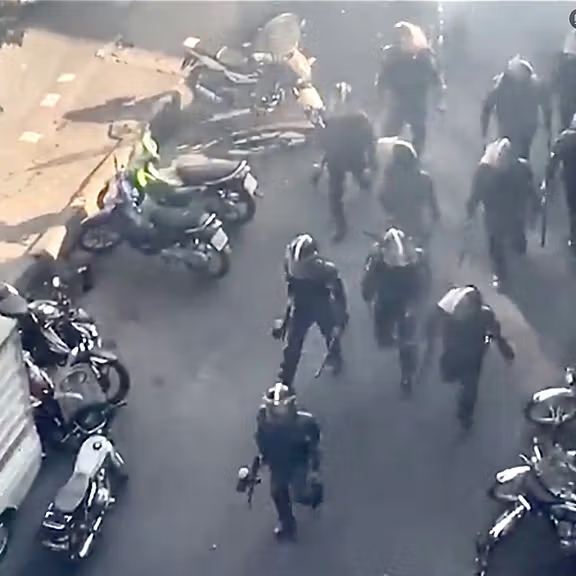
Iranian anti-riot troops in action against protesters in Tehran on October 12, 2022

Iran International has received reports that Iraqi Hashd al-Shaabi and Kata’ib Hezbollah forces have arrived in Iran probably to help suppress protesters.

Hashd al-Shaabi and Kata’ib Hezbollah are radical Iraqi Shiite paramilitary groups which are part of the Popular Mobilization Forces backed by Iran.

According to eyewitness information received by Iran International, 150 people aged between 25 and 30, wearing special uniforms and carrying black bags, flew to Mashhad airport in northeastern Iran from Baghdad airport on Monday.

It is said that a charter flight transferred the special forces from the VIP section of Baghdad airport.

Some say the people were led by two Iranians and no one was allowed to approach their gate (Gate 43).

In the past years, there have been similar reports about deployment of repressive forces to Iran from countries where Iranian proxy militia groups operate, including Lebanon.

Recently, an unverified – and seemingly fake -- document, showing an official Hezbollah letter, was leaked on social media, claiming that Iran-backed Lebanese militant group was sending forces to help the Islamic Republic crackdown on protesters.

The document, allegedly leaked from the office of Hezbollah’s chief Hassan Nasrallah two weeks ago – dated October 14 -- said that personnel from unit 133 and unit 910 (special foreign operations) are being prepared to be deployed to defend the Islamic regime. The total number of these forces is 9,500 people.

According to a report by the Jerusalem Post in October, plainclothesmen with Lebanese-accented Arabic were seen trying to help Iranian security to suppress protesters in various cities, including in the capital of Tehran, creating speculation that Hezbollah and Iraq’s Shiite militias have been helping the Islamic Republic in its clampdown.

The clerical regime has tried not to give any hint of foreign forces being used against Iranian protesters, possibly even killing them, knowing that such information will anger the population.

The reason behind this move by the Islamic Republic could be its concern that the Iranian police might not follow orders to attack unarmed, ordinary people, or simply because its forces are insufficient to stop protests in more than 100 cities.

Fars News Agency, which is close to the Revolutionary Guard, earlier refuted the claims saying “The claim about the presence of Iran’s regional allies such as Hashd al-Shaabi and Lebanon’s Hezbollah in the internal events of our country has been said before. This proposition is repeated every time when some people say they heard security forces speaking with an Arabic accent in the [protest] rallies!”

The IRGC’s Quds (Qods) Force, which is responsible for extraterritorial operations, has for many years recruited and backed proxies across the Middle East focusing on special operations, sabotage, and finance. The Quds force is run directly by Supreme Leader Ali Khamenei, having relations with armed groups in Afghanistan, Iraq, Lebanon, Syria, Yemen, and the Palestinian territories.


Most Viewed

State media slam Araghchi's Hormuz tweet, say it let Trump claim victory
1

State media slam Araghchi's Hormuz tweet, say it let Trump claim victory

2
OPINION

The Hormuz get out of jail card turned to a grave

3
INSIGHT

How Tehran bends its own red lines to boost state rallies

4

Iran International says it won’t be silenced after London arson attack

5
VOICES FROM IRAN

Iran blackout cripples freelancer, small business incomes

Banner
Banner

Spotlight

  • Too early to tell who is winning Iran war, experts say
    PODCAST

    Too early to tell who is winning Iran war, experts say

  • How Tehran bends its own red lines to boost state rallies
    INSIGHT

    How Tehran bends its own red lines to boost state rallies

  • Iran blackout cripples freelancer, small business incomes
    VOICES FROM IRAN

    Iran blackout cripples freelancer, small business incomes

  • Ideology may be fading in Iran, but not in Kashmir's ‘Mini Iran'
    INSIGHT

    Ideology may be fading in Iran, but not in Kashmir's ‘Mini Iran'

  • US blockade enters murky phase as tankers spoof signals and buyers hesitate
    ANALYSIS

    US blockade enters murky phase as tankers spoof signals and buyers hesitate

  • Why the $100 billion Hormuz toll revenue is a myth
    ANALYSIS

    Why the $100 billion Hormuz toll revenue is a myth

•
•
•

More Stories

Iran Asks Countries Not To Attend UN Meeting On Rights Violations

Nov 1, 2022, 14:34 GMT+0
•
Iran International Newsroom

The Islamic Republic has urged countries not to attend a US-organized meeting at the United Nations over its human rights violations and violent crackdown on protesters.

In a letter released on Monday, Tehran accused Washington of “politicizing” human rights issues, as Tehran has been cracking down on antigovernment protests, ignited by the death in custody of a 22-year-old woman.

Calling on UN member states to skip an informal meeting the US plans to hold among Security Council members, the Islamic Republic’s Ambassador and Permanent Representative to the United Nations Amir Saeed Iravani said, “The US has no true and genuine concern about the human rights situation in Iran or elsewhere.”

He called the ongoing protests an internal issue, warning that it would be “counterproductive to the promotion of human rights” if the UN Security Council discussed it. “The United States lacks the political, moral, and legal qualifications to hold such a meeting, distorting the very basic principles of human rights,” Iravani added.

Iran’s Ambassador and Permanent Representative to the United Nations Amir Saeed Iravani (file photo)
100%
Iran’s Ambassador and Permanent Representative to the United Nations Amir Saeed Iravani

The United States and Albania plan to hold an informal Security Council meeting on Iran on Wednesday, aimed at highlighting “the ongoing repression of women and girls and members of religious and ethnic minority groups,” and would “identify opportunities to promote credible, independent investigations into the Iranian government's human rights violations and abuses.”

The informal UN Security Council gathering was called by the US and Albania, which currently sits on the council. Iranian Nobel Peace Prize laureate Shirin Ebadi, actress Nazanin Boniadi, and Javaid Rehman, the UN Special Rapporteur on human rights in Iran, are due to address the gathering, which will be open to state representatives and human rights organizations.

Islamic Republic’s snipers stationed on roofs to target protesters  (October 2022)
100%
Islamic Republic’s snipers stationed on roofs to target protesters

The format of the meeting is called the “Arria formula”, after its originator, Diego Arria, a Venezuelan ambassador who in 1992 initiated the first informal meeting of the Council to discuss the crisis in former Yugoslavia. The meetings take place in a non-rigid setup where member states can hear comments by individuals and non-state actors.

Iran’s foreign ministry spokesman Monday dismissed the significance of the meeting and claimed that the aim of the meeting is to put “political pressure on the Islamic Republic,” and is the continuation of a clear policy of interference by the American government in Iran’s internal developments.”

Expulsion of Iran from UN Women Commission 

Following weeks-long efforts by several countries as well as numerous calls by activists for the immediate expulsion of the Islamic Republic from the UN Commission on the Status of Women (CSW), the Canadian Parliament unanimously adopted a motion on Monday that calls for Iran’s removal.

Introduced by Conservative Party Deputy Leader Melissa Lantsman, the motion was adopted following a similar call made by New Zealand’s prime minister, and Canada’s deputy prime minister and foreign minister.

“Given the brutal death of Masha Amini at the hands of Islamic Revolutionary Guard Corps (IRGC), the subsequent crackdown in Iran on women’s rights, civil liberties, and fundamental freedom, and the long history of grave human rights abuses and violence against women perpetuated by the Iranian state, that this House declares its support for the removal of Iran from the UN Commission on the Status of Women,” read the motion.

A second motion put forward by Bloc Quebecois member of parliament Andreanne Larouche called on fellow MPs to declare support for Iranians protesting for their rights, and that the House of Commons “condemns the intimidation and bullying and violence against the protesters, who are supporting the movement to free women in Iran.”

In an open letter published in The New York Times on Sunday, Deputy Prime Minister Chrystia Freeland and Foreign Affairs Minister Melanie Joly joined other female world leaders in business, politics, and the arts from over 14 countries urging the UN to oust the Islamic Republic from the CSW.

The UN commission on the status of women is a global intergovernmental body “exclusively dedicated to the promotion of gender equality and the empowerment of women” through “promoting women’s rights, documenting the reality of women’s lives around the world, and shaping global standards on gender equality and the empowerment of women,” its website says.

Iran’s Security Forces Threaten To Behead Protesters

Nov 1, 2022, 12:30 GMT+0
•
Iran International Newsroom

Despite constant threats by Iranian officials to people to stop their antigovernment demonstrations, citizens continue holding daily and overnight protests.

Videos circulating on social media show that Monday evening people in the central city of Arak threw Molotov cocktails at a basij militia base. Security forces fired live rounds at demonstrators in Vali Asr town of Arak who kept up with their protests with the slogan “Death to Dictator.”

Some other videos show people at a metro station in the capital Tehran were chanting the same slogan.

Videos received by Iran International show some young girls preparing fliers for protests and then distributing them among people on the streets.

Another video shows an elderly woman with a walker and without the mandatory hijab walking down a street chanting “Freedom, Freedom, Freedom.”

In Tehran, regime forces fired tears gas and detonated stun grenades in the Ekbatan neighborhood in the west of the city threatening the residents who were shouting slogans behind the windows.

Videos show Basij militia forces and special forces used loudspeakers cursing and threatening people saying that “Forty countries came to Syria, but they couldn't do anything there... We swear to God, we will behead our own family if it comes to defending the regime. We would even kill our own wives and children...”

Since the beginning of protests, gatherings have been routinely held in the middle class Ekbatan neighborhood. Videos published on social media showed some clashes between protesters and security forces in the past week.

Reports say a few days ago a member of Basij militia who was harassing residents in Ekbatan was beaten up and now the government claims he succumbed to his injuries at hospital and Basij forces want to take revenge on Ekbatan residents.

Basij thugs have repeatedly fired tear gas at houses and destroyed people’s property, but officials have tried to deny it blaming imposters.

It should be mentioned that during the recent uprising, security forces and Basij militia have used inappropriate words and culturally unacceptable insults to threaten peaceful demonstrators.

However, on Monday evening, they threatened people using new language, saying, “We sacrifice our lives and blood for our country. We swear to Allah, if it would be needed, we would behead our wives and children, but we will not let this country [regime] be harmed.”

Some reports also suggest that Tehran municipality officials have decided to change the name of Ekbatan neighborhood to Arman after the name of the Basiji militiaman who was killed there.

In recent weeks, security forces have used all their tactics to suppress the nationwide uprising against clerical rule, including internet shutdown, and using live ammunition against the protesters.

Demonstrations that were initially a reaction to the death of the 22-year-old Mahsa Amini in mid-September, began in her hometown Saqqez, but quickly spread to other cities and grew into an anti-regime movement.

The Norway-based Iran Human Rights organization says 253 people, including children and women, have been killed in the ongoing nationwide protests.

Document Alleges Hezbollah Sending Forces Against Iran Protesters

Nov 1, 2022, 11:24 GMT+0

An unverified – and seemingly fake -- document has been leaked on social media, claiming that Iran-backed Hezbollah is sending forces to help the Islamic Republic crackdown on protesters. 

The document, allegedly leaked from the office of Hezbollah’s chief Hassan Nasrallah two weeks ago – dated October 14 -- said that personnel from unit 133 and unit 910 (special foreign operations) are being prepared to be deployed to defend the Islamic regime. The total number of these forces is 9,500 people.

On top of the paper, it is written "secret and urgent," and the deadline for sending the troops according to the alleged leaked document was on October 20.

Another similar document, dated September 18, was allegedly leaked last month, saying 4,000 forces will be deployed to Iran. 

The document has been described by social media users as an attempt by psychological operations unit of IRGC’s Intelligence Organization to deter Iranians from joining antigovernment protests. Some argue that if the document is not fake, it means the Islamic Republic is at such a low point that has asked Hezbollah for help, and in such a few thousand forces cannot help to quash the uprising in a large country like Iran with a population of more than 80 million.

According to a report by the Jerusalem Post in October, plainclothesmen with Lebanese-accented Arabic were seen trying to help Iranian security to suppress the protesters in various cities, including in the capital of Tehran, creating speculation that Hezbollah and Iraq’s Shiite militia Hashd al-Shaabi have been helping the Islamic Republic in its clampdown. 

Iran Intelligence Says Seven People Detained For Shiraz Shrine Attack

Nov 1, 2022, 10:27 GMT+0

Iran’s Intelligence Ministry says it has identified and arrested seven people as part of the investigation into last Wednesday attack on a Shia shrine in the southern city of Shiraz.

The attack, which the authorities call a “terrorist attack by Takfiris,” killed at least 15 people and injured dozens more. Iranian state media said right after the attack two people linked to the incident had been arrested and a manhunt was underway to capture the third.

Hours after the raid, Reuters quoted a statement from an ISIS telegram channel saying that the group claimed responsibility for the attack.

The group has also released their statement through its affiliated Amaq news agency that said one of its members had “targeted groups of Shiite refusal infidels inside the shrine.”

Many Iranians, however, believe the regime itself engineered the attack to divert attention from fierce antigovernment protests.

Intelligence Minister Ismail Khatib initially said on Monday that the “second agent” behind the attack had been arrested. An hour later, the Ministry of Intelligence announced six of the “support agents” of the armed attack team have also been identified and detained.

Still no details about the identity of the seven people have been published, but the Ministry of Intelligence has “promised” to provide additional reports soon.

The governor of Fars province said Sunday that the attacker, who was wounded, succumbed to his injuries in Shiraz hospital.

For Iran's Ruling Clerics There Is No 'Dialogue' With Protesters

Nov 1, 2022, 06:58 GMT+0
•
Iran International Newsroom

Although some Iranian officials occasionally call for a dialogue between the government and protesters, many observers in Iran and outside the country believe holding such a dialogue is extremely unlikely.

A very clear indication of the impossible situation took place Saturday night when the state television in Iran placed ‘reformist’ journalist Mohammad Ghoochani, in front of ultraconservative cleric Qasem Ravanbakhsh for a dialogue about the situation that has brought millions of angry Iranians face to face with a heavily armed hardliner government.

Reformist daily Etemad on Monday wrote in a commentary on the program that Ravanbakhsh clearly "damned those who refuse to accept ruling clerics' violent behavior!" The daily concluded that "belief in dialogue in the ruling political faction is either too weak or non-existent."

Ultraconservative cleric Qasem Ravanbakhsh (file photo)
100%
Ultraconservative cleric Qasem Ravanbakhsh

Trying to convince the cleric to have sympathy with young Iranian protesters, Ghoochani asked Ravanbakhsh whether he feels sad for the death of Mahsa Amini, the young woman who was murdered in police custody in mid-September and her death triggered the current wave of nationwide uprising. The ultraconservative cleric who happens to have four daughters, responded: "No. I do not feel any sadness. Many girls die every day and Mahsa was one of them." Etemad slammed Ravanbakhsh's annoying rhetoric calling it "a behavior against religious principles."

Ravanbakhsh, the editor of Qom's hardliner weekly newspaper Parto, who has for two decades levelled all sorts of accusations against reform-minded politicians and activists in Iran, said this in cold blood while looking deep into the TV camera. His attitude defied the idea of bringing if not the people, at least the leading members of opposing political factions in Iran closer to each other.

Reformist journalist Mohammad Ghoochani (file photo)
100%
Reformist journalist Mohammad Ghoochani

Ghoochani, who has been the editor of several reformist newspapers and magazines during the past two decades, was speechless before this man although he acknowledged that reformist parties in Iran act like a safety valve to release the explosive pressures in society. Iran's hardliners have banned nearly every publication Ghoochani used to publish. He is currently a political bureau member of the Centrist Executives of Construction Party and the editor of Agahi-ye No magazine, which has a pro-reform slant.

In another indication of Tehran's unpreparedness for holding dialogue with relatively open-minded activists took place last week when a debate between a reform-minded sociologist and another ultraconservative figure was turned into a monologue by the latter as the former was kicked out of the studio as soon as he went off-camera at the beginning of the debate.

Many, including Etemad's commentator believe that it is too late to begin a dialogue with angry protesters in the streets, and that dialogue should have started long ago, before the Iranian society became extremely polarized.

Lawmaker Mohammad-Hassan Asafari
100%
Lawmaker Mohammad-Hassan Asafari

Some Iranian politicians including lawmaker Mohammad-Hassan Asafari have claimed they have already "received" protesters in their offices and held dialogues with them, but in the absence of convincing evidence, and in view of the deep distrust between the people and government officials, it is doubtful if they have really held such meetings.

Meanwhile, as the article in Etemad pointed out, some Iranian officials who talk about the need to hold dialogue with protesters, put forward funny conditions such as "those taking part in the dialogue must not have been influenced by foreign media." This is obviously based on the assumption that "any protest, even by workers who demand their unpaid wages is planned by foreigners."





