• العربية
  • فارسی
Brand
  • Iran Insight
  • Politics
  • Economy
  • Analysis
  • Special Report
  • Opinion
  • Podcast
  • Iran Insight
  • Politics
  • Economy
  • Analysis
  • Special Report
  • Opinion
  • Podcast
  • Theme
  • Language
    • العربية
    • فارسی
  • Iran Insight
  • Politics
  • Economy
  • Analysis
  • Special Report
  • Opinion
  • Podcast
All rights reserved for Volant Media UK Limited
volant media logo

Iran Boosts Enrichment In Latest Breach Of Nuclear Deal
Iran International Newsroom
Oct 11, 2022, 11:10 GMT+1Updated: 18:09 GMT+1
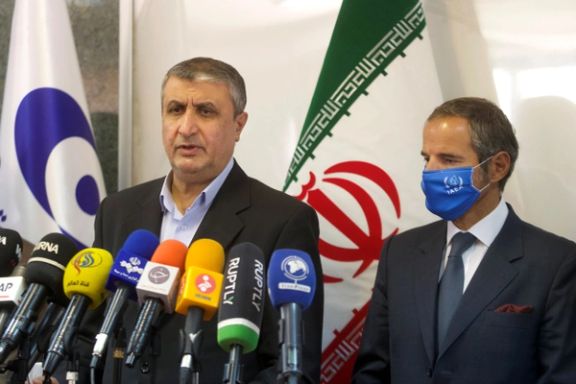
Iran's nuclear chief Mohammad Eslami speaking after a meeting with IAEA director Rafael Grossi in 2021

With talks over reviving the 2015 nuclear agreement in abeyance, Iran is continuing to expand uranium enrichment using relatively advanced machines.

A confidential report by the International Atomic Energy Agency (IAEA) to member states, seen by Reuters Monday, confirmed Tehran had brought onstream three clusters of IR-6 centrifuges at the underground Natanz enrichment plant. The 2015 agreement, the JCPOA (Joint Comprehensive Plan of Action), allowed Iran to use only IR-1 centrifuges, but Tehran began to exceed the agreement’s terms in 2019, the year after the United States left the JCPOA and imposed ‘maximum pressure’ sanctions.

The IAEA reported in August that Iran was carrying through plans announced in June to use three cascades of IR-6s at Natanz with just one at that time operational. These cascades are enriching to 5 percent, well short of Iran’s highest enrichment level of 60 percent, but using more advanced centrifuges enhances Tehran’s capacity, making it easier and quicker to achieve 90 percent ‘weapons grade’ enrichment – an aim Iran denies.

The Iranian parliament in December 2020 – following the killing of scientist Mohsen Fakhrizadeh widely attributed to Israel, which opposes the JCPOA – passed legislation it had drafted earlier despite objections by then President Hassan Rouhani requiring the installation of 1,000 IR-6 centrifuges by the end of 2021, a target the Atomic Energy Organization of Iran (AEOI) failed to meet.

By May, there were 538 IR-6 centrifuges in two cascades at Fordow and one cascade at the above-ground Natanz pilot plant. The AEOI announced plans in June to install two more IR-6 cascades underground at Natanz, in addition to one already planned there, which appeared to bring the AEOI in line with the 2020 law.

While IR-6 centrifuges have been used at Fordow and at Natanz above ground to enrich to 60 percent, some specialists have suggested Iran faces technical difficulties with more advanced machines with progress also hampered by the June 2021 attack on the manufacturing plant at Karaj, also attributed to Israel.

Biden anxiety

Talks aimed at restoring the JCPOA have appeared frozen since April, when Iran and the US exchanged several communiques through European Union mediators. Some analysts attribute the delay to the US November 8 Congressional elections with President Joe Biden anxious not to add Republican criticism of Iran policy to the unpopularity of high gasoline prices.

While the three European JCPOA signatories – France, Germany and the United Kingdom – have aligned with US criticism of Iran over its responses to IAEA questions over pre-2003 nuclear work, Russia and China have argued that both Washington and Tehran need to negotiate more seriously.

Iran has said both that the pre-2003 IAEA enquiries, centered on unexplained uranium traces, should be shelved, citing a 2015 precedent, and that it needs ‘guarantees’ against economic damage should the US leave a renewed JCPOA and reimpose sanctions. Wang Chang, deputy head of China’s IAEA mission, told the IAEA board last month that there was “neither urgency nor proliferation risk” in “possible nuclear activities that took place decades ago, if at all.” China is an ally of Iran and the only major buyer of Iranian oil, ignoring US sanctions.

Reports in August that US-Iran contacts had found a form of words dealing with the IAEA enquiries apparently came to naught. IAEA director-general Rafael Mariano Grossi in an interview August 23 suggested questions over the uranium trades might be better tackled with the JCPOA back in place. Grossi met with AEOI head Mohammad Eslami in New York in September.

Most Viewed

Iran International says it won’t be silenced after London arson attack
1

Iran International says it won’t be silenced after London arson attack

2
VOICES FROM IRAN

Hope and anger in Iran as fragile ceasefire persists

3
INSIGHT

How Tehran bends its own red lines to boost state rallies

4

Iran halts petrochemical exports to supply domestic market

5

US arrests Iranian national over alleged Basij-linked visa fraud

Banner
Banner

Spotlight

  • Too early to tell who is winning Iran war, experts say
    PODCAST

    Too early to tell who is winning Iran war, experts say

  • How Tehran bends its own red lines to boost state rallies
    INSIGHT

    How Tehran bends its own red lines to boost state rallies

  • Iran blackout cripples freelancer, small business incomes
    VOICES FROM IRAN

    Iran blackout cripples freelancer, small business incomes

  • Ideology may be fading in Iran, but not in Kashmir's ‘Mini Iran'
    INSIGHT

    Ideology may be fading in Iran, but not in Kashmir's ‘Mini Iran'

  • US blockade enters murky phase as tankers spoof signals and buyers hesitate
    ANALYSIS

    US blockade enters murky phase as tankers spoof signals and buyers hesitate

  • Why the $100 billion Hormuz toll revenue is a myth
    ANALYSIS

    Why the $100 billion Hormuz toll revenue is a myth

•
•
•

More Stories

Iran Says Nuclear Talks Not Related To Internal Crisis

Oct 10, 2022, 09:48 GMT+1

Tehran on Monday rejected any connection between nuclear talks with the West and protests in Iran, insisting that the internal situation does not concern others.

“European countries and America have linked the negotiating process to recent issues in Iran. The internal issue in Iran concerns the government and the people. We will not allow any country to meddle in Iran’s internal affairs,” foreign ministry spokesman Nasser Kanaani told reporters in Tehran.

As fierce antigovernment protests have entered their fourth week and close to 200 protesters are reported to have been killed by security forces, European countries, the United States and Canada have warned the Islamic Republic not to use force against its citizens.

Washington, Ottawa and the European Union have issued statements and some sanctions against those Iranian officials who have been identified as responsible for using repressive measures against protesters.

Kanaani stressed that as far as Tehran is concerned, the nuclear talks are not related to the protests and Iran is ready to continue the process.

Negotiations that the Biden Administration started in April 2021 to return to the Iran nuclear deal or JCPOA came to a halt before the current protests began in mid-September. The EU had presented a draft agreement in early August to Tehran and Washington based on 17 months of talks, but after several rounds of exchanges, Washington said that Tehran’s position was too far from bridging the gaps.

The onset of protests following the killing of Mahsa Amini after her arrest by the notorious ‘morality’ police, and a strong international reaction to the incident already signaled that chances for a nuclear deal further diminished.

While Amini’s killing became an important issue, Tehran’s violent reaction to protesters made the situation more complicated.

Any nuclear deal would mean lifting crucial sanctions that would hand tens of billions of dollars to the Islamic Republic, an untenable proposition in the current atmosphere.

Kanaani defended the actions of the clerical government, saying that authorities are defending “people’s security” and the United States and Europe are intervening in Iran’s internal affairs by advocating for human rights. He referred to a few incidents in Western capitals where Iranian protesters have tried to enter Islamic Republic embassies. He argued that the West has double standards, telling Iran not to use violence against protesters but allowing attacks on embassies.

Both in France and Britain police intervened on a few occasions not to allow any breach of embassy grounds by protesters. In September, French police used tear gasand attacked protesters near the Iranian embassy.

Meanwhile, the protests in Iran have gone much farther that the issue of Amini’s death in police custody. Numerous videos from demonstrations across the country show that protesters want an end to the Islamic Republic or clerical rule, demanding full social and political freedoms.

The 83-year-old ruler Ali Khamenei has become a particular target of protests, with people in the streets chanting, “Death to Khamenei” or “Death to the dictator.”

Iran Claims Progress Over Frozen Funds, US Denies Prisoner Swap

Oct 3, 2022, 19:45 GMT+1
•
Iran International Newsroom

Iran said Monday advances had been made in talks with South Korea over the release of funds frozen by banks due to United States third-party sanctions.

Foreign ministry spokesman Nasser Kanaani spoke a day after the US denied any frozen resources had been released or that a prisoner swap had been agreed with Washington. Iranian state media had suggested that an agreement had been reached on an exchange – Iranian-Americans held in Tehran for Iranians jailed in the US over sanctions violations – and that Washington would waive punitive action against South Korean banks repatriating $7 billion in Iranian assets.

Hopes for a prisoner swap had been raised after Stephane Dujarric, a United Nations spokesman, said Saturday that Iran would allow Bagher Namazi, 85, to leave the country for medical treatment and would release his son Siamak from detention. Siamak Namazi’s lawyer confirmed his client’s furlough to Reuters news agency. Siamak Namazi has been in prison since 2015 for “collaborating with hostile governments,” while his father was detained in 2016 after going to Iran to secure his son’s release.

But Kanaani said Monday that decisions over the Namazis were purely ‘humanitarian.’ While denying any arrangement over the funds in Korea, the US spokesman confirmed Sunday that Washington was continuing “indirect discussions on possible humanitarian arrangements to facilitate the urgent release of the remaining US citizens.” The spokesman said there was “nothing further to announce at this time.”

‘Information therapy’ to boost currency?

In Tehran, Shargh daily was skeptical in an analysis published Monday. The reformist newspaper noted that earlier Iranian claims over the imminent release of funds in South Korea, going back to the last year in office of President Hassan Rouhani, were seen by “many experts and economists” as ‘information therapy’ to bolster the flagging rial in currency markets.

Citing the generally conservative Fars news agency to support its contention, Shargh suggested the latest news had helped rally the currency from 340,000 to 320,000 against the US dollar.

Shargh went on to argue that Iran’s decision over the Namazis might also be intended to “paint a better picture [internationally] in the field of human rights” given “the current negative atmosphere against Iran due to the death of Mehsa Amini,” the women who died September 16 after being detained by morality police.

Shargh also noted Saudi Arabia’s release Sunday of Khalil Dardman, an Iranian detained on pilgrimage, which it said might lead to a “positive regional atmosphere centered on the restoration of relations.” Tehran and Riyadh have been in Iraq-brokered talks since April 2021 over reopening embassies six years after relations were severed following the Saudis executing leading Shia cleric Nimr al-Nimr.

Qatar’s ‘main mission’

The newspaper argued that the reported role of Qatar in mediating over the Namazis reflected Doha’s efforts over “its main mission, which is the revival of the JCPOA, by solving marginal disputes…”

Both the US and Iran publicly argue that a possible prisoner exchange is unrelated to efforts to revive the Joint Comprehensive Plan of Action, the 2015 Iran nuclear agreement. Both say any talks take place in parallel. But Shargh welcomed the Namazi move as at least preventing “the current situation of negotiations from worsening” given the US had put “the brakes on negotiations with Iran on the eve of the Knesset elections [in Israel, November 1]…as well as the [US November 8] mid-term elections of the Congress.”

Apparently reflecting Tehran’s desire to keep JCPOA talks alive, the official news agency IRNA ran a report Sunday that Iran and the US had exchanged messages, mediated by Qatar, during the recent United Nations General Assembly in New York.

But even with the Namazis’ release, Iran’s arrest of nine foreigners allegedly involved in current unrest is a further complication. Alberto Piperno, father of Alessia Piperno, an Italian woman, said Sunday he had received a telephone call from his daughter in jail. Alberto posted on social media that Alessia, a blogger, was a “solitary traveler” who had been in Iran two months.

New US Push On Iran Sanctions Signals End Of Nuclear Talks

Sep 30, 2022, 09:08 GMT+1
•
Mardo Soghom

After reports that nuclear talks with Iran have ended, Washington tightened the screws by sanctioning several foreign companies involved in oil trade with Tehran.

Critics have been accusing the Biden administration of not seriously implementing sanctions imposed by former President Donald Trump, while negotiating with Tehran to revive the 2015 nuclear accord, the JCPOA. They argue that a substantial increase in Iranian oil exports to China occurred when President Joe Biden assumed office. This in turn made Iran more intransigent in nuclear talks that began in April 2021.

The latest warning came on September 23 from an advocacy group, United Against Nuclear Iran (UANI), opposed to the revival of the JCPOA. In a report UANI argued that since President Joe Biden’s election, China has bought around $38 billion of crude oil from Iran in violation of US third-party sanctions.

The US State Department spokesperson Ned Price on September 28 evaded a question from Iran International during his daily briefing about the UANI report.

“I think what we can say with some confidence is that some of the open-source statistics have been inflated, and that is the case when it comes to certain reports of Iranian oil exports to the PRC,” Price said when he was asked about the administration’s response to the UANI report.

But the shipment of at least 750,000 barrels of crude per day to China has been reported by industry sources, news agencies and experts since early 2021, which triggered the warnings by critics of the administration’s Iran policy. Although prices Iran charges small Chinese refineries is a secret and it is reported that discounts are offered, Iran must have earned close to $30 billion in this period by shipping 350-400 million barrels of crude to China.

Although this is far below the heyday of Iran’s $100 billion annual oil export earnings around 2010, but it was sufficient to convince Tehran that it can weather the economic pressure while negotiating with the Biden administration.

Now, the Biden administration is left with no discernible Iran policy except tightening enforcement of sanctions, the same ‘maximum pressure’ strategy Trump was using when he lost the 2020 election.

In addition, a popular revolt against the clerical regime in Tehran has exposed the degree to which the rulers are willing to use violence against their own citizens, forcing the Biden team to impose new human rights sanctions.

The protests were triggered by the death in custody of a 22-year-old woman who received fatal blows to her head while being arrested for “inappropriate hijab”. Both her killing and the ensuing protests have generated a high level of international support for the people in Iran, which can be a double nail in the coffin of the JCPOA talks.

A renewed deal would have released tens of billion of dollars for the Islamic Republic and in the current atmosphere of human rights violations by Tehran, signing a nuclear agreement that would lift sanctions and enrich the government, seems improbable.

The Biden administration has apparently reached the conclusion that Iran does not want a nuclear agreement, which would mean that the way it tried to revive the JCPOA simply allowed Iran to sell more oil and greatly advance its nuclear program. It calculated that maybe it can reach the nuclear weapons threshold and have enough income to survive.

Washington Outlet Claims Iran Nuclear Talks Over

Sep 29, 2022, 18:03 GMT+1

United States negotiations over reviving the 2015 Iran nuclear deal are at an end, the pro-conservative Washington Free Beacon reported Wednesday.

The Beacon said this was concluded by senior US officials in a classified briefing two weeks ago to members of the House of Representatives Foreign Affairs Committee. The outlet cited Darrell Issa, a Republican house member, and “other congressional sources familiar with the briefing.”

Issa, a supporter of former president Donald Trump, said they “are stymied over how they get to a deal because they’ve negotiated all there was to negotiate.” Issa said Iran was “basically on the eve of getting a nuclear weapon and don’t want to be talked out of it.”

Since the confidential House briefing September 14, US officials have publicly stressed their support for continuing efforts to revive the 2015 agreement, the JCPOA (Joint Comprehensive Plan of Action), which limited Iran’s nuclear program and eased international sanctions.

A State Department official told journalists September 22 that talks had “hit a wall.” Ned Price, State Department spokesman, defended the JCPOA Monday by arguing US withdrawal had increased Iran’s “actions against our partners, the potential targeting even of American facilities and personnel…[making Iran] more aggressive, and … deadlier.”

Iran Foreign Minister Hossein Amir-Abdollahian restated Wednesday that Iran wanted US ‘guarantees’ of economic cushions should the US leave a revived JCPOA, as it did during Trump’s presidency in 2018 when imposing ‘maximum pressure’ sanctions.

Several US senators told Iran International that Washington should stop talks with the Islamic Republic over revival of the 2015 nuclear deal, especially considering the ongoing popular protests.

US Senators Warn Against Nuclear Talks Amid Protests In Iran

Sep 29, 2022, 13:15 GMT+1
•
Iran International Newsroom

Several US senators told Iran International that Washington should stop talks with the Islamic Republic over revival of the 2015 nuclear deal, especially considering the ongoing popular protests.

Democratic Senator from New Jersey Bob Menendez, who is the chairman Senate Foreign Relations Committee, told our correspondent that the United States should get ready for the fall of the regime in Iran, noting that the last time Iranians revolted against the government, the US did not have any plans. 

“I hope we'd be ready, and we'd have our contingencies and engagement, because we lost in the Green Revolution, we should be able to be ready for it now,” he said. 

Utah’s Republican Senator Mitt Romney also voiced his support for the popular uprising of the Iranians -- triggered by the death of 22-year-old woman Mahsa Amini in the hands of hijab police – saying that currently it is not a good idea to be negotiating with Iran on a nuclear deal. “Iran is a bad actor and providing more resources to them and relieving sanctions would be a big mistake.”

Echoing similar sentiments, Alabama’s Republican Senator Tommy Tuberville warned against further nuclear negotiations with Iran while the country is in turmoil. “We don't need to get back to that dialog with Iran. They're obviously having problems over there right now. They need to work out their own problems.” 

Calling the Islamic Republic’s authorities “dictators,” he said he is not surprised that “the Iranian regime is clamping down on Iranian protesters.”

Republican Senator from North Carolina Thom Tillis described the Biden administration's plan to go back to negotiating table with Iran as “ill-advised,” underlining that the Islamic Republic is a “state sponsor of terror” that every year “invests hundreds of millions of dollars” to destabilize the Middle East. 

He added that it is beyond his comprehension that the Biden administration “thinks it'd be wise to do anything that would bolster that leadership versus stand with the Iranian people who want change.”

Pennsylvania's Senator Pat Toomey, also a Republican, called on the Biden administration to voice very strong, clear support for the protesters, highlighting that they are “only protesting for basic human rights, and they deserve those rights.”

He told our Congressional reporter Arash Alaei that “I don't think we can get a workable nuclear deal with this regime.”

Toomey said he does not have the expertise to make a prediction about the collapse of the regime, adding that “Sadly we know authoritarian regimes are able to retain power for a long period of time even when they're not popular.”

Republican Senator Mike Rounds from South Dakota also urged the administration against negotiating with Iran right now, emphasizing that the Islamic Republic is “a terrorist state.” 

He touched upon the suffering of Iranians under the regime, saying, “Once again they're using some of those same tactics against their own people.”

Stressing that the “terrorist” regime in power in Iran is different from the Iranians who are good people themselves, he said that “we're having a difficult time in trying to find common ground with them (the regime). And that hurts our ability to have a good relationship with the people of Iran.”

Chris Van Hollen, Maryland's Democratic senator, also denounced the Islamic Republic's “vicious crackdown” on protesters as a “gross violation of women's rights and human rights,” expressing satisfaction that Washington slapped sanctions on hijab police and some security officials involved in the crackdown on peaceful protesters.

The Treasury Department said last week that its Office of Foreign Assets Control (OFAC) isdesignating Iran’s Morality Police “for abuse and violence against Iranian women and the violation of the rights of peaceful Iranian protestors.”

However, he said repression is already brutal in Iran without a nuclear deal, “So the idea that entering an agreement would cause the Iranian regime to be more brutal in its crackdown doesn't make sense to me.” “A nuclear armed Iran is worse for the US and our allies than a non-nuclear Iran,” he said, implying support for revival of the Joint Comprehensive Plan of Action (JCPOA).