• العربية
  • فارسی
Brand
  • Iran Insight
  • Politics
  • Economy
  • Analysis
  • Special Report
  • Opinion
  • Podcast
  • Iran Insight
  • Politics
  • Economy
  • Analysis
  • Special Report
  • Opinion
  • Podcast
  • Theme
  • Language
    • العربية
    • فارسی
  • Iran Insight
  • Politics
  • Economy
  • Analysis
  • Special Report
  • Opinion
  • Podcast
All rights reserved for Volant Media UK Limited
volant media logo

Iran's Oil, Petrochemical Workers Begin Strikes, Protests

Maryam Sinaiee
Maryam Sinaiee

Iran International

Oct 10, 2022, 13:19 GMT+1Updated: 17:26 GMT+1
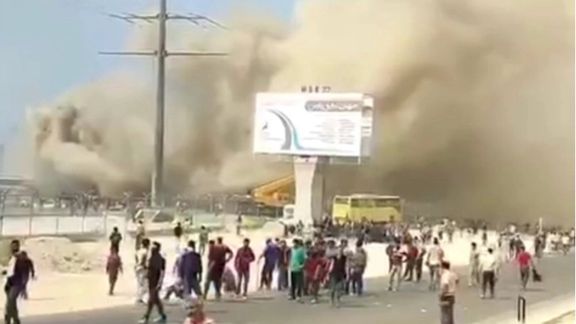
Petrochemical workers on strike in Iran on October 10, 2022

Some workers at Iran's Abadan Refinery have joined the petrochemical workers’ strike in Asalouyeh off the coasts of the Persian Gulf, which began Monday morning.

Social media reports say workers and staff of Phase 2 of state-owned Abadan Refinery walked out hours after reports of the strike at Asalouyeh Complex in Bushehr Province emerged. The government has disrupted access to mobile Internet in Khuzestan in the past few days but a video has emerged showing workers walking out Monday.

In other videos posted on social media contract workers at Asalouyeh are seen chanting “This year is the year of blood, Seyed Ali Khamenei is done! and “Down with the Dictator” in front of an administrative building. The narrator of the video says it is the beginning of the workday, 6:00 AM Monday, and that the workers have begun their “strike-campaign”.

The narrator of another video which shows smoke rising in the distance and workers gathering, says they have blocked the road to Asalouyeh Complex and gone on strike.In other videos workers are seen blocking the road with stones and rubble on a motorway where barrels of tar have been set on fire by workers.

Officials have accused protesters many of whom hail from other provinces and belong to various ethnic groups, of sabotage. “Long live Iran! Long live Lurs, Turks, Kurds, Arabs and Bakhtiari’s!” a worker says in one of the videos taken on the blocked road and stresses that workers are on strike in solidarity with the people of Iran.

Workers at Bushehr Petrochemical Company’s Site One at Asalouyeh Complex chanting “Don’t be afraid: We stand together!”.

Some social media reports claim workers of other companies in Asalouyeh have also joined the strike including Damavand Petrochemical Company and Kangan Petro Refining Company.

A statement by Council for Organizing Oil Contract-Workers’ Protests circulating on social media Monday said contract workers at Bushehr Petrochemical Company (Site One) and Hengam Petrochemical Company both of which operate at Asalouyeh Complex in Bushehr have begun their protests in solidarity with other protesters.

The statement urged all oil, gas, and petrochemical workers of every employment status (temporary, contract-based, permanent) as well as workers on oil rigs to start protesting and prepare for nation-wide strikes. “This is only the beginning of our path, and we will continue our protests every day in solidarity and in tandem with the people from all over the country.”

In some of the videos posted from Asalouyeh, however, workers clearly state that they are on strike.The council had warned last week that workers would not remain indifferent to the killing of protesters and would go on strike if it continued.

There are also reports that drivers of bitumen tankers employed by a private company have gone on strike and refused taking any loads for a fourth consecutive day from privately-owned Pasargad Oil Company serving Abadan Refinery.

In the capital Tehran, university students rallied to continue antigovernment protests. Images received show large demonstrations in Polytechnic and Amir Kabir universities.

Most Viewed

Iran negotiators ordered to return after internal rift over Islamabad talks
1
EXCLUSIVE

Iran negotiators ordered to return after internal rift over Islamabad talks

2
ANALYSIS

US blockade enters murky phase as tankers spoof signals and buyers hesitate

3

US tightens financial squeeze on Iran, warns banks over oil money flows

4
INSIGHT

Ideology may be fading in Iran, but not in Kashmir's ‘Mini Iran'

5
INSIGHT

Hardliners push Hormuz ‘red line’ as US blockade tests Iran’s leverage

Banner
Banner

Spotlight

  • Hardliners push Hormuz ‘red line’ as US blockade tests Iran’s leverage
    INSIGHT

    Hardliners push Hormuz ‘red line’ as US blockade tests Iran’s leverage

  • Ideology may be fading in Iran, but not in Kashmir's ‘Mini Iran'
    INSIGHT

    Ideology may be fading in Iran, but not in Kashmir's ‘Mini Iran'

  • War damage amounts to $3,000 per Iranian, with blockade set to add to losses
    INSIGHT

    War damage amounts to $3,000 per Iranian, with blockade set to add to losses

  • Why the $100 billion Hormuz toll revenue is a myth
    ANALYSIS

    Why the $100 billion Hormuz toll revenue is a myth

  • US blockade targets Iran oil boom amid regional disruption
    ANALYSIS

    US blockade targets Iran oil boom amid regional disruption

  • Iran's digital economy battered by prolonged blackout
    INSIGHT

    Iran's digital economy battered by prolonged blackout

•
•
•

More Stories

Several Iranian State TV Figures Leave For Supporting Protests

Oct 10, 2022, 11:39 GMT+1

A number of TV show hosts and presenters of the Iranian state television have resigned or been fired following their support for the ongoing nationwide protests. 

As the Islamic Republic’s authorities are cracking down on people who are protesting against the government, they are also threatening or arresting celebrities who have voiced support for the protests.

Mojtaba Pourbakhsh, a presenter in a popular football show, was banned from the state TV because he expressed support for football star Ali Karimi, who has been very critical of the regime’s heavy-handed clampdown since the beginning of the current wave of the protests, triggered by the death of 22-year-old Mahsa Amini in hijab police custody. 

Many celebrities have been summoned for questioning, or their passports have been confiscated, because of their social media posts demanding freedoms or calling on security forces to stop violence. 

Amid the ongoing crisis in Iran ‘reformist’ commentator Abbas Abdi said in an interview on Sunday that what Iran's state-run television broadcasts are “sheer propaganda." Those who are looking for news in Iran will not turn to the state TV, Abdi argued.

Ironically, when hackers interrupted the state TV news program October 8, playing a short clip, most Iranians found out about it through social media reports or on foreign-based satellite TV rather than watching the actual program on the state TV.

Meanwhile, former Vice President Mostafa Hashemi Taba has argued in another interview that the state TV, also known as the Islamic Republic of Iran's Broadcasting organization (IRIB) excels in keeping Iranians uninformed about developments.

Iran Says Nuclear Talks Not Related To Internal Crisis

Oct 10, 2022, 09:48 GMT+1

Tehran on Monday rejected any connection between nuclear talks with the West and protests in Iran, insisting that the internal situation does not concern others.

“European countries and America have linked the negotiating process to recent issues in Iran. The internal issue in Iran concerns the government and the people. We will not allow any country to meddle in Iran’s internal affairs,” foreign ministry spokesman Nasser Kanaani told reporters in Tehran.

As fierce antigovernment protests have entered their fourth week and close to 200 protesters are reported to have been killed by security forces, European countries, the United States and Canada have warned the Islamic Republic not to use force against its citizens.

Washington, Ottawa and the European Union have issued statements and some sanctions against those Iranian officials who have been identified as responsible for using repressive measures against protesters.

Kanaani stressed that as far as Tehran is concerned, the nuclear talks are not related to the protests and Iran is ready to continue the process.

Negotiations that the Biden Administration started in April 2021 to return to the Iran nuclear deal or JCPOA came to a halt before the current protests began in mid-September. The EU had presented a draft agreement in early August to Tehran and Washington based on 17 months of talks, but after several rounds of exchanges, Washington said that Tehran’s position was too far from bridging the gaps.

The onset of protests following the killing of Mahsa Amini after her arrest by the notorious ‘morality’ police, and a strong international reaction to the incident already signaled that chances for a nuclear deal further diminished.

While Amini’s killing became an important issue, Tehran’s violent reaction to protesters made the situation more complicated.

Any nuclear deal would mean lifting crucial sanctions that would hand tens of billions of dollars to the Islamic Republic, an untenable proposition in the current atmosphere.

Kanaani defended the actions of the clerical government, saying that authorities are defending “people’s security” and the United States and Europe are intervening in Iran’s internal affairs by advocating for human rights. He referred to a few incidents in Western capitals where Iranian protesters have tried to enter Islamic Republic embassies. He argued that the West has double standards, telling Iran not to use violence against protesters but allowing attacks on embassies.

Both in France and Britain police intervened on a few occasions not to allow any breach of embassy grounds by protesters. In September, French police used tear gasand attacked protesters near the Iranian embassy.

Meanwhile, the protests in Iran have gone much farther that the issue of Amini’s death in police custody. Numerous videos from demonstrations across the country show that protesters want an end to the Islamic Republic or clerical rule, demanding full social and political freedoms.

The 83-year-old ruler Ali Khamenei has become a particular target of protests, with people in the streets chanting, “Death to Khamenei” or “Death to the dictator.”

Gunfire In Western Iranian City Amid Protests On Sunday

Oct 10, 2022, 07:54 GMT+1
•
Maryam Sinaiee

Unrest across Iran Saturday and the opposition’s show of strength were followed by more protests Sunday in some cities including Tehran, Sanandaj, and Mahabad.

Kurdish towns and cities in western Iran were restless all-day Sunday, after government agents killed two men in Sanandaj the previous day. This fueled more intense protests in the city and Security forces resorted to the full use of military weapons Sunday night.

Social media reports spoke of an undetermined number of people killed and wounded among protesters. One protester tweeted, “We pushed them back and it feels like a revolution”.

Security forces, mainly the Revolutionary Guard, were firing automatic weapons till the early hours of Sunday in Sanandaj, a city that was one of the first to rebel in mid-September after the now iconic face of the protests, Mahsa Amini was killed after being arrested the by the notorious ‘morality’ police.

Gunfire in Sanandaj, Sunday, October 9

Protesters also took to the street again in the evening in Tehran’s southern working-class areas such as Shahrak-e Vali Asr and Nazi Abad where angry protesters turned out in such huge numbers that astonished everyone, including security forces who feared the situation could get totally out of control if they interfered. Protesters torched a building used by the IRGC-linked Basij militia which are always deployed to suppress protests.

Social media reports say in Nazi Abad security forces fired shotguns to disperse a group of protesters who were chanting against Supreme Leader Ali Khamenei to prevent the crowd from coalescing.

In other places such as Tehran’s western Ekbatan neighborhood, a massive apartment complex, people chanted “Down with the Dictator” even louder than previous nights and called on the “silent-ones” to join the protests.

Disturbing footage on social media Sunday of security forces vandalizing private cars on thee streets.

The Oslo-based Iran Human Rights Organization (IHR) reported Saturday a death toll of 185 in the protests that started three weeks ago, including at least 19 children, across the country with the highest number of killings in the southeastern province of Sistan and Baluchistan province where half the deaths have been recorded.

There is no reliable information on the number of the wounded as most of those injured in the protests are not taken to hospital for fear of being arrested.

Several protesters were killed during the protests Saturday including at least two young men in Sanandaj, capital of Kordestan Province. One of the victims, Yahya Rahimi, was shot in the head inside his car because he was honking his horn in support of the protesters on the street.

Students also continued their strike and further protests Sunday in several universities in Tehran as well as Rasht, Arak, and Qazvin during the day.

Students, both in universities and secondary schools, also tried to consolidate some of the ground they have gained. Women and girls continue to refuse to wear headscarves. In a university in Tehran men and women broke the forty-year segregation taboo as they had promised, taking over the canteen, and chanted “Don’t be mistaken and think it’s only today. We’ll be doing this everyday!”

Activists have reported pressure and intimidation on secondary school girls in some areas for refusing to wear headscarves and chanting anti-regime slogans. In some schools children have been threatened with expulsion. Security forces reportedly tried to enter some schools Sunday to arrest students but faced resistance from the children, who booed them and chanted “Women, Life, Freedom”, as well as their parents.

There are some unconfirmed reports of disobedience among security forces. Hardliner lawmaker Mohammad Esmail Kowsari, an IRGC general, on Sunday threatened security forces of consequences if they did not “fulfil their duties” during the crackdown on popular protests.

Those Who Beat Women Stand On Wrong Side Of History – German FM

Oct 9, 2022, 20:22 GMT+1

German Foreign Minister Annalena Baerbock said Sunday that Berlin will ensure the European Union freezes the assets of those responsible for a violent crackdown on antigovernment protests in Iran. 

She told German Sunday newspaper Bild am Sonntag that "Those who beat up women and girls on the street, who abduct, arbitrarily imprison and condemn to death people who want nothing other than to live free -- they stand on the wrong side of history."

Expressing support for protesters she said, "To those people in Iran we say: we stand by you, and will continue to do so," she said.

Antigovernment protests began on September 17 following the murder of Mahsa Amini and soon turned into the biggest challenge to Iran's clerical leaders in years, with protesters calling for the downfall of Supreme Leader Ali Khamenei.

Germany, France, Denmark, Spain, Italy and the Czech Republic have submitted 16 proposals for new EU sanctions against Iran for its clampdown on protests ignited by the death in hijab policy custody of the 22-year-old Kurdish girl. 

The EU foreign ministers are set to decide on the measures at their meeting on October 17, with no resistance expected from the members of the bloc, Spiegel magazine reported. "We are now working flat out to implement these proposals," a German foreign ministry source said.

Former US President Trump Voices Support For Iran Protests

Oct 9, 2022, 19:57 GMT+1

Former US President Donald Trump has expressed support for the current uprising in Iran, saying that he and his supporters are with the people of Iran. 

Addressing his supporters during a rally in Minden, Nevada, on Saturday, he said that “the people of Iran are bravely protesting against their corrupted and brutal regime, courageously facing down violence, persecution, jail, torture, and even death.” 

He added that “we are with you and we will always be with you.” 

While protests are going on in Iran amid a bloody crackdown by security forces, foreign governments and officials are promising sanctions and punitive measures against the Islamic Republic’s authorities, especially those involved in the suppression of the popular protests. 

Oslo-based organization Iran Human Rights said on Saturday that at least 185 people have been killed in the uprising ignited by the death in custody of 22-year-old Mahsa Amini. The NGO added that about 20 of the killed were minors.

The protests first erupted in Mahsa Amini’s hometown Saqqez and capital Tehran and soon spread to all over the country and garnered support from Iranian expatriate communities around the world as well as foreign governments and officials.

The Persian hashtag to express support for the protests has been retweeted over 270 million times and is still being used.