• العربية
  • فارسی
Brand
  • Iran Insight
  • Politics
  • Economy
  • Analysis
  • Special Report
  • Opinion
  • Podcast
  • Iran Insight
  • Politics
  • Economy
  • Analysis
  • Special Report
  • Opinion
  • Podcast
  • Theme
  • Language
    • العربية
    • فارسی
  • Iran Insight
  • Politics
  • Economy
  • Analysis
  • Special Report
  • Opinion
  • Podcast
All rights reserved for Volant Media UK Limited
volant media logo

Raisi Says Iran Wants 'Guarantees' From West For Nuclear Deal
Iran International Newsroom
Sep 19, 2022, 13:14 GMT+1Updated: 17:33 GMT+1
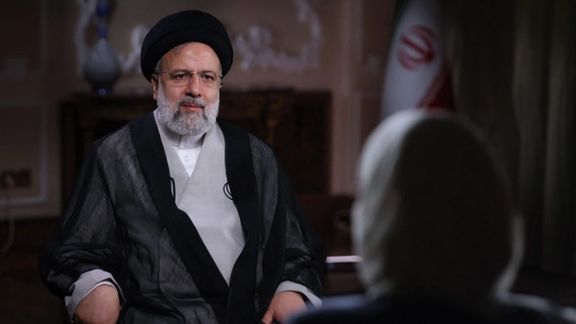
President Raisi during his CBS interview on September 13, 2022

President Ebrahim Raisi has said Iran is ready to revive the 2015 nuclear agreement given guarantees that the United States and Europe will uphold it.

In two television interviews ahead of leaving Monday for the United Nations General Assembly (UNGA) in New York, where he is due to speak this week, Raisi stressed Tehran’s lack of trust in both Washington and European states. This, he said, followed US withdrawal from the 2015 deal – the JCPOA, Joint Comprehensive Plan of Action – and Europe’s failure to support Iran economically in the face of US ‘maximum pressure’ sanctions.

Speaking last Tuesday to America’s CBS in Tehran in an interview broadcast over ten minutes Sunday, and to Qatar’s al-Jazeera in a half-hour slot Friday in Samarkand during the Shanghai Cooperation Organization (SCO) summit, Raisi said that while Iran wanted to expand trade globally with sanctions lifted it was ready to emphasize links with other countries facing sanctions.

“If there were guarantees, then the Americans could not withdraw from the deal,” Raisi said. “The Americans broke their promises, they did it unilaterally…We cannot trust the Americans because of the behavior we have already seen from them.”

CBS billed the interview as Raisi’s “first with a western reporter” while Raisi might receive more media coverage while in New York.

Meeting Biden ‘not beneficial’

Asked about Iranian-Americans detained in Iran, Raisi referred to Iranian nationals imprisoned in the US “because they tried to circumvent sanctions.” He reiterated talks “between the two countries” on this “humanitarian issue” were possible aside from the nuclear talks.

Raisi ruled out a “face to face” meeting in New York with President Joe Biden, which he said “would not be beneficial” as Iran had “not witnessed in reality” any changes since the administration of President Donald Trump, who in 2018 withdrew the US from the nuclear agreement and imposed ‘maximum pressure.’ But Iran’s foreign ministry spokesman Nasser Kanaani on Monday kept the door open to contacts during the UN summit.

Interviewer Lesley Stahl quizzed Raisi over 1988 prison executions, at time when the president was deputy prosecutor in Tehran. Raisi dismissed “allegations and claims made by a terrorist group” – the Mujahideen-e Khalq, whose members were most of those executed. CBS highlighted Amnesty International calling the executions as “a crime against humanity.”

Quizzed over the Jewish holocaust and Israel’s “right to exist,” Raisi evaded the question by bringing up the rights of Palestinians “forced to leave their homes and motherland,” and said Israel’s accords with some Arab states meant those states “were stabbing the very idea of Palestine in the back.” He also called for “justice” over the “heinous crime” of the US 2020 killing of Iranian general Qasem Soleimani.

Building confidence

Raisi’s interview with Jazeera focused on Iran’s strategy in looking to expand ties with other SCO members – China, India, the Kyrgyz Republic, Kazakhstan, Pakistan, Russia Tajikistan, and Uzbekistan – to create “balance” and as a bulwark against current or future US sanctions.

“Those who are violators of their commitment, they need to build confidence again,” he said. Asked over 40 years of poor relations with the US, Raisi evoked US support for the ‘terrorist’ MEK, for Saddam Hussein during the 1980-88 war, its 1988 shooting down of the civilian Iran Air Flight 655, and decades of sanctions – all of which he called a “very long list.”

In fact, the Soviet Union rendered greater support to Iraq with large arms shipments, but the Islamic Republic maintained ties with Moscow and later expanded relations. Also, there is no evidence of the US administrations having helped the MEK, although some US lawmakers support the organization.


Most Viewed

Iran International says it won’t be silenced after London arson attack
1

Iran International says it won’t be silenced after London arson attack

2
VOICES FROM IRAN

Hope and anger in Iran as fragile ceasefire persists

3
INSIGHT

How Tehran bends its own red lines to boost state rallies

4

Iran halts petrochemical exports to supply domestic market

5

US arrests Iranian national over alleged Basij-linked visa fraud

Banner
Banner

Spotlight

  • Too early to tell who is winning Iran war, experts say
    PODCAST

    Too early to tell who is winning Iran war, experts say

  • How Tehran bends its own red lines to boost state rallies
    INSIGHT

    How Tehran bends its own red lines to boost state rallies

  • Iran blackout cripples freelancer, small business incomes
    VOICES FROM IRAN

    Iran blackout cripples freelancer, small business incomes

  • Ideology may be fading in Iran, but not in Kashmir's ‘Mini Iran'
    INSIGHT

    Ideology may be fading in Iran, but not in Kashmir's ‘Mini Iran'

  • US blockade enters murky phase as tankers spoof signals and buyers hesitate
    ANALYSIS

    US blockade enters murky phase as tankers spoof signals and buyers hesitate

  • Why the $100 billion Hormuz toll revenue is a myth
    ANALYSIS

    Why the $100 billion Hormuz toll revenue is a myth

•
•
•

More Stories

Tehran Says Ready For 'Prisoner Swap', Pending US Decision

Sep 18, 2022, 11:37 GMT+1
•
Iran International Newsroom

Iran’s foreign ministry said Sunday that with, or without a nuclear deal Tehran is ready for a “prisoner exchange”, pending Washington’s agreement.

The spokesman of the ministry Nasser Kanaani told reporters in Tehran that agreements have been worked out between the sides “and now it is the decision of America whether this deal is implemented or not.” He was responding to a question whether the prisoner exchange scheme has been delayed because nuclear talks with the United States are stalled.

Kanaani did not give details of the prisoner exchange agreement he referred to.

Although both Iran and the United States have claimed that a prisoner exchange deal is not directly tied to the revival of the 2015 nuclear accord, the JCPOA, but indications are that the two issues are intricately connected.

In August, Iran International reported that Tehran’s chief nuclear negotiator, Ali Bagheri-Kani had given an off-the-record briefing to local reporters in Tehran about the outlines of a nuclear agreement drafted after 17 months of negotiations in Vienna.

He reportedly said that when a nuclear agreement is signed, and its implementation period begins Iran will release all US prisoners (hostages) once $7 billion worth of its assets frozen in South Korea are released. In fact, the issue of the $7 billion held by two South Korean banks due to US sanctions on Tehran, has been tied to the issue of hostages at least since last December.

Father and son, Baqer and Siamak Namazi held hostage in Iran for several years
100%
Father and son, Baqer and Siamak Namazi held hostage in Iran for several years

Bagheri in his briefing also told reporters that Iran and the US had earlier agreed on this, but Washington reneged on its promise, assuming that the money will give Iran financial breathing room to raise new demands in the nuclear talks.

This does not sound too much off the mark, since US officials have been in frequent talks with South Korean diplomats since 2021, when the fate of the nuclear talks were still uncertain.

In early January, Choi Jong-kun, first vice foreign minister of South Korea visited the venue of the nuclear talks in Vienna and held meetings with various delegations in what was an attempt to untie knots in the talks. Seoul has no involvement in the nuclear dispute, except the $7 billion of Iranian money it holds. Other countries also have frozen Iranian funds.

South Korea’s First Vice Foreign Minister Cho Hyundong visited Washington on Friday and met with top State Department officials, including US Special Envoy for Iran Rob Malley. The US envoy tweeted, “We thank the Republic of Korea for their close partnership, including their efforts to help ensure the return of our wrongfully detained citizens in Iran and to reach a deal on JCPOA.”

It is not clear if the visit of the high-ranking Korean diplomat was mainly related to the Iran issue or the meeting with Malley was just one part of his visit, while other international issues such as tensions with China and the war in Ukraine were the main points of agenda for his visit.

The Biden Administration is under pressure to arrange the release of six American citizens and permanent residents held by Iran as of July. In addition there around 20 Western European citizens and residents also taken hostage since the JCPOA was signed in 2015.

But given widespread criticism of the administration’s policy to lift sanctions in order to restore some limits to Iran’s nuclear program, a hostage deal giving Iran $7 billion before a nuclear agreement would be politically costly for the Biden White House.

US State Department Defends Biden's Hostage ‘Emergency'

Sep 18, 2022, 08:52 GMT+1
•
Iran International Newsroom

Wendy Sherman has defended President Joe Biden’s July executive order on the detention of Americans abroad and the choice of countries for the new ‘D’ notice.

The EO evoked the 1976 National Emergencies Act and empowered the Secretary of State to “publicly or privately designate or identify officials of foreign governments who are involved, directly or indirectly, in wrongful detentions,.”

In an interview with ‘Washington Post live,’ Sherman, a deputy secretary of state, highlighted as an example of the ‘emergency’ Secretary of State Antony Blinken’s introduction of the ‘D’ notice as a warning to travelling Americans.

Sherman said the notice was applied to a country that was “using the detention, unjust detention of Americans as leverage, economic leverage, geopolitical leverage.” She insisted the Biden administration was committed to “bring Americans home who are wrongfully detained.”

Families of those detained in US allies like Egypt or Saudi Arabia have saidthe US approach – the ‘D’ notice applies to Burma, China, Iran, North Korea, Russia, and Venezuela – is based on politics rather than concern for detained Americans. One relative told the Guardian newspaper in June that Blinken was guilty of “hypocritical cherry-picking.”

Sherman, however, said the ‘D’ indicator was attached to “countries that unjustly detain Americans over a period of time or in numbers.”

“It’s not every American who might be jailed, because sometimes Americans do things that are illegal, that are crimes, and it is not an unjust detention,” she explained.“But we look at things like have they gotten a fair trial, a fair judicial process…”

Father and son, Baqer and Siamak Namazi held hostage in Iran for several years
100%
Father and son, Baqer and Siamak Namazi held hostage in Iran for several years

International human rights organizations and UN experts have repeatedly said that Iran engages in systematic unlawful imprisonment of foreigners and dual-nationals as hostages to gain leverage against Western countries. Usually, Tehran demands the release of people convicted for terrorism or other unlawful acts benefitting the Islamic Republic.

‘Brutal meetings’

Sherman said that her contact with relatives of four Americans detained in Iran had been “brutal meetings,” as it had been with Christine Levinson, the Central Intelligence Agency contractor who disappeared in Kish Island, Iran, in 2007 and who Washington believes is dead.

As Irans' President Ebrahim Raisi is scheduled to arrive in New York soon to attend the United Nations General Assembly, two former hostages in Iran and an ex-political prisoner have announced they will launch a civil lawsuit againt him in the United States.

Sherman, who during the administration of President Barack Obama was actively involved in negotiations leading to the 2015 Iran nuclear agreement, defended the current administration’s approach to reviving the agreement, the JCPOA (Joint Comprehensive Plan of Action).

Repeating the US assessment that Iran had given “a pretty tough response” in its latest input to negotiations mediated by the European Union, Sherman said President Joe Biden would “continue to look for ways to move forward as long as we believe that it makes sense to do so.”

The administration was “planning for any eventuality,” Sherman said. “Whether the deal happens or the deal doesn’t happen, the president still believes it is in our interest to pursue the deal, and we’ll continue to do so as long as that is the case.”

The deputy secretary of state insisted that efforts to bring home American detainees from Iran was “a very high priority, the highest priority in many ways.” It was not dependent on whether the JCPOA was revived or not, she said.

Iran Can Thwart US Sanctions Via Shanghai Organization

Sep 16, 2022, 11:21 GMT+1

Iranian President Ebrahim Raisi said on Friday that the Shanghai Cooperation Organization (SCO) can help thwart “US unilateralism” and solve the problems created by sanctions. 

Raisi made the remarks during his meeting with his Chinese counterpart Xi Jinping on the sidelines of the SCO summit in the Uzbek city of Samarkand on Friday, adding that "the Islamic Republic has not been and won't be stopped despite all the enmities, and will not give up in the face of US' bullying."

During the summit, he reiterated that foiling "draconian" US sanctions required new solutions, stressing the need for expanding the central Asian security organization.

Raisi also called for expanding free trade among SCO member countries, alongside financial and banking cooperation, noting that Tehran and Beijing have enormous capacities in the fields of oil and energy, transit, agriculture, and trade. 

Xi, for his part, pointed out that the longstanding friendship of China and Iran have stood the test of a changing international landscape, adding that their common strategic choice is consolidating and growing their comprehensive partnership. 

The two sides should make active efforts to implement their 25-year comprehensive cooperation plan, advance China’s Belt and Road initiative -- a global infrastructure development strategy by the Chinese government to invest in various countries -- and strive for more deliverables of cooperation, Xinhua quoted Xi as saying.

Tehran, which seeks to overcome economic isolation imposed by US sanctions, on Thursday signed a memorandum of obligations to become a permanent member of the SCO, formed in 2001 as a talking shop for Russia, China and ex-Soviet states in Central Asia, and expanded four years ago to include India and Pakistan.

Pressure Builds Againt Iran's Raisi Before Trip To New York

Sep 16, 2022, 10:50 GMT+1
•
Iran International Newsroom

Days before Iran’s president is scheduled to attend the UN General Assembly, three former prisoners in Iran are launching a civil lawsuit against him in New York.

The hardliner president Ebrahim Raisi’s scheduled trip to the United States, together with a large entourage, has been the subject of controversy. Human rights activists, Iranian dissidents, former political prisoners and hostages in Iran have urged the Biden administration not to issue a visa to Raisi.

Raisi served as Iran’s Judiciary chief before becoming president in August 2021, but he spent most of life in the Islamic judiciary and is accused by human rights groups of taking part in gross violations of human rights. He was a member of a death committee that ordered the killing of thousands of political prisoners in 1988, an involvement he has proudly admitted.

The US sanctioned him, along with other Iranian officials in 2019 for human rights violations.

A former prisoner in Iran, Mehdi Hajati and two former hostages, Hamid Babaei and Australian-British academic Kylie Moore-Gilbert, who was held hostage for two years in Iran announced Thursday that they will launch a civil lawsuit.

The National Union for Democracy in Iran (NUFDI), an American Iranian advocacy group is assisting the plaintiffs in their legal action. NUFDI said in a statement that human rights attorney Shahin Milani will represent the three plaintiffs.

Former Iranian president Mahmoud Ahmadinejad speaking at the UN General Assembly in September 2005
100%
Former Iranian president Mahmoud Ahmadinejad speaking at the UN General Assembly in September 2005

Mehdi Hajati was an elected local official in the Iranian city of Shiraz who was sentenced to prison for his defense of the persecuted Baha’i community in 2019. Hamid Babaei, a resident of Belgium was also held hostage in Iran.

Moore-Gilbert, a lecturer in Islamic studies at the University of Melbourne was arrested on bogus charges in Iran in September 2018 and held until November 2020, when she was exchanged with Iranians jailed in Thailand on terrorism convictions. They received a hero’s welcome upon their return to Iran.

A bipartisan group of 52 US lawmakers urged President Joe Biden on September 9 to deny visas for Raisi and his delegation.

"The United States cannot overlook Ebrahim Raisi’s direct involvement in gross violations of internationally recognized human rights, including the 1988 organized mass murder of thousands of political prisoners, among whom were women and children, by the Iranian regime,” the lawmakers wrote to Biden.

So far the Biden Administration appears to be determined to issue the visas, arguing that it is legally obligated as host nation of the United Nations to allow officials of other government to conduct their UN business in New York.

Critics who urge a visa denial say that “As the host country for UN headquarters, the United States has a general obligation to grant visas to those conducting UN business. However, as lawmakers noted in their letters to Biden, U.S. law authorizes a denial of visas to individuals responsible for torture and extrajudicial killings.” They cite the example of Austrian President Kurt Waldheim who was denied entry into the US in 1987 for his responsibility for the persecution of Jews and others during World War II.

Iranian Americans have organized a protest outside the UN headquarters in New York City on September 21, the day Raisi is scheduled to speak at the General Assembly and at the same time NUFDI will unveil the details of the lawsuit against him.

Iran Says Determined To Boost Ties With Russia 'At All Levels'

Sep 16, 2022, 08:45 GMT+1
•
Maryam Sinaiee

Relations between Tehran and Moscow are strategic and Tehran aims to boost ties at all levels, Iran's president said Thursday in a meeting with Vladimir Putin.

On the sidelines of the Shanghai Cooperation Organization (SCO) summit in the Uzbek city of Samarkand Thursday,President Ebrahim Raisi assured his Russian counterpartthat Tehran will never recognize the sanctions against Russia and will strengthen and develop its trade and economic relations with Moscow.

“Our relations are not ordinary; they are of a strategic nature. Iran wishes to expand its strategic relations with Russia and all political, economic, trade, and aerospace areas,” he told the Russian President. Raisi Also stressed that Tehran- Moscow cooperation can “neutralize” the effects of US sanctions on both countries.

President Raisi and his government consider relations with Moscow and Beijing and Iran’s full membership in SCO a powerful tool in overcoming US sanctions and their effects which have hugely affected the Iranian economy since 2018 when former US President Donald Trump pulled out of the 2015 nuclear agreement (JCPOA) and slapped crippling sanctions on the country.

"The relationship between countries that are sanctioned by the US, such as Iran, Russia or other countries, can overcome many problems and issues and make them stronger," Raisi told Putin in the meeting.

"The Americans think whichever country they impose sanctions on, it will be stopped, their perception is a wrong one."

That is exactly what critics of the Biden Administration policy of reviving the JCPOA argue. Freeing Iran from US sanctions will open a back door for Russia to violate Western sanctions imposed on its energy exports and international banking. Already the two countries have deals for natural gas and oil swaps, which can help disguise Russian energy exports.

Putin meeting Iran's ruler Ali Khamenei in Tehran on July 19, 2022
100%
Putin meeting Iran's ruler Ali Khamenei in Tehran on July 19, 2022

Iran has also supported Russia's invasion of Ukraine and has delivered military drones to Moscow. Recent images from Ukraine show Iranian suicide drones being used in the war.

For his part, Putin announced in the meeting that a Russian delegation of 80 large companies are to visit Tehran next week now that Iran has signed documents pertaining to full membership in SCO.

The Russian President said Tehran and Moscow actively cooperate on the international arena and their positions “coincide” on many issues. He added that many joint projects are moving forward “thanks to Supreme Leader Ali Khamenei’s support.” “We are interested in his further support,” he said.

Referring to Iran’s membership in SCO, Iranian foreign ministry spokesman Nasser Kanaani said in a tweet Wednesday that Iran “acts dynamically, intelligently and balanced in realizing the strategic goals of its foreign policy and expanding its foreign relations” but “does not wait for the JCPOA and the return of the United States to its JCPOA commitment” despite adhering to the talks for the restoration of the deal.

The SCO summit which brings together leaders of China, Russia, India, Pakistan and four ex-Soviet Central Asian countries together will ends on Friday. The Eurasian political, economic and security organization was founded by China, Russia, and four former Soviet republics in 2001 and has since expanded its membership to include India and Pakistan.

SCO approved Iran's application for accession last year at a conference in Dushanbe, Tajikistan, in September after many years of a slow process.

In a tweet Wednesday, Foreign Minister Hossein Amir-Abdollahian who is accompanying the president said he had signed a memorandum of commitments to join the organization as a full member, calling a "new phase" of economic, trade, transit, energy, and other cooperation with the body.

According to SCO deputy secretary-general Grigory Logvinov, it may take some time for Iran to complete the accession procedure.