• العربية
  • فارسی
Brand
  • Iran Insight
  • Politics
  • Economy
  • Analysis
  • Special Report
  • Opinion
  • Podcast
  • Iran Insight
  • Politics
  • Economy
  • Analysis
  • Special Report
  • Opinion
  • Podcast
  • Theme
  • Language
    • العربية
    • فارسی
  • Iran Insight
  • Politics
  • Economy
  • Analysis
  • Special Report
  • Opinion
  • Podcast
All rights reserved for Volant Media UK Limited
volant media logo

Europe, US Discuss Iran As Ex-US Official Calls For Threat Of Force
Iran International Newsroom
Sep 10, 2022, 16:10 GMT+1Updated: 17:43 GMT+1
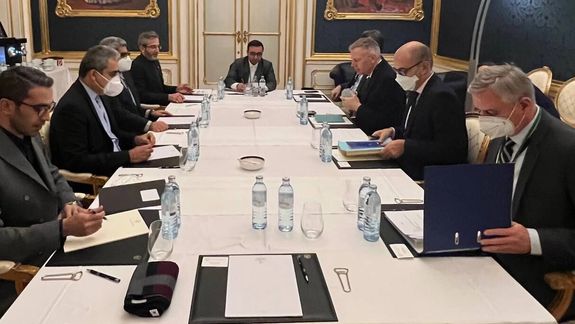
Iranian and European delegatrion meet in the Vienns talks on January 3, 2022

France, Germany and the United Kingdom said Saturday they were consulting “international partners” on “how best to address Iran’s continued nuclear escalation.”

A statement from the ‘E3’ said Tehran had chosen not to take the “critical diplomatic opportunity” offered by a text circulated August 8 by the European Union in an effort to conclude 18-month talks to revive the 2015 Iran nuclear deal, the JCPOA (Joint Comprehensive Plan of Action).

A statement from United States foreign affairs spokesman Ned Price Friday said Secretary of State Antony Blinken had briefed the E3 foreign ministers on his Ukraine visit and that they had “discussed the challenges posed by Iran and our commitment to working together to address them.”

Since the EU draft was circulated August 8, there has been a series of diplomatic exchanges between Iran and the US that have failed to resolve remaining differences over JCPOA revival.

The E3 statement highlighted this week’s report from the IAEA director Rafael Mariano Grossi that he had made no progress with Iran in explaining the uranium traces since the IAEA managing board in June passed a resolution, drawn up by the US and the E3, censuring Tehran. Saturday’s E3 statement reiterated that Iran needed to “provide technically credible answers,” regardless of the JCPOA talks, because of its “legally binding obligations” under the Nuclear Non-Proliferation treaty.

Secretary of State Antony  Blinken in Israel in March 2022
100%
Secretary of State Antony Blinken in Israel in March 2022

Tehran has argued the IAEA probe is politically motivated, and results from allegations made by Israel in 2018 as Trump withdrew the US from the JCPOA. In December 2015, Iran argues, the IAEA had produced a final report on Tehran’s pre-2003 nuclear work.

But while the E3 and US statements referred to continuing consultation, neither suggested what steps might be taken at the next IAEA board. Russia and China have both said that pursuing the matter, even back in June, was unhelpful to the JCPOA talks, and both countries hold vetoes at the United Nations Security Council should the E3 and US seek to refer Iran there.

The pause in the JCPOA talks has heightened focus on the Biden administration’s approach. It has stoked debate in Israel as it approaches a November 1 election. Opposition leader Benjamin Netanyahu is highlighting Iran to undermine Prime Minister Yair Lapid after David Barnea, head of the extraterritorial force Mossad, gave August press briefings critical of Biden, with whom Lapid has sought to coordinate.

Ross: US must ‘make clear’ it will act

Former senior US diplomat Dennis Ross. FILEPHOTO
100%
Former senior US diplomat Dennis Ross

Opponents of the JCPOA in the US have also gained momentum. Dennis Ross, who has held senior positions in Republican and Democratic administrations and maintains a skeptical view of the JCPOA while acknowledging it curbed Iran’s nuclear program, this week published a piece in Foreign Policy arguing that even if the 2015 agreement were revived, “Iran after 2030 [when some JCPOA clauses expire] would be in a position to move quickly to a bomb unless Iranian leaders come to believe that the cost of doing so is too high.”

Given Iran had acquired “nuclear know-how” and had become “a threshold nuclear weapons state” since Trump left the JCPOA and Iran expanded its nuclear activities, Ross wrote, Washington needed to make clear to the Iranian leadership that “the United States will act at a certain point and take out their entire nuclear infrastructure.”

While the Biden administration, and the E3, have never ruled out military action, Ross’s argument was that Iran’s leaders “do not believe Washington will ever use force against them.” This, he wrote, the US can and should change.


Most Viewed

100 days after carnage: Iran economy reels from war, inflation, unemployment
1
INSIGHT

100 days after carnage: Iran economy reels from war, inflation, unemployment

2
INSIGHT

Ghalibaf defends Iran-US talks amid hardline backlash

3
INSIGHT

A nation in limbo: 100 days after the massacre, has the world moved on?

4
ANALYSIS

From instability to influence: Pakistan’s pivotal role in US-Iran diplomacy

5
ANALYSIS

100 days on: why Iran’s January protests spread across social classes

Banner
Banner

Spotlight

  • War-hit homeowners feel abandoned as Iran’s reconstruction aid fades

    War-hit homeowners feel abandoned as Iran’s reconstruction aid fades

  • 100 days on: the anatomy of Iran’s January crackdown
    INSIGHT

    100 days on: the anatomy of Iran’s January crackdown

  • Ghalibaf defends Iran-US talks amid hardline backlash
    INSIGHT

    Ghalibaf defends Iran-US talks amid hardline backlash

  • 100 days on: why Iran’s January protests spread across social classes
    ANALYSIS

    100 days on: why Iran’s January protests spread across social classes

  • From instability to influence: Pakistan’s pivotal role in US-Iran diplomacy
    ANALYSIS

    From instability to influence: Pakistan’s pivotal role in US-Iran diplomacy

  • A nation in limbo: 100 days after the massacre, has the world moved on?
    INSIGHT

    A nation in limbo: 100 days after the massacre, has the world moved on?

•
•
•

More Stories

US Special Envoy For Iran Meets Jewish Groups Over Nuclear Deal

Sep 9, 2022, 22:17 GMT+1

The US Special Representative for Iran Rob Malley has met with Jewish groups after an unexpected lag in Iran nuclear negotiations following several weeks of progress. 

Malley met on Thursday with the leaders of several US Jewish organizations, including The Jewish Federations of North America (JFNA), Conference of Presidents of Major American Jewish Organizations, Union for Reform Judaism, American Jewish Committee, Democratic Majority for Israel and AIPAC, the Jewish Insider reported on Friday. 

Participants declined to share information about what was discussed, but a JFNA spokesperson said that “Federations appreciated the engagement from the White House, and we’re pleased the meeting took place.”

Most of the participants had publicly criticized the 2015 Joint Comprehensive Plan of Action – or the JCPOA -- and similarly spoken out against ongoing nuclear negotiations with Iran. 

Earlier in the day, a statement by the Israeli Prime Minister’s Office said Mossad chief David Barnea has shared "sensitive intelligence materials" with heads of CIA, FBI, Pentagon and other top officials, warning US against being cheated by the Islamic Republic’s lies.

Earlier in September, Yair Lapid said the country is leading “an intensive campaign” meant to prevent the signing of “a dangerous” nuclear deal between Iran and world powers.

US Ambassador to Israel Thomas Nides said on September 5 that President Joe Biden has assured Lapid that Washington will never tie Israel’s hands against Iran.

Also on Friday, Republican Senator Lindsey Graham of South Carolina predicted that a new Iran deal will not be finalized until after the upcoming US midterms and Israeli elections, set for November 1, and talked of plans for multiple legislative initiatives aimed at countering Tehran.

Deal With Iran Disastrous, Absolutely Catastrophic – US Senator

Sep 9, 2022, 21:23 GMT+1

US Senator Ted Cruz told Iran International that reviving the 2015 nuclear deal will be “disastrous and absolutely catastrophic,” warning the administration against its repercussions. 

Expressing hope that the talks to restore the deal go nowhere, the senator for Texas told our correspondent Arash Aalaei on Thursday, "The Biden White House seems bound to shovel hundreds of billions of dollars into the hands of a theocratic despot who routinely chants 'death to America' and 'death to Israel'."

“If this deal goes through, that money will be used to murder Americans and our allies, and it would dramatically accelerate the process of the Ayatollah getting a nuclear weapon which if God forbid, he does, could well be used to murder millions of Americans,” he added. 

Cruz went on to criticize President Joe Biden’s foreign policy, which, he claims, have emboldened Russian President Vladimir Putin to attack Ukraine. “This (Ukraine) war should never have happened. It only happened because of Joe Biden's weakness and appeasement.” 

“First of all, in surrendering Afghanistan and signaling weakness to all of our enemies, but then secondly in waiving sanctions on Nord Stream 2 pipeline, handing a multi-billion-dollar gift to Putin, which was the direct and incipient cause of Putin's invasion of Ukraine,” he said. 


Israel Won’t Stand By Idly As Iran Deceives World - Mossad To CIA

Sep 9, 2022, 15:12 GMT+1

Mossad chief David Barnea has shared "sensitive intelligence materials" with heads of CIA, FBI, Pentagon and other top officials, warning US against being cheated by the Islamic Republic’s lies.

Barnea, who wrapped up on Thursday a trip to Washington for high-level talks as part of Israeli efforts against reviving the 2015 nuclear deal with Iran (JCPOA), held meetings with CIA chief William Burns, FBI Director Christopher Wray, National Security Adviser Jake Sullivan, US Defense Secretary Lloyd Austin, Chairman of the Joint Chiefs of Staff Mark Milley and some senior officials at the State Department.

According to a statement by the Prime Minister’s Office, the Mossad chief showed the officials “sensitive intelligence materials” and stressed “Israel will not be able to stand idly by while Iran continues to deceive the world.” “The enrichment of uranium to 60% means that they now have the tools and can make at least one nuclear bomb,” Barnea told US officials.

“The director of the Mossad heard from his counterparts that the US remains committed to the security of the State of Israel,” the statement read, adding that “The Americans emphasized that they will not allow Iran to obtain a nuclear weapon and that they will continue to act in full cooperation with the State of Israel with regards to regional issues in the Middle East concerning the security of the State of Israel.” 

Barnea is the third Mossad chief who has fought against Iran’s nuclear dealover the last decade in visits to Washington. Tamir Pardo in 2012, before the interim deal that led to the JCPOA, and Yossi Cohen in April 2021, in the heat of America's first round of negotiations to return to the deal, tried to dissuade Washington from signing an agreement with Iran.

Republicans To Force US Admin To Provide Congress With Iran Draft Deal

Sep 8, 2022, 22:17 GMT+1

A Republican-sponsored resolution to force the Biden administration to provide Congress with the still-pending draft text of the nuclear deal with Iran is set for a vote next week. 

The resolution, introduced by Virginia Foxx (R-NC) and Joe Wilson (R-SC), is scheduled for a vote in the House Foreign Affairs Committee, Jewish Insider reported on Thursday. 

The bill would compel the administration to provide Congress with the text of the draft deal and any related side agreements immediately, even if negotiations are still in progress when the bill is passed. Under existing law -- the Iran Nuclear Agreement Review Act (INARA) -- the administration is required to submit any nuclear agreement with the Islamic Republic in full to Congress when it is signed.

A source familiar with the legislation characterized it as an “opening salvo” in efforts to “force” the administration to comply with the existing law, raising concerns that the administration will seek to duck INARA review or conceal side agreements related to the deal, something that Republicans accuse the Obama administration of doing in 2016.

Sen. Bob Menendez (D-NJ), who chairs the Senate Foreign Relations Committee, said during his visit to Israel earlier this week that the administration has committed that it will submit any final deal for congressional review. 

Earlier in the month, a bipartisan group of 50 US lawmakers -- 34 Democrats and 16 Republicans -- sounded the alarm on a looming agreement over Iran’s nuclear deal, urging the administration to immediately consult with Congress.

Europe Mulls Next Iran Nuclear Moves, US Evokes ‘Other Options’

Sep 8, 2022, 19:52 GMT+1
•
Iran International Newsroom

France’s foreign affairs spokesperson said Thursday Paris was “extremely concerned” at Iran’s lack of co-operation with the United Nations nuclear watchdog.

In Washington the United States national security spokesman John Kirby said President Joe Biden had told officials to make sure that, should efforts to revive the 2015 Iran nuclear deal fail, “we have other available options to us to potentially achieve that solid outcome of no nuclear weapons capability for Iran.”

While Kirby was reiterating existing policy, and did not elaborate what these options might be, the French foreign ministry spokesperson Anne-Claire Legendre concentrated on what may be an issue at the September 12-16 board meeting of the International Atomic Energy Agency (IAEA).

Legendre said France was consulting with “partners” on how to proceed after an IAEA report circulated Wednesday said there had been no progress in discussions with Tehran since agency director-general Rafael Mariano Grossi in June reported as inadequate explanations given by Tehran over uranium traces found by inspectors.

Iran had not “seized the opportunities” offered by the IAEA to “engage and shed light on the presence of non-declared nuclear materials at non-declared sites,” Legendre said. Following Grossi’s June report, France joined Germany, the United Kingdom, and the US in successfully moving a resolution at the IAEA board censuring Iran.

Whatever the “other options” raised by Kirby, the US and the three European states, the ‘E3’ may opt to tread lightly at the board so as not to scupper remaining hopes for reviving the 2015 nuclear deal, the JCPOA (Joint Comprehensive Plan of Action).

European dipomats (R) and Iranian envoys meet in Vienna on January 9, 2022
100%
European dipomats (R) and Iranian envoys meet in Vienna on January 9, 2022

While the E3 and US insist that the uranium traces are unrelated to JCPOA revival and instead a basic Iranian commitment under the Nuclear Non-Proliferation Treaty, Tehran has repeatedly said the IAEA enquiry into the uranium, which relates to work before 2003, must be dropped before the JCPOA is revived

Will the IAEA board escalate?

The US and E3 may not want to escalate matters at the IAEA board by referring Iran to the United Nations Security Council (UNSC), as happened in 2005 when the UNSC went on to impose multilateral sanctions. Russia and China voted against the June resolution at the IAEA board on grounds it undermined diplomacy over JCPOA revival, and both hold UNSC vetoes.

Russia’s IAEA ambassador, Mikhail Ulyanov, this week said another board resolution would be “extremely counterproductive.” As the E3 has edged closer to the Biden administration, Russia and China have maintained that an onus in the talks lies on the US, whose previous president Donald Trump left the JCPOA in 2018 and imposed ‘maximum pressure’ sanctions on Iran.

While analysts increasingly believe that the JCPOA talks are on hold until the November 8 US Congressional elections, Iran’s nuclear program continues to expand. The IAEA’s latest quarterly report showed Tehran’s stocks of highly enriched uranium of 60 percent purity at 55.6 kg, and its overall uranium stockpile at 3,941 kg. Under the JCPOA, Iran is allowed to enrich only to 3.67 percent and to hold 300 kg. Tehran has also recently brought into use more advanced centrifuges banned under the JCPOA.

Malley briefing Congress 14

Both supporters and opponents of the JCPOA in the US say this expansion confirms their views. Rob Malley, the White House special Iran envoy who is due to give a confidential briefing to the House of Representatives Foreign Affairs committee September 14, has argued both that agreement is close and that restoring the JCPOA is the most effective way to curb Iran’s nuclear program.

Critics of the agreement point to reported concessions offered by Washington that would ease the JCPOA’s nuclear restrictions, and they bemoan the billions in frozen overseas assets Iran would regain with the easing of ‘maximum pressure.’ Senator Tommy Tuberville, a Republican, this week criticized efforts to revive the agreement as motivated by a desire to “get Iranian oil to Europe.”





