• العربية
  • فارسی
Brand
  • Iran Insight
  • Politics
  • Economy
  • Analysis
  • Special Report
  • Opinion
  • Podcast
  • Iran Insight
  • Politics
  • Economy
  • Analysis
  • Special Report
  • Opinion
  • Podcast
  • Theme
  • Language
    • العربية
    • فارسی
  • Iran Insight
  • Politics
  • Economy
  • Analysis
  • Special Report
  • Opinion
  • Podcast
All rights reserved for Volant Media UK Limited
volant media logo

Iran Asserts Islands Sovereignty, Arabs Sing In ‘Garden Alleys’
Iran International Newsroom
Sep 9, 2022, 14:30 GMT+1Updated: 17:38 GMT+1
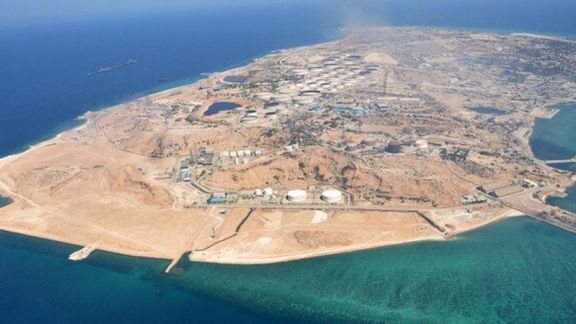
An aerial view of Abu Musa island in the Persian Gulf which has an air strip now

Iran has reasserted its claim to sovereignty over three Persian Gulf islands after Gulf Cooperation Council (GCC) foreign ministers met this week in Riyadh.

Foreign ministry spokesman Nasser Kanaani said Friday that Abu Musa, Greater Tunbs, and Lesser Tunbs were all Iranian, rejecting the GCC view that the islands belong to the United Arab Emirates (UAE). Kanaani said the GCC claim was “opening the security equations of the region to foreigners.”

The three islands have been in dispute since the British withdrew their armed forces in 1971 and Mohammad Reza Shah sent the Iranian navy to secure all three. Iranian forces remain on the islands, with only Abu Musa having much of a civilian population at several thousand.

Kanaani stressed Tehran’s wish for improved relations with the GGC member states, a central commitment of President Ebrahim Raisi since taking office in August 2021. Relations between Iran and the six GCC member-states have thawed with August’s return to Tehran of Kuwaiti and Emirati ambassadors, and with cautious Saudi-Iran dialogue since last year mediated by Iraq.

Raw nerve

But the statement closing the GGC foreign ministers’ meeting, their 153rd, in making a routine reference to three islands, has touched a raw nerve in Tehran amid wider tensions. Amongst the GCC, Qatar and Oman would welcome the return of the 2015 nuclear deal, the JCPOA (Joint Comprehensive Plan of Action), and have both mediated between Tehran and Washington.

The Iranian flag being raised in one of the three Persian Gulf islands taken by the Imperial Navy in 1971
100%
The Iranian flag being raised in one of the three Persian Gulf islands taken by the Imperial Navy in 1971

But even after President Joe Biden’s July visit to Jeddah, Saudi Arabia remains skeptical. The Saudis loudly opposed the JCPOA when it was agreed in 2015, and Crown Prince Mohammad bin Salam closely identified with President Donald Trump, who withdrew the US from the JCPOA in 2018.

In a piece Friday, Fars News republished a 2006 article written by Hossein Shariatmadari, long-serving editor of the flagship principlist daily Kayhan, establishing the “historical and legal reasons for Iran’s ownership.”

Maps from ancient Greece

With barely concealed contempt for the six nations of the GCC, none of which he pointed out had existed for as long as 100 years, Shariatmadari referred to maps and documents going back to ancient Greece, arguing that geographers and officials had considered the islands part of Iran. Shariatmadari gave particular mention to the work of the British, including an 1881 Royal Navy map with “the three islands and the soil of Iran” in the same color.

Shariatmadari headlined his 2006 article Avaz Kuche Baghi, ‘songs of the garden alleys,’ referring to old stories of passers-by singing to keep up their spirits as night fell. Similarly, the editor suggested, the Arab monarchs of the Persian Gulf ‘sang’ to dampen their fears of the “earthquake that the Islamic Revolution has thrown on their medieval and illegal governments” whose people lacked “the least involvement” in “the rule of one family.”

Shariatmadari also argued that Bahrain, which became an independent state 1971, had been “separated” from Iran in an “illegal conflict.” After the British took over Bahrain in the late nineteenth century there was agitation in the Iranian parliament by the 1950s to declare it an Iranian province, but Shah Mohammad Reza abandoned Iran’s claim in 1970.


Most Viewed

US blockade enters murky phase as tankers spoof signals and buyers hesitate
1
ANALYSIS

US blockade enters murky phase as tankers spoof signals and buyers hesitate

2

US tightens financial squeeze on Iran, warns banks over oil money flows

3
INSIGHT

Ideology may be fading in Iran, but not in Kashmir's ‘Mini Iran'

4
INSIGHT

Hardliners push Hormuz ‘red line’ as US blockade tests Iran’s leverage

5
VOICES FROM IRAN

Hope and anger in Iran as fragile ceasefire persists

Banner
Banner

Spotlight

  • Hardliners push Hormuz ‘red line’ as US blockade tests Iran’s leverage
    INSIGHT

    Hardliners push Hormuz ‘red line’ as US blockade tests Iran’s leverage

  • Ideology may be fading in Iran, but not in Kashmir's ‘Mini Iran'
    INSIGHT

    Ideology may be fading in Iran, but not in Kashmir's ‘Mini Iran'

  • War damage amounts to $3,000 per Iranian, with blockade set to add to losses
    INSIGHT

    War damage amounts to $3,000 per Iranian, with blockade set to add to losses

  • Why the $100 billion Hormuz toll revenue is a myth
    ANALYSIS

    Why the $100 billion Hormuz toll revenue is a myth

  • US blockade targets Iran oil boom amid regional disruption
    ANALYSIS

    US blockade targets Iran oil boom amid regional disruption

  • Iran's digital economy battered by prolonged blackout
    INSIGHT

    Iran's digital economy battered by prolonged blackout

•
•
•

More Stories

Group Of 52 US Lawmakers Ask Biden To Deny Visa For Iran’s President

Sep 9, 2022, 13:34 GMT+1

A bipartisan group of 52 US representatives has called on President Joe Biden to deny necessary "entry visas" for Iran’s President Ebrahim Raisi and his delegation to attend the UN Assembly.

The lawmakers led by Rep. Young Kim (R-CA), wrote in a letter published on Thursday, "The United States cannot overlook Ebrahim Raisi’s direct involvement in gross violations of internationally recognized human rights, including the 1988 organized mass murder of thousands of political prisoners, among whom were women and children, by the Iranian regime."

The lawmakers told the President that “Raisi was a documented member of the Tehran 'death committee,' the group responsible for overseeing the massacre. It is highly concerning that Raisi and other members of the so-called ‘death committee’ have not been investigated and charged with crimes against humanity.” 

Also on Thursday, a group of 500 Iranian-American scientists, academics, and professionals urged Biden to pursue Raisi’s international prosecution, saying that “Raisi does not represent the people of Iran and therefore must be denied entry visa to the US."

Since early August, eight Republican Senators, former US ambassador to the United Nations Nikki Haley, and former secretary of state Mike Pompeo have asked Biden to deny a visa to Raisi who plans to travel to New York City for the upcoming 77th United Nations General Assembly, which opens on September 13.

Raisi – who is on US and European sanctions list -- did not attend the UN meeting in 2021 and only delivered a video speech. 

Iranian Vice President Denies Son's Immigration To Canada

Sep 9, 2022, 12:07 GMT+1

Iran’s Vice President for Women and Family Affairs Ensieh Khazali has denied reports about her son’s immigration to Canada that caused uproar among the Iranian community.

In a series of tweets on Wednesday, Khazali claimed that her son, Hamidreza Rezazadeh, is on a temporary business trip abroad aimed at enhancing the country’s “knowledge-based sector,” in reference to the Supreme Leader’s call for a knowledge-based economy. 

Ali Khamenei designated the new Iranian calendar year as the year of knowledge-based productivity and job creation. He has been designating slogans for each year in the past decade, such as “Leap in Production”. Iranian officials and organizations try to portray their activities as if they are in line with the Khamenei-designated motto.

Khazali added that her son never planned immigration, “although he is married and independent,” and criticized those who spread the rumor, noting that “Fortunately, the job project is near completion and he will return to the country in the coming months.” 

“Undoubtedly, [efforts] to lay the foundation for knowledge-based activities in the country stem from patriotism,” she said

Calling for her dismissal, university professor and political activist Rahmatollah Bigdeli said, “If I were in Mr. Raisi’s shoes, I would fire Mrs. Khazali not because of her son's stay in Canada, but because of this kind of ridiculous abuse of this year’s designation by the Supreme Leader.”

In early August, an official criticized the high number of “senior officials” whose relatives are living abroad, confirming that there are over 4,000 sons and daughters who have left Iran.

Iraq, Iran Close Borders As Safety Concerns Grow Over Pilgrimage

Sep 9, 2022, 10:30 GMT+1
•
Iran International Newsroom

Iraq and Iran have closed land borders as millions of Iranian pilgrims supported by Tehran were on the move to reach Karbala to mark a Shiite religious event.

The Iranian government’s office organizing the Arbaeen pilgrimage said Friday, “Because of worrying incidents at [two border crossings] and serious dangerous incidents occurring for the security and wellbeing of pilgrims” the borders are closed.

Although Iranian authorities say they made the decision, but Iraq already closed border crossings Thursday afternoon because of congestion and high temperatures. Reports from Iraq say that the government has closed also internal roads leading to Krabala, the venue of the gathering, because existing infrastructure reached its full capacity.

The Iranian government has been advertising the pilgrimage with all its official media and religious organizations and offering financial help to potential pilgrims in the past few weeks. As late as Thursday, top Iranian officials, including the interior minister, were re-assuring the public that everything was coordinated with Iraq and the pilgrimage would continue throughout September.

But unexpectedly Iraq closed two major crossing points Thursday evening and Iran announced Friday morning that pilgrims who have made arrangements should change their plans and people with bus tickets can get their money back. It also said no more passports will be issued in person and those who have applied will receive them through the mail.

The pilgrimage is on the occasion of Arbaeen, the 40th day after the death of the third Shiite Imam, Hussain Ibn Ali, who was killed in a power rivalry by the reigning caliph in a clash in Karbala in 680 Ad.

Pilgrims in Iraq marching toward Karbala. Undated
100%
Pilgrims in Iraq marching toward Karbala. Undated

The battle and Hussain’s death is the main pillar of Shiite beliefs. The minority sect in the Muslim world believes that Hussain was the rightful successor to the first four Muslim rulers, being Prophet Muhammad’s grandson and the son of the fourth caliph Ali.

Iranian officials said Friday that conditions in Iraq were simply not ready for accepting a flood of hundreds of thousands of people that could well turn into millions of pilgrims not only from Iran but also Pakistan and Afghanistan.

However, the Arbaeen March to Iraq’s Karbala is a new phenomenon pushed by the Islamic Republic to show the power of Shiites who are a minority in the Muslim world and in West Asia.

Just a decade ago Arbaeen was marked in Iran’s religious centers and there was no tradition of a march to Karbala, but the government with its army of religious institutions and networks began to cultivate concept and with financial appropriations turned it into a millions-strong annual gathering.

This year, the government is offering $100 to each pilgrim, plus a loan of $160 to facilitate the march. In addition to that, transportation, food, medical services, free Wi-Fi and other services are offered. In all, it is estimated that Iran will spend at least $500 million this year despite its dire economic circumstances.

Iraq also experienced political upheaval in August between Iran-backed Shiite groups and followers of Muqtada Sadr, an influential Shia cleric opposed to Iran’s influence in the country.

In 2019, The New York Times quoted an influencial Iranian media boss, Hossein Sulaimani, as saying, “Arbaeen is a display of power for Iran and a showcase of unity among Shiites in the region."

Exodus Of Doctors From Iran Raises Serious Concerns

Sep 9, 2022, 06:21 GMT+1
•
Maryam Sinaiee

Officials and lawmakers are warning that Iran may be forced to hire foreign doctors as Iranian physicians are emigrating to other countries in droves.

Dr Mohammad Raeeszadeh, head of Medical Council of the Islamic Republic of Iran, recently warned in a speech at a national gathering on the occasion of Physicians’ Day that wrong government policies is causing disillusionment among young medical practitioners and could lead to a wave of emigration or change of career among them.

Warning about the emigration of medical staff, Dr Ali Javaherforoushzadeh, head of the Medical Council of Ahvaz, capital of the southwestern Khuzestan province, recently told the Iranian Students News Agency (ISNA) that in the past year around 300 good standing certificates, which are required for job applications abroad, had been issued for doctors and nurses in the province.

Experts and social scientists in Iran and abroad have told the media that the brain drain in the past few decades, beginning with the 1980-88 war with Iraq, has been accelerated by lack of social freedoms in the clerical-dominated system, political upheavals, deterioration of the economy, and government repression.

Dr Raeeszadeh said many among doctors have no motivation to study further and specialize in fields such as surgery, which are crucial to the country’s healthcare system.

“We will have to dispatch patients abroad for treatment or hire foreign doctors as we did [before the Islamic Revolution more than 40 years ago] if this trend continues,” he said.

Dr Raeeszadeh said that interest in heart surgery has hugely dropped and in the current academic year only two pediatric surgeons graduated in the whole country.

Elaborating on the same subject, Mohammad-Ali Mohseni-Bandpey, a member of the parliament health committee said wrong government policies affecting doctors included ignoring their needs and demands and refusing to allow them to raise their fees despite higher costs of living and running their practices.

For instance, Mohseni-Bandpey explained, the government has allowed private medical practitioners to increase their fees by between 6 to 10 percent but renting a practice is now costing 70 or 80 percent more, the price of equipment has doubled, as have energy costs and the salaries they are paying to the staff at their practices which is up to 60 percent higher than 3 years ago. “They have also set a ceiling [for the fees] in the public sector and the fees that doctors receive are not proportionate to the services they offer.”

According to Mohseni-Bandpey, despite an almost 50 percent annual inflation rate, the government is trying to prevent an similar increase in doctors’ fees, to keep healthcare costs down. He suggested that the government should them to increase their fees but shift the burden to insurance companies rather than patients.

Mohseni-Bandpey told Rouydad 24 news website that Oman, Qatar, and other neighboring countries are attracting not only Iranian doctors but also engineers and those working in the field of humanities.

“These countries use the workforce trained and educated by another country with the least cost,” he said, adding that Hong Kong is currently accepting Iranian students in medical universities and providing them with all their living and educational needs.

“They believe that it would be enough for them if only 10 percent of these students remain in their country, but they don't know that many more will stay and usually not more than 10 percent will come back [to Iran],” he said.

Republicans To Force US Admin To Provide Congress With Iran Draft Deal

Sep 8, 2022, 22:17 GMT+1

A Republican-sponsored resolution to force the Biden administration to provide Congress with the still-pending draft text of the nuclear deal with Iran is set for a vote next week. 

The resolution, introduced by Virginia Foxx (R-NC) and Joe Wilson (R-SC), is scheduled for a vote in the House Foreign Affairs Committee, Jewish Insider reported on Thursday. 

The bill would compel the administration to provide Congress with the text of the draft deal and any related side agreements immediately, even if negotiations are still in progress when the bill is passed. Under existing law -- the Iran Nuclear Agreement Review Act (INARA) -- the administration is required to submit any nuclear agreement with the Islamic Republic in full to Congress when it is signed.

A source familiar with the legislation characterized it as an “opening salvo” in efforts to “force” the administration to comply with the existing law, raising concerns that the administration will seek to duck INARA review or conceal side agreements related to the deal, something that Republicans accuse the Obama administration of doing in 2016.

Sen. Bob Menendez (D-NJ), who chairs the Senate Foreign Relations Committee, said during his visit to Israel earlier this week that the administration has committed that it will submit any final deal for congressional review. 

Earlier in the month, a bipartisan group of 50 US lawmakers -- 34 Democrats and 16 Republicans -- sounded the alarm on a looming agreement over Iran’s nuclear deal, urging the administration to immediately consult with Congress.





