• العربية
  • فارسی
Brand
  • Iran Insight
  • Politics
  • Economy
  • Analysis
  • Special Report
  • Opinion
  • Podcast
  • Iran Insight
  • Politics
  • Economy
  • Analysis
  • Special Report
  • Opinion
  • Podcast
  • Theme
  • Language
    • العربية
    • فارسی
  • Iran Insight
  • Politics
  • Economy
  • Analysis
  • Special Report
  • Opinion
  • Podcast
All rights reserved for Volant Media UK Limited
volant media logo

Iran’s Reformist Ex-President Says Committed To Islamic Republic

Iran International Newsroom
Sep 8, 2022, 16:19 GMT+1Updated: 17:33 GMT+1
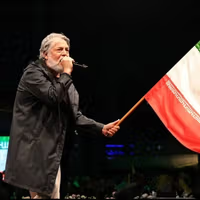
Former Iranian reformist president Mohammad Khatami. Undated

Years after ex-president Mohammad Khatami was barred from media and public appearances, his camp has found a way to communicate his messages to the public.

Online media, including Rouydad24 website on September 7, quoted reformist academic Fayyaz Zahed as saying that Khatami told him in a recent meeting that "Reformism does not mean opposition to the Islamic Republic system." Fayyaz said that Khatami is still preoccupied with the idea of reforming the Islamic Republic.

Iran's reformists and their de-facto leader Mohammad Khatami, who has never announced himself as a leader, fell out of Supreme Leader Ali Khamenei's favor long before the end of Khatami's presidency [1997-2005]. However, Khatami was forced into isolation after the disputed re-election of conservative candidate Mahmoud Ahmadinejad in 2009 and the ensuing protests.

Since then, Khatami's presence was limited to rare appearances in rare electoral events and in YouTube videos where he called on voters to take part in elections. Even this worked against him when in the 2016 parliamentary and Assembly of Experts elections the list he advocated included several ultraconservatives with a reputation as thugs.

Meanwhile, the extremely poor and counter-productive performance of the reform faction in the parliament between 2016 and 2020, put the final nail in the reform movement's coffin as many reformist analysts have observed in numerous articles since 2020.

This, along with disqualification of reformist candidates by the Guardian Council, brought their share of the votes in the 2021 election to a humiliating 3 percent.

Reformist academic and political activist Fayyaz Zahed
100%
Reformist academic and political activist Fayyaz Zahed

Fayyaz Zahed quoted Khatami as saying that "Iran's reformist are not in a position they deserve to be. They need to revise their ideas in many areas including their relations with the people. Khatami has also said that reformists need to re-organize."

According to Rouydad24, Zahed was in a meeting with Khatami on September 3 when they discussed current affairs and the reformists. Fayyaz said that "Khatami's main preoccupation is preserving the Islamic Republic." He said Khatami is loyal to the regime and feels indebted to the regime and the legacy of Ayatollah Ruhollah Khomeini the founder of the Islamic Republic of Iran in 1979.

This has been an important dividing issue in recent years among Iranian political activists at home and abroad. Those favoring regime change argue that Iran’s reformists wrongly think that the clerical-military system can be reformed, and Khatami is in fact the leader of this faction.

Khatami stressed on the rule of law within the Islamic Republic in his meeting. He said that Islam cannot support despotism, Zahed observed and added that Khatami still believed in his theory of dialogue among civilizations.

Oddly enough, Fayyaz said he is not allowed to share Khatami's ideas about reformists' political activity! He only explained that Khatami believed that reforms were the least costly way of correcting governance in Iran.

Other reports on Wednesday indicated that the regime under Khamenei was not even prepared to accept moderate conservatives such as Former President Hassan Rouhani. One report observed that the ultraconservative-dominated parliament still openly brands the Rouhani administration as the culprit for the current economic crisis in Iran. This is an accusation also made several times by President Ebrahim Raisi and his vice presidents and cabinet ministers.

The report observed that although some reformist figures such former vice president Es'haq Jahangiri have become more vocal recently, Iran's conservatives are quick to respond with more accusations, calling on former officials to keep their mouths shut.


Most Viewed

Ghalibaf defends Iran-US talks amid hardline backlash
1
INSIGHT

Ghalibaf defends Iran-US talks amid hardline backlash

2
INSIGHT

A nation in limbo: 100 days after the massacre, has the world moved on?

3
ANALYSIS

From instability to influence: Pakistan’s pivotal role in US-Iran diplomacy

4
ANALYSIS

100 days on: why Iran’s January protests spread across social classes

5

War-hit homeowners feel abandoned as Iran’s reconstruction aid fades

Banner
Banner

Spotlight

  • War-hit homeowners feel abandoned as Iran’s reconstruction aid fades

    War-hit homeowners feel abandoned as Iran’s reconstruction aid fades

  • 100 days on: the anatomy of Iran’s January crackdown
    INSIGHT

    100 days on: the anatomy of Iran’s January crackdown

  • Ghalibaf defends Iran-US talks amid hardline backlash
    INSIGHT

    Ghalibaf defends Iran-US talks amid hardline backlash

  • 100 days on: why Iran’s January protests spread across social classes
    ANALYSIS

    100 days on: why Iran’s January protests spread across social classes

  • From instability to influence: Pakistan’s pivotal role in US-Iran diplomacy
    ANALYSIS

    From instability to influence: Pakistan’s pivotal role in US-Iran diplomacy

  • A nation in limbo: 100 days after the massacre, has the world moved on?
    INSIGHT

    A nation in limbo: 100 days after the massacre, has the world moved on?

•
•
•

More Stories

FIFA Demands Iran’s Explanation Over Banning Women From Stadium

Sep 8, 2022, 15:04 GMT+1

FIFA has asked Iran to explain the incidents surrounding a match in March in the city of Mashhad where women who wanted to watch the game were pepper sprayed.

The Disciplinary Committee of the international governing body of association football – or soccer -- sent a letter to the Iranian Football Federation on Tuesday, and gave it a week to provide a response about the events at the FIFA World Cup qualifier between Iran and Lebanon on March 29, during which security forces denied women entry into the stadium and used tear gas and pepper spray to disperse them. 

The letter stated five cases of violations of the body’s codes and regulations, adding that investigations are in progress about the incidents.

About 12,500 tickets were sold for the match, and 2,000 of them were allocated for women, but hundreds of women with tickets were not allowed into the Imam Reza stadium in the religious city of Mashhad. 

Mashhad is home to numerous hardliner clerics who are against the presence of women in male dominated places. Firebrand representative of the Supreme Leader in the city, Ayatollah Ahmad Alamolhoda has been banning concerts and cultural events for years. The forceful banning of women’s entry into the stadium was reportedly ordered by the local clergy.

The world’s soccer authority had tried to convince Iran’s government -- which has barred female spectators from stadiums for years claiming it would violate religious rules of decency -- to lift the unwritten ban for nearly a decade. The ban has led to many arrests, beatings, detentions, and abuses against women.

95% Of Abortions Are Done Illegally In Iran – Official

Sep 8, 2022, 13:51 GMT+1

An Iranian official says according to the available data about 95 percent of abortions in the country are carried out through "illegal" procedures. 

Saleh Ghasemi, head of the Center for Strategic Research on Population, said on Thursday that abortion is one of the most effective variables in population growth, adding that "Only three percent of abortions [in Iran] are legal, and two percent of abortions are spontaneous."

He also said that only four percent of abortions happen due to what he called "illegitimate relations".

The ban on abortion in Iran has made women go to underground and often unsanitary centers to terminate their pregnancies. Unsanitary abortion has caused the death of many women and sometimes it has caused lifetime complications. 

Earlier in the year, Iran’s Supreme Leader Ali Khamenei said efforts to increase the country's population are among the most urgent duties and essential policies of the Islamic Republic.

Parliament has passed legislation to outlaw tubectomy, vasectomy, and the free dispensation of contraceptives other than where pregnancy would threaten a woman's health. The health ministry has advised women over 35 to wait only a year before becoming pregnant again and under-35s to wait six months.

Medical experts have warned that the new legislation would increase sexually transmitted diseases by restricting access to condoms.

The law obliges the government to offer incentives, including a 7.5-fold increase in child-benefit payments to government employees, interest-free loans, and other benefits. While the new law does not include a ban on prenatal screening, doctors have been advised not to encourage it.

Iran Pushing Large Pilgrimage To Iraq To Show Influence

Sep 7, 2022, 11:34 GMT+1
•
Maryam Sinaiee

The Iranian government is promising perks including loans and free Internet to those participating in the Arbaeen pilgrimage to Karbala, Iraq, later this month.

Government spokesman Ali Bahadori-Jahromi said Tuesday that in the latest cabinet meeting President Ebrahim Raisi ordered all government organizations to provide maximum facilitation for the annual pilgrimage to Karbala where the main events of the annual ceremonies take place.

According to Bahadori-Jahromi, the government has improved the country’s infrastructures to facilitate pilgrimage to the religious city of Karbala including ten different airports for flights to Iraq as well as six dedicated border checkpoints, and the railway network. The first rail line from Tehran to Karbala has now been launched, he added.

The Civil Aviation Organisation has said but it has prepared 1,000 special flights to Iraq For the ceremonies.

Iran will probably end up spending hundreds of millions of dollars to sponsor a large pilgrimage because both domestically and in the region the clerical regime needs to show its ideology is influential.

In 2019, The New York Times quoted an influencial Iranian media boss, Hossein Sulaimani, as saying, “Arbaeen is a display of power for Iran and a showcase of unity among Shiites in the region."

The government will also be stationing a hot air balloon in the Iraqi border area to provide free mobile Internet access as well as free Wi-Fi to pilgrims and will also grant 50 million rial loans (around $160) to heads of households going on family pilgrimage and 30 million ($100) to individual pilgrims, he said, adding that the loan can be secured by online application and there will be no need for guarantees if the applicant has a cash subsidy account.

Arbaeen pilgrims walking to Karbala in Iraq. Undated
100%
Arbaeen pilgrims walking to Karbala in Iraq

Around 5 million Iranian pilgrims are expected to travel to Iraq during the Arbaeen ceremonies which fall on September 18 this year. If such a large number end up going, the loan alone can cost the government upwards of $500 million amid an estimated 50-percent budget deficit.

Iranian authorities deploy all religious entities and media to encourage pilgrimage to Karbala. Government organisations and the state affiliated charities as well as municipalities and city councils often allocate considerable budgets to organize the Arbaeen Walk. Some officials and clerics say the Arbaeen gathering is one of the manifestations of the Shia “soft power’.

Many government organizations, municipalities, and city councils have separately allocated special budgets for the Arbaeen ceremonies in Iraq. The City Council of Mashhad, for instance, has approved a budget of 150 billion rials ($5 million) for services in the Iraqi holy city of Najaf and will dispatch 525 city cleaners and 354 bus drivers there.

“Arbaeen was a grassroots religious occasion…but the Islamic Republic turned it into a state ceremony. holding state religious events and using public money for that purpose. It means the government is putting its hand in people’s pockets without asking for permission,” Reza Veisi, Iran International analyst tweeted Monday.

The Arbaeen ceremony which marks the end of the 40-day mourning period following Ashura -- the religious ritual for the commemoration of the third Shia Muslim Imam, Hussain ibn Ali, the grandson of the Prophet Muhammad, killed in 680 AD – is the world's largest annual gathering.

Millions of Shia Muslims gather every year to mark Arbaeen in Karbala, Iraq, where the Imam is buried. Many walk long distances, even hundreds of kilometres, to the shrine of the Imam.

There are no reliable methods for tallying the number of visitors to Iraqi holy Shia sites during Arbaeen. In 2019, before the pandemic, an estimated 15 million people from various countries attended the ceremonies.

Critics Slam Iran’s President For Having Inexperienced Ministers

Sep 6, 2022, 08:22 GMT+1
•
Iran International Newsroom

No Iranian president has faced so much criticism over his government’s economic record in the first year of his term as President Ebrahim Raisi is facing now.

Economist Mehdi Pazouki says, "The government of President Ebrahim Raisi has been put at the disposal of the Imam Sadeq alumni who have no executive experience." Imam Sadeq University is known for its more than usual religious orientation.

Pazouki added in an interview with the centrist daily Ham Mihan on September 2 that "economic managers of the early years after the 1979 revolution had a far better performance than the current officials."

Meanwhile, the moderate news website Rouydad24 quoted Pazouki as having said in the interview that no foreign investment is likely to be made in Iran without solving the Islamic Republic's problems with the JCPOA and FATF. The economist was hinting that Iran needs to improve its ties with the West by reaching a nuclear deal and accept the terms of FATF, an international financial watchdog.

The Financial Action Task Force, whose evaluations of a country’s financial regulations can impact it ability to interact with the international financial system has black listed Iran and demanded legislation to improve transparency and a ban on financing of terrorism.

Pazouki added that the government's economic team behaves like an organized religious organization. "When you hand over a government ministry to someone whose only accreditation is having studied at the Imam Sadeq University and has no background in executive work, you will obviously leave the government face to face with economic problems," he said.

Iranian economic Mehdi Pazuki in an earlier media interview. Undated
100%
Iranian economic Mehdi Pazuki in an earlier media interview

Journalist Zaynab Ghobayshavi writing in Rouydad24 quoted critics who say Raisi's economic team cannot step up to its job and his aides lack coordination and a teamwork mentality.

Pazouki told Rouydad24 that Raisi’s economic ministers have yet to present an economic plan, but they lack a strategy. Nonetheless, the Raisi administration claims that the budget bill for the current year has been formulated based on the country's sixth development plan that was made under former President Hassan Rouhani while the new administration has been constantly criticizing its predecessor’s economic policies.

"If Rouhani's plans are bad, why are you still following them as your own policy?" Pazouki asked.

During the election campaign in 2021, Raisi had said that he has a 7000-page economic plan, but no one has ever seen even seven pages of that plan, the economist said. He then argued adding that lacking a plan, the Raisi Administration made one of the biggest mistakes in the history of the Islamic Republic, that is increasing the minimum wage by 57 percent overnight while the country was suffering from an inflation rate more than 40 percent. It also increased employment in the government sector by 38 percent.

Even some of Raisi’s political allies, such as hardline conservative politician Hedayatollah Khademi have charged that Raisi's ministers are not fit for their jobs and the President should fire them and demand operational plans from the remaining ministers.

Khademi went on to say that Raisi's ministers failed to meet any one of the nation's expectations during the past 13 months, and even if Iran reaches an agreement with the West, the current ministers will not be able to solve any of the country's problems.

In another development, lawmaker Somayeh Rafiei has also said that after 13 months in office, there is no coherence and coordination visible in Raisi's economic team.

Iranian lawmakers have repeatedly threatened to impeach Raisi's economic team, and tabled motions for their impeachment, but Speaker Mohammad Bagher Ghalibaf have so far stopped every motion, waiting for Raisi to fire them.

Despite FIFA’s Pressure, Iran Not To Allow Women To Referee Men’s Matches

Sep 5, 2022, 18:47 GMT+1

An Iranian official has rejected reports that the international governing body of football, FIFA, is forcing Iran to let female referees officiate matches in the men's league.

Khodadad Afsharian, the head of the referees' committee of the country, said on Monday that although it was one of FIFA's demands, there is no requirement to do so and all national matches in men's and women's categories will continue to be judged by their respective referees.

Last week, he told the media that FIFA has asked the country’s federation to employ women referees for men's games, adding that the issue will be taken into consideration for the youth leagues.

He also said that women referees will participate in training courses on the use of Video Assistant Referee (VAR) Technology, which will be added to the country’s matches in the near future.

Late in August, under pressure from FIFA, 500 female fans were allowed into Tehran's Azadi Stadium to watch a local league football match.

Tickets were sold only to 500 female fans and a special forces unit consisting of female anti-riot police was present to lead them to their secluded section of the 100,000-seat stadium.

The world’s soccer authority had tried to convince Iran’s government to lift an unwritten ban on women attending stadiums to watch male players for nearly a decade. The ban has led to many arrests, beatings, detentions, and abuses against women.