• العربية
  • فارسی
Brand
  • Iran Insight
  • Politics
  • Economy
  • Analysis
  • Special Report
  • Opinion
  • Podcast
  • Iran Insight
  • Politics
  • Economy
  • Analysis
  • Special Report
  • Opinion
  • Podcast
  • Theme
  • Language
    • العربية
    • فارسی
  • Iran Insight
  • Politics
  • Economy
  • Analysis
  • Special Report
  • Opinion
  • Podcast
All rights reserved for Volant Media UK Limited
volant media logo

Critics Slam Iran’s President For Having Inexperienced Ministers
Iran International Newsroom
Sep 6, 2022, 08:22 GMT+1Updated: 17:22 GMT+1
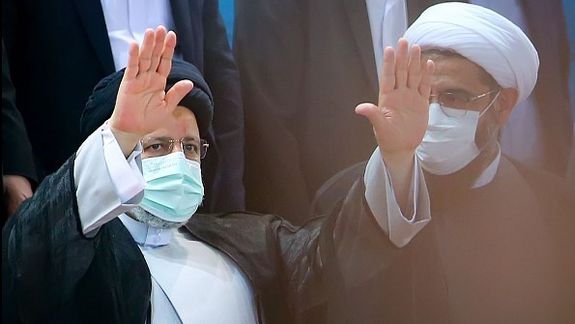
President Ebrahim Raisi during one his frequent provincial visits in Hamedan in July 2022

No Iranian president has faced so much criticism over his government’s economic record in the first year of his term as President Ebrahim Raisi is facing now.

Economist Mehdi Pazouki says, "The government of President Ebrahim Raisi has been put at the disposal of the Imam Sadeq alumni who have no executive experience." Imam Sadeq University is known for its more than usual religious orientation.

Pazouki added in an interview with the centrist daily Ham Mihan on September 2 that "economic managers of the early years after the 1979 revolution had a far better performance than the current officials."

Meanwhile, the moderate news website Rouydad24 quoted Pazouki as having said in the interview that no foreign investment is likely to be made in Iran without solving the Islamic Republic's problems with the JCPOA and FATF. The economist was hinting that Iran needs to improve its ties with the West by reaching a nuclear deal and accept the terms of FATF, an international financial watchdog.

The Financial Action Task Force, whose evaluations of a country’s financial regulations can impact it ability to interact with the international financial system has black listed Iran and demanded legislation to improve transparency and a ban on financing of terrorism.

Pazouki added that the government's economic team behaves like an organized religious organization. "When you hand over a government ministry to someone whose only accreditation is having studied at the Imam Sadeq University and has no background in executive work, you will obviously leave the government face to face with economic problems," he said.

Iranian economic Mehdi Pazuki in an earlier media interview. Undated
100%
Iranian economic Mehdi Pazuki in an earlier media interview

Journalist Zaynab Ghobayshavi writing in Rouydad24 quoted critics who say Raisi's economic team cannot step up to its job and his aides lack coordination and a teamwork mentality.

Pazouki told Rouydad24 that Raisi’s economic ministers have yet to present an economic plan, but they lack a strategy. Nonetheless, the Raisi administration claims that the budget bill for the current year has been formulated based on the country's sixth development plan that was made under former President Hassan Rouhani while the new administration has been constantly criticizing its predecessor’s economic policies.

"If Rouhani's plans are bad, why are you still following them as your own policy?" Pazouki asked.

During the election campaign in 2021, Raisi had said that he has a 7000-page economic plan, but no one has ever seen even seven pages of that plan, the economist said. He then argued adding that lacking a plan, the Raisi Administration made one of the biggest mistakes in the history of the Islamic Republic, that is increasing the minimum wage by 57 percent overnight while the country was suffering from an inflation rate more than 40 percent. It also increased employment in the government sector by 38 percent.

Even some of Raisi’s political allies, such as hardline conservative politician Hedayatollah Khademi have charged that Raisi's ministers are not fit for their jobs and the President should fire them and demand operational plans from the remaining ministers.

Khademi went on to say that Raisi's ministers failed to meet any one of the nation's expectations during the past 13 months, and even if Iran reaches an agreement with the West, the current ministers will not be able to solve any of the country's problems.

In another development, lawmaker Somayeh Rafiei has also said that after 13 months in office, there is no coherence and coordination visible in Raisi's economic team.

Iranian lawmakers have repeatedly threatened to impeach Raisi's economic team, and tabled motions for their impeachment, but Speaker Mohammad Bagher Ghalibaf have so far stopped every motion, waiting for Raisi to fire them.


Most Viewed

Hardliners push Hormuz ‘red line’ as US blockade tests Iran’s leverage
1
INSIGHT

Hardliners push Hormuz ‘red line’ as US blockade tests Iran’s leverage

2

Iran International says it won’t be silenced after London arson attack

3
VOICES FROM IRAN

Hope and anger in Iran as fragile ceasefire persists

4

US sanctions oil network tied to Iranian tycoon Shamkhani

5

Iran halts petrochemical exports to supply domestic market

Banner
Banner

Spotlight

  • Hardliners push Hormuz ‘red line’ as US blockade tests Iran’s leverage
    INSIGHT

    Hardliners push Hormuz ‘red line’ as US blockade tests Iran’s leverage

  • Ideology may be fading in Iran, but not in Kashmir's ‘Mini Iran'
    INSIGHT

    Ideology may be fading in Iran, but not in Kashmir's ‘Mini Iran'

  • War damage amounts to $3,000 per Iranian, with blockade set to add to losses
    INSIGHT

    War damage amounts to $3,000 per Iranian, with blockade set to add to losses

  • Why the $100 billion Hormuz toll revenue is a myth
    ANALYSIS

    Why the $100 billion Hormuz toll revenue is a myth

  • US blockade targets Iran oil boom amid regional disruption
    ANALYSIS

    US blockade targets Iran oil boom amid regional disruption

  • Iran's digital economy battered by prolonged blackout
    INSIGHT

    Iran's digital economy battered by prolonged blackout

•
•
•

More Stories

US Will Never Tie Israel’s Hands Against Iran - Biden Assures Lapid

Sep 5, 2022, 21:30 GMT+1

US Ambassador to Israel Thomas Nides said Monday that President Joe Biden has assured Prime Minister Yair Lapid that Washington will never tie Israel’s hands against Iran. 

Reiterating the pledge to stop the Islamic Republic from acquiring nuclear weapons, Nides said at a press conference in Jerusalem that “We understand the aggression of Iran,” adding that “[Biden] was very clear to the prime minister in that belief.” 

“We also would like a diplomatic solution, but only under the conditions the president has laid out with our European colleagues. There are many gaps and conditions that have to be reached before we would actually agree to an agreement,” Nides said.

He made the remarks as a congressional delegation, including Robert Menendez, the chairman of the Senate Committee on Foreign Relations, is visiting Jerusalem. Menendez told a press conference that Biden has pledged to submit any agreement on Iran’s nuclear program to Congress for review. 

He added that a review would be conducted by his committee and that there would be a vote on such a deal, noting that he was unsure if the outcome of that vote “would meet the threshold under the law to nullify the agreement.”

Republican Senator Lindsey Graham of South Carolina, also part of the congressional group, said the delegation was briefed by Mossad chief David Barnea, who will be in Washington this week to attend closed-door classified meetings of House and Senate intelligence committees.

“The Mossad leader’s trip to the US will focus on tightening security and intelligence coordination with the Americans surrounding the Iranian nuclear issue,” read a Sunday statement from Lapid’s office.

IRGC Adds New Military Vessels To Its Navy Fleet

Sep 5, 2022, 16:40 GMT+1

Iran’s Revolutionary Guard (IRGC) navy has added three new military vessels to its fleet including a patrol combat warship named after Qasem Soleimani, killed by a targeted US air strike in 2020.

Addressing the unveiling ceremony in the southern Iranian port city of Bandar Abbas on Monday, Major General Mohammad Bagheri, Iran's chief of staff for the Armed Forces, said the Soleimani patrol combat warship is a multi-hulled watercraft that can carry choppers and can unload strike speedboats and vertical take-off and landing (VTOL) drones, adding that it is the first Iranian military vessel equipped with air defense missiles with a vertical launching system that can fire mid- and short-range missiles.

He claimed that the hull of Shahid Soleimani-class missile corvette is made with radar-evading stealth technology construction techniques, meaning that it has a very low level of radar cross-section thanks to its shape. 

In addition to Bagheri, the IRGC Chief Commander Major General Hossein Salami, Commander of the IRGC Navy Rear Admiral Alireza Tangsiri and a number of other high-ranking military officials, commanders and state officials attended the ceremony. 

The IRGC Navy also delivered Shahid Rouhi and Shahid Dara high-speed and missile-launching assault boats. 

Shahid Dara is an upgraded version of old Tondal-class missile boat  (September 5, 2022)
100%
Shahid Dara is an upgraded version of old Tondal-class missile boat
Shahid Rouhi missile boat  (September 5, 2022)
100%
Shahid Rouhi missile boat

In July, the United States Naval Institute published satellite photos showing that Iran was constructing new stealth missile boats on the island of Qeshm in the Strait of Hormuz in the Persian Gulf.

On Sunday, two surface-to-surface missile launchers, one logistic vessel and one Ghadir-class submarine were added to the South Fleet of the Iranian Army Navy of the country.


Iran Confirms Bid To Buy Russian Su-35 Fighter Jets

Sep 5, 2022, 15:42 GMT+1

The Commander of the Iranian Army’s Air Force has confirmed that the Islamic Republic is seeking to purchase Sukhoi Su-35 fighter jets from Russia. 

Brigadier General Hamid Vahedi said on Monday that buying Su-35s is on the agenda of the Air Force but the country has no plans to buy Sukhoi Su-30s, both developed from Sukhoi Su-27 which was a Soviet-origin twin-engine supermaneuverable fighter aircraft. Su-35 is single-seat but Su-30 is a two-seat, multi-role fighter. 

According to reports, the Army’s Air Force needs at least 64 aircraft, 24 of which will come from Egypt's order which remained undelivered due to US pressure on Cairo. 

Tehran-Moscow deals for drones, satellites and other aviation equipment have been increasing in recent months. Russia not only launched a satellite for Iran in August, but its personnel were also reportedly sent to train on Iranian military drones to use in Ukraine.

As tensions remain high between Washington and Tehran, the United States military said earlier in the day that it flew a pair of nuclear-capable B-52 long-distance bombers over the Middle East in a show of force, the latest such mission in the region as tensions remain high between Washington and Tehran.

The bombers took off from the Royal Air Force base at Fairford, England, and flew over the eastern Mediterranean, the Arabian Peninsula and the Red Sea on Sunday in training missions together with Kuwaiti and Saudi warplanes. Three Israeli F-16 fighter jets accompanied the American bombers “through Israel’s skies on their way to the Persian Gulf,” the Israeli military said, describing the country’s cooperation with the US military as key to “maintaining aerial security in Israel and the Middle East.”

Iranian Industry Losing Money Due To Gas And Electricity Shortages

Sep 5, 2022, 14:10 GMT+1
•
Mardo Soghom

As Iran claims it can help Europe with its energy crisis, a new report shows Iranian industry lost $7 billion last year due to shortages of gas and electricity.

Amid nuclear talks with the West, Iran has hardened its position in recent days and government officials as well as its media have been suggesting that Europe is facing a winter energy shortage that Iran can help alleviate if a deal is reached and US sanctions lifted.

But the relatively independent Shargh newspaper in Tehran has published a report based on official statistics saying that shortages of gas and electricity cost Iranian businesses billions of dollars in losses in 2021-2022.

The loss equals 10 percent of Iran’s oil and non-oil exports that generate desperately needed foreign currency.

The government facing both a natural gas shortage and inadequate electricity generation decided not to reduce supplies to homes, which was common during the last years of the former administration. Instead, industries were deprived of electricity in peak summer months and gas in the winter.

Iran’s petrochemical sector needs natural gas to operate, and they sustained losses because of shortages. The other export-oriented sector, the steel industry needs a lot of electricity, and some plants were intermittently idle in the past 15 months.

Shargh quoted figures from the energy ministry saying that electricity imports from neighboring countries increased by 51 percent in June-July 2022, compared with the same period last year, while exports decreased by 60 percent.

Blackout in Tehran in January 2021
100%
Blackout in Tehran in January 2021

Iran holds the world’s second largest natural gas reserves, but its energy shortage is mainly due to two self-made problems, emanating mostly from its confrontational foreign policy that deprives the government from income and investments.

Iran’s gas production is gradually falling as natural pressure in its South Pars fields is dropping and it needs technological help from Western energy giants to build larger platforms with stronger pumps to get the gas out. This in turn needs either partnership deals or Iranian cashinvestments to the tune of $50 billion.

But because of its long-running confrontation with the West, primarily the United States, and its nuclear program seen as a serious threat, Iran has not been able to benefit from Western technology and investments. Recently, it is trying to import gas from Russia.

The other serious issue is insufficient electricity generation capacity, which is also largely due to lack of efficient technologies and money for investments. Domestic demand for gas and electricity has been rising, while production has been falling.

Lack of money, price controls and bad planning have also prevented the development of solar energy, which is suitable for a country with more than 300 sunny days in the year.

The rising demand for energy is due to extremely low rates for domestic consumers, which essentially amounts to subsidies that have been in place since the 1980s. The Islamic Republic has been reluctant to erase the subsidy that amounts to more than $50 billion a year because of its closed economic system run by the government.

As the government controls the energy markets and prices, offering very low prices to producers, there is little incentive to invest in power generation, including solar energy.

With an economic crisis prevailing since 2018 when the United States withdrew from the 2015 nuclear agreement and imposed sanctions, it is much harder for the government to reduce energy subsidies. When the government modestly raisied gasoline prices in November 2019 it led to nationwide anti-regime protests in which security forces killed at least 1,500 people.

Iran Will Not Tolerate Enemy Drones In Region – Military Chief

Sep 5, 2022, 12:32 GMT+1

Iran's most senior military commander says the "enemies" endanger the safety of navigation by launching and sending small unmanned reconnaissance maritime drones.

Major General Mohammad Bagheri, the chief of staff for the Armed Forces of the Islamic Republic, made the remarks on Monday referring to a series of encounters between Iranian and United States naval forces last week.

"Enemies are trying to compensate for the reduction of force in the Middle East by creating new units," he said, adding that “They endanger maritime security by dispatching small unmanned surveillance drones, but the armed forces' response to vessels wandering in open waters will be decisive."

He also criticized Israel joining the United States Central Command (CENTCOM), calling it a ‘threat’ for Iran. “We do not tolerate the presence of the Zionist regime," Bagheri said, noting that "We will not make any compromises regarding the rights of the Iranian nation and the security of our seas and lands,"

Iran seized and released two American sea drones in the Red Sea on Friday. Later in the day, US officials reported that Iran returned the two captured maritime drones after being confronted by US destroyers but the unmanned vessels were missing their cameras.

On Tuesday, the US Naval Forces Central Command said that the US Navy prevented a support ship from Iran’s Revolutionary Guard’s Navy -- named Shahid Baziar -- from capturing an unmanned vessel operated by the US 5th Fleet in the Persian Gulf.

Iran’s tough military tone is coupled with its hardening of diplomatic posture in the ongoing talks to revive the 2015 nuclear agreement, the JCPOA.