• العربية
  • فارسی
Brand
  • Iran Insight
  • Politics
  • Economy
  • Analysis
  • Special Report
  • Opinion
  • Podcast
  • Iran Insight
  • Politics
  • Economy
  • Analysis
  • Special Report
  • Opinion
  • Podcast
  • Theme
  • Language
    • العربية
    • فارسی
  • Iran Insight
  • Politics
  • Economy
  • Analysis
  • Special Report
  • Opinion
  • Podcast
All rights reserved for Volant Media UK Limited
volant media logo

Water Protests In Iranian City Continue For Second Night
Aug 25, 2022, 10:50 GMT+1
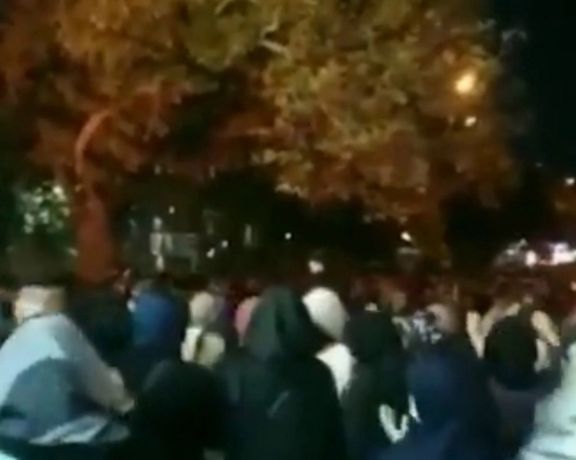
A frame grab from a video of the water protests in Hamedan

Protests by residents of Iran’s western city of Hamedan, an ancient capital, continued for the second night over a lack of water in the past ten days. 

Videos and photos surfaced on social media showing people chanting slogans against the government and authorities' incompetence for their mismanagement of the water resources in the province. 

Protesters gathered in front of the governor’s office and some iconic landmarks in the city, carrying placards and empty bottles while security forces – backed by special anti-riot forces -- were trying to disrupt the gatherings. Some clashes were also reported during the police standoff with people. 

The crisis which has seriously affected the everyday lives of the majority of the city’s nearly 600,000 population, has been attributed to the critical depletion of the water in the Ekbatan Dam reservoir, with zero inflows.

The popular protests against the government's inefficiency in water supply have also been reported in the city of Kazeroon (Kazerun) in southwestern Fars province.

Iran’s Energy Minister admitted on Wednesday that the main problem of water tensions in Iran is the government's negligence in building water supply infrastructure, whereas Hamedan’s governor had blamed the farmers for the water crisis.

Earlier in the month, a large group of people in the city of Shahrekord in Chaharmahal-Bakhtiari -- a traditionally water-rich region in the Zagros mountains -- held a protest rally after nine days with no drinking water.

In recent years, many cities across the country were scenes of massive protests against the authorities’ mismanagement of water resources or harmful dam building and politically motivated diversion of rivers that have devastated agriculture and drinking water sources, while the Iran has been suffering from drought for at least a decade.


Most Viewed

Iran diplomacy wobbles as factions compete to avoid looking soft on US
1
INSIGHT

Iran diplomacy wobbles as factions compete to avoid looking soft on US

2
ANALYSIS

The politics of pink: how Iran uses cuteness to rebrand violence

3

Scam messages seek crypto for ships’ safe passage through Hormuz, firm warns

4
EXCLUSIVE

Family told missing teen was alive, then received his body 60 days later

5
INSIGHT

Is Iran entering its Gorbachev moment?

Banner
Banner

Spotlight

  • Diplomacy tolls at Hormuz as conflict returns to its doorstep
    OPINION

    Diplomacy tolls at Hormuz as conflict returns to its doorstep

  • Opposition to US talks grows in Tehran as ceasefire deadline nears
    INSIGHT

    Opposition to US talks grows in Tehran as ceasefire deadline nears

  • Tehran moderates see ‘no deal–no war’ limbo as worst outcome
    INSIGHT

    Tehran moderates see ‘no deal–no war’ limbo as worst outcome

  • The future has been switched off here
    TEHRAN INSIDER

    The future has been switched off here

  • Lights out, then gunfire: Witnesses recount Mashhad protest crackdown
    VOICES FROM IRAN

    Lights out, then gunfire: Witnesses recount Mashhad protest crackdown

  • Is Iran entering its Gorbachev moment?
    INSIGHT

    Is Iran entering its Gorbachev moment?

•
•
•

More Stories

Political Prisoner Busts Out Of Evin Prison – Former Lawyer

Aug 24, 2022, 15:15 GMT+1

Unconfirmed reports are circulating in social media about the escape of a political prisoner, who used to work as an official of Iran’s Presidential Administration, from Tehran’s Evin prison. 

Attorney Mohammad Moghimi said on Twitter on Wednesday that his former client Farhad Salmanpour Zahir has managed to "escape" from the prison.

“In a bold and clever move, he escaped from Evin prison with a very complex, technical, and stylish act after misleading” intelligence officers -- Moghimi said. 

Salmanpour, who worked at the president's office under Mahmoud Ahmadinejad, was detained on August 21, 2019, by the intelligence ministry agents without any arrest warrant and was taken to Evin’s 209 ward, where he spent 45 days in solitary confinement. He had been imprisoned many times by the security agencies during the past years.

About two months later, human rights sources reported that Salmanpour was subjected to the most severe torture in order to obtain a forced confession about his relationship with Ruhollah Zam, a dissident journalist who was the director of the Amadnews Telegram channel before he was abducted in Iraq in 2019, and taken to Iran and hanged.

He reportedly faced new charges for informing about the suspicious death of another prisoner, Shahin Naseri.

Some Politicians Delayed Revival Of Nuclear Deal – Iranian Lawmaker

Aug 24, 2022, 14:40 GMT+1

An Iranian lawmaker says some politicians unnecessarily delayed an agreement to revive the 2015 nuclear deal (JCPOA), hurting ordinary people’s livelihoods.

Jalil Rahimi Jahanabadi, member of the Iranian parliament’s foreign policy and national security committee, told local media that the same people who were tearing up the JCPOA in recent past now completely agree with its revival.

Rahimi was implicitly referring to hardliners who during the presidency of Hassan Rouhani opposed the agreement his government had concluded with world powers in 2015.

The lawmaker said that opposition to the deal was driven by political motives. He retorted that some politicians “did not want the previous government to restore the agreement. They wanted to be the ones to do it.”

Rahimi, a Sunni Muslim and a two-term parliament member, told the former opponents of JCPOA that they have to answer to the people as “why they did that to their livelihood.”

The US left the JCPOA in 2015 and imposed crippling sanctions on Iran.

Tehran began talks in April 2021, and could have reportedly concluded an agreement to revive the deal, but it was delayed until presidential elections in June 2021 when it was all but certain that hardliner Ebrahim Raisi would be elected.

Five months after the election, the new government dominated by the hardliner camp returned to negotiations in Vienna.

Iran, Russia Increasing Cooperation In Automotive Industry

Aug 23, 2022, 20:25 GMT+1

Around 50 Iranian companies from the automotive sector have showcased their parts and equipment in Russia’s main car show while the country itself is struggling to make good quality vehicles.

Iran’s Industries Minister Reza Fatemi-Amin traveled to Moscow at the head of a large delegation to attend the opening ceremony of the MIMS Automobility Moscow 2022, from August 22 to 25. 

He told IRNA that the show marks a turning point in automotive industry cooperation between Iran and Russia as the two countries seek to offset the impacts of foreign sanctions on their economies.

Seeking to expand their markets in Russia, Iran’s largest carmaker the Iran Khodro Company, branded as IKCO, and its rival Saipa plan to cooperate with Russian automakers in car productions, such as a project between Saipa and Russia’s AvtoVaz -- maker of the Lada -- to manufacture a Renault model that was discontinued in Iran in 2018 after the French company left Iran because of US sanctions. 

Sixteen European car manufacturers (including four of the top 10 by market share) sold close to half a million units of Russia’s total sales of 1.67 million in 2021, making the country the eight-largest car market in the world in terms of global sales volumes. But following the sanctions over the Russian invasion of Ukraine, almost all foreign firms left and car sales were down by 84 percent in May. 

Criticizing Iranian automakers for producing low-quality vehicles responsible for a high rate of road accident casualties, Iran’s traffic police said Tuesday that substandard and unsafe cars lead to at least 17,000 deaths and 300,000 injuries every year.

Iran Says Europe Needs A Nuclear Deal 'Not To Freeze' This Winter

Aug 23, 2022, 20:15 GMT+1
•
Mardo Soghom

Fars news agency in Tehran has again brought up the issue of an energy crunch, arguing that Europe needs a nuclear deal with Iran not to "freeze this winter."

Fars, linked to the Revolutionary Guard, is not the only government-controlled media outlet periodically bringing up this issue, as Iran negotiates with the United States through the Europeans to restore the 2015 nuclear deal (JCPOA).

Once the deal is restored the United States will lift oil export sanctions imposed by former President Donald Trump when he withdrew from the JCPOA in 2018. It will also remove international banking restrictions also imposed as part of Trump’s ‘maximum pressure’ on Tehran.

But what Iranian media presents as ‘Europe’s freezing winter” has almost nothing to do with Tehran’s crude oil exports, except generally helping to bring down oil prices. Europe’s need to replace Russian gas is a specific issue on its own that Iran cannot help with at all.

There are two major reasons why a nuclear agreement now cannot impact Iran’s ability to export natural gas for the foreseeable future.

First is Iran’s huge domestic need that exceeds its current production capacity, and second is the absence of the infrastructure to export the gas as LNG.

Iran produces around 750 million cubic meters of gas per day, which is a considerable amount, but it has suffered from domestic shortages for the past three years as demand has risen and gas production has plateaued or decreased.

A gas production platform in South Pars field in the Persian Gulf in 2018
100%
A gas production platform in South Pars field in the Persian Gulf in 2018

The huge domestic demand primarily comes from extraordinary low prices – a de facto fuel subsidy offered to the population more as a loft-over of the revolutionary days than any good reason. Some estimates say that Iran has sustained a loss of close to $300 billion in the past decade simply by selling gas cheap to domestic consumers. In the same manner, gasoline and electricity are extremely cheap in Iran. A gallon of gasoline is sold at the pump for around 22 US cents.

Natural gas production could have increased with exports in mind, since Iran has the second largest reserves in the world, but for close to 20 years successive government were unable to invest in boosting extraction. The reason for this was both international sanctions (2010-2015) and current US sanctions imposed since 2018. There are also US sanctions prohibiting American participation in Iran’s energy sector going back to 1996.

All these sanctions were imposed because of Iran’s nuclear program and they banned investments and critical technology that only Western energy giants could have provided for expanding production.

Even Chinese energy companies left Iran’s South Pars gas field in the Persian Gulf that can easily produce more than 10 percent of global needs.

Having fallen behind in gas production, Iran also never built LNG terminals to serve global markets, like its tiny neighbor Qatar has done. Building such terminals can take 3-5 years, even if a nuclear agreement is signed today and US sanctions are lifted. Considering the need to build larger gas platforms to boost production, the time needed for Iran to ship LNG to Europe is at least 7-8 years.

There are also political hurdles Tehran must overcome. Its most important strategic ally is Russia, which would not like Iran taking a big share of its European market. The Iranian government is talking about a “gas swap” with Moscow, which means Russia wants Iran to sell its natural gas.

If current European strategy of replacing Russian gas stays in place in the absence of a resolution to the Ukraine crisis, any gas deal with Iran would mean buying energy from Moscow.

Iran’s Government Says It Won’t Support Artists Critical Of Regime

Aug 23, 2022, 11:36 GMT+1

Iran’s deputy culture minister for artistic affairs says the government only supports artists who promote the Islamic Republic’s values and policies. 

In an interview with the government’s official news website IRNA on Tuesday, Mahmoud Salari said "I am not a representative of the artists, I am a representative of the government of the Islamic Republic."

He noted that the artistic department of the ministry is not responsible for artists who seek their own artistic values, adding that the department does not back artists who would act against the policies of the Islamic Republic. 

The government’s money is only for those artists who work in line with the charter of the Islamic arts devised by the founder of the Islamic Republic Rouhollah Khomeini, he elaborated, adding that "anyone who wants to insult the Islamic Republic should take money from the people who ask them to do so."

Films, music and books go through a rigorous censorship process in Iran and often have to change and re-write segments to be accepted by religious-political censors. In Iran’s closed economy, most artistic creations also depend on government financing.

On Saturday, the minister of culture and Islamic guidance Mohammad-Mehdi Esmaili threatened filmmakers and actors with a work ban if they criticize Islamic Republic entities and officials, adding that Iranian films cannot participate in foreign film festivals if they are not authorized to be shown in Iran.

Iran’s Intelligence Minister Esmail Khatib also warned government’s critics on Thursday against writing statements and open letters to criticize the current situation in the country.