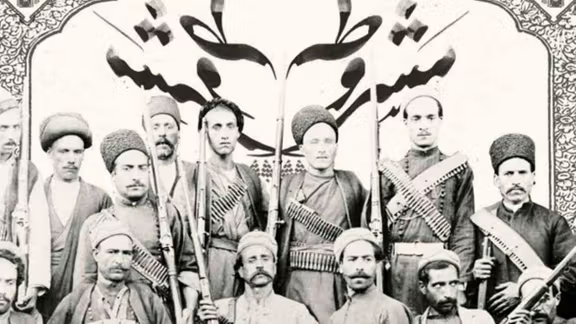
The leaders of the revolutionary military forces who captured Tehran and forced the Shah to agree to a constitution. Circa 1905
August 5 is the anniversary of Iran’s 1905 Constitutional Revolution, although 1905 was the beginning of a process that led to the revolution’s victory in 1911.
It was the outcome of Europe’s multifaceted ascendance in the 19th century that motivated Iranian intellectuals to demand freedom and justice.
Justice was the main demand, and many thought “Constitution” meant justice and a process that would eventually lead to the establishment of courts of justice [Edalat Khaneh or house of justice]. For several centuries, Iranians, then called Persians, were suffering in the hands of despotic monarchs and Sharia judges. Since the 16th century, the oppression by courtiers and Shiite clerics close to the court became unbearable. Kings and grand ayatollahs did whatever they wanted without consulting members of the public.
Particularly under the Safavids (1501-1736) and the Qajars (1789-1925), despotism was the main characteristic of the Persian governments. Under the Qajars, many intellectuals and learned clerics fled Iran and went to the Ottoman Empire or India and set up newspapers and magazines to promote democracy and justice in Iran.
The first parliament building in 1900s
Once the revolution was successfully established, the idea of justice was soon forgotten or pushed to oblivion by the kings, but democracy flourished in the form of a parliament (Majles or Iran's National Assembly) where most seats were occupied by clerics. The parliament, throughout the Qajar period was divided between pro-British and pro-Russian factions who were constantly fighting each other. Traditionally, Russia supported the despotic monarchs, and Great Britain lent its support to intellectuals and Westernizers.
The second anniversary of the Constittional revolution, 1906 or 1907
The Qajar kings who were supposed to be the guarantor of the Constitution could hardly tolerate it. Muzafareddin Shah who signed the decree of Constitution and Muhammad Ali Shah, his son, who bombed the Majles with the help of the Russians, are widely believed to have been Russian puppets. They were educated and trained by Russian advisers in Tabriz as crown princes. Muhammad Ali Shah finally fled to Russia.
The only likeness of a modern judiciary system was created under Reza Shah Pahlavi with modern courts, and a civil code based on the laws of Belgium, albeit with some clauses to guarantee some benefit for clerics who were no longer partners in the government.
The leaders and tribal cavalry of revolutionary forces in mid-1900s
Although the Majles experienced increasingly less upheavals under the Pahlavis, it was never the institution envisaged by the forefathers of the constitutional revolution. However, the limits the Constitutional Law imposed on the power of the kings were respected by Reza Shah and his son Mohammad Reza Shah Pahlavi.
But if the Constitutional Revolution also meant free and fair elections for a parliament represented by all walks of life, the Pahlavis were somewhat successful in upholding the law although there are many reports about rigged elections throughout the period and arrests of political opponents. Apart from that, the Shah held his position for life, and his eldest son would inherit the throne.
Under the Islamic Republic, the Constitution and the Parliament lost their true meaning, as the Supreme Leader’s powers are boundless and for life, and candidates for parliament and president are first chosen by the Guardian Council, controlled by the Supreme Leader, before the people can vote for them.
During the past few days, Empress Farah Pahlavi, and Prince Reza Pahlavi, both in exile, paid tribute to the people’s quest for democracy and remembered the Constitutional Revolution and its heroes. Politicians in the Islamic Republic generally ignored the occasion as freedom and justice, the main elements of the Constitutional Revolution are dangerous issues to raise in Iran under the Islamic Republic.
Iran’s government is working behind the scenes with hardliners in parliament to restrict Internet access, a lawmaker has charged amid major service disruptions.
Gholamreza Nouri-Ghezeljeh, chairman of the Independents’ Faction in the parliament told Salam-e No website Thursday that the government is collaborating with hardliners in favor of restricting access to the internet by reducing its speed and disrupting connectivity.
“They are restricting access to the Internet to make communication between people harder … Those who wrote the Siyanat bill don't want people to conjoin in the cyberspace, talk to each other, and discuss social and political issues,” he said.
Siyanat (Protection) refers to a draft bill proposed last yearby ultra-hardliners titled “Legislation to Protect Cyberspace Users’ Rights”. An ad hoc parliamentary committee in February approved the outlines of the Siyanat bill which will result in broad restriction of social messaging platforms and access to the global net, in addition to extensive blockage of thousands of websites and most social media platforms, if approved.
Out of 290 members of parliament, 190 representing the hardliner majority issued a statement in January asking the government and the conservative Judiciary for measures to restrict peoples’ activities on the internet. Some of the Siyanat bill’s supporters argue that Iran should emulate China in creating a national intranet to control cyberspace.
In the past few months mobile and broadband internet users have reported considerable reduction in speed and unexplained outages.
Member of the Islamic Republic parliament Gholamreza Nouri
Most Iranians use mobile internet rather than broadband. According to government figures, there are 10.6 million broadband and 84.1 million mobile internet subscribers.
NetBlocks, which monitors cybersecurity and the governance of the internet, on Monday said it had registered a significant internet outage in Iran affecting cellular and fixed-line services including Irancell and the TIC gateway. “Real-time network data show national connectivity at 79% of ordinary levels; incident ongoing,” Netblocks reported.
The Telecommunication Company claims that recent widespread disruptions in internet service were caused by a fire in infrastructure facilities or power fluctuations but the Electricity Distribution Company has refuted their claims.
The slow internet has affected many areas of life from navigation of taxis and cars to tens of thousands of large and small online businesses that rely on Instagram, as well as government and public online services.
Telecommunications minister, Issa Zarepour, in April said Iran ranked between 140 to 150 in broadband speed and 70 to 80 in mobile internet speed globally.
Slow speed also disrupts access to circumvention software and VPNs (virtual private networks) which an overwhelming majority of Iranians routinely use to access blocked websites and applications.
These include platforms such as Facebook and You Tube and messaging applications such as WhatsApp, currently the most popular messaging and social media platform in Iran with over 50 million users. Instagram is the only major social-media platform not blocked in Iran.
Iran has one of the world’s worst internet censorships, with tens of thousands of websites blocked since the early 2000s and most social media platforms banned. In the absence of free media and the very high level of censorship, many Iranians turn to social media for political news and information.
A hardliner newspaper in Iran has accused Tehran's ‘reformist’ media of carrying out psychological warfare designed by the "enemy", meaning the United States.
Usually when Kayhan Daily attacks an individual or entity it signals a policy or attitude by hardliners. The paper is linked to and supported by the office of Supreme Leader Ali Khamenei. Its front-page story on Wednesday, August 4,accusing the ‘reformists’ who are loyal to the Islamic Republic, can be a signal of an impending campaign by hardliner followers of Khamenei.
The Kayhan has gone farther, charging that reformist media outlets publish lies and censor positive news daily to instil despair in society and suggest that Iran is entangled in a deadlock and that there is a wide rift between the nation and the government.
The accusation is characteristic of Kayhan's behavior in fabricating incriminating cases against intellectuals, journalists and political activists.
The paper claimed that the Cato Institute, a libertarian think tank in Washington DC has suggested to the US government "to exert psychological pressure on the people of Iran and use the accumulated anxiety and anger among Iranians to instil hatred toward the government, while “beautifying” its enemies.
Kayhan charged that reformist media in Iran constantly portray ordinary problems as crises to accomplish that objective and further Cato's agenda to reinforce the West's “minions” and collaborators. The effort, said Kayhan, is aimed at discrediting the government, erode the people's trust, having the idea of a regime change on its agenda.
Kayhan presented no evidence to support its wild accusations and it was not clear why it singled out the Cato Institute or how the US government could influence government-controlled media in Iran.
Hossein Shariatmadari, the ultra-conservative editor of Kayhan
Like similar cases in the past, the Kayhan quoted Khamenei’s past warnings about a media onslaught on the Islamic Republic. In this way Kayhan accused the reformist media and journalists of working against Khamenei's will as accomplices of the United States.
The Kayhan said that Shargh newspaper's coverage of recent flash floods in Iranwas an example of the kind of articles that have a destructive role. Shargh had written mostly objective reports about lack of government warnings about the impending floods and lack of preparedness to deal with its aftermath.
The Kayhan also mentioned another report in the same newspaper last year about child marriage in Iran and characterized it as portraying a disparaging image of the country.
Kayhan made the same accusation about a similar report in Ebtekar newspaper and went on to quote a report in Etemad newspaper about the suicide attempts by 8 desperate workers, calling it mud-slinging against the government.
The hardliner daily also accused Iran's reformist press of featuring articles by Iranian expat journalists and criticized them for interviewing former deputy chief of the Iranian Environmental Agency Kaveh Madani, charging him as always of being a fugitive spy, while Madani has never been officially charged with any offense.
The Kayhan also accused the Jomhouri Eslami, a newspaper founded by Khamenei in 1979, of spreading lies by writing about drought in Iran quoting Madani, who happens to be an expert on water resources.
Meanwhile, the Kayhan claimed that some reformist journalists work for foreign-based media from Iran and get paid in dollars. Although some of these accusations are hard to prove, or in fact do not constitute an offense under Iranian laws, the hardliner Judiciary can use Kayhan’s claims to prosecute journalists in the future.
Photo published by Fars news reportedly showing one of the arrested ISIS agents
Iran’s intelligence ministry said Thursday it has arrested a group of 10 Islamic State (ISIS) militants, hired by Israel to plan attacks on religious mourning ceremonies during Muharram.
A statement by the ministry said that the arrests took place over the past three days in two locations in western and southern Iran, adding that the 10 were captured in possession of explosives, communication devices and weapons.
The militants injured two Iranian intelligence agents in an exchange of fire before being detained, the statement added, without specifying where or when the clash took place.
The ministry claimed that it had them under surveillance before they entered the country from Iraq and Turkey to bomb the gatherings for the Islamic month of Muharram, which started on July 30.
Recently the Intelligence Ministry claiming has been making similar claims of uncovering alleged spy networks and thwarting operations following a major reshuffling of it rival, the IRGC intelligence and counter-intelligence leadership, widely attributed to reported Israeli infiltration and the inability of Iran’s security bodies to deal with the situation. Since May, several Revolutionary Guard personnel were killed or died in Iran, which Iran blamed on Israel.
Ayman al-Zawahiri, the slain leader of al-Qaeda terrorist group
A US-based think tank says al-Qaeda terrorist group’s second in command, who is set to become its new leader following the death of Ayman al-Zawahiri, is in Iran.
Senior researcher of the Foundation for Defense of Democracies Behnam Ben Taleblu told Sky News on Tuesday that following the death of al-Zawahiri, “All eyes are on Iran’s eastern border.” “With the killing of al-Zawahiri, the next up – believed to be number two of al-Qaeda – is assumed to be in Iran.”
“So that may mean that the Iranian government – if that individual is still there – will have to decide what to do; to expel this person or to allegedly promote them or to basically facilitate the rise of Al-Qaeda’s next leader.
According to the 2019 US State Department’s terrorism report, Tehran allowed al-Qaeda to transfer money via Iran, as well as to transit personnel and resources across conflict zones such as Afghanistan and Syria.
In the past years, several US officials, including ex-CIA director Mike Pompeo, accused the Islamic Republic of having links with al-Qaeda, citing documents that were declassified.
Senior al-Qaeda facilitator and financier Ezedin Abdel Aziz Khalil, also known as Yasin al-Suri, is also allegedly based in Iran.
An Iranian war veteran injured during the eight-year conflict with Iraq has died after setting himself on fire due to financial harship in the Kurdish-majority city of Sonqor in Western Iran.
The US-based Human Rights Activists News Agency (HRANA) said that the war veteran, identified as Khosro Yavari, committed suicide on Tuesday and succumbed to his burns after he was transferred to hospital. According to reports, it was the ninth case of self-immolation due to livelihood problems and vocational issues in the past 70 days.
The most recent cases happened in the northern city of Lahijan and western city of Ilam due to financial hardships the victims faced.
The prosecutor of Lahijan, Ebrahim Ansari, said on Sunday that one of the workers of the city’s water and wastewater management company set himself on fire in protest to his suspension by the contracting company. Hengaw Organization for Human Rights also reported that a 30-year-old man, identified as Jamil Valibaygi, set himself on fire because of financial pressures.
In June, two workers in Bandar-e Mahshahr in the southwestern province of Khuzestan also set themselves on fire in protest to their dismissal. They survived thanks to prompt intervention by their coworkers. Earlier, a worker in the city of Yasuj, the capital of Kohgiluyeh and Boyer-Ahmad province, set himself on fire over his inability to pay a debt of about 10 million tomans, or $300.