• العربية
  • فارسی
Brand
  • Iran Insight
  • Politics
  • Economy
  • Analysis
  • Special Report
  • Opinion
  • Podcast
  • Iran Insight
  • Politics
  • Economy
  • Analysis
  • Special Report
  • Opinion
  • Podcast
  • Theme
  • Language
    • العربية
    • فارسی
  • Iran Insight
  • Politics
  • Economy
  • Analysis
  • Special Report
  • Opinion
  • Podcast
All rights reserved for Volant Media UK Limited
volant media logo

Saudi Crown Prince To Discuss Iran In Paris Meeting With Macron
Iran International Newsroom
Jul 28, 2022, 18:35 GMT+1Updated: 17:27 GMT+1
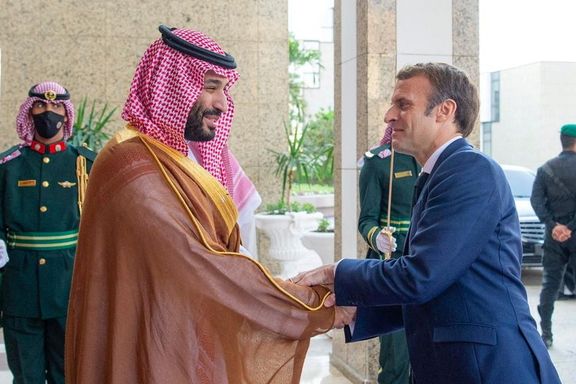
Saudi Crown Prince, Mohammed bin Salman receives French President Emmanuel Macron in Jeddah, Saudi Arabia, December 4, 2021.

Iran sits on a crowded agenda as French President Emmanuel Macron hosts Saudi Crown Prince Mohammed bin Salman in Paris Thursday evening.

Ahead of Prince Mohammed’s arrival, a presidential official said there was still time to save the 2015 nuclear deal, the JCPOA (Joint Comprehensive Plan of Action), despite widespread skepticism that Tehran and Washington can bridge their differences.

Saudi Arabia is known for having oppsed the deal with Iran and together with its other Persian Gulf Arab allies has drawn closer to Israel as a way of defending agianst the Iranian threat.

The European Union has acted as mediator in trying to keep the JCPOA revival talks alive, after a pause since March, with reports this week that EU foreign policy chief Josep Borrell had floated a proposal reportedly for a partial restoration based on US concessions over oil sanctions and Tehran restoring closer monitoring by the International Atomic Energy Agency (IAEA).

The Saudi crown prince’s trip to Paris comes two weeks after he hosted US President Joe Biden and apparently marks his greater acceptance internationally four years after Washington Post journalist Jamal Khashoggi was killed in the Saudi consulate in Istanbul.

DAWN, a pro-democracy group Khashoggi created three months before his murder, filed a complaint in Paris Thursday calling for the criminal prosecution of Prince Mohammed under universal jurisdiction and France’s commitment to United Nations conventions on torture and enforced disappearances.

Agnes Callamard, Amnesty International’s Secretary General, wrote on Twitter that the “rehabilitation of the murderous prince” was the result of “bargaining.” Both France and the US want Saudi Arabia to raise oil production, so bearing down on rising prices. Both are also major arms suppliers to Riyadh, as well as to the United Arab Emirates.

Raisi: Iran armed forces ‘prepared’

While seeking to improve its own armed forces, Saudi Arabia has been involved in developing cooperation, under US auspices, with Israel over air defense largely against the threat of Iranian and Iranian-supplied missiles and drones.

In the Shahid Nojeh air base, Hamedan province, Thursday Iranian President Ebrahim Raisi suggested that “regional countries” could “feel secure” due to Iran’s role.

“Our great military advances have given us power,” Raisi said. “The enemy studies our movement and preparedness – not that it doesn’t want to attack us, but it cannot take such a step because our armed forces have great preparedness. Both the supreme leader, the commander-in-chief [Ali Khamenei], and the government have said repeatedly that anyone who tries to violate our country will strongly regret it.”

Raisi drew particular attention to Iran’s presence on the “high seas in international waters.” Naval tensions in the Persian Gulf and further afield have included US pressure to stop Iran’s oil exports. Following a recent ruling by the Greek supreme court, an Iranian-flagged tanker anchored off Piraeus is expected to retrieve part of its cargo, which had been confiscated by the US in a move that prompted Iran to seize two Greek tankers – which it still holds – in the Persian Gulf.


Most Viewed

Ghalibaf defends Iran-US talks amid hardline backlash
1
INSIGHT

Ghalibaf defends Iran-US talks amid hardline backlash

2
INSIGHT

100 days after carnage: Iran economy reels from war, inflation, unemployment

3
INSIGHT

A nation in limbo: 100 days after the massacre, has the world moved on?

4
ANALYSIS

From instability to influence: Pakistan’s pivotal role in US-Iran diplomacy

5
ANALYSIS

100 days on: why Iran’s January protests spread across social classes

Banner
Banner

Spotlight

  • War-hit homeowners feel abandoned as Iran’s reconstruction aid fades

    War-hit homeowners feel abandoned as Iran’s reconstruction aid fades

  • 100 days on: the anatomy of Iran’s January crackdown
    INSIGHT

    100 days on: the anatomy of Iran’s January crackdown

  • Ghalibaf defends Iran-US talks amid hardline backlash
    INSIGHT

    Ghalibaf defends Iran-US talks amid hardline backlash

  • 100 days on: why Iran’s January protests spread across social classes
    ANALYSIS

    100 days on: why Iran’s January protests spread across social classes

  • From instability to influence: Pakistan’s pivotal role in US-Iran diplomacy
    ANALYSIS

    From instability to influence: Pakistan’s pivotal role in US-Iran diplomacy

  • A nation in limbo: 100 days after the massacre, has the world moved on?
    INSIGHT

    A nation in limbo: 100 days after the massacre, has the world moved on?

•
•
•

More Stories

Iran Pundits Pessimistic Over Outlook For A Nuclear Deal

Jul 28, 2022, 13:59 GMT+1
•
Iran International Newsroom

Hassan Beheshtipour, an expert on Iran's nuclear case, says the latest statement by IAEA Chief Rafael Grossi paves the way for a new UN resolution against Iran.

Grossi told CNN on Tuesday, July 26, that "Iran has to restore all our inspection capabilities" after Iran's nuclear chief Mohammad Eslami declared on the same day that Iran will keep cameras monitoring its nuclear activities switched off until a deal is struck with the United States." Grossi, the head of the UN nuclear watchdog, the International Atomic Energy Agency explained: "We do not know what is happening with Iran's nuclear program."

In an interview with the Iranian Labor News Agency ILNA on Wednesday, Beheshtipour criticized Iranian officials for saying repeatedly that the IAEA is under the influence of the United States and Israel, and said that this will not solve any problem. He stressed that the difference between Iran and IAEA can be solved only through negotiations.

Beheshtipour said while Iran and the IAEA level accusations against each other it means that this is not the right time for cooperation and added that Iran possibly expects Grossi to also call on the United States to go back to its commitments under the 2015 nuclear deal.

With the latest accusations against Iran, the IAEA will certainly issue a resolution against Tehran in September, Beheshtipour remarked, adding that Iran will take that as a step fabricated to condemn Tehran. However, Beheshtipour pointed out that the IAEA has confirmed in 14 previous reports that Iran was committed to the terms of JCPOA.

Jalal Sadatina, former Iranian envoy to the United Kingdom
100%
Jalal Sadatina, former Iranian envoy to the United Kingdom

Meanwhile, Iran's former ambassador to the United Kingdom Jalal Sadatian said in an interview with Didban Iran website that the negotiations to revive the JCPOA have failed. He added that the 2015 agreement could be revived only with a miracle. "We should consider the JCPOA as a terminated case, and if Iran's nuclear issue is not resolved, its economy will not improve," Sadatian said, adding that Russia and China are not able to solve Iran's economic problems. He argued that there has been no benefit for Iran in the boosting of its ties with Russia.

Lately, Iran has been insisting that it can survive under US sanctions by closer ties with Russia and China. Vladimir Putin visited Tehran earlier this month and Supreme Leader Ali Khamenei praised him for his invasion of Ukraine.

The former diplomat further said that Russia is determined to prevent Iran from providing oil for Europe while Europe is keen to have access to Iran's energy market.

In a related development, former diplomat and current political analyst Ali Bigdeli said in an interview with Nameh News website that there is no hope the nuclear talks would continue and bear results, nonetheless, the two sides are reluctant to declare the failure of the negotiations, partly because they know that there is no chance for another agreement.

Bigdeli's view is more pessimistic than the position of commentators such as Heshmatolah Falahatpisheh who believe that Iran and the United States should forget about the JCPOA and start working from the scratch on a new agreement.

Bigdeli went on to say without an explanation, that the United States is by no means prepared to accept a new agreement. In the meantime, Iran has demands from the US which are beyond the scope of the JCPOA, and the United States insists that the two sides should return to the 2015 nuclear deal.

It is not in Iran's interest to declare the failure of the JCPOA as this would be a bonus for Israel, which could launch a war in that case to protect its security, the analyst added.

Iraqi Protesters Enter Parliament To Reject Iran-Backed Nominee For New Premier

Jul 28, 2022, 12:10 GMT+1

Hundreds of followers of an Iraqi influential Shiite cleric stormed into Baghdad's Green Zone and parliament Wednesday, chanting anti-Iran slogans against a Tehran-backed prime ministerial nominee. 

The protesters – some of whom were seen walking on tables, waving Iraqi flags and sitting in lawmakers' chairs – were followers of Muqtada al-Sadr, who seeks to curb the influence of the Islamic Republic in Iraqi politics. 

On Monday, the Coordination Framework, a coalition of Shiite parties close to Iran, nominated Mohammed al-Sudani as the prime minister, a decision opposed by firebrand Shia cleric al-Sadr, whose party won last year’s general elections.

Protesters, who had forced their way into the Green Zone, which houses the parliament, after removing a number of concrete barriers, began making their way out of the parliament building when al-Sadr issued a statement on Twitter telling them their message had been received and "to return safely to your homes. 

Addressing the protesters, the leader of the Sadrist movement, Saleh Muhammad al-Iraqi, said, "I stand in reverence and respect. It is a wonderful spontaneous and reformist popular message, thank you."

It was the largest protest since federal elections were held in October and the second time al-Sadr has used his ability to mobilize the masses to send a message to his political rivals this month.

The protest took place after Iran’s Revolutionary Guard’s Quds Force Chief Esmaeil Gha’ani arrived in Baghdad, one day after Iran-backed groups nominated Sudani, and met with leaders of Shiite groups.

Tehran Politician Says Proposed EU Nuclear Deal Is A 'Partial' One

Jul 28, 2022, 09:55 GMT+1
•
Iran International Newsroom

A former senior Iranian lawmaker says that European Union’s latest plan to bring about a nuclear deal with Iran would be a partial one, with minimal trade-offs.

Fararu website in Tehran quoted Heshmatollah Falahatpisheh, former chairman of parliament’s foreign policy committee as saying that fully restoring the JCPOA is not possible in current circumstances, therefore, the EU is proposing lifting oil exports sanctions in return for “some monitoring” of Iran’s nuclear activities.

The conservative Iranian politician did not say if he has concrete information about the EU plan, which this week its foreign policy chief Josep Borrell presented to Washington and Tehran for consideration. But given statements lately by some officials and well-informed sources that restoring the 2015 nuclear agreement, JCPOA, is difficult, a limited plan might make sense from the perspective of Iran.

Tehran has always labeled the nuclear talks as “negotiations to lift sanctions” and if a plan calls for oil sanctions to be lifted in exchange for monitoring by the International Atomic Energy Agency, IAEA, Iran has not really given up much.

Falahatpisheh did not say if he believes Iran’s uranium enrichment would be stopped or curtailed according to Borrell’s plan, a key issue given the fact that Tehran has enriched a considerable amount of fissile material to 60-percent and either already has enough for a nuclear bomb or is close to obtaining it.

Meanwhile, Axios quoted White House Middle East coordinator Brett McGurk as having told of experts last week that it “highly unlikely” that the JCPOA will be revived in the near future. He was also quoted as saying that with a deal highly unlikely, the Biden Administration plans to strengthen sanctions and diplomatic isolation against Tehran, “but not needlessly escalate the situation.” Use of force would only be a last resort; he was quoted as saying.

Borrell has said that his proposal includes a detailed plan about the lifting of sanctions, as well as steps that Iran must take, without offering details. This, in general might not be much different from what Falahatpisheh says the “temporary” deal could be.

John Kirby, the US National Security Council spokesman in a briefing on Wednesday refused to comment on what Axios had reported about McGurk’s remarks.

However, he told reporters that the US remains committed first, “to seeing Iran never achieve a nuclear weapons capability,” and second, “the President believes diplomacy is the best path forward to see that outcome.” This was a reiteration of the long-held White House position.

Kirby added, “the negotiations are pretty well complete on a new JCPOA, and it’s on the table. And the onus is now on Iran to decide whether they’re going to take that deal or not.” He said that Washington and its European allies still believe that Tehran will “come back into compliance” with the JCPOA.

Kirby was not asked about Borrell’s proposal at the briefing, but he added that the President has an obligation to defend US interests and allies in the Middle East against continuing non-nuclear threats by Iran. The US has an obligation “to defend ourselves and to help defend our allies and partners against the range of other Iranian threatening behavior: their burgeoning ballistic missile capability, which continues to improve; their support for terrorist groups; their threats in the maritime environment. All of that is still happening.”

Exclusive: After Israeli Attacks Two Iranian Airlines Stop Flights To Syria

Jul 27, 2022, 20:45 GMT+1
•
Iran International Newsroom

Two Iranian airlines stopped flights to Syria after an Israeli air strike June 10 temporarily shut down the Damascus airport, sources told Iran International.

Western intelligence sources said that Caspian Air and Qeshm Fars Air both have stopped flying to Syria and the only Iranian airline sending planes is Mahan Air, which was sanctioned by the United States in 2011 for transporting weapons to Iranian proxies at the outset of the Syrian civil war.

Caspian Air is also sanctioned by the United States for its links with Iran’s Revolutionary Guard and its extraterritorial Qods (Quds) Force (IRGC-QF). In 2019, the US also sanctioned Qeshm cargo airline as part of Mahan Air and providing material support to the IRGC-QF. All three airlines are believed to have been established and owned by the Revolutionary Guard.

According to information received by Iran International, Mahan Air flights have increased by 30 percent following suspension of service by the other two companies. Aleppo is the destination of most Mahan flights. The same sources said Hamid Arabnejad the CEO of Mahan Air in a recent trip to Syria took part in the inauguration of a new flight to the Aleppo airport.

In addition to transporting weapons, the sources alleged that Mahan Air is also carrying smuggled goods to Syria without paying taxes or customs duties.

Last November, a hacking group calling itself ‘Vigilant sons of the homeland’ in Persian accused Mahan Air of closely linked with IRGC-QF and often issuing fake or falsified air tickets for people with false identities.

The aftermath of an Israeli attack on Syria's Latakia port targeting an Iranian arms shipment, December 28, 2021
100%
The aftermath of an Israeli attack on Syria's Latakia port targeting an Iranian arms shipment, December 28, 2021

The group also alleged that Mahan was registering its interactions with IRGC-QF in one particular name, which appeared seven thousand times in the company’s records. “We’ve found Mahan does keep records of its suspicious business with QF under the name ‘Hamrah’, and that this business is managed by sardar (general) Golparast.”

The group added that Golparast is also listed as the owner of Qeshm Fars Air which “is a known QF cover company, frequently used to transport munitions throughout the Middle East,” the group said in November.

Israel is known to have conducted operations, including in Iran, to track and prevent IRGC-QF form transporting weapons to other countries.

Iran International reported July 21 that the Israeli Mossad had captured and interrogated an IRGC official inside Iran, about weapons transfers. The man was introducing himself as Yadollah Khedmati, deputy commander of the IRGC logistics and provided information to Mossad about weapons transfers before being freed.

IRGC’s wings for weapons transport

Mahan Air was fully under the control of IRGC-QF when Qasem Soleimani headed the extraterritorial military-intelligence unit. There were many reports about the airline’s role in weapons shipments. Soleimani was killed in a targeted US air strike in Baghdad in January 2020.

Amir Assadollahi a Mahan Air pilot revealed in June 2020 that on one occasion Soleimani in 2013 Soleimani was on a Mahan flight to Syria with 200 passengers and 7 tons of “banned cargo” that landed in Baghdad with orders of the Iraqi government. Soleimani instructed the pilot to bribe inspectors and was able to continue the flight to Syria.

Iran’s former foreign minister Javad Zarif in an audio recording leaked in 2021 had said that Soleimani preferred to use the official Iran Air flights for his purposes to reduce risk to his operations.

However, it seems that with continuing Israeli air strikes on Iranian arms depots in Syria, IRGC-QF prefers to use Mahan Air more often.

Israeli is usually silent about its attacks on Iranian targets in Syria but in recent months there have been repeated attacks on Iranian arms depots. The attack on the Damascus airport on June 10 was the 15th airstrike in Syria attributed to Israel.

Four Rockets Fired At Syrian Base Hosting US Troops

Jul 27, 2022, 16:28 GMT+1

Four rockets were fired Tuesday night in the vicinity of the Shaddadi Patrol Base, northern Syria, the largest base where US troops are stationed in the country. 

According to a BBC correspondent, the attack on the base – located in al-Shadadi city 55 kilometers south of Al-Hasakah in the northeastern corner of Syria -- had no casualties and all the US-led coalition’s personnel are accounted for with no damage reported.

"The attempted strikes were ineffective and landed well outside the Coalition base. Our Syrian Democratic Partners quickly responded to the incident and have the lead for any further response," a senior coalition official said. 

However, Syrian news agency SANA quoted local sources as saying that several rocket targeted “the illegal US occupation base,” one of which fell inside the base, claiming that loud explosions were heard by the people of the city and the surrounding areas and smoke plumes were billowing from the base.

The same base was attacked in January, with eight rockets landing inside its perimeter.

The attack occurred less than a week after the top US Air Force general in the Middle East, Lt. Gen. Alexus Grynkewich, warned of increasing attacks by Iran-backed militias against the United States and its allies as tensions rise in the region. 

Iran’s Supreme Leader Ali Khamenei and President Ebrahim Raisi last week called for US troops to leave Syria, during the visit of Russia’s Vladimir Putin to Tehran.

No group has claimed responsibility for the Tuesday night attack but the US coalition operating in Syria and Iraq has repeatedly condemned Iran for attacks on its bases as repeated strikes have hit sites near American forces in the region.





