• العربية
  • فارسی
Brand
  • Iran Insight
  • Politics
  • Economy
  • Analysis
  • Special Report
  • Opinion
  • Podcast
  • Iran Insight
  • Politics
  • Economy
  • Analysis
  • Special Report
  • Opinion
  • Podcast
  • Theme
  • Language
    • العربية
    • فارسی
  • Iran Insight
  • Politics
  • Economy
  • Analysis
  • Special Report
  • Opinion
  • Podcast
All rights reserved for Volant Media UK Limited
volant media logo

US Says Silence From Tehran May Indicate No Interest In Nuclear Deal
Iran International Newsroom
Jul 26, 2022, 10:52 GMT+1Updated: 17:38 GMT+1
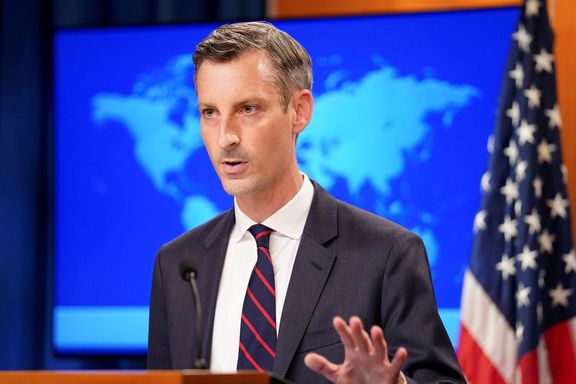
US State Department spokesperson, Ned Price. FILE PHOTO

Washington says that lack of a response from Iran on the nuclear talks is an indication that Tehran is not serious and not ready to re-enter the JCPOA.

State Department spokesperson Ned Price in his daily briefing on July 25 said, “And in fact, every day that they drag their feet or every day that is filled with nothing but silence on their end, it’s an indication to us that they are not serious and that they are not ready to re-enter the JCPOA on a mutual basis.”

The comments came one day after chief of Iran's nuclear program, Mohammad Eslami said that Tehran will not allow monitoring equipment of the International Atomic Energy Agency (IAEA) to operate until the JCPOA is restored.

At the same time, the director general of the IAEA, the UN nuclear watchdog, Rafael Grossi told the Spanish newspaper El Pais on July 22 that Iran’s nuclear program is “galloping” forward. He added that enriching uranium at 60 percent is not needed if there are no military intentions, referring to Iran accumulating highly enriched fissile material that can be elevated to weapons-grade uranium in a relatively short time.

Grossi also told CNN on Monday that Iran keeping IAEA’s inspectors away and monitoring cameras off at its nuclear installations leaves the international community blind as to what is really taking place there. “We are saying this is relevant. They have to restore all our inspection capabilities, that if they want to be trusted confidence must be there,” he told CNN and added, “In the nuclear field the only way to have confidence is to be inspected.”

Rafael Grossi in Tehran holding a press conference with Iran's nuclear chief Mohammad Eslami
100%
Rafael Grossi (R) in Tehran holding a press conference with Iran's nuclear chief Mohammad Eslami

Asked about Iran’s announcement that IAEA cameras will remain turned off until an agreement is reached on JCPOA, Ned Price said this was “extremely regrettable, to put it mildly.” The State Department spokesperson went on to warn that Iran’s behavior regarding inspections “only complicates the challenges associated with a potential mutual return to compliance with the JCPOA. It only deepens the nuclear crisis that Iran itself has created.”

Iran began limiting IAEA inspections and boosting uranium enrichment in early 2021, after the incoming Biden administration had clearly indicated its desire to restore the 2015 nuclear deal.

Price was also asked what Iranians want in order to accept a deal presented to them last December, which the US and its European allies say was a fair offer. He responded that he will Tehran say publicly what they demand and mentioned the possibility that the Iranians may not be planning to restore the JCPOA.

“We are clear-eyed about our Iranian interlocutors. And that’s why for some time we have been preparing equally for scenarios in which there is a mutual return to compliance with the JCPOA, and a scenario in which there is not a mutual return to compliance with the JCPOA.,” Price said.

But he reiterated the administrqation's position that it will cointinue to pursue the diplomatic path, since it believes a negotiated return to the JCPOA still is in US interest.

He also referred to President Joe Biden’s trip to the Middle East earlier this month and his discussions with Israel and other allies about threats Iran poses to the region. Biden pledged to Israel and Saudi Arabia that the United States would not allow Iran to produce nuclear weapons.

Price said that the contingency of Iran not returning to the JCPOA “was a focus of President Biden’s trip to Israel, and to Saudi Arabia, where he also had an opportunity to meet with leaders of the GCC+3. But these are discussions that we’ve been having for some time.”


Most Viewed

100 days after carnage: Iran economy reels from war, inflation, unemployment
1
INSIGHT

100 days after carnage: Iran economy reels from war, inflation, unemployment

2
INSIGHT

Ghalibaf defends Iran-US talks amid hardline backlash

3
INSIGHT

A nation in limbo: 100 days after the massacre, has the world moved on?

4
ANALYSIS

From instability to influence: Pakistan’s pivotal role in US-Iran diplomacy

5
ANALYSIS

100 days on: why Iran’s January protests spread across social classes

Banner
Banner

Spotlight

  • War-hit homeowners feel abandoned as Iran’s reconstruction aid fades

    War-hit homeowners feel abandoned as Iran’s reconstruction aid fades

  • 100 days on: the anatomy of Iran’s January crackdown
    INSIGHT

    100 days on: the anatomy of Iran’s January crackdown

  • Ghalibaf defends Iran-US talks amid hardline backlash
    INSIGHT

    Ghalibaf defends Iran-US talks amid hardline backlash

  • 100 days on: why Iran’s January protests spread across social classes
    ANALYSIS

    100 days on: why Iran’s January protests spread across social classes

  • From instability to influence: Pakistan’s pivotal role in US-Iran diplomacy
    ANALYSIS

    From instability to influence: Pakistan’s pivotal role in US-Iran diplomacy

  • A nation in limbo: 100 days after the massacre, has the world moved on?
    INSIGHT

    A nation in limbo: 100 days after the massacre, has the world moved on?

•
•
•

More Stories

Iran Says IAEA Access Stays Limited Unless Nuclear Deal Revived

Jul 25, 2022, 17:03 GMT+1
•
Iran International Newsroom

Iran’s atomic chief Mohammad Eslami said Monday Iran would not switch on nuclear-monitoring cameras turned off in June until the 2015 nuclear deal was restored.

Tehran’s relations with the International Atomic Energy Agency (IAEA) have soured since the agency’s board, made up of 35 member states, passed June’s resolution critical of Iran’s alleged failure to supply adequate information about its pre-2003 nuclear work.

Eslami said Tehran would not go further in answering IAEA questions over this work, despite the dissatisfaction expressed by agency director-general Rafael Mariano Grossi in his report to June’s IAEA board at Iran’s explanation of uranium traces in sites not declared as nuclear-related.

Eslami was quoted by state media as saying the file on pre-2003 work had been “closed” at the time of the 2015 agreement, the JCPOA (Joint Comprehensive Plan of Action). “They should know that closed items will not be reopened,” Eslami said. “The basis of the nuclear accord was a response to those alleged cases.”

Following the passage of the June IAEA board resolution – moved by the United States and three European countries, and opposed by Russia and China with India among those abstaining – Tehran said it would remove some IAEA monitoring equipment, that had been kept in place under a temporary arrangement reached with Grossi in February 2021.

Iran had agreed to this ‘extra’ equipment staying, even though it had decided in December 2020 to reduce cooperation with the agency to the basic level required by the Nuclear Non-Proliferation Treaty (NPT).

Talks in Vienna tried for a year up to March to reach agreement between Iran and six world powers over restoring the JCPOA, which had imposed strict limits on the nuclear program and gave the IAEA enhanced inspection powers. But when the US in 2018 left the JCPOA and imposed ‘maximum pressure’ sanctions, Tehran responded after 2019 by expanding its nuclear program beyond JCPOA limits and by February 2021, in response to parliamentary legislation restricting IAEA access. The parliamentary bill was introduced the day after the US presidential election and passed after a nuclear scientist was assassinated near Tehran.

‘Politically motivated’

While the role of the IAEA is essentially technical, June’s resolution has further enmeshed it in the wider dispute over JCPOA restoration. The US and Iran, both in Vienna talks and in June’s European Union-mediated talks in Doha, have failed to agree which US sanctions are incompatible with the 2015 agreement.

Iran's foreign ministry spokesman Nasser Kanaani said Monday Grossi was displaying "unprofessional, unfair and unconstructive views” and called on him to “refrain from politically motivated statements.”

In an interview with Spanish newspaper El Pais published July 22, Grossi said the Iranian program was “advancing at a gallop” while the agency had “very little visibility.” Repeating his remarks reported in May, the IAEA chief was quotedthat “no country that does not have warlike developments enriches at that level, at 60 percent.”

Iran expanded enrichment from the JCPOA limit of 3.67 percent to 4.5 percent in July 2019, and to 20 percent in January 2021 after. President Hassan Rouhani in April 2021, following an attack on the Natanz nuclear facility, announced enrichment to 60 percent, saying the move would enable Iran to attend negotiations“with an even fuller hand.”

Stop Iran’s Nuclear Program Before It’s Too Late – Israel Tells The World

Jul 25, 2022, 10:36 GMT+1

Israel has called on the international community to "stop" the nuclear program of the Islamic Republic before it is "too late".

In a tweet on Sunday, the Israeli Foreign Ministry said that “a nuclear Iran is not a threat only to Israel, but to the entire region and the world.” 

Echoing remarks by the head of the UN nuclear watchdog, the International Atomic Energy Agency (IAEA), Rafael Grossi, the ministry said, "Today what we have is a nuclear program that has grown enormously....” and a country that does not seek nuclear weapons would not enrich uranium to 60 percent.

On July 22, Grossi told Spain's El Pais newspaper that the Islamic Republic’s nuclear program is "galloping ahead" and the IAEA has very limited visibility on what is happening. 

In 2019, Iran began breaching restrictions on its nuclear program following the 2018's pullout of the United States from the 2015 deal, the JCPOA, or the Joint Comprehensive Plan of Action. The process accelerated after President Joe Biden’s administration signaled it was ready to return to the JCPOA.

“If there is an agreement, it is going to be very difficult for me to reconstruct the puzzle of this whole period of forced blindness,” Grossi said. “It is not impossible, but it is going to require a very complex task and perhaps some specific agreements.”

Iran would like to see a nuclear agreement taking shape soon, but it will not act with emotion and haste, Iran’s foreign ministry spokesman Naser Kanaani said Monday.

Iran Says No Haste In Nuclear Talks Although Hopes For A Deal

Jul 25, 2022, 09:20 GMT+1
•
Iran International Newsroom

Iran would like to see a nuclear agreement taking shape soon, but it will not act with emotion and haste, Iran’s foreign ministry spokesman Naser Kanaani said Monday.

Meanwhile, the head of the country's Atomic Energy Organisation, Mohammad Eslami said on Monday that Iran will keep the UN nuclear watchdog's cameras turned off until a 2015 nuclear deal is restored, the semi-official Tasnim news agency reported.

In a media briefing, Kanaani emphasized Tehran’s often repeated slogan that it will not hinge the future of the economy and people’s well-being on the nuclear issue.

The hardliner government of President Ebrahim Raisi and its supporters, who are loyal to Supreme Leader Ali Khamenei, argue that they can manage the country despite American sanctions, and a nuclear agreement is not absolutely necessary to deal with economic challenges.

However, as annual inflation approaches 60 percent and food price inflation is close to 90 percent, critics argue that a deal to restore the 2015 nuclear agreement, the JCPOA, is a prerequisite. Without lifting sanctions imposed by the United States and boosting oil exports and trade, the government simply has little money to deal with the economic crisis.

The United States imposed oil export and banking sanction in 2018 when former President Donald Trump withdrew from the JCPOA, demanding a stronger agreement. The move drastically weakened Iran's economy, which is heavily dependent on oil revenues.

The Raisi administration’s claim of dealing with challenges despite sanctions is a public posture to show the West that it is not desperate for a deal. On the domestic front, few believe that the situation will improve as they see that real food prices have doubled and tripled since the beginning of May.

But since the Biden administration took office, Iran has been able to increase its oil exports, mainly to China and many believe it is pinning hope on the additional income to weather out the storm and continue expanding the nuclear program.

Kanaani, however, did not dash hopes for an agreement saying that discussions do take place through “communication channels.”

A local news agency asked the spokesman about a recent statement by the head of the UN nuclear watchdog, the International Atomic Energy Agency (IAEA), Rafael Grossi, who said he had “very limited visibility,” of Iran’s nuclear program. He also said that only a country with military intentions would enrich uranium to 60-percent purity.

Kanaani responded with defiance. “We call upon him to refrain from politically motivated statements,” he said, and added that Grossi's remarks were "unprofessional, unfair and unconstructive views."

Iran began restricting IAEA’s monitoring access in early 2021, as the incoming administration of President Joe Biden signaled its readiness to return to the JCPOA and lift sanctions. Tehran announced more restriction after the IAEA Board of Governors passed a resolution on June 8 to censure Iran for lack of cooperation in its investigations.

Grossi told the Spanish newspaper El Pais June 22 that his agency’s ability to monitor Iran’s nuclear activities had substantially decreased as Tehran’s nuclear program is “galloping ahead.”

Iran Says Exposed Israeli Team Planted Explosives At Sensitive Site

Jul 24, 2022, 18:17 GMT+1
•
Iran International Newsroom

Iran claims an “Israeli-linked” sabotage team it recently arrested had planned to destroy a sensitive facility in the central Iranian province of Esfahan.

According to a Sunday report by Nour News, a website affiliated with the secretary of Iran's Supreme National Security Council (SNSC), Ali Shamkhani, “These individuals (Mossad-linked agents) had identified a sensitive center in Esfahan, planted strong explosives there, and only a few hours were left until the explosion” when they were arrested.

The report added that the members of the network were trained in an African country for months and had simulated the planned operation several times.

It claimed that Iran’s security forces were monitoring the team even before it arrived in Iran and all its members and contacts both inside and outside the country were identified by the Intelligence Ministry several months before they entered the country.

The report did not disclose the name of the site, but Esfahan is home to Iran’s largest multi-purpose nuclear research complex with about 3,000 scientists. It also operates a conversion facility, a fuel production plant, a zirconium cladding plant, and four small nuclear research reactors -- all supplied by China – as well as other facilities and laboratories. Moreover, it could also mean the all-important Natanz uranium enrichment facility, which is located in the province of Esfahan.

Natanz was the target of two major sabotage acts in the past two years- in July 2020 and April 2021, both ascribed to Israeli intelligence.

In January, Iran told the International Atomic Energy Agency (IAEA) that it would move production of crucial nuclear components from a plant in Karaj to a facility in Esfahan. The Karaj TESA plant was producing parts for uranium enrichment machines or centrifuges.

IAEA nuclear facility monitoring device shown in December 2021
100%
IAEA nuclear facility monitoring device shown in December 2021

In April, Tehran said that before the 2015 nuclear deal is revived it will not give the IAEA access to data from cameras at the new centrifuge parts plant in Esfahan.

In a short announcement from the Intelligence Ministry on Saturday, July 23, Iran claimed that “a network from the spy agency of the Zionist regime who were sent to the country for terrorist operations” were identified and arrested.

"This network's members were in contact with (Israel's) Mossad spy agency through a neighboring country and entered Iran from (Iraq's) Kurdistan region with advanced equipment and strong explosives," the ministry said.

Since March, Iran has at least three times made similar claims without presenting any evidence or information about what investigators discovered from the persons allegedly detained.

The intelligence ministry’s announcement came two days after Iran International in an exclusive report on July 21 said that Israel’s Mossad had captured a senior Revolutionary Guard official on Iranian soil and interrogated him about weapons shipments to Iran’s proxies in the region. After the interrogation the man was released.

Since mid-2020 a series of high-profile mysterious attacks have hit Iran’s nuclear and military installations around the country, widely believed to have been Israeli sabotage operations. In November 2020, Mohsen Fakhrizadeh, a key figure in Iran’s controversial nuclear program was assassinated in a complex operation on the outskirts of Tehran. His killing resembled more a Hollywood thriller, with a heavy, remotely controlled gun mounted in the back of a pickup truck that fired on Fakhrizadeh’s car on a highway.

In May, several IRGC officials were killed or died in suspicious circumstances, prompting Tehran to blame Israel, which has never officially taken credit for these operations.

In June, a major reshuffling of IRGC intelligence and counter-intelligence leadership took place, widely attributed to reported Israeli infiltration and the inability of Iran’s security bodies to deal with the situation.

France Tells Iran It's Disappointed To See No Progress In Nuclear Talks

Jul 23, 2022, 22:46 GMT+1

In a two-hour telephone conversation Saturday, French President Emmanuel Macron told Iran's Ebrahim Raisi that he is disappointed with results of nuclear talks.

Macron expressed his disappointment to his Iranian counterpart Raisi at the lack of progress over talks on the 2015 nuclear agreement, the Elysee Palace said in a statement.

In June, Iran began removing essentially all the monitoring equipment of the International Atomic Energy Agency (IAEA), installed under its 2015 nuclear deal with world powers.

Iran has been enriching uranium at 20 and 60 percent since early 2021, raising alarm in Western capitals and among regional countries of getting closer to a nuclear breakout point.

The French leader urged Raisi to make a "clear choice" to reach a deal and go back to the implementation of Iran's commitments under the 2015 nuclear agreement, the Elysee Palace said.

Macron said he was convinced that such an outcome was still possible but that it should take place "as soon as possible," the French presidency said.

According to the official Iranian news agency IRNA, Raisi reiterated Iran's demands of receiving guarantees of full economic benefits to make a nuclear deal possible.

Macron also urged the liberation of four French citizens that he said were "held arbitrarily" in Iran.






