• العربية
  • فارسی
Brand
  • Iran Insight
  • Politics
  • Economy
  • Analysis
  • Special Report
  • Opinion
  • Podcast
  • Iran Insight
  • Politics
  • Economy
  • Analysis
  • Special Report
  • Opinion
  • Podcast
  • Theme
  • Language
    • العربية
    • فارسی
  • Iran Insight
  • Politics
  • Economy
  • Analysis
  • Special Report
  • Opinion
  • Podcast
All rights reserved for Volant Media UK Limited
volant media logo

Iran-Backed Hashd Al-Shaabi Forces Hold Military Parade In Iraq
Jul 23, 2022, 15:47 GMT+1
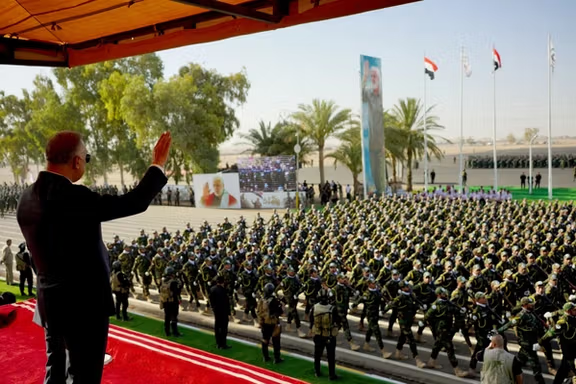
Iraqi Prime Minister Mustafa al-Kadhimi during a military parade by Iran-backed Shiite militia Hashd al-Shaabi, also known as Popular Mobilization Forces in the town of al-Khalis, Diyala province, eastern Iraq, on July 23, 2022

Iran-backed Shiite militia Hashd al-Shaabi, also known as Popular Mobilization Forces, held a military parade Saturday to mark the eighth anniversary of its formation. 

The Saturday ceremony was held in al-Khalis, located about 15 kilometers (9 miles) northwest of the city of Baqubah in Diyala Province, and was attended by Prime Minister Mustafa al-Kadhimi, Chairman of the Popular Mobilization Forces Falih al-Fayyadh, Secretary General of the Badr Organization Hadi al-Amiri and a number of high-ranking military officials.

The militia also unveiled new weapons and military equipment, including al-Rasid (Monitor) and al-Hassib (Auditor) systems to control unmanned aerial vehicles and overhauled Russian T-52 tanks.

Al-Hashd al-Shaabi was established back in 2014, following a fatwa (a decree or ruling in Islamic sharia law) by influential Iraqi religious authority, Ali al-Sistani, to fight ISIS, which controlled four governorates and reached the borders of the capital Baghdad at the time. The Iraqi state-sponsored umbrella organization is composed of approximately 67 different armed factions, with around 128,000 fighters that are mostly Shia Muslim groups, but also include Sunni Muslim, Christian, and Yazidi groups. 

Earlier in July, Moqtada al-Sadr, the most influential Shiite cleric in Iraq, who is against Iran’s presence in Iraq -- renewed his call to reorganize the Hashd al-Shaabi, which was led by former Iraqi militia commander Abu Mahdi al-Muhandis before he was killed alongside Qasem Soleimani in January 2020 by a US drone strike.

He said Hashd al-Shaabi should not be involved in sectarian conflicts, should withdraw from the Sunni-dominant areas, and should be kept away from foreign interventions – an indirect reference to Iran.

Most Viewed

State media slam Araghchi's Hormuz tweet, say it let Trump claim victory
1

State media slam Araghchi's Hormuz tweet, say it let Trump claim victory

2
OPINION

The Hormuz get out of jail card turned to a grave

3
INSIGHT

How Tehran bends its own red lines to boost state rallies

4

Iran International says it won’t be silenced after London arson attack

5
VOICES FROM IRAN

Iran blackout cripples freelancer, small business incomes

Banner
Banner

Spotlight

  • Too early to tell who is winning Iran war, experts say
    PODCAST

    Too early to tell who is winning Iran war, experts say

  • How Tehran bends its own red lines to boost state rallies
    INSIGHT

    How Tehran bends its own red lines to boost state rallies

  • Iran blackout cripples freelancer, small business incomes
    VOICES FROM IRAN

    Iran blackout cripples freelancer, small business incomes

  • Ideology may be fading in Iran, but not in Kashmir's ‘Mini Iran'
    INSIGHT

    Ideology may be fading in Iran, but not in Kashmir's ‘Mini Iran'

  • US blockade enters murky phase as tankers spoof signals and buyers hesitate
    ANALYSIS

    US blockade enters murky phase as tankers spoof signals and buyers hesitate

  • Why the $100 billion Hormuz toll revenue is a myth
    ANALYSIS

    Why the $100 billion Hormuz toll revenue is a myth

•
•
•

More Stories

Brussels Court Temporarily Bans Extraditing Iranian Diplomat

Jul 23, 2022, 11:09 GMT+1

A court in Brussels has temporarily stopped Belgium from extraditing Assadollah Assadi, an Iranian diplomat sentenced to 20 years in jail on a terrorism conviction.

Darya Safai, an Iranian-born member of the Belgian parliament, released a document by the Brussels Court of Appeal on twitter on Friday evening showing the decision.

Following numerous complaints after the Belgian Parliament ratified a controversial prisoner swap treaty with Iran on July 20, the court ordered that Belgium be “provisionally prohibited from releasing Assadi […] from the Belgian prison where he is serving a sentence of 20 years […] and transferring him to any foreign state whatsoever.”

Assadi is imprisoned for “attempted murder and involvement in terrorism” for his role plotting to bomb a gathering of the exiled opposition group Mujahedin-e Khalq Organization (MEK) near Paris in 2018.

After being rejected by the court of first instance in Brussels on Thursday, the opponents of the prisoner-swap deal with Tehran -- including victims who had registered as civil parties to the trial -- won their appeal on Friday. 

Georges-Henri Beauthier, a lawyer acting for the National Council of Resistance of Iran – an umbrella organization with MEK as its main member, said that according to the order, any proposed release of Assadi be subject to “cross-examination before a judge”.

The court noted that the rights of the plaintiffs “could be irreparably violated” if Assadi were handed over to the Iranian authorities, without allowing the decision to be legally challenged and confirmed by a judge through an adversarial procedure – a hearing where both parties are present or represented by a lawyer. The ban will apply until such a hearing is held, the court added.

Tehran’s Relations With Neighbors Not Tied To JCPOA Or US Permission – Foreign Ministry

Jul 22, 2022, 15:28 GMT+1

Iran says its relations with neighbors are not tied to the revival of the 2015 nuclear agreement (JCPOA) or permission from the United States. 

Foreign ministry spokesperson Nasser Kanaani tweeted on Friday in English that the “false dichotomy between JCPOA, of which Iran unlike US remains a party, and good ties between Iran and its neighbors, including Russia, doesn't hide the fact that indecision of the unfaithful US is the main hurdle for a deal.”

He added, “Our neighborly policy is not contingent on JCPOA or US permission.”

Kanaani made the comments in reaction to remarks by US Special Envoy for Iran Robert Malley who said Iran either agrees to return to the nuclear deal and mend its relations with the world or stick to Russia and become more isolated. 

Following a trip to Tehran by Russian President Vladimir Putin this week, Malley, said on July 19 that Iran "can opt for a position of relative dependency on Russia ... or it can choose to come back into the deal that’s been negotiated."

Echoing the comment, State Department Spokesperson Ned Price said on July 20 that Iran has a choice; siding with Russia, or choosing the path of diplomacy and taking up the deal that has been on the table for some time now, to have an economic relationship with other countries around the world.

On July 21, Foreign Minister Hossein Amir-Abdollahian said Iran is making efforts to strengthen relations with its Persian Gulf neighbors, UAE and Kuwait, noting that both countries will be sending their envoys to Tehran soon.

Iran Says Saudi Arabia Ready To Advance Talks

Jul 22, 2022, 13:15 GMT+1

Iran's foreign minister says Saudi Arabia has shown readiness to advance the bilateral talks from security issues to the political phase.

In an interview broadcast on state television Thursday evening, Hossein Amir-Abdollahian said, "Last week we received a message from Iraqi foreign minister [Fuad Hussein] saying that the Saudi side is ready to move the talks from a security phase to a political and public one.”

"We also expressed our readiness to continue talks at the political level so that it leads to the return of Iran-Saudi Arabia ties to the normal level," he added. 

Late in June, Iraqi Prime Minister Mustafa al-Kadhimi traveled to Iran and met with President Ebrahim Raisi after a visit to Saudi Arabia and meeting with the kingdom’s de facto ruler Crown Prince Mohammed bin Salman aimed at jumpstarting stalled talks between Tehran and Riyadh. 

Iran and Saudi Arabia -- which are locked in proxy conflicts around the region -- have held several rounds of talks mediated by Baghdad since 2021. In April, they finally held the much-anticipated fifth round of negotiations, saying that a clear outlook was reached for the resumption of regular talks. 

However, it was the Islamic Republic that suspended the talks earlier in April a day after Saudi Arabia announced it had beheaded 81 men, for “heinous crimes.” Forty-one were Saudi Shiites, Human Rights Watch reported, apparently convicted over protests.

Saudi Arabia cut ties with Iran in 2016 when mobs attacked its embassy in Tehran after Riyadh executed 47 dissidents including the leading Shiite cleric Sheikh Nimr al-Nimr.

US Air Force Mideast Commander Warns Of Attacks By Iran-Backed Militias

Jul 22, 2022, 11:49 GMT+1

The top US Air Force general in the Middle East warned of increasing attacks by Iran-backed militias against the United States and its allies as tensions rise in the region.

As he stepped into his new role -- with responsibility for military operations in Iraq, Syria, Afghanistan, and across the region, Lt. Gen. Alexus Grynkewich told reporters at al-Udeid Air Base in Qatar on Thursday that such assaults could lead to a new escalation, while Russia and China are vying for economic and military influence across the Mideast.

“We’re in this position where we’re not under attack constantly, but we do see planning for attacks ongoing. Something will occur that unleashes that planning and that preparation against us,” Grynkewich said. 

He also expressed concerns about Iran preparing to send Russia armed and unarmed drones to use in its war on Ukraine, saying it “is not a surprise … but it’s concerning.”

He also referred to Tehran’s rapidly growing stockpile of near-weapons-grade nuclear fuel in recent months, saying, “Everyone in the region is very concerned.”

His remarks came as the Syrian defense ministry said an Israeli strike killed three Syrian soldiers and wounded seven others near Damascus early Friday. 

According to The Syrian Observatory for Human Rights war monitor the attack targeted an "Iranian weapons depot", an air force intelligence facility and a high-ranking officer's office, as well as a car near the Mezzeh military airport.

It said three Syrians were killed in military positions hosting air defense batteries in the perimeter of the Mezzeh airbase, as well as three non-Syrians and two “collaborators” of the Iran-backed Lebanese Hezbollah group at a workshop for manufacturing Iranian drones near the town of Sayyidah Zaynab, commonly known as Sitt Zaynab, 10 kilometers south of Damascus.

Pelosi Says Putin-Khamenei Ties Are Tyrant-To-Tyrant Friendship

Jul 21, 2022, 20:27 GMT+1

Iranian Supreme Leader’s endorsement of the Russian invasion of Ukraine is not surprising, Speaker of the US House of Representative Nancy Pelosi said Thursday.

Asked by Iran International correspondent Arash Aalaei about Islamic Republic’s ruler, Ali Khamenei praising Vladimir Putin’s “initiative” to invade Ukraine, Pelosi said, “Tyrants find their friends and there’s no surprise in any of that. I don’t think anybody has ever recognized Khamenei as a respecter of boundaries or people.”

During Putin’s trip to Tehran July 19, Khamenei lauded the Russian leader’s initiative in attacking Ukraine, saying that NATO would have launched a war sooner or later in Ukraine.

Pelosi added, “To me what Khamenei said was practically irrelevant, but what is relevant is the weapons he may supply Russia with.”

The United States has warned that Russia is preparing to receive Iranian military drones to use in Ukraine and has even sent teams to Iran to review its options. Iran has half-heartedly denied the accusation, but Khamenei’s strong endorsement of the invasion is a signal that Tehran would have little hesitation in supplying the drones.

Pelosi sounded resigned that Iran will cooperate with Russia. “It’s tyrant-to tyrant; doesn’t matter what any of us think; it’s what they will do,” she said.







