• العربية
  • فارسی
Brand
  • Iran Insight
  • Politics
  • Economy
  • Analysis
  • Special Report
  • Opinion
  • Podcast
  • Iran Insight
  • Politics
  • Economy
  • Analysis
  • Special Report
  • Opinion
  • Podcast
  • Theme
  • Language
    • العربية
    • فارسی
  • Iran Insight
  • Politics
  • Economy
  • Analysis
  • Special Report
  • Opinion
  • Podcast
All rights reserved for Volant Media UK Limited
volant media logo

US Cautiously Agrees With UK Spy Chief On Iran's Intentions
Iran International Newsroom
Jul 22, 2022, 08:20 GMT+1Updated: 17:37 GMT+1
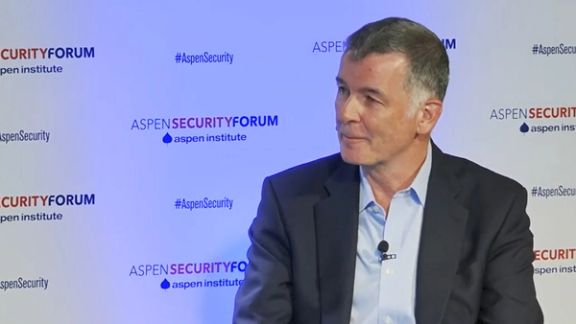
Richard Moore, chief of MI6, speaking at the Aspen Security Forum on July 21, 2022

US State Department Thursday said remarks by Britain’s spy chief that Iran is not interested in a nuclear deal, did not need any special intelligence insight.

Richard Moore, chief of the Secret Intelligence Service (SIS) known as MI6, speaking at the Aspen Security Forum in Colorado, he was skeptical that Iran’s Supreme Leader Ali Khamenei wants to revive the 2015 nuclear agreement known as the JCPOA.

"I'm not convinced we're going to get there. ... I don't think the Supreme Leader of Iran wants to cut a deal," Moore said and added, "The Iranians won't want to end the talks either, so they could run on for a bit."

Asked about these remarks during the State Department briefing on Thursday, spokesperson Ned Price said, “I…don’t think you need a security clearance to discern the fact that Iran at this point doesn’t seem to have made the political decision – or decisions, I should say – necessary to achieve a mutual return to compliance with the JCPOA.”

After almost 16 months of negotiations with Iran and seven months after Washington says a final draft was offered to Tehran, negotiations remain stalled, as Iran seems to demand more concessions. More pundits and critics of the Biden strategy have begun to say that Iran simply wants to drag out the talks to prevent any decisive decision in Washington, while expanding its nuclear program to the point of a nuclear threshold state.

Price in his comments Thursday agreed with Moore’s assessment. The fact is that a deal has been on the table for months now. We have continued to engage in indirect diplomacy with Iran, courtesy of the efforts of the European Union and other partners, but Iran, to this point at least, has not displayed an inclination to seek that deal. So certainly, those comments ring true,” he said.

Iran’s former president Hassan Rouhani told his former aides in Tehran earlier this week that he could have made a deal with the new Biden Administration as early as March 2021 but the hardliners in parliament blocked any progress in the talks by passing legislation to intensify uranium enrichment and reducing UN inspections.

But the Biden Administration still argues that diplomacy remains the best option to restrain Iran’s nuclear program.

The British spy chief who said he agrees with the diplomatic option said, "I think the deal is absolutely on the table. And the European powers and the (US) administration here are very clear on that. And I don't think that the Chinese and Russians, on this issue, would block it. But I don't think the Iranians want it.”

Speaking later in the day at the Aspen forum, Israel's defense minister Benny Gantz said Israel had the military capability to prevent Iran from obtaining a nuclear weapon, if it came to that as a last resort.

"Should we be able to conduct military operation to prevent it, if needed? The answer is yes. Are we building the ability? Yes. Should we use it as a last (resort)? Yes. And I hope that we will get United States' support," Gantz said.

Bahrain's Undersecretary of Political Affairs Sheikh Abdulla bin Ahmed bin Abdulla Al Khalifa declined to directly answer a question about whether his country might participate in pre-emptive military action against Iran's nuclear program.

But when asked whether it would be fair to interpret his answer as "an ambiguous maybe," he quipped: "Fair enough."


Most Viewed

Iran diplomacy wobbles as factions compete to avoid looking soft on US
1
INSIGHT

Iran diplomacy wobbles as factions compete to avoid looking soft on US

2
ANALYSIS

The politics of pink: how Iran uses cuteness to rebrand violence

3

Scam messages seek crypto for ships’ safe passage through Hormuz, firm warns

4
EXCLUSIVE

Family told missing teen was alive, then received his body 60 days later

5
INSIGHT

Is Iran entering its Gorbachev moment?

Banner
Banner

Spotlight

  • Diplomacy tolls at Hormuz as conflict returns to its doorstep
    OPINION

    Diplomacy tolls at Hormuz as conflict returns to its doorstep

  • Opposition to US talks grows in Tehran as ceasefire deadline nears
    INSIGHT

    Opposition to US talks grows in Tehran as ceasefire deadline nears

  • Tehran moderates see ‘no deal–no war’ limbo as worst outcome
    INSIGHT

    Tehran moderates see ‘no deal–no war’ limbo as worst outcome

  • The future has been switched off here
    TEHRAN INSIDER

    The future has been switched off here

  • Lights out, then gunfire: Witnesses recount Mashhad protest crackdown
    VOICES FROM IRAN

    Lights out, then gunfire: Witnesses recount Mashhad protest crackdown

  • Is Iran entering its Gorbachev moment?
    INSIGHT

    Is Iran entering its Gorbachev moment?

•
•
•

More Stories

Iran Says Draft US Law Might Undercut Nuclear Talks

Jul 20, 2022, 20:41 GMT+1

Tehran has said that a proposed new United States legislation could further undermine diplomatic efforts to revive the 2015 Iran nuclear deal.

Nasser Kanaani, spokesman for the foreign ministry, said Wednesday that Tehran regarded all US political bodies as “one unified unit and that any unconstructive measures will naturally affect the course of talks,” leading Tehran to “adjust its actions accordingly.”

The proposed bill would require the US administration to establish a task force to give Congress an assessment every 120 days of the Iranian nuclear program based both on intelligence from US, Israel and the regular reports of the International Atomic Energy Agency (IAEA), the United Nations body that monitors Iran as a signatory of the Nuclear Non-Proliferation Treaty (NPT). The bill would also require the White House to outline diplomatic and military plans over Iran.

The bill’s sponsors, Democrat Bob Menendez and Republican Lindsey Graham, are long-term opponents of the 2015 nuclear deal, the Joint Comprehensive Plan of Action (JCPOA), and have criticized efforts of the Biden administration to revive it through year-long discussions with Iran and world powers in Vienna.

The legislation, dubbed the ‘Iran Nuclear Weapons Capability Act,’ could jeopardize the international verification system by undermining the IAEA, Tariq Rauf, the agency’s former Head of Verification and Security Policy Cooperation, told Bloomberg. IAEA inspectors, Rauf argued, were “the only ones that can carry out on-site intrusive inspections.”

‘Up to date information’

But Menendez, who chairs the Senate’s Committee on Foreign Relations, wrote Tuesday in a statement there was “no reason why the US Congress should not receivethe most up to date information about Iran’s nuclear and ballistic missile activities.”

The bill will put further pressure on the Biden Administratrion to take Congressional critics of the JCPOA into account in its Iran strategy.

Iran has expanded its nuclear program beyond JCPOA limits since 2019, the year after President Donald Trump withdrew the US from the agreement and imposed ‘maximum pressure’ sanctions aimed at enforcing 12 demands including Iran halting all uranium enrichment.

Following legislation in the Iranian parliament passed December 1, 2021 after the assassination of scientist Mohsen Fakhrizadeh, Iran reduced cooperation with the IAEA to that required under the NPT and increased the level to which it enriched uranium. At 60 percent purity this has now left Tehran within weeks of having enough sufficiently enriched material for a bomb should it choose to do so, US special envoy Rob Malley told CNN Tuesday.

In Tehran, Kanaani said Wednesday that while European Union foreign policy chief Josep Borrell was“following-up on preparations for the next round of talks… [there was no] fundamental problem for an agreement except that the Americans need to make a political decision.”

Malley by contrast told CNN the onus was with Iran. It has been widely reported that one outstanding issue is the US listing in 2019 of Iran’s Revolutionary Guards, part of its armed forces, as a ‘foreign terrorist organization.’ Tehran argues that all sanctions introduced by Trump under ‘maximum pressure’ should be lifted for it to return to the JCPOA’s nuclear limits.

Iran Spokesman Does Not Deny Possibility Of Drones For Russia

Jul 20, 2022, 11:15 GMT+1
•
Iran International Newsroom

Iran commenting on possible delivery of military drones to Russia said Wednesday that Tehran’s “technical cooperation” with Moscow predates the Ukraine war, .

In his weekly press conference, foreign ministry spokesman Naser Kanaani was asked about reports that Iran might sell military drones to Russia for its war effort in Ukraine, which he did not deny. Instead, he said, “Iranian and Russian technological cooperation predates developments in Ukraine. Any linkage between our cooperation with Russia with developments in Ukraine is intentionally biased.”

He went on to reiterate that Iran pursues “political solutions for this crisis.”

The US National Security Adviser Jake Sullivan recently said that Russian officers visited Iran in June and July to review possible drone purchases.

US Special Envoy for Iran Robert Malley told CNN on Tuesday that any drone shipment from Iran was “of course of concern” and would “bolster Russia’s ability to wreak havoc.” He said it “speaks volumes” that Iran would be in a position where it sold drones to Russia “against its professed position of neutrality in the conflict.” Without giving details, Malley said the US would “use the tools at our disposal” to sanction any supply of weapons to Russia.

Kanaani in his briefing said, however, “Russian and Iranian ties are bilateral, based on the interests of the two countries and do not concern the American government, which cannot comment about the relationship.”

Kanaani also said that he cannot confirm if Ukraine was discussed between presidents Vladimir Putin, Recep Tayyip Erdogan and Iran Ebrahim Raisi when they met in Tehran on Tuesday, although “naturally international issues are discussed in multilateral meetings,” he added.

However, Iran’s Supreme Leader Ali Khamenei in his meeting with Putin clearly backed Russia’s “initiative” in attacking Ukraine, saying that if Moscow had not taken that step, NATO would have started a war anyway.

“Nato is a dangerous creature,” Khamenei said, “[that] didn’t recognize any limits or borders. If you cannot stand up to them in Ukraine, then a little while later, with the excuse of Crimea, they would have started this war anyway,” Khamenei told Putin.

Speaking about Iran’s talks with the United States to restore the 2015 nuclear agreement known as JCPOA, Kanaani rejected US statements that the latest meeting in Doha in June failed. “As a matter of fact, these were good talks,” he insisted.

He went on to speak with optimism that the diplomatic process is well and alive and the European Union is pursuing discussions with the two sides.

Kanaani reiterated Iran’s position that it needs “serious guarantees” about the US commitment to a new agreement and “verification” that Washington carries out its obligations.

Eleven months of talks in Vienna to revive the JCPOA came to a stop in March as Iran demanded the lifting of all sanctions introduced by the US after former President Donald Trump withdrew from the agreement in 2018.

Kanaani also repeated remarks by Khamenei and Raisi on Tuesday that the United States should withdraw its troops from Syria.

US Envoy Says Iran Can Choose A Better Future Or Side With Russia

Jul 19, 2022, 23:07 GMT+1
•
Iran International Newsroom

Reacting to Vladimir Putin’s visit to Tehran, US envoy Robert Malley said Tuesday Iran has a stark choice between a nuclear deal or more isolation with Moscow.

In an interview with CNN, Malley, the United States special envoy for Iran, said, “It can opt for a position of relative dependency on Russia, which itself is isolated internationally…or it can choose to come back into the deal that’s been negotiated...and have normal economic relations with its neighborhood and with Europe and the rest of the world.”

The special envoy suggested that not “getting back into the deal” would mean Iran “having to turn to Russia, having to sell on drones to Russia, a choice that is not a particularly attractive one…”

The US recently alleged that Russian officers visited Iran in June and July to review possible drone purchases. Malley said any drone shipment from Iran was “of course of concern” and would “bolster Russia’s ability to wreak havoc.” He said it “speaks volumes” that Iran would be in a position where it sold drones to Russia “against its professed position of neutrality in the conflict.” Without giving details, Malley said the US would “use the tools at our disposal” to sanction any supply of weapons to Russia.

Iran’s supreme leader Ali Khamenei, meeting President Vladimir Putin, gave Tuesday the clearest expression yet of support for Russia over Ukraine, which had “taken the initiative” while “the other side, with its own initiative would have created a war anyway.”

But Russia and Iran have long had some military cooperation, especially supporting President Bashar al-Assad in Syria, during the operation of the 2015 nuclear deal (the JCPOA, Joint Comprehensive Plan of Action) until President Donald Trump withdrew the US in 2018, prompting Iran to begin exceeding JCPOA limits in 2019.

Malley again called Trump’s decision to leave the agreement “catastrophic,” while reiterating that the onus to revive the JCPOA, which has been the subject of year-long negotiations between Iran and world powers, lay in Tehran.

‘A few weeks’

Malley dismissed a suggestion Iran might be responding to US actions, being pushed towards Russia for example not just by US ‘maximum pressure’ but by Biden’s statement during his recent trip to Israel and Saudi Arabia that the US would not leave a regional “vacuum” to be filled by Russia, China, and Iran.

Iran’s leaders have argued with President Joe Biden continuing Trump’s sanctions, has refused as part of JCPOA restoration to lift them all, including listing Iran’s Revolutionary Guards as a ‘foreign terrorist organization,’ and to give assurances it would not impede Iran in benefiting from the agreement.

Malley refused to give a deadline for JCPOA talks.He said Tehran was “a few weeks” from creating enough fissile material for a bomb, “if it chooses to enrich at that level,” although the weaponization “would take longer.”

“Every day” made JCPOA restoration and the return of Iran’s nuclear program to a “safe box” less likely, Malley argued. Terms for reviving the deal had been agreed, he suggested, by all parties in talks other than Iran – including Russia as well as the US, China, France, Germany and the United Kingdom.

Iran's Ex-President Says He Could Have Made A Nuclear Deal In 2021

Jul 19, 2022, 11:38 GMT+1
•
Mardo Soghom

Iran could have ended US sanctions before even negotiations began in April 2021, if parliament had not intervened, former president Hassan Rouhani said Friday.

A brief overview of Rouhani’s remarks were carried by Aftab News website in Tehran.

Rouhani who was meeting with former officials and aides in his office in Tehran on the occasion of Eid Ghadir, said his administration could have removed US sanctions in 2021, in the Iranian month of Esfand (February 21-March 20). He added that “unfortunately” the parliament passed the ‘Strategic Action to Eliminate Sanctions and Defend Iranian Nation's Interests’ bill on December 1, 2020,

The bill, adopted by the hardliner-dominated parliament, boosted uranium enrichment, limited nuclear inspections by the International Atomic Energy Agency (IAEA), demanding the removal of all sanctions.

The February-March date Rouhani mentioned as the time when his administration could have lifted United States’ sanctions predates the start of negotiations on April 7, 2021, in Vienna to revive the 2015 nuclear deal known as the JCPOA.

If Rouhani’s claim is true, it means that his government had already reached an agreement with President Joe Biden’s administration, which had just assumed office, which in turn could mean that some sort of negotiation might have taken place even before Biden took office.

The parliament’s bill that Rouhani referred to was adopted as a reaction to the assassination of Iranian nuclear scientist Mohsen Fakhrizadeh a few days earlier, presumably by Israel, but in fact the outlines of the law had already been proposed on November 4, one day after the US presidential election.

During Rouhani’s eight-year, two-term presidency, hardliners loyal to Supreme Leader Ali Khamenei persistently criticized him for the talks that led to the signing of the JCPOA in 2015, although without Khamenei’s blessing no agreement would have never materialized.

The criticism continued and intensified after former President Donald Trump withdrew from the agreement in May 2018 and imposed sanctions on Iran.

With the election of hardliner Ebrahim Raisi in June 2021, Iran suspended the Vienna talks for five months and when they resumed in November an agreement remained elusive until another suspension in March 2022, which still continues. The prospects for a deal have diminished, as Iran demands the removal of all post-2018 sanctions, including terrorism-related designations.

Rouhani has rarely responded to criticisms by hardliners over the nuclear issue and Iran’s economic crisis since he left office in August 2021.

Although some ‘reformist’ and former politicians and even senior clerics call for an agreement to lift the sanctions and ease hardship for the people, no one dares to say that Khamenei makes all decisions over key foreign policy and nuclear issues.

Rouhani told his former colleagues during the Friday meeting that he hopes the negotiations to revive the JCPOA will succeed. He added, “We have many enemies in the world and in the region and internal disagreements and divisions is not in the interest of anyone. We all have to help the government.”

Iran’s Knowhow To Build Nukes Should Be Wake-Up Call For Biden – US Senator

Jul 19, 2022, 11:22 GMT+1

US Senator Joni Ernst says remarks by a top Iranian official about Tehran’s capability to produce nuclear weapons should be a wake-up call for the administration. 

On July 17, Kamal Kharrazi, a senior adviser to Supreme Leader Ali Khamenei had said Iran has the technical capability to build a nuclear bomb.

The Republican senator from Iowa told Iran International’s Arash Aalaei on Monday that "I believe his comments should be a wake-up call for President Biden's administration and for the rest of the Middle East.”

About the bicameral effort to create a united front against “Iranian aggression” in the Middle East, she said, “I have the DEFEND Act which will bring the Abraham Accords countries together, some of our other partners, friends and allies in the region, and provide a collaborative effort to provide a protective defense against Iran.”

The Deterring Enemy Forces and Enabling National Defenses (DEFEND) Act is a joint effort by Congress to develop a strategy for signatories of the Abraham Accords and other countries to combat Iranian destabilizing activities threatening peace and security in the Middle East. 

CENTCOM Commander General Michael Kurilla and IDF Chief of Staff Lt General Aviv Kochavi discussed on Sunday, July 17, “the importance of an integrated air and missile defense system.”

“It's very worrisome that they have the technology and they can move forward so quickly. So, we need to be aware of this and we need to know and understand that Iran is never going to operate in our best interest," Ernst noted.