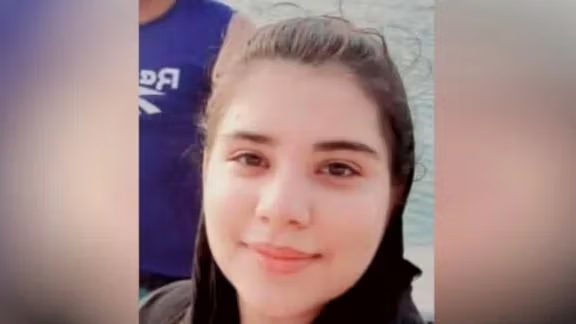
Aryana Lashkari who was killed by har father in an 'honor killing' on June 27, 2022
The murder of a girl by her father, allegedly for laughing with a boy at a park, has once again highlighted lack of laws to prevent ‘honor-killings’ in Iran.
The father of sixteen-year-old Ariana Lashkari shot her in the chest with a hunting rifle on Monday in Nourabad-e Mamasani, a small town in Fars Province. The young girl had fled to her paternal grandmother’s home after an argument with her father, Mohammad-Kazem Lashkari, over her behavior which her father considered as a disgrace to the family.
Ariana’s father said after his arrest that he had only meant to scare his daughter and killed her in a moment of rage.
Iran's Islamic Penal Code stipulates that fathers and paternal grandfathers cannot be sentenced to death for killing a child or grandchild. In such cases the perpetrator may be sentenced to prison and payment of blood money to the next of kin, that is the mother, if demanded. Mothers can also completely forgive the murderer and forego the blood money.
In murder cases, the judge has the power to hand out additional sentences "on behalf of the public" if the crime is particularly violent or harms society in some way.
Perpetrators of honor killings are often not brought to justice as most families do not demand harsh punishment for them, particularly if the perpetrator is the victim’s father.
Honor killings are prevalent in some parts of Iran mostly due to societal beliefs and the Islamic Republic’s lax laws and light sentences that encourage the behavior.
The head of Reyhaneh Women’s NGO said in Januarythat about 60 women had fallen victim to honor killings in Iran in the preceding two years including some as young as ten years old.
Former President Hassan Rouhani’s administration in January 2021 passed a bill intended to help protect women against domestic and other forms of gender-based violence but the parliament which is dominated by hardliners has so far shelved the bill.
Romina and her lover were detained after her family filed complaints with the police, and a court handed her back to her father despite her pleas not to send her home because she said her father was a temperamental and would kill her for her disobedience.
Iranian media said before killing his daughter, Romina’s father had investigated the legal punishment before committing the crime and killed his daughter knowing that the maximum sentence for killing one's child was ten years in prison.
In February, a young man beheaded his 17-year-old wife, Mona Heydari, with the help of his brother and displayed the head around the streets in the southwestern city of Ahvaz when the young wife was brought back from Turkey. Mona who had traveled to Turkey to get away from her family had been persuaded by her own father, her husband’s uncle, to return to Iran.
A view of the entrance of Malek Ashter IRGC base in Tehran
Two explosions rattled the Malek Ashtar base of Iran’s Revolutionary Guard’s paramilitary force Basij militia in southeast of the capital Tehran late Friday.
Iranian official media and websites affiliated with the Revolutionary Guard have remained silent on the incident.
Since May, there have been several attacks and mysterious incidents against Revolutionary Guard (IRGC) officers. One key commander was assassinated in Tehran on May 22 in broad daylight, while another was said to have fallen from the roof of his house and died a few days later. Iran has blamed Israel, in what has damaged the reputation of Iran’s intelligence and security organizations.
In a statement, the exiled Iranian opposition group Mujahedin-e Khalq Organization (MEK) claimed the attack was carried out by “revolutionary cells”, a term it often uses to characterize anti-regime acts and protests in Iran. The group which used large-scale violence in the 1980s and 1990s in its fight against the Islamic Republic, later distanced itself from armed attacks.
In early June, an Iranian hacktivist group reportedly affiliated with the Albania-based MEK, named ‘Uprising till Overthrow’ hacked into and deactivated over 5,000 surveillance camerasand 150 websites and online services of Tehran Municipality.
The MEK was listed by the US from 1997 to 2012 as a ‘foreign terrorist organization,’ but was subsequently removed from the list. The group has cultivated links with many politicians in the US and Europe, paying large sums for attendance or speeches at its rallies.
At least five people were killed and 49 injured by two strong earthquakes followed by many aftershocks in southern Iran early on Saturday, July 2.
A magnitude 6.1 earthquake hit Iran’s Hormozgan province, with the area hit soon after by two strong quakes of up to 6.3 magnitude.
Some 24 tremors, two with a magnitude of 6.3 and 6.1, followed the 2 a.m. local time quake that flattened the village of Sayeh Khosh near Iran's Persian Gulf coast. The most recent tremor occurred around 8 a.m., officials told state TV.
"All of the victims died in the first earthquake and no-one was harmed in the next two severe quakes as people were already outside their homes," said Foad Moradzadeh, governor of Bandar Lengeh country, quoted by the state news agency IRNA.
Emergency services spokesperson Mojtaba Khaledi told state TV that half of the 49 people injured had been discharged from hospitals.
Saeid Pourzadeh of the Kish island crisis task force said shipping and flights in that part of the Persian Gulf had not been affected by the quakes.
State TV said 150 quakes and tremors had struck western Hormozgan over the past month.
Major geological fault lines crisscross Iran, which has suffered several devastating earthquakes in recent years. In 2003, a magnitude 6.6 quake in Kerman province killed 31,000 people and flattened the ancient city of Bam.
Media outlets affiliated with Iran’s Revolutionary Guard have released an audio file in which Brigadier General Ali Nasiri denies “rumors” about his arrest on charges of espionage.
He said in the file that he is doing his job despite the allegations but did not mention where in the IRGC he is serving since he was removed from his post at the Guard’s counter-intelligence unit. The fact that there is no video footage of him or any recent reports about his activities as part of the IRGC, strengthens the speculations that he may be in fact in detention as Iran is notorious for extracting confessions and statements under duress.
UN Under-Secretary-General for Political and Peacebuilding Affairs Rosemary DiCarlo addressing the Security Council on July 1, 2022
The United Nations has once again confirmed that missiles launched by Yeme’s Houthi militia at Saudi Arabia and the United Arab Emirates in the past two years were Iranian.
She also called on both the United States and the Islamic Republic “to quickly mobilize in the same spirit and commitment to resume cooperation under the JCPOA.”
Together with the UN Secretary General, she “appealed to the US to lift or waive its sanctions as outlined in the plan and to extend the waivers regarding the trade in oil with Iran.”
They also urged Iran “to reverse the steps it has taken that are not consistent with its nuclear-related commitments under the plan,” noting that the International Atomic Energy Agency estimates Iram’s stockpile of enriched uranium is more than 15 times the allowable amount under the JCPOA, including uranium enriched to 20 percent and 60 percent “which is extremely worrying.”
A combo image of the Belgian Parliament and Iranian diplomat Asadollah Assadi, imprisoned in the country for masterminding failed terrorist attacks in Europe
The Belgian Parliament is set to review a bill on the exchange of convicts with Iran next week, which can facilitate a prisoner swap with the Islamic Republic.
A treaty between Iran and Belgium, which was signed in March, was brought before parliament on June 29 for approval.
If approved, it will potentially result in sending back Iranian diplomat Asadollah Assadi, who was sentenced to 20 years in prison for masterminding a failed terrorist attack in Europe, back to Iran.
Iranian dissidents have raised alarm on social media that the agreement would mean the Islamic Republic can send agents to target its critics in Belgium and, if arrested and convicted, Brussels will send them home to spend their sentences, because Iran can easily arrest a Belgian on false charges to arrange an exchange.
The Iranian diplomat -- the ever brought to trial in Europe for direct involvement in terrorism -- was arrested in Germany, where he did not enjoy diplomatic immunity, while he was on holiday. German authorities later extradited Assadi to Belgium.
Iranian officials say there are no plans to trade EU citizens held in Iran including Ahmadreza Djlali (Jalali), a Swedish-Iranian doctor that Iran says it will execute soon on charges of spying for Israel, with Iranians held in EU countries such as Assadi or Hamid Nouri, facing life imprisonment in Sweden over his role in prison executions of the 1980s.