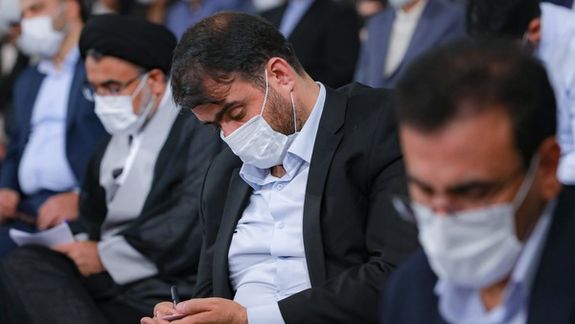
Iranian officials attending Khamenei's speech on June 28, 2022
Enemies of Iran's regime have always miscalculated its stamina to survive, Supreme Leader Ali Khamenei said on the anniversary of a massive bombing in Tehran.
On June 28, 1981, a bomb hidden in the microphone, or the audio system, exploded at a meeting of the Islamic Republican Party killing around 70 top officials of the new revolutionary government. The chief prize for whoever was behind the plot was ayatollah Mohammad Beheshti, seen at the time as the number two figure after the founder of the clerical regime, ayatollah Ruhollah Khomeini. Beheshti died.
The Supreme Leader paid his utmost respects to Beheshti in his speech, but introduced him as a top judicial official, not as the powerful figure he was at the time.
Khamenei reminisced the tough monthsin the summer of 1981, when the Mujahedin organization (MEK) and a variety of leftist and Marxist groups challenged Khomeini and the Islamic Republic.
“They threw everything they had at us,” but the regime survived and has continued to survive for four decades, the aging leader boasted.
Indeed, the regime has survived, but Khamenei did not mention the methods used for survival. For one, he failed to mention the hundreds of people executed right after the revolution, all without a real trial, including Amir-Abbas Hoveida, the long-time prime minister during the monarchy, who had no trace of financial corruption and was known for his diligent pursuit of economic development.
A wall of photos showing the victims of the 1988 prison killings in Iran
Khamenei also failed to mention the jailing of thousands of MEK members and other leftists in the 1980s, and Khomeini’s decision to massacre them in prisonswhile they were serving their sentences. Around 5,000 prisoners were killed in 1988 in a matter of 30 days.
He also did not mention the ‘chain murders’ of intellectualsin the early 1990s and the thousands of journalists, dissidents and ordinary people killed during protests or use of excessive force by the government in the three decades since.
Khamenei also claimed in his speech that Islamic Republic’s enemies have been looking for its demise for more than four decades, seeing signs of weakness as potential good news, but they have been disappointed.
“The enemy cannot understand that in this world, other than political calculations, there are also other considerations, which are God’s rules and traditions,” he said. Khamenei has been reinforcing his legitimacy by claiming that he is the highest Shiite authority on earth, and it is the hand of God that has secured his rule.
Khamenei also did not mention Iran’s economic decline since 1979, especially in the past 15 years as his foreign policy and nuclear program have brought about devastating sanctions. The currency rial has fallen by close to 4,500-fold since 1978, from 70 rials to the dollar to over 300,000.
Facing serious economic problems and continuing anti-government protests, he called on his followers to stick with “God’s rules”, meaning “jihad” to defend the regime.
Khamenei also asked the hardliner judiciary, which is controlled by him, to deal with cyperspace to protect "people's psychological peace", implicitly encouraging a push by his followers to restrict access to the Internet.
Iranian President Ebrahim Raisi and his Russian counterpart Vladimir Putin in Moscow on January 19, 2022
Iranian President Ebrahim Raisi and his Russian counterpart Vladimir Putin will hold a meeting during their visit to Ashgabat, the capital of Turkmenistan, on Wednesday.
Assistant to the Russian President for Foreign Policy Yuri Viktorovich Ushakov said on Tuesday that the meeting will take place on the sidelines of the 6th summit of the heads of state of the Caspian Sea littoral states.
This is Putin's first known trip abroad since the Russian invasion of Ukraine. Kremlin spokesman Dmitry Peskov said Putin would return to Moscow Wednesday evening.
Raisi is also scheduled to hold separate meetings with his counterparts from the other three participating countries in the summit, namely Turkmenistan, Kazakhstan, and Azerbaijan Republic.
The meeting of the foreign ministers of these countries kicked off on Tuesday to “review cooperation in the Caspian Sea and discuss the further collaboration modalities for the upcoming meeting of leaders of five Caspian littoral states.”
Russian Foreign Ministry Spokeswoman Maria Zakharova said, "The meeting, organized on the eve of the Fifth Caspian Summit, witnessed the signing of a historical Convention on the Legal Status of the Caspian Sea.”
Addressing the event, Iran’s Foreign Minister Hossein Amir-Abdollahian said, “We support Russia's recent proposal to develop and establish a structure of cooperation in the Caspian Sea. This initiative strengthens and systematizes the five-way cooperation in the Caspian Sea.”
Brigadier General Majid Khademi, new head of IRGC's counter-intelligence
Iran's Supreme Leader Ali Khamenei has appointed a new IRGC intelligence security chief following a series of similar high-level changes last week.
Defa Press, the news agency of Iran’s Armed Forces, reported Monday that Brigadier General Majid Khademi, head of the Defense Ministry’s Intelligence Security, has been appointed by the Supreme Leader to succeed Mohammad Kazemi as the new chief of the IRGC Intelligence Organization’s information security (SAS InfoSec).
Kazemi replaced the controversial cleric Hossein Ta’eb as chief of the IRGC Intelligence Organization (SAS).
The SAS IntelSec is responsible for protecting the IRGC against espionage, infiltration by undesirable political fractions, leakage of secret information to the outside as well as political and security monitoring of the forces’ commanders and the staff. The organization is directly accountable to the Supreme Leader and works under his supervision.
Ta’eb’s replacement after 13 years at the helm of SAS which was announced on Thursday came as a big surprise and fueled many speculations about the reasons for his dismissal.
The change considered to be a pivotal move by Supreme Leader Ali Khamenei came after a series of unexplained deadly attacks against IRGC officers and other breaches of security in Iran’s nuclear and military installations.
On June 19, following Ta’eb’s recent threats against Israelis, the Israeli Prime Minister Naphtali Bennet said that Israel would continue to strike those who send terrorists to attack Israelis in various overseas locations. “Our new rule is: Whoever sends – pays,” he said. This has been interpreted as a direct threat against the head of the IRGC’s SAS.
Taeb’s dismissal has also been linked to Turkey's announcement Thursday that the National Intelligence Organization (MIT) thwarted a planned attack against Israeli diplomats and tourists in Istanbul. MIT said that it detained eight suspects allegedly working for an Iranian intelligence cell.
There are also rumors that Ta’eb was replaced due to long-simmering opposition by other top security figures, including the chief commander of IRGC’s Quds (Qods) Force Esmail Ghaani (Qaani) and Intelligence Minister Esmail Khatib.
Media linked to the IRGC such as Javan newspaper have downplayed the importance of Ta’eb’s dismissal, claiming that the shift in the leadership of the IRGC’s SAS by Khamenei was nothing out of the ordinary and should even be considered as a step towards an “intelligence onslaught on the enemy” and an “increase in operations against Israel” by the SAS.
On Saturday, two days after Ta’eb’s dismissal, which officials say was a mere shift in positions, the head of the IRGC's special unit responsible for the Supreme Leader’s protection (Sepah-e Vali-ye Amr) was also replaced. Sepah-e Vali-ye Amir is solely responsible for protection of the Supreme Leader. It was officially established in mid-1980s and is believed to consist of as many as 12,000 highly trained forces.
In an interview with the Iranian Labour News Agency (ILNA) Monday, hardliner lawmaker Mohammad Kowsari who hails from the top brass of the IRGC stressed that Ta’eb’s replacement was normal after his long years in the position.
The IRGC Intelligence Organisation (SAS) was created by Supreme Leader Ali Khamenei in 1997 after the election of reformist President Mohammad Khatami and gradually turned into an organization with broad powers and responsibilities.
Former senior lawmaker Ali Motahari has lashed out at Iran’s foreign minister over his remarks about Russia to benefit from the revival of the 2015 nuclear agreement.
Motahari, a social conservative who has often criticized hardliners in recent years, said on twitter on Sunday that the JCPOA (Joint Comprehensive Plan of Action) has nothing to do with Russia and Moscow does not have the right o benefit from it.
His reaction was to a sentence by Hossein Amir-Abdollahian, who told Croatian daily Večernji List in a recent interview that Russia has demanded that if the JCPOA were to be restored, the agreement should also benefit Russia as a party that has taken constructive measures for its revival.
“Russia has taken its share of interests from Iran and its territory years ago with the annexation of Azerbaijan, Georgia and Armenia,” he said referring to the early 19th century, adding that “it is not necessary that Russia takes advantage of the JCPOA too.”
Vienna talks were almost completed in March before Russia demanded a US guarantee that sanctions for its invasion of Ukraine should not hurt its trade with Tehran.
President Ebrahim Raisi's TV interview on June 25, 2022
Iran's President Ebrahim Raisi, facing serious economic challenges, gave his 6th interview in 10 months to the state television Saturday evening, June 25.
During the interview, Raisi defended his government's problematic economic performance and blamed the previous government and "conspiracies hatched by the enemies," for the country's mounting problems.
According to the official news agency, IRNA, Raisi said that his government has repaid the previous government's 290 trillion rial (around $1.2 billion) debt to the banks within only 20 days after he took office. He added that very little fund in foreign currency was left at the treasury by the end of the previous government's term of office. He also claimed that the "economic reform" he is pursuing should have been implemented under the government of President Hassan Rouhani.
Meanwhile, he blamed foreign conspiracies and the previous government's performance for the financial crisis Iranians are facing today.
One news website commented that the interview was not really an interview. It was a one-sided campaign speech, and the interviewer acted like an employee, referring to the state televsion fully at the service of the government.
He said it was not clear if the President meant that prices would come down after a while, or as is more likely, he meant that there will be no further increases.
Raisi’s government abolished food import subsidies in early May that led to an immediate jump in prices. The point-to-point inflation rate for May-June jumped 55 percent to the same period in 2021. The government called its decision “economic surgery.”
Boghosian added that Iranians were not prepared for Raisi's 'economic surgery’ and likened the resident's move to building a house while ignoring that the operation will lead to the collapse of neighboring buildings. The economist said ironically that Raisi has performed the surgery but there is no one around to take care of the patient's recovery.
He warned that Iran is in a situation that even stabilizing the prices are not acceptable and there should be a reduction in inflation. "People cannot wait…hoping that prices will hopefully come down in six months," he said.
In another development, moderate-conservative news website Khabar Online asked its readers whether Raisi's remarks were convincing. Most of the comments sent to the website were negative. One reader said: "It was disappointing. He did not say anything new." Another reader wrote: "Raisi's comments about the banking system, inflation, prices, and housing did not make sense." Still, a third reader commented that "The honorable president did not accept responsibility for his cabinet's performance and blamed the previous government and sinister elements. Generally, he did not convince anyone."
Economic journalist Ebrahim Alizade wrote in series of tweetson Sunday: "Why did Raisi took part in this interview? Was he trying to calm the people? He kept promising that the situation is going to get better but did not talk about the parliament's plans to further increase prices."
In the meantime, reports from the Iranian parliament (Majles) say the process has been completed for the impeachment of Industry Minister Reza Fatemi Amin while motions have been also tabled to impeach the ministers of Agriculture, Interior, and Roads and Housing.
The prosecutor general of Khuzestan province, Sadegh Jafari-Chegeni
The prosecutor of Ahvaz announced the arrest of the former head of one of the governmental organizations of Khuzestan province as well as a number of managers of oil companies.
He added more than 100 indictments have been issued against officials, companies, government or government-affiliated organizations and public institutions since last year.
Jafari-Chegeni also said 16 people have been arrested in connection with the deadly collapse of a high-rise building in May, and other people may face charges following the decisions by the expert taskforce that is investigating the case.
The Metropol twin towers collapsed on May 23 burying more than 80 people under the rubble, with 42 bodies recovered so far. It is not clear what happened to the other 40 people who went missing, as most of the debris has been removed.
The governor general of Khuzestan province, Sadegh Khalilian, admitted earlier in the month that "corruption" was the underlying reason for the collapse of the building that led to days of protests, adding that "the building was erected on the foundations of corruption and unhealthy relations.”