• العربية
  • فارسی
Brand
  • Iran Insight
  • Politics
  • Economy
  • Analysis
  • Special Report
  • Opinion
  • Podcast
  • Iran Insight
  • Politics
  • Economy
  • Analysis
  • Special Report
  • Opinion
  • Podcast
  • Theme
  • Language
    • العربية
    • فارسی
  • Iran Insight
  • Politics
  • Economy
  • Analysis
  • Special Report
  • Opinion
  • Podcast
All rights reserved for Volant Media UK Limited
volant media logo

Thailand Police On Lookout For Iranian Spies
Jun 6, 2022, 17:13 GMT+1Updated: 18:37 GMT+1
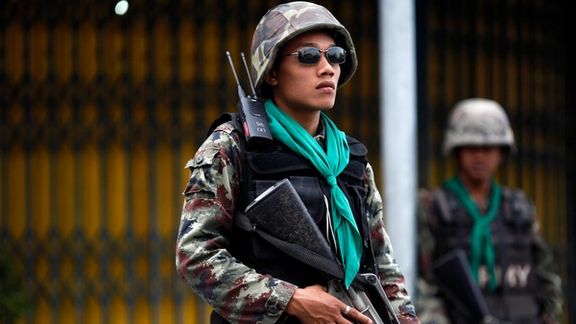
A Thai security force

Following warnings that Iran was planning attacks on Israeli citizens in various parts of the world, Thailand’s police have are on high alert to find the Islamic Republic’s agents.

A police source told the Bangkok Post on Monday that the Royal Thai Police (RTP) has issued a secret order to officers across the country to keep an eye out for spies from Iran believed to be in the region after one was arrested in Indonesia last year.

According to the source, security agencies are closely monitoring the movements of Iranian nationals and gathering intelligence about some Shiite Thai Muslims who are suspected to be working as the Islamic Republic’s agents.

The source said the order cited an incident in May last year when Indonesian authorities were tipped off that a man named Ghassem Saberi Gilchalan arrived in the country carrying a fake Bulgarian passport.

He was arrested just before departing for Qatar, and was sentenced to two years in jail. Police found that he entered the country more than 10 times using false papers and had 11 mobile phones with the names of some Thai Muslims saved on them.

Following interrogations, Gilchalan confessed that he had been given several assignments by a former Iranian diplomat in Malaysia to act as a spy both there and in Indonesia several times, the latest of which involved lobbying Indonesian authorities to release the Iranian-flagged MT Horse oil tanker apprehended there January last year.

IRGC colonel Sayys-Khodaei dead in his car after assailants fired five shots. May 22, 2022
100%
IRGC colonel Sayys-Khodaei dead in his car after assailants fired five shots. May 22, 2022

In May, an Israeli informed source told Iran International that security measures are tight around the Israeli embassy in the Indian capital New Delhi reportedly over a serious possibility of an attack by Iran-backed elements.

Late in May, President Ebrahim Raisi said Iran will “definitely” take revenge for the spectacular assassination of Revolutionary Guard Qods (Quds) Force colonel Hassan Sayyad-Khodaei in Tehran. Sayyad-Khodaei, who Israeli media say was the acting commander of an elite Qods Force unit, Unit 840, was shot dead behind the wheel of his car by two gunmen who fled the scene on a motorbike.

A few days later, Fars news website in Iran affiliated with the IRGC published an article profiling several Israeli businesspeople, using thinly veiled threatening language.

Moreover, conflicting reports are still circulating about the death of Iranian aerospace scientist Ayoob Entezari -- who held a PhD in mechanical and aerospace engineering -- with some calling it an assassination and government saying he died of food poisoning.

Reports about Entezari’s fate came a day after Iran confirmed the death of a colonel from the Quds Force, Ali Esmailzadeh of the Islamic Revolutionary Guard Corps. Iranian government and IRGC media said that Col. Esmailzadeh died “in an incident in recent days” at his home without mentioning any details after Iran International quoted sources in Iran as saying that the IRGC killed him over suspicions of espionage.

Last week, Israel issued a warning to citizens traveling or planning to travel to Turkey that they could be targeted by Iranian operatives seeking to avenge the recent assassination. The National Security Council explicitly identified “Iranian terrorist operatives” as being the source of the threat to Israelis in Turkey and nearby countries. Israel’s Channel 12 news reported on Sunday that Israel is considering expanding the travel warning to additional countries.

Early in May, a short audio recording was published by Israeli media with a photo of a man introduced as Iranian national Mansour Rasouli, 52. In the audio recording, Rasouli says he was sent to Turkey by the Revolutionary Guards (IRGC) to establish an operational network to assassinate an Israeli diplomat in Istanbul, a Germany-based US general, and a journalist in France.

Later in May, Israel’s security agency Shin Bet uncovered an alleged plot by Iranian intelligence to lure Israeli academics and former defense officials to travel abroad in order to kidnap them. The Iranian operatives used the stolen identities and relevant cover stories in an attempt to gather intelligence about Israelis and to invite them to locations abroad -- some under the guise of a conference -- in order to abduct or harm them.


Most Viewed

100 days after carnage: Iran economy reels from war, inflation, unemployment
1
INSIGHT

100 days after carnage: Iran economy reels from war, inflation, unemployment

2
INSIGHT

Ghalibaf defends Iran-US talks amid hardline backlash

3
INSIGHT

A nation in limbo: 100 days after the massacre, has the world moved on?

4
ANALYSIS

From instability to influence: Pakistan’s pivotal role in US-Iran diplomacy

5
ANALYSIS

100 days on: why Iran’s January protests spread across social classes

Banner
Banner

Spotlight

  • War-hit homeowners feel abandoned as Iran’s reconstruction aid fades

    War-hit homeowners feel abandoned as Iran’s reconstruction aid fades

  • 100 days on: the anatomy of Iran’s January crackdown
    INSIGHT

    100 days on: the anatomy of Iran’s January crackdown

  • Ghalibaf defends Iran-US talks amid hardline backlash
    INSIGHT

    Ghalibaf defends Iran-US talks amid hardline backlash

  • 100 days on: why Iran’s January protests spread across social classes
    ANALYSIS

    100 days on: why Iran’s January protests spread across social classes

  • From instability to influence: Pakistan’s pivotal role in US-Iran diplomacy
    ANALYSIS

    From instability to influence: Pakistan’s pivotal role in US-Iran diplomacy

  • A nation in limbo: 100 days after the massacre, has the world moved on?
    INSIGHT

    A nation in limbo: 100 days after the massacre, has the world moved on?

•
•
•

More Stories

Iranian Retirees Hold Protests Across Country As Inflation Reduces Incomes

Jun 6, 2022, 15:31 GMT+1

Iranian retirees held demonstrations Monday in several cities across the country to protest the meager rise in their pensions while the inflation rate is hovering over at over 40 percent. 

The pensioners took to streets in the capitals of many provinces such as Tabriz, Gilan, and Kermanshah, while several cities across the southwestern oil-rich Khuzestan province, including Ahvaz, Dezful, Abadan, and Shushtar, were also scenes of similar protests. 

The enraged protesters chanted slogans such as “Death to Raisi” and "Shame on you incompetent minister”, against the government and “empty promises” by authorities.

Retirees are demanding pension increases in par with rising prices of essential foods, saying that the current payments are not in line with decrees by the Supreme Labor Council, which had stipulated a 38-percent increase in the minimum wage.

The protests occurred as the government spokesman Ali Bahadori Jahromi said in a tweet on Sunday that the minimum wage for retirees covered by the Social Security Organization has risen by 57 percent, calling it “one of the largest increases in 20 years and nearly 20 percent above the official inflation rate.”

With food prices rising faster after four years of United States’ ‘maximum pressure’ sanctions, Iranian workers and retirees and workers have been holding regular protests or strikes to demand higher salaries. 

Moreover, the collapse of a ten-story Metropol building in Abadan in May has sparked anti-government rallies that have spread to other cities in the southwestern Khuzestan province and elsewhere.

Iranian Expats In US, Canada Hold Rallies In Solidarity With Iran Protests

Jun 6, 2022, 13:52 GMT+1

Iranian expatriates in the United States and Canada held gatherings in Washington DC and Toronto on Sunday to express support for popular anti-regime protests in Iran.

The Washington protest was held at the former building of the Iranian embassy and called by dissident singer-songwriter Arash Sobhani, a blues musician who has been an active advocate of human rights and democracy in Iran and has delivered speeches about Iranian social issues in various universities, including Harvard, Stanford, and University of California Irvine. 

During the event, Sobhani performed some of his original works, which are usually themed around the cultural and political issues in the Islamic Republic, as well as some cover songs about Iran, which were accompanied by the participating crowd. 

The gathering in Toronto was organized by Hamed Esmailioun, who is the flagbearer for the victims of the downing of Ukrainian Airlines Flight PS752 in January 2020 by the Revolutionary Guard, where he himself lost his wife and daughter. 

"Iran is ruled by the turban-wearing criminals and bloodthirsty revolutionary guards," Esmailioun said during his speech at the demonstration.

Hamed Esmailioun, who is the spokesman for the victims of IRGC’s downing of Ukrainian Airlines Flight PS752, delivers a speech during a gathering of Iranian expatriates in Toronto on June 5, 2022, in solidarity with the popular protests in the southwestern Iranian city of Abadan.
100%
Hamed Esmailioun, who is the spokesman for the victims of IRGC’s downing of Ukrainian Airlines Flight PS752, delivers a speech during a gathering of Iranian expatriates in Toronto on June 5, 2022, in solidarity with the popular protests in the southwestern Iranian city of Abadan.

In both gatherings, people expressed solidarity with the people of Abadan, whose mourning ceremonies for the victims of the collapsed ten-story Metropol twin towers in May have turned into anti-government protests and spread to other cities of the southwestern Khuzestan province as well as other cities across the country.

“Although we tremble from sorrow but abound with anger; our heart is with you Abadan and we will not let them trample on the truth,” Esmailioun added. 

Claims About Death Of Another Iranian Scientist Cannot Be Confirmed

Jun 6, 2022, 10:41 GMT+1

An Israeli website has reported the death of another Iranian scientist, but the report canot be confirmed by Iran International. 

Ynet reported on Saturday that Kamran Mollapour, who was reportedly working at Natanz nuclear facility in central Iran, has died but it did not confirm or reject the possibility of assassination. 

Despite Iranian some social media reports about Mollapour’s death, no Iranian official, state media or a source close to the alleged victim have mentioned it.

Conflicting reports are still circulating about the death of Iranian aerospace scientist Ayoob Entezari -- who held a PhD in mechanical and aerospace engineering -- with some calling it an assassination and government saying he died of food poisoning. 

Late in May, an explosion in one of the research centers at Iran’s Parchin military complex near the capital Tehran killed engineer Ehsan Ghadbeigi and injured another employee. 

A few days earlier, Iranian government and IRGC media confirmed the death of Colonel Ali Esmailzadeh also from the Quds Force, saying he died “in an incident in recent days” at his home without mentioning any details after Iran International quoted sources in Iran as saying that the IRGC killed him over suspicions of espionage. 

He was a close colleague of Colonel Hassan Sayyad-Khodaei, the acting commander of the elite Qods Unit 840, who was earlier shot dead behind the wheel of his car outside his home in Tehran on May 22. The sources said that the IRGC became suspicious that Esmailzadeh divulged information about his colleague and decided to eliminate him. 

Iran Summons Indian Envoy Over Remarks About Prophet Muhammad

Jun 5, 2022, 22:47 GMT+1

Iran’s Foreign Ministry summoned the Indian ambassador Sunday to protest remarks made during a TV debate about Islam’s Prophet Muhammad, deemed sacrilegious by Muslims.

The director general of the South Asia Department at the Foreign Ministry conveyed the strong protest of the Iranian government over the comments, which the Indian envoy described as not reflecting the position of the Indian government. 

According to the Foreign Ministry website, the ambassador expressed regret over the comments made by two officials of the ruling party, clarifying that New Delhi reveres all religions. 

“The BJP strongly denounces insult of any religious personalities of any religion. The Bharatiya Janata Party is also against any ideology which insults or demeans any sect or religion,” the ruling Bharatiya Janata Party (BJP) said in a statement issued on Sunday.

In recent remarks on a TV news debate, the BJP's spokesperson Nupur Sharma made inflammatory comments about the Prophet of Islam, which led to widespread condemnation in the country and also triggered protests in Uttar Pradesh’s Kanpur on Friday. The party suspended the spokesperson and also expelled Naveen Kumar Jindal, who heads its Delhi media, from the party. Sharma said that certain things from Islamic religious books could be mocked by people.

Qatar, Kuwait and Pakistan have also denounced the remarks made by the two BJP leaders with Kuwait and Qatar summoning the Indian envoys and Pakistani premier taking to Twitter to condemn the remarks.

Mystery Surrounds Death Of Iranian Aerospace Scientist

Jun 5, 2022, 21:45 GMT+1
•
Iran International Newsroom

Conflicting reports circulate about the death of Iranian aerospace scientist Ayoob Entezari with some calling it an assassination and government saying he was ill.

The governor-general's office in the central province of Yazd handed a certificate to Entezari's family confirming his "martyrdom", a label the Islamic Republic uses for people who died in the line of duty for the country.

Yazd’s provincial judicial authorities, however, announced on Sunday that the news published in some media about the important work the aerospace scientist was doing is not true, insisting that he was an ordinary employee of an industrial company and died in hospital due to illness.

The judiciary claimed that one of Entezari's relatives had posted “these rumors” on his social media page to attract attention and was widely republished on other platforms.

The rumors and claims about Entezari’s death attracted unusual public interest because of a series of accidents and deaths related to researchers and protected nuclear and military installations in Iran in the past two years. It has been widely reported that Israel has been behind most of these incidents.

Enetzari by most accounts wroked for the government in developing drones, a field in which Iran has made significant progress in recent years and raised alarm with Israel.

Entezari, who held a PhD in mechanical and aerospace engineering from Tehran’s Sharif University, died last week with some reports mentioning food poisoning as the cause of his death. He reportedly took part in several projects at the Yazd Institute of Technology.

According to reports, Entezari returned home after a dinner meeting with symptoms of food poisoning and died in a hospital in Yazd as his condition worsened. Some sources also reported the disappearance of the person who had invited him, with some saying that he left the country immediately after the meeting.

The circumstances surrounding his death are shady as some people on social media say the Iranian scientist was killed and the Israeli Mossad is also mentioned in some reports as being responsible.

His death was covered widely across Israeli media as the case bears the hallmark of an assassination by poisoning, reminiscent of attempts portrayed in the TV series Tehran in which Israelis tried to kill the head of Iran’s Revolutionary Guard by a toxic agent.

Reports about Entezari’s fate came a day after Iran confirmed the death of a colonel from the Quds Force, Ali Esmailzadeh of the Islamic Revolutionary Guard Corps, the second in two weeks from the unit which allegedly oversees terror operations abroad.

Iranian government and IRGC media said that Col. Esmailzadeh died “in an incident in recent days” at his home without mentioning any details after Iran International quoted sources in Iran as saying that the IRGC killed him over suspicions of espionage. Officials of the Revolutionary Guard told Esmailzadeh’s family that the reason for his death was suicide.

He was a close colleague of Colonel Hassan Sayyad-Khodaei, the acting commander of the elite Qods Unit 840, who was earlier shot dead behind the wheel of his car outside his home in Tehran on May 22 by two gunmen who fled the scene on a motorbike. The sources said that the IRGC became suspicious that Esmailzadeh divulged information about his colleague and decided to eliminate him.





