• العربية
  • فارسی
Brand
  • Iran Insight
  • Politics
  • Economy
  • Analysis
  • Special Report
  • Opinion
  • Podcast
  • Iran Insight
  • Politics
  • Economy
  • Analysis
  • Special Report
  • Opinion
  • Podcast
  • Theme
  • Language
    • العربية
    • فارسی
  • Iran Insight
  • Politics
  • Economy
  • Analysis
  • Special Report
  • Opinion
  • Podcast
All rights reserved for Volant Media UK Limited
volant media logo

Iran's Former President Says Nuclear Deal Was Possible A Year Ago
May 9, 2022, 11:13 GMT+1
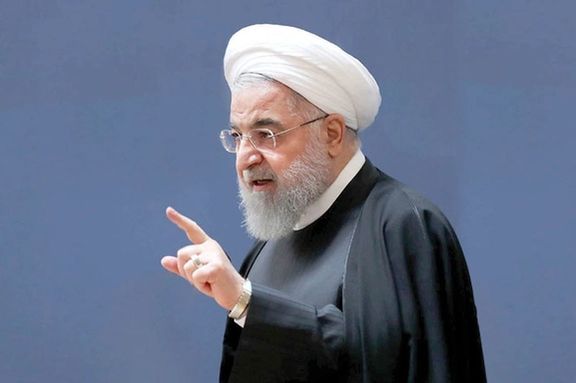
Former Iranian president Hassan Rouhani speaking on May 8, 2022

Former Iranian President Hassan Rouhani has said the revival of the nuclear deal was possible a year ago, noting that the situation has become more complicated.

Speaking to a group of his former officials on Sunday, Rouhani stressed the need for lifting economic sanctions, which is tied to restoring the 2015 nuclear agreement, officially known as the Joint Comprehensive Plan of Action (JCPOA).

He added that the administration of Ebrahim Raisi should not miss the opportunity to reach an agreement with world powers.

Talks began more than a year ago -- when Rouhani was still in office -- in Vienna to revive the JCPOA, and the negotiating sides had reportedly reached some initial agreements until Iran’s presidential elections in June when Tehran stopped the talks for five months. According to reports, about “70 to 80 percent" of the draft agreement was prepared during Rouhani’s term.

The negotiations continued under Raisi, but they seem to have reached a dead-end as they have stalled since mid-March, primarily because of Tehran’s demand to remove its Revolutionary Guard (IRGC) from a US list of terrorist organizations.

The Biden administration so far has not accepted Iran’s demand for delisting the IRGC, as more domestic pressure has emerged in Washington against such a move. Almost all Republicans and many Democrats oppose concessions to Iran.

Enrique Mora, the European Union coordinator for the talks, is scheduled to visit Tehran on Tuesday to exchange views of Tehran and Washington, in what seems to be among the last measures to resolve the remaining issues.


Most Viewed

State media slam Araghchi's Hormuz tweet, say it let Trump claim victory
1

State media slam Araghchi's Hormuz tweet, say it let Trump claim victory

2

Iran International says it won’t be silenced after London arson attack

3
INSIGHT

How Tehran bends its own red lines to boost state rallies

4
OPINION

The Hormuz get out of jail card turned to a grave

5

Iran halts petrochemical exports to supply domestic market

Banner
Banner

Spotlight

  • Too early to tell who is winning Iran war, experts say
    PODCAST

    Too early to tell who is winning Iran war, experts say

  • How Tehran bends its own red lines to boost state rallies
    INSIGHT

    How Tehran bends its own red lines to boost state rallies

  • Iran blackout cripples freelancer, small business incomes
    VOICES FROM IRAN

    Iran blackout cripples freelancer, small business incomes

  • Ideology may be fading in Iran, but not in Kashmir's ‘Mini Iran'
    INSIGHT

    Ideology may be fading in Iran, but not in Kashmir's ‘Mini Iran'

  • US blockade enters murky phase as tankers spoof signals and buyers hesitate
    ANALYSIS

    US blockade enters murky phase as tankers spoof signals and buyers hesitate

  • Why the $100 billion Hormuz toll revenue is a myth
    ANALYSIS

    Why the $100 billion Hormuz toll revenue is a myth

•
•
•

More Stories

EU Coordinator Mora To Visit Iran Tuesday For Nuclear Talks

May 7, 2022, 12:58 GMT+1

Enrique Mora, the European Union coordinator for the Iran nuclear talks, will visit Tehran on Tuesday, Nour News, close to Iran’s national security council reported Saturday.

“Considering the role of the European Union in exchange of views between Tehran and Washington, Enrique Mora’s trip to Tehran could be a new step for constructive exploration of a few remaining limited but important issues,” the website said.

Multilateral talks that began more than a year ago in Vienna to revive the 2015 Iran nuclear agreement known as JCPOA stalled in mid-March, primarily because of Tehran’s demand to remove its Revolutionary Guard (IRGC) from a US list of terrorist organizations.

Earlier on Saturday, EU foreign policy chief Josep Borrell expressed hope that Mora could visit Tehran as a last-ditch effort to salvage the talks.

The Biden administration so far has not accepted Iran’s demand for delisting the IRGC, as more domestic pressure has emerged in Washington against such a move. Almost all Republicans and many Democrats oppose any concessions to Iran.

“Although the continuation of hostile approaches by America against our country contradict the spirit of negotiations for an agreement, but the process of talks have continued,” Nour News said.

Iran is facing what appears to be unsurmountable economic problems partly triggered by US economic sanctions. Tehran this week raised flour prices, which led to unprecedented rise in the cost of bread for millions of impoverished citizens.

EU Making Last Attempts To Revive Iran Talks - Borrell

May 7, 2022, 11:08 GMT+1

The EU foreign policy chief says he is seeking a “middle way” to end the deadlock in Vienna talks to restore the nuclear deal between Iran and world powers.

Josep Borrell told the Financial Times that the impasse threatens to jettison more than a year of European diplomatic efforts to seal the deal.

He said he wanted EU negotiator Enrique Mora to visit Tehran to discuss the remaining issues but Iran “was very much reluctant”, describing the diplomatic push as “the last bullet”.

“We cannot continue like this forever, because in the meantime Iran continues developing their nuclear program”, Borrell warned,

He reiterated the possibility of a scenario whereby the designation on Iran’s Revolutionary Guard is lifted, but other parts of the organization, which has several arms across the security apparatus and a sprawling business empire, will remain under the sanctions.

Negotiations, which started in Vienna in April 2021 to revive the Obama-era nuclear deal, JCPOA, have been on a protracted pause since March 11, as the Islamic Republic demanded removing its Revolutionary Guard (IRGC) from the US list of terrorist organizations.

Iran says the talks have not stopped but continue at a different pace through the exchange of written messages with the Americans through the European Union representative.

US Negotiators Acknowledged Deal Beyond Nuclear Not Possible With Iran

May 6, 2022, 11:14 GMT+1

The Biden administration's negotiating team have reportedly acknowledged in private that an agreement that would go beyond curtailing Iran’s nuclear program is no longer possible.

Politico cited multiple people familiar with classified Congress briefings on the subject that the two Iran-related motions passed in the Senate on Wednesday were a warning shot to the US team negotiating restoring the 2015 agreement with Tehran.

Although the motions were non-binding, the vote was seen as a test run of the bipartisan rebuke that would likely happen if Washington and Tehran clinch an agreement that does not address Iran’s non-nuclear activities and removes Iran’s Revolutionary Guard (IRGC) from the list of foreign terrorist organizations.

The measures -- that for the first time forced lawmakers to go on record about the key sticking points in the year-long negotiations in Vienna -- were also hailed as modest victory for Republicans who have been urging the Biden administration to walk away from the talks, now in limbo for weeks now.

The first vote on Wednesday was proposed by Senator Ted Cruz that called for maintaining terrorism-related sanctions on Iran’s Central Bank to limit Tehran’s cooperation for China, while the other – led by Senator James Lankford instructed Senate conferees to make sure that a House bill would include language that the Biden administration cannot remove the terror designation of the IRGC.

US Committed To Stopping Iran’s ‘Insanity' Of Nuclear Weapons’- Senator

May 5, 2022, 22:33 GMT+1

Republican senator Mitt Romney tells Iran International that the United States is committed to continue pressuring Iran to stop its malign activities across the Middle East.

Romney added that "there is a commitment on the part of our nation to continue to pressure Iran to move away from the insanity of developing nuclear weapons and pursuing a terror agenda in the Middle East and throughout the world”.

He made the remarks in reference to two motions that were passed in the Senate on Wednesday. First, was proposed by Senator Ted Cruz that called for maintaining terrorism-related sanctions on Iran’s Central Bank to limit Tehran’s cooperation for China, while the other – led by Senator James Lankford instructed Senate conferees to make sure that a House bill would include language that the Biden administration caqnnot remove the terror designation of Iran’s Revolutionary Guard (IRGC).

Kentucky Senator Rand Paul, who voted against the motion about the IRGC, told Iran International’s correspondent Arash Alaei that “the problem with dictating all of the things that could be negotiated, in advance, prevents or makes it less likely to have any diplomatic agreement”.

“I voted against precluding certain items that might be negotiated because I think if you preclude those in advance... there would be no negotiations with Iran or never any agreement”, Paul said.

He added that “it is a mistake to legislate away things that could be negotiated”.

Article Reveals Growing Disagreement Within US State Department Over Iran

May 5, 2022, 19:09 GMT+1

A new article has shed light on some disagreements within the US State Department regarding the Iran policy and the US negotiating team in Vienna.

The Al-Arabia article published on Thursday cited US diplomats and sources close to several former and current officials that there is a growing frustration within the State Department due to the centralized decision-making in the hands of only a few officials.

At least three members of the Iran negotiating team, which Special Envoy Robert Malley leads, have left in recent months, namely Richard Nephew, Ariane Tabatabai, and Dan Shapiro.

Nephew, who is known as the architect of Washington’s sanctions against Iran, left his position as the deputy to Malley on December 6 but in January he announced that his decision was “due to a sincere difference of opinion concerning policy.”

According to Al-Arabia sources, Tabatabai decided to leave the team because Malley allowed Russia’s ambassador in Vienna to take the lead on the talks, and Shapiro, a former US ambassador to Israel, also left his role as a senior advisor to Malley after about seven months. The unnamed sources said there was dissatisfaction among the negotiating team over Malley’s unwillingness to listen to opposing points of view.

Nephew told Al Arabiya that he will not comment about the Vienna talks “out of respect for the fact that the negotiations are ongoing and any public comments that I might make could unfairly prejudice those talks or affect the US position.”