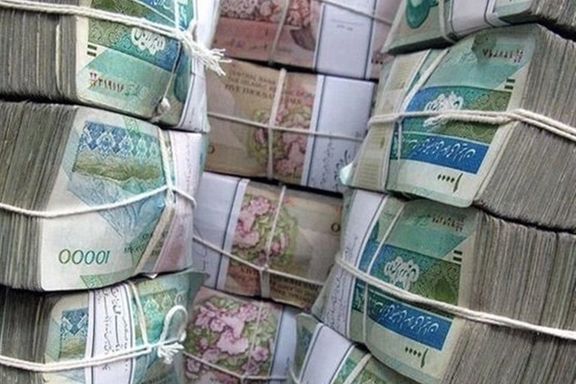
Piles of large denomination Iranian rial banknotes
Iranian government debts have soared since 2018, when the US imposed tough sanctions on the Islamic Republic, International Monetary Fund’s figures show.
According to IMF’s Middle East and Central Asia economic outlook report, Iranian government’s net debt equaled to 41.5% of nominal GDP or $591 billion (based on official USD rate at 42,000 rials) in 2021. It was only $45 billion during 2000-2018 on average, or 11.8% of nominal GDP. The figure reached $214 billion in 2019 and increased to $351 billion in 2020.
During last three years only 70% of government’s annual budget has been realized due to US sanctions and plunging oil exports. Therefore, the government had to borrow a huge amount of money from the Central Bank, The National Development Fund and other internal financial entities to compensate the budget deficit.
Last year, the Supreme Audit Court of Iran announced that the government’s net debts reached 10,000 trillion (10 quadrillion) rials by May 2021, which equals $238 billion based on official USD rate or $37.5 billion based on USD rate in open markets (1 USD: 26,500 rial).
The Supreme Audit Court hasn’t released a new report, but last year it warned that government debt is increasing rapidly, rising 72% only during March-May 2021.
The heavy borrowing from the central bank leads to priniting money and a dangerous rise in liquidity since 2017, which in turn fuels inflation currently standing at more than 40 percent.
Iranian government spokesman Ali Bahadori Jahromi said on April 19 that export revenues, especially from oil shipments, have substantially increased, but the government had to allocate 100 trillion rials per month to pay off mature debts.
IMF put the country’s total exports (oil, non-oil and service) at $54 billion in 2020, but the figure increased to $91 billion in 2021 and expected to reach $140 billion during the current year.
IMF also predicted that the government’s net debts remain unchanged in 2022. International organizations to a large extent have to rely on official figures issued by Iran, as they have no representatives on the ground and do not visit the country.
Iran’s oil and gas condensate export declined from 2.5 million barrels per day (mb/d) in 2018 to 320,000 b/d in 2020 due to the US sanctions, but increased to around 670,000 b/d during last year, according Kpler data intelligence firm. The oil price has also been increasing from $41 in 2020 to above $100 now.
The Wall Street Journal reported on April 28 that Iran’s oil exports rose to 870,000 barrels a day in the first three months of 2022, up 30% from an average of 668,000 barrels a day in 2021, according to Kpler’s estimates.
Iran also exports around 450,000 b/d of petroleum products, which remained unchanged during last years, while oil products prices have also dramatically increased since 2018.
On the other hand, Iranian custom statistics indicate that the value of Iran’s non-oil exports increased by 41% to $48 billion during last fiscal year, ending March 20, due to significantly higher prices for petrochemicals and mine products.
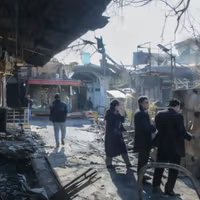
A group of residents of the village of Saravan in Iran’s northern Gilan province clash with police on April 28, 2022.
Iran’s anti-riot police cracked down on people peacefully protesting unsanitary dumping of waste at a local landfill in northern Iran.
A group of residents of the village of Saravan in Iran’s northern Gilan province started a peaceful protest on Thursday, but after police intervention, protesters began throwing stones. Five officers were injured and several protesters arrested.
According to videos circulating inthe socialmedia police used guns and teargas during the clashes.
Furious at the failure of the local authorities to close the gigantic waste landfill, people had been blocking the entrance of the garbage dump for more than two weeks to stop trash trucks from reaching the site.
Piles of stinking rubbish at the Saravan site now tower some 90 meters (295 feet) high, and according to estimates the volume of the waste exceeds one million tons while about a thousand tons is added to it daily.
Waste from the provincial capital Rasht and seven other cities has been dumped there for nearly four decades.
Protesters say the landfill, reportedly due to close next year, is causing diseases and health problems, and demand the site be closed immediately.
The landfill near Saravan in Iran’s northern Gilan province
According to reports, officials have been promising to solve this problem for years but none of their pledges have been fulfilled so far.
The spokesman for Gilan province's waste management office, Javad Shafi'i, told the state broadcaster that some $4 million had been allocated to resolve the issue, including funding a "fertilizer and incinerator plant".
A report by Tehran Times newspaper said that poor waste management is causing environmental damage of around $1.7 billion annually.
Recently, Iran has seen several demonstrations over government mismanagement of environmental issues like the country's water crisis or building factories in natural heritage sites.
Earlier in April, a group of residents held a protest rally in southwest Iran against a project to transfer water out of Chaharmahal-Bakhtiari province, causing water scarcity in their region.
During the protest in the provincial capital of Shahrekord, people carried placards and chanted slogans threatening to take up arms against the ‘mafia’ behind the redistribution project.
Chaharmahal-Bakhtiari, a traditionally water-rich region in the Zagros mountains, has seen its water resources decline due to both drought and projects to irrigate other arid regions.
Iran has been suffering from drought for at least a decade and this year officials have been warning of a further decrease in precipitation.
The petrochemical plant in Miankaleh, northern Iran is planned to be built next to a nature reserve, which galvanized opposition by activists and citizens in the past few weeks. President Ebrahim Raisi came out against the project earlier this month and Iran’s Judiciary issued an order to stop construction until further studies.
However, the governor of Mazandaran province and the Friday Prayer Imam of the region strongly defended the project. The government of former president Hassan Rouhani in an apparently hasty move approved the petrochemical project last year and it obtained the oil ministry’s permission in an unusually fast-tracked manner.
The United States House of Representatives passed legislation Wednesday requiring the president to sanction persons and entities over Iran's drone program.
The Stop Iranian Drones Act (SIDA), approved 424 against two, requires approval from the Senate and a presidential signature to become law.
The lawmakers behind the proposed legislation say it clarifies that US sanctions on Iran’s conventional weapons program under CAATSA include the supply, sale or of drones to and from Iran.
Farzin Nadimi, defense and security analyst in Washington DC, told Iran International Thursday that SIDA was mainly aimed at putting pressure on Iranian institutions and companies importing equipment and technologies used in building drones (unmanned aerial vehicles (UAVs). Nadimi claimed the legislation would help Washington prevent further development of Tehran's indigenous UAV industry.
Supporters of the legislation, including Congresswoman Elise Stefanik, say it will stop Iran or Iranian allies acquiring combat drones that could be used against US troops or US allies. Attacks by Iranian drones and the export of Iran’s drone technology pose a dire threat, SIDA supporters argue.
Alleging that Iran is "the world's leading exporter of terrorism," Stefanik said the world should know the United States will "use every tool at its disposal to cut off Iran’s access to deadly weapons.”
"Time and again, Iran has used UAVs to threaten global stability and US interests," Republican congressman Ted Deutch tweeted after the bipartisan bill passed the House. . “Congress countered this destabilizing behavior today.”
Important timing
Hossein Alizadeh, London-based international affairs analyst in London, told Iran International that the legislation’s timing was important in potentially adding new sanctions while negotiations to restore the 2015 nuclear deal are paused.
Iran's drone technology has already been transferred to some of its proxies, including to the Houthis in Yemen but the legislation shows that Republicans and Democrats are determined to prevent the expansion of Iran's military programs, he said.
Iran’s military drone program has expanded in recent years and UAV’s have been more frequently used in attacks in both on land and at sea. Several attacks in Iraq and at least one attack in Syria have targeted US forces.
SIDA was introduced at the US Senate Foreign Relations Committee December 2021, when a statement by the committee said it sought to amend the Countering America’s Adversaries Through Sanctions Act (CAATSA) to include as sanctionable any action intended to advance Iran’s UAV program.
“Iran’s UAV proliferation continues to threaten the US. and our allies throughout the Middle East. Whether the attack is launched by Iran, the Houthis, Iran-backed militia groups or any other Iran-sponsored entities, these attacks are intolerable,” Rep. Michael McCaul, one of the two Republican lawmakers who proposed the legislation, said after the legislation passed the House Foreign Affairs Committee in December.
Iranian officials have not commented on the proposed legislation. Admiral Mohammad Mousavi said early November that Iran's drones − some of which, including the ‘suicide drone’ Arash − had a range above 2,000km, further than Iran’s missiles. Mousavi told Sobh-e No daily that such drones could evade defense systems like Israel’s Iron Dome, although Saudi Arabia, the US, Iran, Israel, the Houthis, and Hezbollah have all downed UAVs.
A file photo of Iranian negotiators during the Vienna talks to revive the 2015 nuclear deal
Republican lawmakers have urged the Biden administration to brief the “American public” on talks aimed at reviving the 2015 Iran nuclear deal, the JCPOA (Joint Comprehensive Plan of Action).
"With uncertainty surrounding the status of the negotiation, the American people have a right to know what their diplomats agreed to in Vienna, what alternatives your administration is considering,” they wrote.
The Republicans also demanded the administration reveal how it intended to deal with Iran over other matters, “including its increasingly dangerous missile and drone programs and taking American hostages."
The pause in talks has given ample opportunity for JCPOA critics in both Tehran and Washington. The Republicans have highlighted the prospect that lifting US ‘maximum pressure’ sanctions on Iran in return for Tehran accepting JCPOA limits on its nuclear program would see Tehran repatriate billions of dollars currently frozen by creditors wary of punitive US action.
The Republicans’ letter urged public hearings. "To date only closed-door classified briefings have been provided to Congress,” they wrote. “This is a start, but it is not enough. Special Envoy Robert Malley works for the American people, and he should answer to them.”
A member of parliament says the shortage and high prices of medicines in Iran are not limited to certain drugs anymore, and very common medications are also scarce and expensive.
Homayoon Sameh Yeh Najafabadi, who is a member of the parliament's health committee, told ILNA on Wednesday that “today medicine has become very scarce in the country, not special medicines but very ordinary medicines. Therefore, people have to go to several pharmacies for one prescription”.
Criticizing those who claimed to be able to control the prices of medicines, he added that the Health Ministry should have devised a detailed plan for controlling the prices before submitting the budget bill to parliament.
Many officials from the Health Ministry appeared before the parliament and said there would be no problem with the high cost of medicines because the insurance companies would cover the higher in prices, and that there won’t be any pressure on patients once subsidy for imports of essential goods are eliminated, Najafabadi said.
The lawmaker said in addition to medicines, the prices of wheat, flour and bread have also increased, expressing hope that the government has a plan in this regard.
In March, the parliament decided to scrap an annual $9-14 billion subsidy for essential food and medicines, despite warnings of more inflation and hardship.
The subsidy was introduced in April 2018 when former US president Donald Trump signaled his intention to withdraw from the Obama-era nuclear agreement with Iran known as JCPOA, and Iran’s national currency began to nosedive.
Figures released by the Customs Organization show that last year Iran exported gasoline at an average price of 38 cents per liter, lower than even crude oil.
Speaking to Shargh newspaper, Spokesman of the Customs Organization Ruhollah Latifi said Iran's daily gasoline exports averaged 5.3 million liters in the previous Iranian calendar year. Annual revenues from selling gasoline amounted to $732.6 million, around 38 cents per liter, he said, referring to the Iranian calendar year which ended on March 20.
In 2021, according to OPEC figures, crude oil sold for around $78 per barrel which puts the price of one liter of crude at around 49 cents, higher than the price of gasoline, Shargh's Maryam Shokrani wrote.
Latifi told Shargh that nearly half of all gasoline exports -- at around 39 cents and a total of $244.6 million -- were made in the last month of the year (February 20 to March 20). These figures show that despite the spike in international prices of crude oil and gasoline in March, Iran's gasoline sold at the same rate as before.
Mostafa Nakhaei, spokesman of the parliament's energy committee also told Shargh that the parliament had received reports that in the one-year period from March 21, 2020, gasoline had sometimes been exported at prices as low as 5,000 rials, one-third of its subsidized domestic price – an incredible two US cents per liter or around 10 cents a gallon. ($1=280,000 rials)
Why so cheap?
Bulk gasoline prices in the Persian Gulf region were above 80 cents a liter in this period.
Unlike crude oil, gasoline exports are not sanctioned by the United States, and it is not clear why Iran sold the refined product so much cheaper than international prices.
One explanation can be the desperate need for cash dollars as international banking transfers are out of question amid American banking sanctions. It could also be due to shadowy middlemen and networks handling most of Iran’s fuel exports who take substantial cuts and reduce government revenues. Some of these middlemen are people well connected with top officials, as previous scandals from early 2010s revealed.
As the news emerged on Wednesday some Iranians began commenting on social media that in 2019 the government suppressed protests to a hike in fuel prices by killing hundreds of people while it is ready to export gasoline at two cents a liter.
Nakhaei said that some lawmakers have demanded a probe into the export of gasoline at such low prices and the loss the oil and refinery industries have incurred because of that. "Apparently the government only endeavored to raise the gasoline export figures at any cost," he said.
More oil exports with no visible impact
Officials of the government of President Ebrahim Raisi have repeatedly boasted that they have succeeded in raising oil exports by as much as 40 percent despite sanctions imposed by the US in 2018 when Donald Trump pulled the US out of the 2015 nuclear deal with Iran. They also claim that they are now even fully repatriating the revenues from oil sales.
Many Iranians ask why they can see no change in economic indices despite increased oil exports and repatriation of revenues as the government claims, especially with very high fuel prices since the invasion of Ukraine.
An informed source in oil ministry on Tuesday told the government mouthpiece, Iran newspaper, that the reason for not being able to experience any prompt effect of the money coming into government coffers from oil sales was that it takes 90 days to receive the payments from buyers.
But the government claim about higher oil exports goes back to all of 2021, not just the last three months.