• العربية
  • فارسی
Brand
  • Iran Insight
  • Politics
  • Economy
  • Analysis
  • Special Report
  • Opinion
  • Podcast
  • Iran Insight
  • Politics
  • Economy
  • Analysis
  • Special Report
  • Opinion
  • Podcast
  • Theme
  • Language
    • العربية
    • فارسی
  • Iran Insight
  • Politics
  • Economy
  • Analysis
  • Special Report
  • Opinion
  • Podcast
All rights reserved for Volant Media UK Limited
volant media logo

Republicans Urge US Administration To Stop Secret Diplomacy With Iran

Apr 28, 2022, 11:31 GMT+1
A file photo of Iranian negotiators during the Vienna talks to revive the 2015 nuclear deal

Republican lawmakers have urged the Biden administration to brief the “American public” on talks aimed at reviving the 2015 Iran nuclear deal, the JCPOA (Joint Comprehensive Plan of Action).

According to a report in the Washington Free Beacon, a group of Republican Congressmen on the House Foreign Affairs and Armed Services Committees wrote a letter Wednesday calling on the United States administration to reveal details of talks in Vienna, which have been paused since March.

"With uncertainty surrounding the status of the negotiation, the American people have a right to know what their diplomats agreed to in Vienna, what alternatives your administration is considering,” they wrote.

The Republicans also demanded the administration reveal how it intended to deal with Iran over other matters, “including its increasingly dangerous missile and drone programs and taking American hostages."

The pause in talks has given ample opportunity for JCPOA critics in both Tehran and Washington. The Republicans have highlighted the prospect that lifting US ‘maximum pressure’ sanctions on Iran in return for Tehran accepting JCPOA limits on its nuclear program would see Tehran repatriate billions of dollars currently frozen by creditors wary of punitive US action.

The Republicans’ letter urged public hearings. "To date only closed-door classified briefings have been provided to Congress,” they wrote. “This is a start, but it is not enough. Special Envoy Robert Malley works for the American people, and he should answer to them.”

Most Viewed

State media slam Araghchi's Hormuz tweet, say it let Trump claim victory
1

State media slam Araghchi's Hormuz tweet, say it let Trump claim victory

2
OPINION

The Hormuz get out of jail card turned to a grave

3

Iran International says it won’t be silenced after London arson attack

4
INSIGHT

How Tehran bends its own red lines to boost state rallies

5

Iran halts petrochemical exports to supply domestic market

Banner
Banner

Spotlight

  • Too early to tell who is winning Iran war, experts say
    PODCAST

    Too early to tell who is winning Iran war, experts say

  • How Tehran bends its own red lines to boost state rallies
    INSIGHT

    How Tehran bends its own red lines to boost state rallies

  • Iran blackout cripples freelancer, small business incomes
    VOICES FROM IRAN

    Iran blackout cripples freelancer, small business incomes

  • Ideology may be fading in Iran, but not in Kashmir's ‘Mini Iran'
    INSIGHT

    Ideology may be fading in Iran, but not in Kashmir's ‘Mini Iran'

  • US blockade enters murky phase as tankers spoof signals and buyers hesitate
    ANALYSIS

    US blockade enters murky phase as tankers spoof signals and buyers hesitate

  • Why the $100 billion Hormuz toll revenue is a myth
    ANALYSIS

    Why the $100 billion Hormuz toll revenue is a myth

•
•
•

More Stories

UN Nuclear Chief Calls For ‘Cooperation’ In Reviving Iran Deal

Apr 27, 2022, 19:05 GMT+1
•
Iran International Newsroom

The head of the United Nations nuclear body has said “political circumstance” must be overcome if UN monitoring of the Iran nuclear program is to be effective.

In an interview Wednesday with Associated Press (AP), Rafael Mariano Grossi, head of the International Atomic Energy Agency, stressed the agency’s continuing work both in inspecting Iranian atomic facilities and in pursuing answers over its past nuclear work.

“There are certain things they need to explain that are not very clear to us,” Grossi said, referring to work carried out by Iran before 2003 in sites where the IAEA later detected traces of uranium. Tehran is due to satisfy the agency’s concerns by June 21.

Grossi referred to Iran’s recent transfer of nuclear manufacturing from Karaj, west of Tehran, to Natanz as a shift to “a place where they feel they are more protected.” The Karaj workshop, which made parts for centrifuges used to enrich uranium, was sabotaged in June 2021 in an attack widely attributed to Israel.

Grossi noted that the new manufacturing plant at Natanz also reflected growth in Iran’s nuclear program. “The activity is not new, but the production lines, the production capacities, are being expanded,” he said.

While the IAEA is not directly involved in Vienna talks to revive the 2015 Iran nuclear agreement, the JCPOA (Joint Comprehensive Plan of Action), Grossi has made clear the agreement’s demise − following United States 2018 withdrawal and Iran’s 2019 decision to reduce IAEA access and break JCPOA limits − has undermined the agency’s monitoring role.

Grossi told AP that the real value of a temporary access arrangement in place since February 2021 would be realized only if the JCPOA were back in place, when the agency would be able to retrieve all data in its monitoring equipment, including cameras, in Iran’s nuclear sites.

‘Not easy'

"Well, you know, that access to information is part of an understanding I have with Iran that has it, that once the JCPOA is back in application, then they are going to be releasing this material to us,” Grossi said. “So, if JCPOA negotiations were to fail and I don't want to imagine that, but it's a possibility. Then I have to sit down with my Iranian counterparts and look into this again."

The IAEA chief, whose time since taking office December 2019, has been dominated by Iran, conceded that “putting every effort into making this process a success…is not easy.”

Among the issues stalling year-long Vienna talks to revive the JCPOA is reportedly the US 2019 listing of Iran’s Revolutionary Guards (IRGC) as a ‘foreign terrorist organization.’

“There is a political circumstance surrounding this whole thing,” he noted. “And I do not exclude that Iran and others are, of course, looking peripherally at what is going on elsewhere and measuring their reactions to this. My job is to focus on this, to insist, to be very inquisitive in our questioning, to try to get to a clarification. And I'm sure that this will help if we get there. If we don't, there could be further complications. So, I hope this is incentive enough for people to cooperate."
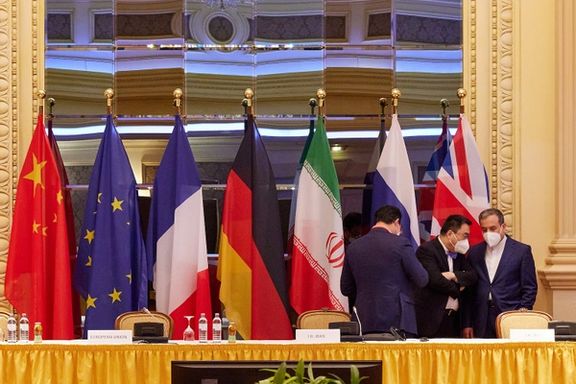
Former European Officials Urge Iran, US To Reach A Nuclear Deal

Apr 27, 2022, 11:16 GMT+1

More than 40 former European officials have called on both the US and Iranian leadership to successfully complete the negotiations to revive the nuclear deal.

The open letter published on Tuesday is led by the International Crisis Group, which is a Brussels-based transnational non-profit think tank consisting of policymakers and academics that describes itself as "working to prevent wars and shape policies that will build a more peaceful world".

The letter, signed by members of the European Leadership Network, board members of the group and council members from the European Council on Foreign Relations, said that the parties to the Vienna nuclear talks are now within touching distance of reinstating the Joint Comprehensive Plan of Action (JCPOA).

Expressing their growing concern over the fate of the talks, they said a period of stasis in the talks threatens to undo the progress made in recent months “toward reinstating a non-proliferation achievement that is crucial for international peace and security.”

“At a time when transatlantic cooperation has become all the more critical to respond against Russia’s unprovoked invasion of Ukraine, for U.S. and European leaders to let slip the opportunity to defuse a nuclear crisis in the Middle East would be a grave mistake”, read the letter.

The US and the Islamic Republic have held more than one year of talks to revive the JCPOA, but the diplomatic process is at a standstill since March. Iran is demanding the removal of its Revolutionary Guard from the US list of terrorist organizations, something the administration has so far not accepted.

Democratic Senators Say No Surprise Iran Pursued Nukes In The Past

Apr 26, 2022, 22:51 GMT+1
•
Iran International Newsroom

Two Senate Democrats say it isn’t news that the Iran was trying to make nuclear weapons in the past, reiterating that the 2015 deal was the best way to stop it.

On the sidelines of Secretary of State Antony Blinken’s testimony at the Senate Foreign Relations Committee on Tuesday, Virginia’s Tim Kaine and Maryland’s Ben Cardin told Iran International that former president Donalds Trump’s move to abandon the Joint Comprehensive Plan of Action (JCPOA) made Iran move closer to nuclear breakout capacity.

In reaction to remarks by a former senior Iranian lawmaker who disclosed that Iran’s aim from the beginning was to produce nuclear weapons, they concurred that regular “intrusive inspections” and finding “an enforceable deal” is the way to keep Iran from getting a nuclear weapon.

Kaine said that the 2015 nuclear agreement, “provided a significant window of time before they could break out”, calling for returning to intrusive inspections to enable the world to know if Iran is going to violate its pledges under the JCPOA and “to make sure that they are honoring their commitments”.

“The Trump decision to terminate the JCPOA has now put Iran right back at the threshold of the breakout capacity, which anyone would have predicted”, he said.

US Democratic Senator Tim Kaine. February 15, 2022
100%
US Democratic Senator Tim Kaine. February 15, 2022

Cardin said, “We never thought they were giving up their desire to be a nuclear-weapon state. But it was put in check, it was put on hold. We have lost that now”.

About Iran’s demand for removing the Revolutionary Guard (IRGC) from the US list of foreign terrorist organizations (FTO), Cardin said it is a proper concern to question whether there will be some relaxation on that.

On the sidelines of the session, Texas Republican senator Ted Cruz also told Iran International’s Arash Alaei that it is a positive step that Blinken acknowledged terrorist activities by the IRGC, but expressed disappointment that he “wasn't willing to answer straight out” if it is true that Iranians have refused to renounce any intention of killing former US officials.

“Three times I asked Secretary Blinken that question, three times he refused to answer the question. I think the reason is obvious, because the answer... is yes”, he said.

Cruz said it is “utterly indefensible” to delist the IRGC and give the Islamic Republic billions of dollars even when it is “actively trying to murder former US officials”. “The IRGC is a vicious terrorist organization”, he stated.

During the committee session earlier in the day, several Senators told Secretary Blinken to walk away from the Vienna negotiations to restore the nuclear deal with Iran.

US Senators Tell Blinken To Walk Away From Iran Deal

Apr 26, 2022, 21:40 GMT+1
•
Iran International Newsroom

Iran is hellbent on having nuclear weapons, Senator Mitt Romney told a Senate Foreign Relations Committee hearing with Secretary of State Antony Blinken Tuesday.

The Republican Senator added, “they'll negotiate and delay as long as they can, the negotiations with us, but that they ultimately intend to have a nuclear capacity.” He went on to say that the way the United States deals with Iran is important because some other nations would also be pursuing nuclear weapons and counting on a temporary restraint by Tehran “is not the right course.”

The Biden administration has held more than one year of talks with Iran to revive the 2015 nuclear agreement, JCPOA, but the diplomatic process is at a standstill since March. Iran is demanding the removal of its Revolutionary Guard from the US list of terrorist organizations, something the administration has so far not accepted.

Romney, who unlike other Republicans has been generally silent about the issue, also urged Blinken that if an agreement is reached it should pass Congressional review.

“And I would encourage the administration to once again bring this matter to Congress for an up or down vote,” he reiterated a demand by most Republicans and some Democrats.

“Iran asks for more and more and more. The answer is no,” Romney said at the hearing called for discussing the 2023 budget.

Democratic Senator Robert Menendez (NJ), chairman of the committee also expressed doubts whether reviving the JCPOA is the best option for the United States. “It will do nothing about the destabilization of the region,” he said and added that the deals sunset clauses are fast approaching, and that is a challenge.

Senator James Risch (R-Idaho) who opposes a return to the JCPOA said “No agreement is better than a bad agreement,” emphasizing that a deal over the nuclear issue does not stop Iran from its destabilizing regional activities. He told Secretary Blinken, “I urge you to move on.”

Blinken defended the JCPOA saying that "agreement was working by all objective accounts." He said that under the nuclear accord the breakout time to Iran producing material for a nuclear weapon was a year. That time frame, he said, has now sped up to a "matter of weeks."

Senator Ted Crus (R-Texas) focused on Iran’s threat to harm former senior Trump administration officials to avenge the killing of IRGC General Qasem Soleimani, asking Blinken if it is true that Iranians have refused to renounce any intention of killing former US officials. Blinken replied that there are threats against present and former officials, and the administration is determined to protect them, but he avoided a direct answer if Iran has refused to renounce its intentions.

The White House press secretary Jen Psaki said later in her press briefing said that the administration is worried Iran could develop a nuclear weapon in weeks.

"Yes, it definitely worries us," Psaki said, adding the time needed for Iran to produce a nuclear weapon is down from about a year.

US Closer To Admitting Failure Of Iran Talks, Israelis Say

Apr 26, 2022, 09:36 GMT+1

As Israeli National Security Advisor Eyal Hulata visited Washington to discuss Iran, Tehran media remained conspicuously silent on the nuclear issue on Tuesday.

Economic crisis and rising prices have dominated news and discussion in Iranian media, while the government often tries to persuade the public that the talks to revive the 2015 nuclear agreement, JCPOA, are not completely dead.

Negative news on the talks would be very harmful to the government’s effort to defend the battered local currency, which is tethering on the edge of another precipitous fall. Annual inflation, already above 40 percent, could completely get out of hand if the rial crosses the 300,000 threshold against the US dollar. It currently trades close to 280,000.

Another possible political damage for the Islamic Republic in the diplomatic stalemate is being blamed by the hard-pressed population desperate for relief from US sanctions.

Iran’s foreign ministry spokesman on Monday called for some sort of renewal of the nuclear talks, telling the public that Europeans, Russia and China have no objection to an agreement and only Washington is delaying the process.

As Tehran prefers positive news on the talks, international and Israeli media have a completely different interpretation of the current diplomatic stalemate. Israel Hayom newspaper and Kan public broadcaster said on Tuesday that the Biden administration is approaching the point of admitting the failure of the one-year-old talks in Vienna.

Whether these reports are based on information received from Hulata’s meetings in Washington or is the opinion of other Israeli officials, it seems the United States and Israel are more seriously discussing “a plan B”. Axios reported on Mondaythat the Biden team is already preparing for the contingency that the nuclear talks will fail, and Israel is pushing for a discussion of a Plan B, which would mean putting more pressure on Tehran.

Although former President Donald Trump imposed maximum pressure sanctions on Iran, the consensus among observers is that the Biden administration has relaxed their enforcement. Even Iranian officials who like to boast about their ability to circumvent restrictions and increase oil exports, sometimes admit that lax enforcement has helped their cause.

A Plan B by Israel and the United Sates could mean revamping the economic pressures, but it could also mean brandishing a military threat in case Tehran decides to play nuclear brinksmanship. Then, there is the issue of confronting Iran’s ability to use its proxy forces in the region to put counter-pressure on the US and its allies.

Iran insists that all Trump sanctions, including those imposed for terrorist related activities should be removed before it agrees to a nuclear agreement. The foremost among these sanctions is the designation of the Revolutionary Guard, IRGC as a terrorist organization by the United States. At what point Tehran would realize that a US and Israeli Plan B is coming and would retreat from its maximalist demands, is not clear, but it has invested a lot of political capital into saying it would never agree to anything less. A retreat would not only be domestically embarrassing but also would inflict some credibility damage among allies and proxies in the region.

An Israeli official told Israel Hayom, “The possibility that the parties sign an agreement in the foreseeable future is dwindling at an exponential rate,” and the Biden administration is increasingly willing to admit it.

US National Security Advisor Jake Sullivan told Hulata on Monday that “the United States is attuned to Israel’s concerns about threats to its security, including first and foremost from Iran and Iranian-backed proxies.”