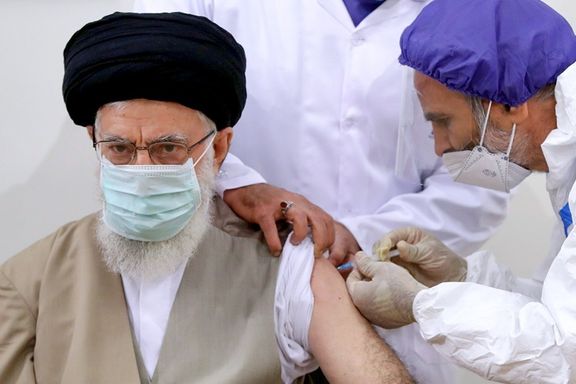
Ali Khamenei receiving a COVID vaccine shot in 2021
The trial of five activists who had filed a lawsuit against Iran’s Supreme Leader Ali Khamenei for "Covid mismanagement" was held behind closed doors Saturday.
The group of five, who were put on trial at Branch 29 of Tehran Revolutionary Court, has come to be called 'Defenders of Right to Health' by the media. They are: Mehdi Mahmoudian, Mostafa Nili, Arash Keykhosravi, Mohammadreza Faghihi and Maryam Fara-Afraz
The group's litigation apparently sought to establish that decisions by Khamenei, former President Hassan Rouhani, and others led to thousands of unnecessary deaths when a severe wave of infections hit Iran from June to August 2021.
The members of the group were arrested on August 15 last year while holding a meeting to prepare legal action against authorities for mismanagement of the pandemic and delay in in mass vaccination. All, except Mahmoudain, were released after spending more than a month in solitary confinement.
Five activists put on trial for suing Iran's Supreme Leader over his vaccine ban.
In an unexpected move in early March, Iran's Judiciary accepted to register the group's lawsuit against the authorities, including Khamenei.
While Khamenei banned the Western vaccines, hundreds of millions of dollars were distributed among government-run companies with no experience in vaccine development to produce a homegrown variant.
The five activists have been charged with "acting against national security", an often-used vague charge often brought against dissidents and critics of the Islamic Republic. They are accused of forming a "hostile group aiming to harm the country's security and make propaganda against the state".
“If demanding justice for thousands of lives lost is an act against national security, then what is the failure to save 40,000 lives?” Mahmoudian said Saturday in the court, according to family members who were the only ones allowed to attend.
In a statement one day before the trial, Mahmoudian urged the authorities to hold it publicly and allow independent media and political, social, and civil figures to attend.
Several political activists, including reformist activist Mostafa Tajzadeh, tried to attend the court on Saturday but were barred. "Why is that they are being tried … although there has been no trial yet for the people they had sued?" Tajzadeh asked in a tweetafter he was not allowed to enter the courtroom.
Mahmoudian, who is also an outspoken journalist, has remained in prison since August. In September, authorities threw the book at him and gave him a 5-year sentence for his previous civic activities.
Three of the detainees including Mahmoudian, Nili, and Keykhosravi in a letter in September said the reason for their arrest and solitary confinement was their refusal to sign a pledge not to take legal action against the Supreme Leader and other officials.
The spokesman for Iran’s Covid-19 taskforce says the country is ready to send medical personnel and vaccines to China if needed.
Abbas Shirozhan said in a series of tweets on Saturday that the Islamic Republic ranks 12 in the world in research related to the coronavirus and boasted about the low number of Covid-19 fatalities.
However, reports suggest that the number of Covid-related deaths in Iran is much higher than the official figure of over 141,000. Official records show that since the pandemic began in early 2020, deaths have been 300,000 higher than before, suggesting more Covid deaths that official figures indicate.
Covid cases have surged in China in recent weeks, with new strict quarantines enforced by tough government measures.
Shirozhan said the Iranian producers of vaccines are allowed to export their home-grown vaccines to other countries, while earlier in the month Iran’s national carrier Iran Air said Iraq does not allow entry to visitors who have received Iranian-made vaccines. Iran has approved at least six homegrown vaccines for production, although none have received international approval.
Iran itself was able to vaccinate most of its population only when China began shipping tens of millions of doses in August 2021. Iranian-made vaccines never reached a high level of production.
A high-ranking official of Iran’s Judiciary says a total of 30 Iranian nationals are imprisoned abroad on charges of circumventing Washington’s sanctions.
Kazem Gharibabadi, a senior Judiciary official and secretary of the Iran’s High Council for Human Rights, added on Friday that government officials are following up on their cases.
He criticized what he called the Western “double standard” approach on the issue of human rights, saying that “the number of Iranians who need human rights protections abroad is not small”.
“There are many examples in this regard, like the sham trial of [former Iranian judicial official] Hamid Nouri in Sweden, the violent mistreatment of a female Iranian asylum seeker by the Danish police in front of her child, and even Iranians being prosecuted under the pretext of circumventing US sanctions against Iran,” Gharibabadi said.
He stressed that “in some cases the follow-up process is lengthy and does not mean that we are abandoning them. We give various forms of human rights support.”
His remarks came as talk of a possible prisoner swap deals between Iran and the United States circulates in media especially since Iran freed British Iranian Nazanin Zaghari-Ratcliffe and Anoosheh Ashoori in exchange for the UK paying a four-decade-old £400m ($522 million) debt to Iran.
Following reports about the release of Iranian funds frozen by third countries in return for Tehran freeing Iranian-Americans it holds hostage, the US State Department denied “any breakthrough” in talks on the release of four US citizens.
Iran's foreign ministry has called the US State Department's annual report on human rights in Iran "baseless" and said the US government is "addicted to lies".
"Publication of repetitive and baseless reports does not create any kind of legitimacy for such reports," Saeed Khatibzadeh said in a statement Thursday on the foreign ministry's website in reaction to the US State Department's 2021 report on human rights practices published Tuesday.
"The lie-addicted government of the US cannot be expected in any way to talk about truth and existing realities," he said while alleging that the United States ignores "systemic violation of human rights" in its own country and by its allies.
Khatibzadeh also said that the assassination of Iran's Revolutionary Guards (IRGC) Qods Force commander, Ghasem Soleimani in Baghdad by former US President Donald Trump's orders was an indication of the "terrorist nature of the United States".
The State Department's report, the second by the administration of President Joe Biden, said Iran violates human rights in various ways including unlawful or arbitrary killings by the government and its agents, executions for offences that do not meet the threshold of the "most serious crimes" such as drug-trafficking and financial corruption, and for acts not internationally recognized as crimes. "Death sentences were used as a weapon of repression against protesters, dissidents and ethnic minorities," the report said.
The report alleged that the Islamic Republic takes reprisal against individuals in other countries including killing, kidnapping, or violence and punishes family members for offenses allegedly committed by an individual.
"The government [in 2021] took few steps to identify, investigate, prosecute, and punish officials who committed human rights abuses or corruption. Impunity remained pervasive throughout all levels of the government and security forces," the report said.
"We continue to find ways both in public and in very discreet manners to support people who are trying to advance the human rights situation in Iran," said Lisa Peterson, acting assistant secretary of state for democracy, human rights and labor affairs at a special briefing on Tuesday. "We have also put into play a variety of sanctions tools."
The global rights watchdog criticized Iran for torture and other ill-treatment of prisoners, use of the death penalty as a weapon of repression, and executions carried out after unfair trials as well as holding the country's June 2021 presidential elections "in a repressive environment'.
Iran routinely dismisses any criticism of its human rights record but has not allowed international rights groups and the United Nations special rapporteurs to visit the country.
The Biden administration released its first report on human rights practices in Iranon March 31 last year in which it alleged that violation of human rights was a policy in the Islamic Republic and the regime was also involved in widespread human rights violations in other countries in the Middle East.
Despite tough criticism of Iran’s record by successive US administrations, the issue of gross human rights violations hardly have a place in negotiations with Tehran over its nuclear program or aggressive policies in the region, although certain human rights sanctions are in place.
A Kurdish young man living in Tehran has died in a police detention center, with the family claiming he was killed under “torture.”
The Kurdistan Human Rights Network said on Wednesday that 25-year-old Milad Jafari was arrested on drug-related charges on April 7.
A member of Jafari’s family, which is from the western city of Kermanshah, told the human rights group that the department of forensic medicine in the Kahrizak Detention Center in Tehran Province had contacted the family to pick the dead body of their relative.
The father was shown photos of the body with clear marks of bruises and bleeding on the face, the relative said, with the authorities explaining that Jafari had committed “suicide” and “fell from a height”.
His family was also told that the body was transferred on April 8 to Kahrizak, while police said the young man died on April 11.
The family refused to take the body until autopsy results reveal the cause of the death.
The Kahrizak Detention Center is notorious for its cramped and squalid cells where prisoners have been routinely verbally abused and beaten by guards.
Two inmates, Amir Javadifar and Mohsen Ruholamini, son of a well-known political figure close to Iran’s supreme leader, were allegedly beaten to death there. They had been arrested during unrest triggered by the disputed 2009 disputed presidential elections.
Complaints lodged with Supreme Leader Ayatollah Ali Khamenei led to the closure of the detention center in 2009, but the facility re-opened a year later after being renamed Soroush 111 Detention Center.
Political prisoner Mehdi Salehi in traditional tribal costume.
An Iranian political prisoner, who was arrested during mass protests in December 2017, has died due to the injection of an unknown substance in prison.
Mehdi Salehi, whose death was announced in social media on Thursday, had a stroke and went into a coma in January because of the injection of an unknown drug by Esfahan prison officials, human rights monitors said at the time.
A source close to Salehi's family told Iran International that he was chained to the bed in hospital. Recently, he had come out of coma but suddenly the family was told that he passed away.
He was among five protesters sentenced to death, with Iran Human Rights Organization warning about the possibility of authorities secretly executing them.
Large nationwide protests in December 2017 were triggered by rising prices and turned into anti-Islamic-Republic unrest in over 100 cities and towns. Hundreds of striking and protesting workers and labor activists have also been arrested since 2017, many spending months in prison. Some are still detained without trial.
The global rights organization has documented how prison authorities routinely cause or contribute to deaths in custody, including by blocking or delaying prisoners’ access to emergency hospitalization.
Sixty-four of all these prisoners died inside their prison cells meaning they were not given even basic medical supervision in their final hours.