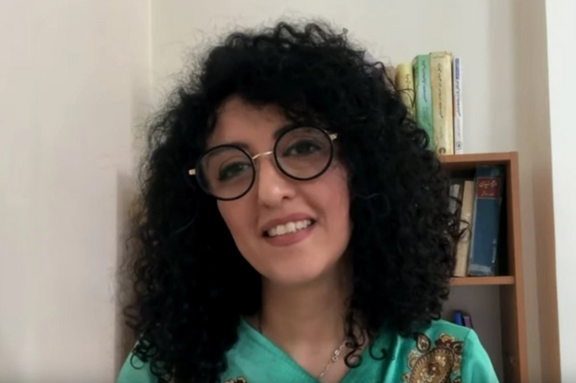
Narges Mohammadi, a long time human rights defender and political prisoner in Iran.
A prominent Iranian rights defender argues that sanctions should target violators of human rights in Iran, such as the Revolutionary Guards, not the people.
Speaking to Iran International TV on Friday, Narges Mohammadi said Western sanctions have failed to weaken Iran's oppressive regime but led to a "disastrous weakening of the Iranian middle class as the driving force of democracy".
The sanctions failed, she argued, because they were not "targeted" and Western politicians did not have adequate knowledge of the Islamic Republic system.
"It appears that the West lacks a proper understanding of the hypocrisy of the Islamic Republic and that it is a dictatorial government with systemic financial corruption that can use various tools [of repression]," she told Iran International.
There has been huge social media controversy over Mohammadi's views over sanctions after a Washington Post opinion article Wednesday referring to interviews with her in which she said sanctions weaken Iran’s civil society.
Critics attacked Mohammadi accusing her of defending the lifting of US sanctions, and her approach benefits the regime and the Revolutionary Guards (IRGC) which is also under US sanctions.
The controversy gained more attention among Iranians because the Washington Post article coincided with Iran’s demand from the Biden administration to remove the IRGC from its foreign terrorist list as a condition for the revival of the 2015 nuclear agreement.
A man was shot in the face by security forces using a shotgun 'birdshot' during protests in Esfahan, on November 26, 2021
Mohammadi told Iran International that in the interview with the Washington Post she had said that she considers the IRGC as an oppressive force and a violator of human rights and that it must be targeted by the international community by various means including sanctions but not all her comments had been included in the article.
Mohammadi also explained that she believes the international community has the duty to target "any person or group" in the Islamic Republic that violates human rights to support the Iranian people and civil society and one of the ways to target the violators is using sanctions.
Mohammadi added that the IRGC's "political, terroristic, and economic investments and activities", both inside and outside the country, result in oppression of the Iranian civil society and therefore it must be placed on the list of "targeted" international sanctions along with other entities of the Islamic Republic that violate human rights such as its Judiciary and Police.
Some harshly attacked her integrity and questioned her honesty as a regime critic, while others said she should have been more careful during the interview with the author of the Washington Post opinion article, Jason Rezaian.
Mohammadi has an eight-year sentence hanging over her head for supposed “crimes against national security”, for her activities as a human rights activist and may be hauled off to prison any moment to serve it.
Cofounder and chair of the Defenders of Human Rights Center, Mohammadi has been to jail several times over the past two decades. She was freed from Evin prison in September 2020 after serving five and half years when she had no contact with her husband and children for long periods of time.
But one of Mohammadi's supporters in a tweet Thursday said she could not understand why she was criticized so strongly. "She has said that sanctions destroy the civil society. Do you doubt this statement? wrote Banafsheh Jamali, a feminist activist. "People are not going to have any demands other than economic ones when they are in dire need of food to survive," she added.
Some argue that it is difficult to put in place effective sanctions that do not lead to economic pressure on the people, and mention the example of Russia. If the government is supposed to be pressured to stop a certain behavior, it must feel economic pressure, which invariably also impacts the people.
Others say that the civil society Mohammadi refers to has not been able to reform the Islamic Republic and has been badly suppressed, so sanctions are the remaining tool to bring about a change.
Senator March Rubio (R-Fl) at the Senate Intelligence Committee. March 10, 2022
A group of US Republican senators have called on the administration to provide Israel with the military capabilities it needs to defend itself from a nuclear-armed Iran.
In a letter led by Florida Senator Marco Rubio, 11 senators told President Joe Biden that his new nuclear deal with Iran will provide the regime with a pathway to nuclear weapons and warned of major negative regional implications of a nuclear-armed Iran.
Stressing the necessity for a course-direction, they said, the new agreement “would put at risk the existence of the State of Israel and the governments of our Arab allies, destroy America’s position in the Middle East, and ultimately threaten the US homeland”.
The senators also warned of the grave threats of Iran’s ballistic missile arsenal, its support for terrorism, and other destabilizing activities in the Middle East.
“The Iranian regime arms the Houthis in Yemen with the missiles and drones that they use to attack civilian targets in Saudi Arabia and the United Arab Emirates”, they wrote, adding that “Iran equips Hezbollah and Hamas with tens of thousands of rockets”.
Iranian navy vessels during drills in the Sea of Oman. Undated
Iran has seized a “foreign vessel” in the Persian Gulf for carrying “smuggled fuel”, Fars news website close to the Revolutionary Guard (IRGC) reported Saturday.
The head of Iran’s Judiciary in Hormozgan Province on the Persian Gulf said that the IRGC naval forceshad “identified” a foreign vessel carrying 220,000 liters of “smuggled fuel” and seized the unidentified vessel.
The report said 11 foreign crew members were detained until investigations are completed. There was no reference to the nationality of the tanker in question or the crew. The report also did not say where the fuel was being smuggled from and to what destination.
The news come as negotiations to revive the 2015 nuclear deal known as JCPOA are in limbo mainly due to Iran’s demand that the IRGC be removed from the United States’ list of Foreign Terrorist Organizations (FTO).
Iran has boarded and seized foreign-flagged tankers in the past. One major incident occurred in January 2021 when the IRGC seized a Korean tanker for what seemed to be Iranian pressure on Seoul to release around $7 billion of funds frozen because of US sanctions.
Iran also was behind mine attacks against foreign tankers in the summer of 2019, when the US imposed full sanctions on Tehran’s oil exports.
The US Navy in the Persian Gulf region is known to have intervened in some instances to protect tankers.
Iran’s capital Tehran on Friday had the worst air quality index in the world, according to data by IQAir -- a global air quality monitoring company.
The company’s real-time air quality index (AQI) for Tehran was 206 on Friday, putting the Iranian capital on top of the list followed by Beijing and Pakistan’s Lahore with AQIs of 182 and 173, respectively.
According to the Swiss company that specializes in protection against airborne pollutants, the index of over 200 is considered ‘Very Unhealthy’.
The air quality is not much better in other Iranian cities like Esfahan, and people have been warned against going out, as a wave of dust carrying pollutants has hit the country from neighboring Iraq.
An official from Iran’s meteorological organization, Mohammad Asghari, told state broadcaster IRIB on Friday that 26 provinces of the country will be engulfed by dust in the coming days.
Using another pollution standard, Asghari said Tehran’s air quality index was 491, which is only nine points less than the maximum level in this scale and is considered ‘Hazardous’.
Pollution in Tehran also forced authorities to cancel outdoor sport matches scheduled for Friday while schools have gone virtual again only a week after they opened following the New Year holidays and a year of Covid-19 restrictions.
Air pollution is a persistent problem in large Iranian cities, especially in cold and hot weather when more electricity is used and power stations resort to using heavy dirty diesel fuels because of natural gas shortages.
Afghan immigrants registering at the border in Iran.
A conservative newspaper in Tehran says the knife attack on clerics in Mashhad this week was an outcome of Iran's "wrong policy" about Afghan immigration.
An Afghan immigrant attacked three clerics at the most important Shiite shrine in Iran April 5 in what President Ebrahim Raisi has called a “Takfiri” assault, referring to Sunni extremists.
Calling the incident " a terrorist attack", the Jomhuri Eslami said in its editorial on Thursday, this is only one of the negative consequences of the Iranian government's "easy approach" to the takeover of Taliban in Afghanistan.
The daily also claimed that "Taliban elements have brought all sorts of weapons to Iran and have prepared places to recruit Takfiri elements," and called all this part of a special plot to carry out the conspiracies hatched by the enemies of the Islamic Republic.
Demographic danger
According to Jomhuri Eslami, "some 8 million Afghans are living in Iran and every day at least another 10,000 Afghans arrive legally or illegally. The daily also revealed that Iranian officials issue up to 7,000 visas to Afghans every day while the borders are left open for immigrants to enter illegally.
If this estimate of the Afghan population in Iran is correct, it means around 10 percent of the country’s 83-million population is comprised of Afghan nationals. Some even argue that Iran’s actual population is much less than what the government claims, since millions have left the country for good.
The daily added that most Afghan immigrants are Pashtuns, and that up to 75 percent of births in hospitals in Tehran and its suburbs are registered by Afghans. The birth rate among Afghan women in Iran is between 4.7 to 5.2, the daily reported, adding that there are 600,000 Afghan students at government schools, while officials predict that this number will rise to 1.2 million next year.
A group wedding of Afghans in Iran. Women sit separate from the men.
As a result, the daily warned, that the demographic combination of provinces such as Esfahan, Yazd, Kerman and Sistan-Baluchestan is changing and some 35 percent of the population in some areas are Afghans. This is evident around the Revolution Square, Azadi Square and the Persian Gulf Lake near Tehran.
Jomhouri Eslami further claimed that with the 2019 legislation granting Iranian citizenship to the children of Iranian women marrying foreigners, a tsunami of “buying Iranian girls and women” from poor families has started in Iran.
The daily warned that the combination of these changes will lead to an uncontrollablesocial catastrophe including insecurity in the near future.
Taliban Infilteration
The editorial noted that although the Taliban had committed many crimes in the first round of their takeover in 2001, including murdering two dozen Iranian diplomats in Mazar-i Sharif, Iranian officials welcomed the second Taliban takeover eight months ago, claiming that the Taliban have changed. The daily also warned that the Taliban is not an entity separate from the ISIS. "You cannot separate the Taliban from the ISIS, in the same way that you cannot separate the United States from Satan," the editorial said.
Earlier, even before the attack at the shrine in Mashhad, Iranian observers, including Jomhouri Eslami's editor Masih Mohajeri had warned that uncontrolled immigration of Afghans into Iran might lead to an infiltration by the Taliban and ISIS militants that will threaten Iran's security. The daily, as well as commentators in other media outlets in Iran had also warned that the influx of Pashtuns into Iran might lead to disputes and even conflicts between Iranian Shiites and Afghan Sunnis.
Iranians traditionally support the Hazarah and Tajik communitiess of Afghanistan who speak the same language as Iranians, but do not trust Pashtuns who live further down in southern Afghanistan.
The daily stressed that "The Taliban has not changed during the past 20 years and is still the same terrorist group." Jomhouri Eslami further called for replacing all the pro-Taliban Iranian officials at the Iranian embassy in Kabul and the Iranian Foreign Ministry. It also called on Iran's state television to replace its policy of “beautifying the Taliban” with real news dissemination. "Iran should be purged from Afghan infiltrators, the borders with Afghanistan should come under strict control and Iran should recognize only an Afghan government that comes to power through a free and fair election," the editorial concluded.
Meta, formerly the Facebook company, has removed two Iranian cyberespionage groups that were targeting academics, activists, journalists and other victims.
According to its latest Adversarial Threat report released on Thursday, the two networks were targeting people across the internet to collect intelligence, manipulate them into revealing information, and compromise their devices and accounts.
The first network was linked to a group of hackers known in the security industry as UNC788. The network is Iran’s decade-long campaign of credential harvesting and surveillance operations that is possibly sponsored by Revolutionary Guard (IRGC). It targets Iranian diaspora, dissidents and human rights activists from Israel and Iran, Iran-focused academics, politicians in the US, people in the Middle East including the Saudi military, and journalists around the world.
The other group is a separate newly identified cyberespionage network that was targeting companies in the energy, telecommunications, maritime logistics, semiconductor, and information technology in several countries, including the United States, Israel, Saudi Arabia, UAE, Russia, Canada, and others.
The previously unreported hacking group relied on phishing and extensive social engineering tactics to impersonate the domains of legitimate companies and used a complex network of fake personas across Facebook, Telegram, and other platforms along with a network of fake recruiting firms.
Both groups used unique malware applications disguised as a VPN app, a salary calculator, an audio book reader, a chat app, a birthday calendar app, or a Quran app.