• العربية
  • فارسی
Brand
  • Iran Insight
  • Politics
  • Economy
  • Analysis
  • Special Report
  • Opinion
  • Podcast
  • Iran Insight
  • Politics
  • Economy
  • Analysis
  • Special Report
  • Opinion
  • Podcast
  • Theme
  • Language
    • العربية
    • فارسی
  • Iran Insight
  • Politics
  • Economy
  • Analysis
  • Special Report
  • Opinion
  • Podcast
All rights reserved for Volant Media UK Limited
volant media logo

Cruz Says Biden 'Deliberately' Keeping Congress In Dark On Iran Deal
Apr 7, 2022, 18:26 GMT+1
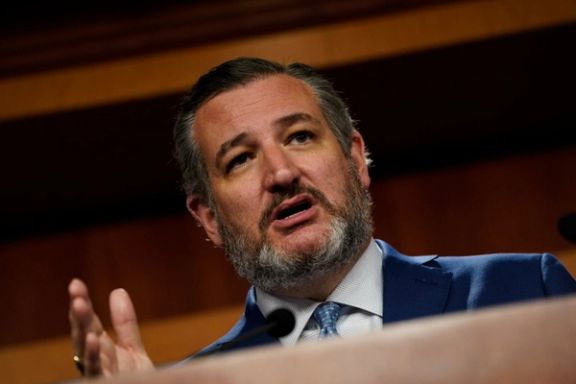
Senator Ted Cruz during a press conference on April 6, 2022

Senator Ted Cruz has criticized the Biden administration for ‘deliberately’ keeping Congress in the dark over the details of a potential nuclear deal with Iran.

In a brief interview with Iran International’s correspondent Arash Alaei on Thursday, the Texas Republican Senator said the reason the administration doesn’t want everybody to know about the details “unfortunately is the deal they’re negotiating [which] is a terrible deal for America”.

“Joe Biden has asked [Russian President] Vladimir Putin to negotiate on our behalf, and Russia is negotiating with Iran right now in Vienna. Russia is our enemy and Iran is our enemy”, he added, noting that “the one thing they can agree on is policies that endanger the safety and security of America”.

“This deal is a catastrophic mistake and that’s why the Biden administration is so desperate to hide the details of it from the elected members of the Congress”, Cruz said.

Former president Donald Trump withdrew from the 2015 nuclear agreement with Iran known as JCPOA in 2018, saying it was in adequate to keep Tehran from building nuclear weapons. He imposed ‘maximum pressure’ sanctions. President Joe Biden announced before the 2020 presidential elections that Trump’s policy was wrong, and he would work to revive the JCPOA.

Republicans have opposed Biden’s approach from the beginning and their objections became more intense as reports emerged that the White House was weighing the removal of Iran’s Revolutionary Guard from the US list of Foreign Terrorist Organizations (FTO). More Democrats have lately joined the opposition as talks in Vienna to revive the JCPOA have stalled.

About the administration’s options in case of the collapse of the deal, he said, “What they should do is return to the policy of [Donald Trump’s] maximum pressure; they should impose sanctions, they should enforce sanctions”.

Slamming Biden for easing on the oil sanctions that has seen Iran increase its oil exports and revenues, he said, “Right now the Biden administration is turning a blind eye while Iran openly flouts the oil sanctions. The Biden administration is allowing the Ayatollah to sell a million barrels of oil a day with no consequences”.

“The Biden administration has delisted [Iran-backed] Houthis as terrorists even as they carry out ongoing terror attacks”, Cruz said, adding that “the answer is to reverse course entirely; end their policies of weakness, appeasement, and surrender, and instead follow a policy of maximum pressure to prevent the ayatollah from developing nuclear weapons and carrying out terror attacks against Americans and our allies”.


Most Viewed

100 days after carnage: Iran economy reels from war, inflation, unemployment
1
INSIGHT

100 days after carnage: Iran economy reels from war, inflation, unemployment

2
INSIGHT

Ghalibaf defends Iran-US talks amid hardline backlash

3
INSIGHT

A nation in limbo: 100 days after the massacre, has the world moved on?

4
ANALYSIS

From instability to influence: Pakistan’s pivotal role in US-Iran diplomacy

5
ANALYSIS

100 days on: why Iran’s January protests spread across social classes

Banner
Banner

Spotlight

  • War-hit homeowners feel abandoned as Iran’s reconstruction aid fades

    War-hit homeowners feel abandoned as Iran’s reconstruction aid fades

  • 100 days on: the anatomy of Iran’s January crackdown
    INSIGHT

    100 days on: the anatomy of Iran’s January crackdown

  • Ghalibaf defends Iran-US talks amid hardline backlash
    INSIGHT

    Ghalibaf defends Iran-US talks amid hardline backlash

  • 100 days on: why Iran’s January protests spread across social classes
    ANALYSIS

    100 days on: why Iran’s January protests spread across social classes

  • From instability to influence: Pakistan’s pivotal role in US-Iran diplomacy
    ANALYSIS

    From instability to influence: Pakistan’s pivotal role in US-Iran diplomacy

  • A nation in limbo: 100 days after the massacre, has the world moved on?
    INSIGHT

    A nation in limbo: 100 days after the massacre, has the world moved on?

•
•
•

More Stories

Iran Says No IAEA Access To Camera Footage At Nuclear Site Without JCPOA

Apr 7, 2022, 11:35 GMT+1
•
Maryam Sinaiee

Tehran said Wednesday that before the 2015 nuclear deal is revived it will not give the IAEA access to data from cameras at a new centrifuge parts plant in Esfahan.

Mohammad Reza Ghaebi, Head of Iran's Permanent Mission to International Organizations in Vienna and acting ambassador to the International Atomic Energy Agency (IAEA) told reporters in Vienna that Iran would not provide access to the cameras installed by the agency in Esfahan if the 2015 nuclear deal, Joint Comprehensive Plan of Action (JCPOA) is not restored.

“That is why the agency has announced that it was unable to confirm whether or not the manufacturing of spare parts for centrifuges has begun in Esfahan,” Ghaebi noted.

The Esfahan site was built to replace the TESA Karaj Complex, a now decommissioned workshop in the west of the capital Tehran. The Karaj site was damaged in a June 2021 attack that Iran said Israel was responsible for. The IAEA has confirmed that the production of centrifuge rotor tubes and bellows at TESA Karaj Complex has stopped.

Ghaebi added that on April 4 Iran informed the IAEA that all the machines for production had been transferred from Karaj to Natanz and on the same day allowed the agency's inspectors verify the move and that the machines were not operating.

IAEA inspectors installed surveillance cameras at the Esfahan facility January 24 to ensure the machines intended for the production of centrifuge rotor tubes and bellows were under monitoring but the production of the parts there had not started.

Reuters reported on Wednesday that in a new confidential report to its member states, the IAEA has said that Iran moved all its machines making centrifuge parts from the workshop at Karaj to its Natanz site. The equipment, according to the report, remained under IAEA seal at Natanz and was not operational.

The report also said that Iran set up another site at Esfahan where the IAEA has also installed cameras but Iran has not given access to the data and recordings from these cameras.

“Without access to the data and recordings collected by these cameras, the agency is unable to confirm whether the production of centrifuge components at the workshop in Esfahan has begun,” the report to IAEA member states said according to Reuters.

In December 2020 the Iranian Parliament passed a law to mandate the Atomic Energy Organization of Iran (AEOI) mandating the government, if US sanctions against Iran were not lifted, to start 20 percent enrichment, install 1,000 advanced centrifuges, and produce at least 120 kg of highly enriched uranium (which is at least 20 percent) within two months of the bill’s approval.

The legislation also required reduction of IAEA monitoring to the to the level required by the Nuclear Non-Proliferation treaty (NPT). The agency had exercised greater access both under the JCPOA and Iran’s Additional Protocol to the NPT.

Under temporary agreements with the IAEA, Iran continues to keep footage from the agency's cameras instead of destroying them, as it had said it would, but does not provide them to the IAEA.

Democratic Senator Manchin Says He Is ‘Very Leery’ Of Talks With Iran

Apr 7, 2022, 10:41 GMT+1

Opposition against a nuclear deal with Iran is growing among US lawmakers with Democratic Senator Joe Manchin saying he is “very leery” of the ongoing talks.

“I wasn’t for it before and I can’t see myself changing my position”, Manchin of West Virginia told Jewish Insider on Wednesday.

He was one of four Democratic senators — along with Bob Menendez (New Jersey), Ben Cardin (Maryland) and Senate Majority Leader Chuck Schumer (New York) — who voted against the original nuclear agreement between Tehran and world powers in 2015.

Also on Wednesday, New York Democratic Representative Thomas Suozzi expressed concerns “that any wrong move may wrongfully empower Iran, put Israel and the region at risk, and further heighten international tensions”.

Calling Iran “a bad actor” that “cannot be trusted”, Suozzi noted that “If any negotiations continue to move forward, we must ensure that Iran is blocked from purveying its malfeasance throughout the region and the world”.

Earlier in the day in Washington, a group of House Democrats held a news conference marking the first anniversary of the start of the Vienna talks to express concern over the US administration’s efforts to reach a new deal with Tehran. 

Almost all Senate Republicans and many in the House have criticized the Biden administration for its pursuit of a new accord, and Democrats have recently joined the opposition.

House Democrats Join Criticism Of Biden's New Iran Deal

Apr 6, 2022, 20:40 GMT+1

A group of US House Democrats expressed concerns Wednesday in Washington over the Biden Administration efforts to reach a new nuclear deal with Iran.

Led by Democratic Reps. Josh Gottheimer of New Jersey and Elaine Luria of Virginia, the group representing 18 Democrats held a news conference on the one-year anniversary of the start of negotiations in Vienna to revive the 2015 nuclear deal between Tehran and world powers.

The lawmakers said Washington should not enter into a bad deal that allows Iran to continue its terrorist activities across the region and fails to prevent the Islamic Republic from ever obtaining a nuclear weapon.

Almost all Senate Republicans and many in the House have criticized the administration for its pursuit of a new deal with Iran, but Democrats have joined the opposition more recently.

Congresswoman Luria said, "I have serious concerns about reports that Vienna Talks are discussing the lifting of sanctions designed not just to address Iran's... nuclear activities, but even addressing the sponsorship of terrorism", adding that “we cannot afford another failed deal".

“We understand that while the recent negotiations have not concluded, we feel that we can't stay quiet about the unacceptable and deeply troubling turn that these talks have reportedly taken”, she said referring to Iran’s demands to remove the IRGC for the US list of foreign terrorist organizations.

“I believe it's completely unacceptable that it would be considered as part of this negotiation to lift Iran's Foreign Terrorist Organization designation on Iran's Revolutionary Guard Corp, it's completely unacceptable to eliminate sanctions on the leadership of the Iranian regime, which has perpetuated terrorist attacks around the world…and has sought to destabilize the Middle East” she added.

Rep. Gottheimer noted that “if Iran has proven anything, it’s that they can’t be trusted", adding that it is critical the US does not cater to Iran's demands.

He further underlined that "we need a longer and stronger deal, not one that is shorter and weaker. It's time to stand strong against terrorists, protect American values and our allies."

He added that the worst case scenario is “a nuclear Iran, regardless of what commitments are made, funding Hezbollah, Hamas -- through these giving billions of dollars to fund terror around the world to kill Americans, to attack our bases, and of course, to kill our allies”.

He also questioned the role of Russia to keep tab on Iran, asking that "are we seriously going to let a war criminal — Vladimir Putin — be the guarantor of this deal?”

California’s Juan Vargas criticized the Biden administration for keeping Congress in the "dark", saying, “I don’t know exactly what’s in this deal. I can't tell you as they haven't allowed us to look at it”.

"It's a little bit like last time. They keep us in the dark. Then… it turns out there are some fatal flaws. It was a bad deal then, and it's a bad deal now”, he added.

Voicing his suspicion and reservations on the potential deal, Congressman Donald Norcross -- from New Jersey's 1st congressional district -- noted that "all we're doing, in my opinion, is delaying the time it takes Iran to get nuclear weapons."

Minnesota’s Representative Dean Phillips said, “We are not opposed to an agreement. We are opposed to an agreement that doesn't absolutely, positively prevent Iran from either producing or obtaining a nuclear weapon and doesn't end their regime of terror.”

In interview with MSNBC on Wednesday, Secretary of State Antony Blinken answering a direct question said IRGC is a terrorist organization. “I would say simply that I’m not overly optimistic at the prospects of actually getting an agreement to conclusion, despite all the efforts we put into it, and despite the fact that our security would be better off. We’re not there… and time is getting extremely short”.

Blinken Says ‘Not Very Optimistic’ Over Iran Nuclear Deal

Apr 6, 2022, 20:19 GMT+1

US Secretary of State Antony Blinken told NBC News Wednesday in Brussels he is “not overly optimistic about actually getting an agreement,” in Iran nuclear talks.

Blinken added he believes “it would be in the best interests of our country if we can get back into compliance” with the 2015 Iran nuclear deal “if Iran will do the same.”

Efforts to revive the agreement, which former president Donald Trump abandoned in 2018 prompting Iran to expand its nuclear program, are currently paused. Talks in Vienna have struggled to agree which US sanctions, vastly extended by Trump, violated the agreement and exactly how Iran’s nuclear program, expanded since 2019, should be returned to the limits of the deal, the JCPOA (Joint Comprehensive Plan of Action).

Blinken stressed Washington’s cooperation with France, Germany, and the United Kingdom, without mentioning China and Russia, also JCPOA signatories and part of the Vienna process.

Asked if Iran’s Revolutionary Guards were a “terrorist organization,” Blinken replied “they are,” but then added he was “not going to get into the details of where we are in the negotiations.” One point reportedly at issue in the Vienna talks is whether the IRGC should be removed from the US list of ‘foreign terrorist organizations,’ where they were placed by Trump in 2019 after introducing ‘maximum pressure’ sanctions. The IRGC are the only example of any state’s armed forces designated in this way and are subject to other US sanctions.

UN Agency Gives Latest On Iran Nuclear Program As Deal Critics Thunder

Apr 6, 2022, 17:31 GMT+1
•
Iran International Newsroom

Iran has moved equipment used to make components for enriching uranium from the workshop at Karaj, just west of Tehran, to Natanz, the IAEA said Wednesday.

The IAEA reported that the equipment − used to make parts for centrifuges, which enrich uranium − “remained under Agency seal at this location in Natanz and, therefore, were not operating.” Six weeks ago, Iran set up a plant to make parts at Esfahan, another nuclear facility, a move reported to the IAEA in January.

The IAEA (International Atomic Energy Agency), the United Nations nuclear watchdog, had its access to Iran’s atomic program reduced in early 2021. Iran in December agreed to the installation of new cameras at Karaj, after an apparent attack June 2021 widely attributed to Israel. Iran’s security review at the site had threatened a temporary arrangement over monitoring equipment agreed by Iran and the agency in February.

In another area closely followed by the agency, Iran’s nuclear chief Mohammed Eslami said Wednesday that Iran had passed documents to the IAEA related to uranium traces in three sites used before 2003.

Iran and the agency in March agreed a plan to resolve controversy over the traces, which many analysts believe resulted from equipment supplied by Pakistani nuclear scientist AQ Khan. Iran was due to supply answers and evidence by late March, with outstanding questions resolved by June 20.

A uranium enrichment facility in Iran. File Photo
100%
A uranium enrichment facility in Iran

"We have handed over the documents on March 20 to the agency,” Eslami told a televised news conference. “They are reviewing those documents and probably the agency's representatives will travel to Iran for further talks, and then the IAEA will present its conclusion.”

While the IAEA is not directly involved in Vienna talks between Iran and world powers aimed at reviving the 2015 Iran nuclear deal, it would monitor a revived deal and IAEA chief Rafael Mariano Grossi has made clear the agency would be better placed to access Iran’s nuclear program under powers conferred by the 2015 agreement, the JCPOA (Joint Comprehensive Plan of Action). Grossi said last month he would report on Iran’s answers over the pre-2003 nuclear work to a Board of Governors' meeting beginning June 6.

New complications

With delays in the nuclear talks, both with new complications over with sanctions against Russia and disagreements between the US and Iran, JCPOA opponents in both Washington and Tehran have stepped up their efforts.

Tasnim news agency reported Tuesday that 190 Iran parliamentarians had written to President Ebrahim Raisi urging Iran’s “red lines” and national interest to be upheld. In Washington, Democrat Congressman Josh Gottheimer, among 15 Democrats holding a press conference Wednesday criticizing the Vienna talks, tweeted: “are we seriously going to let a war criminal– Vladimir Putin – be the guarantor of this deal?”

Russia was one of six world powers that signed the JCPOA in 2015. Former president Donald Trump withdrew from the agreement in 2018 and imposed ‘maximum pressure’ sanctions on Iran, which a year later began expanding its nuclear program beyond JCPOA limits. President Biden has expressed commitment to revive the JCPOA but has continued ‘maximum pressure.’