• العربية
  • فارسی
Brand
  • Iran Insight
  • Politics
  • Economy
  • Analysis
  • Special Report
  • Opinion
  • Podcast
  • Iran Insight
  • Politics
  • Economy
  • Analysis
  • Special Report
  • Opinion
  • Podcast
  • Theme
  • Language
    • العربية
    • فارسی
  • Iran Insight
  • Politics
  • Economy
  • Analysis
  • Special Report
  • Opinion
  • Podcast
All rights reserved for Volant Media UK Limited
volant media logo

UN Agency Gives Latest On Iran Nuclear Program As Deal Critics Thunder
Iran International Newsroom
Apr 6, 2022, 17:31 GMT+1Updated: 17:20 GMT+1
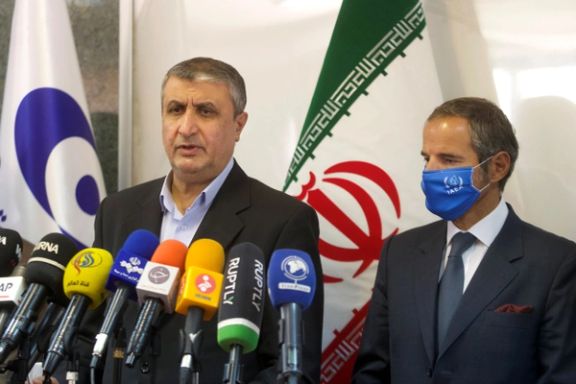
Iran's nuclear chief Mohammad Eslami and IAEA head Rafael Grossi in 2021

Iran has moved equipment used to make components for enriching uranium from the workshop at Karaj, just west of Tehran, to Natanz, the IAEA said Wednesday.

The IAEA reported that the equipment − used to make parts for centrifuges, which enrich uranium − “remained under Agency seal at this location in Natanz and, therefore, were not operating.” Six weeks ago, Iran set up a plant to make parts at Esfahan, another nuclear facility, a move reported to the IAEA in January.

The IAEA (International Atomic Energy Agency), the United Nations nuclear watchdog, had its access to Iran’s atomic program reduced in early 2021. Iran in December agreed to the installation of new cameras at Karaj, after an apparent attack June 2021 widely attributed to Israel. Iran’s security review at the site had threatened a temporary arrangement over monitoring equipment agreed by Iran and the agency in February.

In another area closely followed by the agency, Iran’s nuclear chief Mohammed Eslami said Wednesday that Iran had passed documents to the IAEA related to uranium traces in three sites used before 2003.

Iran and the agency in March agreed a plan to resolve controversy over the traces, which many analysts believe resulted from equipment supplied by Pakistani nuclear scientist AQ Khan. Iran was due to supply answers and evidence by late March, with outstanding questions resolved by June 20.

A uranium enrichment facility in Iran. File Photo
100%
A uranium enrichment facility in Iran

"We have handed over the documents on March 20 to the agency,” Eslami told a televised news conference. “They are reviewing those documents and probably the agency's representatives will travel to Iran for further talks, and then the IAEA will present its conclusion.”

While the IAEA is not directly involved in Vienna talks between Iran and world powers aimed at reviving the 2015 Iran nuclear deal, it would monitor a revived deal and IAEA chief Rafael Mariano Grossi has made clear the agency would be better placed to access Iran’s nuclear program under powers conferred by the 2015 agreement, the JCPOA (Joint Comprehensive Plan of Action). Grossi said last month he would report on Iran’s answers over the pre-2003 nuclear work to a Board of Governors' meeting beginning June 6.

New complications

With delays in the nuclear talks, both with new complications over with sanctions against Russia and disagreements between the US and Iran, JCPOA opponents in both Washington and Tehran have stepped up their efforts.

Tasnim news agency reported Tuesday that 190 Iran parliamentarians had written to President Ebrahim Raisi urging Iran’s “red lines” and national interest to be upheld. In Washington, Democrat Congressman Josh Gottheimer, among 15 Democrats holding a press conference Wednesday criticizing the Vienna talks, tweeted: “are we seriously going to let a war criminal– Vladimir Putin – be the guarantor of this deal?”

Russia was one of six world powers that signed the JCPOA in 2015. Former president Donald Trump withdrew from the agreement in 2018 and imposed ‘maximum pressure’ sanctions on Iran, which a year later began expanding its nuclear program beyond JCPOA limits. President Biden has expressed commitment to revive the JCPOA but has continued ‘maximum pressure.’

Most Viewed

Ghalibaf defends Iran-US talks amid hardline backlash
1
INSIGHT

Ghalibaf defends Iran-US talks amid hardline backlash

2
INSIGHT

A nation in limbo: 100 days after the massacre, has the world moved on?

3
ANALYSIS

From instability to influence: Pakistan’s pivotal role in US-Iran diplomacy

4
ANALYSIS

100 days on: why Iran’s January protests spread across social classes

5

War-hit homeowners feel abandoned as Iran’s reconstruction aid fades

Banner
Banner

Spotlight

  • Bread shortages, soaring prices strain households in Iran, residents say
    VOICES FROM IRAN

    Bread shortages, soaring prices strain households in Iran, residents say

  • War-hit homeowners feel abandoned as Iran’s reconstruction aid fades

    War-hit homeowners feel abandoned as Iran’s reconstruction aid fades

  • 100 days on: the anatomy of Iran’s January crackdown
    INSIGHT

    100 days on: the anatomy of Iran’s January crackdown

  • Ghalibaf defends Iran-US talks amid hardline backlash
    INSIGHT

    Ghalibaf defends Iran-US talks amid hardline backlash

  • 100 days on: why Iran’s January protests spread across social classes
    ANALYSIS

    100 days on: why Iran’s January protests spread across social classes

  • From instability to influence: Pakistan’s pivotal role in US-Iran diplomacy
    ANALYSIS

    From instability to influence: Pakistan’s pivotal role in US-Iran diplomacy

•
•
•

More Stories

Israel Urges World To Take Harder Line On Iran As It Boosts Enrichment

Apr 6, 2022, 16:43 GMT+1

Israeli Defense Minister Benny Gantz has said Iran had increased its stock of 60-percent enriched uranium from 10 kilogram to 50 kilogram since August 2021.

In an address to dozens of foreign ambassadors on Wednesday, Gantz called for the implementation of a robust “plan B” that would include using force as well as economic and diplomatic pressure against Iran to rein in its nuclear program.

According to the minister, Tehran continues to “bury its [nuclear] means in underground hiding places and installed another cascade in Fordow”, Iran’s second most important uranium-enrichment site.

“We are in a race against time”, Gantz warned, adding that a good nuclear agreement between Tehran and world powers isn’t the one that is currently being cooked up by negotiators in Vienna.

“We want an agreement that doesn’t have an expiration date that gives Iran legitimacy to advance its nuclear program when it ends, with extensive monitoring everywhere at any time and monitoring the ballistic missiles Iran is developing”, he said.

In a Wednesday statement summarizing a confidential report to member states seen by Reuters, the UN nuclear watchdog said that Iran moved all its equipment to make centrifuge parts from its mothballed workshop at Karaj to its sprawling Natanz site. The International Atomic Energy Agency (IAEA) said its monitors had verified that “these machines remained under agency seal at this location in Natanz and, therefore, were not operating".

Earlier in the day, Iranian nuclear chief Mohammad Eslami said Iran had sent documents related to outstanding issues to the IAEA.

Unnamed Iran Official Says Portion Of Frozen Funds To Be Released

Apr 6, 2022, 13:55 GMT+1

Iranian media has quoted an unnamed official as saying that a big portion of Iran’s frozen funds will be released in a deal "independent" of the nuclear talks.

An informed but unnamed source spoke about the new agreement to Iran's official news agency IRNA on Wednesday without providing further detail or any timeframe.

He said the amount is several times more than the €470-million debt recently paid by the UK in exchange for releasing two British Iranians -- Nazanon Zaghari-Ratcliffe and Anoosheh Ashuri. His reference to the hostage release deal could be an indication of a similar agreement with the US on a larger scale.

This is not the first time that “informed sources” in Iran claim that release of frozen assets is imminent.

In January, a member of the board of directors of the Iran-Iraq chamber of commerce, Hamid Hosseini, denied reports by the Iranian state-run media that Iraq had released Iran’s funds.

In December, Iran’s Foreign Ministry confirmed similar reports about Tehran accessing some of its frozen funds abroad, but no transfers took place.

The semi-official Iranian Students News Agency (ISNA) reported November 13 that Iran's assets frozen abroad -- largely for money owed for oil and energy shipments -- totaled $50 billion, with $8 billion in South Korea, $3 billion in Japan, and $6 billion in Iraq.

Iran Says It Has Given IAEA Documents On Outstanding Issues

Apr 6, 2022, 11:19 GMT+1

Iran has sent documents related to outstanding issues to the International Atomic Energy Agency (IAEA), Iranian nuclear chief Mohammad Eslami Said Wednesday.

Iran and the International Atomic Energy Agency (IAEA) last month agreed a three-month plan to try to resolve a long-stalled issue over uranium particles found at old but undeclared sites in the country. Resolving the issue would remove an obstacle to the revival of a 2015 nuclear deal between Iran and world powers.

"We have handed over the documents on March 20 to the agency. They are reviewing those documents and probably the agency's representatives will travel to Iran for further talks and then the IAEA will present its conclusion," Eslami told a televised news conference.

The agency has long said Iran had not given satisfactory answers on those issues, but in early March they announced a plan for a series of exchanges.

IAEA chief Rafael Grossi said last month he will aim to report his conclusion by the June 2022 (IAEA) Board of Governors' meeting, which begins on June 6.

The joint plan will help to secure the nuclear deal, which Washington exited in 2018 and reimposed crippling sanctions on Iran.

Eleven months of indirect talks between Iran and the United States in Vienna on salvaging the 2015 deal have stalled as both sides say political decisions are required by Tehran and Washington to settle the remaining issues.

Report by Reuters

Iran Lawmakers Urge Raisi To Stand Firm On Nuclear Red Lines

Apr 5, 2022, 18:45 GMT+1
•
Iran International Newsroom

Nearly 200 Iran parliament members have written to President Ebrahim Raisi urging that Iran’s “red lines” and “national interest” be upheld in nuclear talks.

Tasnim news website close to the Revolutionary Guard reported Tuesday that 190 lawmakers have signed the letter and more might join the petition.

While the hardliners’ victory in the 2020 parliamentary election strengthened critics of the 2015 nuclear deal in the 290-seat body, Iran entered talks in Vienna saying that it would agree to restore the 2015 nuclear deal if the United States lifted ‘maximum pressure’ sanctions.

But all along the existing sanctions have been a source of major differences. While the US has agreed to lift nuclear sanctions, Iran has demanded the lifting of all sanctions imposed since 2018, including terrorism-related ones.

The parliamentarians’ letter is one example of Iranian criticism, or wariness, over the talks. Ali Khezrian, a parliament member, has issued series of tweets claiming that a draft agreement discussed in Vienna had abandoned a requirement set by Iranian Supreme Leader Ali Khamenei that the lifting of US sanctions be verified before Iran returned its nuclear program to JCPOA limits.

He cited specific articles of the draft agreement claiming he has access to it, while no one outside the circle of negotiators so far has seen the document. Khezrian claimes that article 5-1 and 5-7 do not fulfill conditions set forth by Supreme Leader Ali Khamenei.

Hardliner member of Iranian parliament, Ali Khezrian. FILE PHOTO
100%
Hardliner member of Iranian parliament, Ali Khezrian

Al-Alam, Iran’s Arabic television station, has cited sources that the US had refused to lift the IRGC listing, demanding that Iran first abandon calls for “revenge” – legal or otherwise – for US 2020 killing of IRGC general Qasem Soleimani and insisting that the talks include Iran’s regional role.

‘Cannot be patient for ever’

Delays in year-long Vienna talks between Iran and world powers have given time and opportunity for JCPOA opponents to press their case and make compromises harder.

In a Tuesday editorial Tuesday for its English-language edition, Kayhan newspaper, whose editor Hossein Shariatmadari has for decades opposed nuclear talks, wrote that “Iranians cannot be patient for ever,” and highlighted a call made Monday by foreign ministry spokesman Saeed Khatibzadeh for Iran to receive “the economic benefits of the agreement” and for the US to accept talks on an “equal footing.”

Once hardliners won a majority in 2020, Iran’s parliament shifted from a time when President Hassan Rouhani and Speaker Ali Larijani had rallied support for the JCPOA. After the November 2020 killing of nuclear scientist Mohsen Fakhrizadeh, reportedly by Israel, the parliament passed legislation against the Rouhani government’s wishes requiring reduced cooperation with the International Atomic Energy Agency (IAEA) and uranium enrichment to higher levels.

Once followed by the government, these moves hastened Iran’s expansion of its nuclear program beyond JCPOA limits, which it began in 2019, the year after President Donald Trump withdrew the US from the deal and imposed ‘maximum pressure’ sanctions on Iran.

In the United States, many Republicans and some Democrats have seized on reported discussions over the US removing Iran’s Revolutionary Guards (IRGC) from its list of ‘foreign terrorist organizations’ and on the prospect that Moscow, now sanctioned by the US and western Europe over Ukraine, would under a revived JCPOA benefit from renewed nuclear-power co-operation with Tehran.

Washington Reiterates, Onus Of A Nuclear Deal 'Squarely On Iran'

Apr 5, 2022, 10:34 GMT+1
•
Maryam Sinaiee

The United States has defended its approach to the Iran nuclear talks after criticism from Tehran that it is hamstrung by domestic politics.

"Anyone involved in the talks knows precisely who has made constructive proposals, who has introduced demands that are unrelated to the JCPOA, and how we reached this current moment," State Department spokesman Ned Price said.

In a press briefing Monday, Price also did not rule out reaching agreement in year-long Vienna talks between Iran and world powers to revive the 2015 Iran nuclear deal, the JCPOA (Joint Comprehensive Plan of Action).

Iran's Foreign ministry Spokesman Saeed Khatibzadeh said Monday that Washington was responsible for the pause in talks as it had failed to reach a political decision as its approach to outstanding issues had become “hostage to its own domestic issues."

Opponents of the JCPOA in Washington have stepped up criticism of the Biden administration, both over reported discussions within the administration of reversing former president Donald Trump’s decision to add Iran’s Revolutionary Guards to the US list of ‘foreign terrorist organizations’ (FTO) and the prospect of Russia gaining financially from work to develop Iran’s nuclear program within a revived JCPOA.

On Monday the pro-Republican Washington Free Beacon reported that congressional Republicans were preparing draft legislation to require Congressional approval to lift the FTO designation of the IRGC, which is subject to a range of other sanctions and is the only example of a sovereign state’s armed forces listed as a ‘foreign terrorist organization.’

Iran has also criticized recent sanctions levied by the US on Iranian individuals and companies as unhelpful. Foreign Minister Hossein Amir-Abdollahian recently said that Washington’s "maximalist demands" were dragging out the talks.

In his briefing Monday, Price recognized that the expansion of Iran’s nuclear program since the US left the JCPOA in 2018 had brought it closer to the capacity to make a crude atomic weapon. "Iran has been able to shrink that breakout time from where it started to a point where we can measure it weeks rather than months,” Price said. “To us, that is unacceptable as a long-term proposition.”

White House Spokeswoman Jen Psaki Monday put the onus for reaching agreement on JCPOA revival "squarely on Iran." In a joint briefing with National Security Advisor Jake Sullivan, Psaki said Iran had “raised a number of issues that has [sic] nothing to do with the mutual compliance under the nuclear deal” and was “seeking to open issues outside the Vienna context or casting blame…on others for a pause in the talks.”

Ali Bigdeli, political analyst in Tehran, told the Iranian Labour News Agency (ILNA) Tuesday that JCPOA revival could benefit both US President Joe Biden and the Iranian leadership. "Biden needs to show a winning card to the Congress" to improve his own circumstances, Bigdeli said, while lifting US ‘maximum pressure’ sanctions, imposed by Trump and continued by Biden, would ease Iran’s economic problems.

Bigdeli said Washington would agree to lifting IRGC sanctions if Iran moderated its regional policies. "This is the Gordian knot in the talks," Bigdeli said, suggesting that Amir-Abdollahian had insisted on removing all sanctions on the IRGC. Bigdeli argued that under pressure at home and from regional allies, presumably Israel and Saudi Arabia, Biden could not lift IRGC sanctions “without preconditions.”



