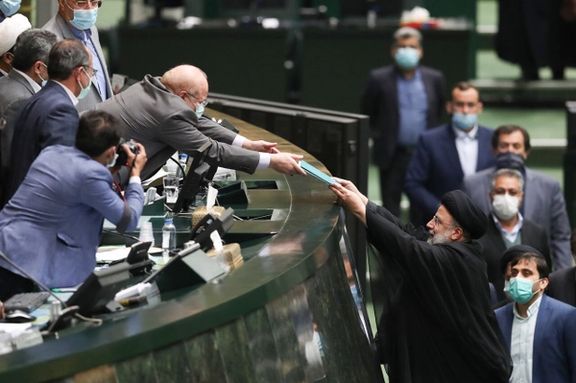
President Ebrahim Raisi handing over the draft budget to Parliament Speaker Ghalibaf on December 12, 2021
Chairman of the Executive Board of Iran's National Development Fund says governments must be prevented from exhausting the fund's resources to supplement their budget.
Speaking to the official news agency IRNA Sunday, Mehdi Ghazanfari, chairman of the executive board of Iran's sovereign wealth fund (NDF), criticized governments, past and present, for taking a larger share from the fund's reserves than they were allowed by law.
Ghazanfari said that governments should not rely on the NDF to supplement their budget, but they always resort to taking money from the fund when they face problems. "The fund's resources should increase to the level that it can provide the country's budget if we are not able to sell gas and oil."
The fund aims to turn some of the country's petrodollars to durable wealth, productivity, economic incentive and capital and preserve wealth from oil and gas for future generations.
But Supreme Leader Ali Khamenei, whose authorization was required, refused to allow the government to borrow from the fund to supplement its budget. Borrowing from the fund would mean printing Iranian rials and spending it in the country, further fueling inflation, which now stands at around 40 percent.
Based on the country's fifth and sixth five-year socio-economic development plans, the percentage of the fund's share from oil revenues has grown from 20 percent to 40 percent since 2011 when the fund was established.
Ghazanfari said the fund is now seriously seeking to recoup all the past loans paid to various government organizations, such as the National Iranian Oil Company (NIOC).
He also suggested that the fund's articles of association need to be revised so that the fund extends 30 percent of its resources to private, cooperative, and non-governmental sectors as loans, and ideally even use the 20 percent share of the government to help the private sector.
The remaining 50 percent of the fund's resources must be used for investment, he said, adding that they are also considering a revision in the conditions for offering loans in the future.
Like the currency reserve fund established in 2000, all administrations have borrowed from the fund for various purposes, including 2 billion euros in 2019 to increase the military's budget. The administration of President Mahmoud Ahmadinejad borrowed heavily from the fund which had been handed over to him with over $24 billion, including $2.7 billion to pay New Year cash handouts to all Iranians in 2013.
In 2008, the Ahmadinejad government classified information about the fund. In 2013, the newly elected President Hassan Rouhani said the fund had completely been drained by his predecessor. There is currently no concrete information on the fund's assets, but it is clear billions have been withdrawn since 2018 when the United States abandoned the 2015 nuclear agreement and imposed sanctions.
According to the charter of the National Development Fund, 40 percent of oil revenues next year should be saved by the government in the fund for investment on productive economic activities that would guarantee the welfare of future generations.
A water resources official in Iran says inflow of water into Tehran area dams has decreased by 30 percent in the past six months, compared to the previous year.
Mohammad Shahriari told Tasnim news agency that from September to the end of March, 409 million cubic meters of water has entered dams in the Tehran province, while in the 2020-2021 season 573 million cubic meters entered the capital’s vital reservoirs.
Iran has been suffering from drought for at least a decade and this year officials have been warning of a further decrease in precipitation.
In 2021, large-scale water protests took place in two important provinces, Khuzestan and Esfahan, with several people killed and hundreds injured by security forces.
As drought persists, more underground water is exploited for irrigation, depleting natural reservoirs formed during thousands of years. This has led to ground subsidence, alarming government officials who have circulated confidential memos on the subject, according to a lawmaker who spoke to local media on Sunday.
Old and unregulated irrigation methods, as well as an aging urban water distribution infrastructure compound the shortage.
However, politicians and experts say that there are no consistent government plans to deal with the water crisis, which can result in mass migration of millions of people in the next ten years.
Ali Larijani, the former long-time speaker of Iran's parliament
Less than two years before Iran's next parliamentary election, moderate conservatives are preparing to reclaim the political place they were denied since 2020.
According to news website Nameh News, different conservative factions have already started to compete within their camp and apparently there are at least three main players lined up for the February 2024 elections.
Moderate conservatives (such as Ali Larijani), ultraconservatives (Paydari and pro-Ahmadinejad groups such as most of the current members of the parliament), and current Speaker Mohammad Bagher Ghalibaf with his ‘neo-cons’ are the main factions.
Hardliner politician Seyyed Hossein Naghavi Hosseini told Nameh News that some of the conservative political groups have already organized election committees for their campaigns. However, he claimed that conservatives will take part in the election as a single front.
This has been their promise since 2007, but conservatives never managed to present themselves as a consolidated front in any election. This appears to be the case for 2024.
Nameh News wrote that even now, former Majles Speaker Ali Larijani is planning for the next election independent of other conservatives, adding that he has a good chance as most people believe he is a logical and capable person who can bring about a change in the country's politics.
The Raisi factor
Naghavi said that the next parliamentary election will be deeply affected by President Ebrahim Raisi's success or failure. People will welcome hardliner conservative candidates if they believe Raisi has been successful, otherwise they will opt to vote for others. He claimed that even now Larijani and his like-minded candidates enjoy support.
President Raisi surrounded by parliament hardliners during his inauguration in August 2021.
Larijani's political allies are also active players in the media and their main activity is criticizing the Raisi administration and the current parliament.
The politician argued that the main rivalry will take place between the Larijani camp and current Majles Speaker Ghalibaf.
Raisi, who was Supreme Leader Ali Khamenei's choice as president, so far has left a dismal record in managing the economy and the hardliner camp that has supported him might loose its value for the regime.
Reformists’ option is Larijani
Moderates and reformists may also be willing to take part in the elections, but it is still not known who will be leading them.
In another report, Nameh News pointed out that the situation has changed since Larijani was disqualified by the Guardian Council and barred from the 2021 presidential election.
The report added that Iran's moderates and reformists will also not be able to find any political ally and leader in the next election other than Ali Larijani. Meanwhile, even among the conservatives, there are many voters who would welcome the Larijani-led right-of-center faction to replace the far right "principlists" who currently control the Majles.
Even Iran's reformist analysts such as Abbas Abdi have backed the idea of Larijani becoming the leader of Iran's moderate conservatives. Nameh News quoted him as saying that "This is Ali Larijani and Iran's traditional conservatives' last chance to come back into the spotlight. Without a figurehead such as Larijani, that would be the end of the traditional conservatives who were side-lined in the 2021 presidential election partly for the same reason."
Some Conservatives might flip
Since his disqualification in June 2021, Larijani has tried hard not to create any controversy and has successfully evaded regime redlines, most importantly, turning against Supreme Leader Ali Khamenei.
In the meantime, as Nameh News has observed, what is certain, is that most current lawmakers are likely to turn against Raisi to distance themselves from his failures. They would want to make sure that increasing dissatisfaction with his performance does not ruin their chance of re-election. Some might even shift to Larijani's camp.
The fate of elections in Iran is determined by the conservative-dominated Guardian Council that can say who can and who cannot run in the fist place. But once the candidates have the Council’s and Khamenei's blessing, it is the man in the street whose votes they need.
Former United States vice-President Mike Pence has linked criticism of the Biden administration over the Russian invasion of Ukraine to world powers’ nuclear talks with Iran.
“it’s incomprehensible to the American people that we are negotiating with Iran to lift sanctions, presumably to buy more oil,” Pence told Fox News Friday. The former vice-President backed refusing Russian oil and gas, while suggesting the US facing rising prices should neither use reserves nor consider imports from Iran or Venezuela.
Pence denounced year-long negotiations, including Russia as one of five world powers, to revive the 2015 Iran nuclear deal, which the US left in 2018 with Pence as vice-president under Donald Trump. Pence said the talks emboldened Putin over Ukraine.
“It’s only with American strength and rallying our Western allies that we’ll be able to return peace to Ukraine,” Pence argued. He rejected “working with Russia to try and convince Iran to get back in the nuclear deal.”
Pence criticized Biden’s move to release 1 million barrels of oil a day over six months from reserves to decrease prices, suggesting there were options to raise production. “These are the kind of messages of weakness the American people aren’t having,” he said. “American strength is the antidote to this moment at home and abroad.”
He attacked Biden for sending a “delegation to Venezuela, to the dictator [President Nicolas] Maduro, to presumably begin to beg for more oil when we have vast reserves of oil in this country.”
A new online survey by a Netherlands-based institute has found that over 60 percent of Iranians want regime change or "transition from the Islamic Republic".
The survey by Gamaan found that 41% of respondents want the overthrow of the Islamic Republic and 21% prefer "structural changes and a transition from the Islamic Republic". On the other hand, only 18% of the respondents said they were happy with the political system and wanted to preserve the principles and values of the Islamic Revolution which overthrew the Shah of Iran and his Pahlavi Dynasty in 1979.
Gamaan focuses on measuring attitudes in Iran and they shared their latest findings with Persian-speaking media abroad on Friday. The institute has published their survey results also in English in the past.
Prince Reza Pahlavi who has lived all his adult life in exile was the most popular in a list of civil and political figures mentioned in the Gamaan survey with 39% of respondents choosing him over all others including the current rulers of the country.
Over 65% of respondents said they had a positive view of the Prince's grandfather Reza Shah Pahlavi (1878-1944) who founded the Pahlavi Dynasty, while 23% evaluated him negatively. His son Mohammad Reza Pahlavi (1919-1980) who was overthrown by the Islamic Revolution of 1979 was viewed positively by 64% of respondents, while 28% judged him negatively.
Prince Reza Pahlavi was followed by hardliner President Ebrahim Raisi with 17%, and former President Mahmoud Ahmadinejad with 12% of support. Former prime minister and presidential candidate Mir-Hossein Mousavi Mousavi who has been under house arrest since 2012, former reformist President Mohammad Khatami, and former moderate Foreign Minister Mohammad Javad Zarif were favored by less than 10% of the respondents.
Only 28% of respondents had a positive view of Ruhollah Khomeini (1902-1989), the founder of the Islamic Revolution, while 64% evaluated him negatively. According to Gamaan, his successor and the current supreme leader, Ali Khamenei, was favored by only 26% of the population while 66% judged him negatively.
The survey titled “Iranians’ Attitudes toward Political Systems” was carried out between February 17-27, 2022, with a final sample population of 16,850 literate Iranians aged above 19 who live inside Iran who make up 85% of the adult population.
When asked about their preferred regime type, 34% chose a “secular republic”, 22% the “Islamic republic”, 19% a “constitutional monarchy”, and 3% an “absolute monarchy”. Also, over 21% declared that they are “not sufficiently informed to answer this question”.
According to Gamaan, the results of the survey can be generalized to the target population with a credibility level of 95 percent. The survey employed multiple chain referral to select the sample population, but there has been no peer review yet of the methodology used in selecting the target audience.
Comparison with previous surveys reveals no drastic changes occurring over the past year, Gamaan said.
About 65% of respondents said they favored “nationwide strikes”, 65% “protest campaigns in social media”, 52% “engaging in civil disobedience” to bring about political change in the current milieu of Iran.
Iran witnessed several widespread protests during 2021, including protests over water shortage in Khuzestan and Esfahan while teachers, workers, nurses, and pensioners had to resort to recurring protests demanding improvement in their livelihoods. Security forces dispersed peaceful gatherings in most cases and even resorted to using lethal forcein Khuzestan in July and in Esfahan in November.
The results of the survey showed that 88% of the population favor a "democratic political system” while 67% of the population are against “having a system governed by religious law”. Only 28% evaluate favored a religious governing system.
Iran’s Energy Minister Ali Akbar Mehrabian says the country has a deficit of about 15,000 megawatts in electricity production.
He announced the shortage in power production on the sidelines of a visit to a power plant construction project in the northeastern province of Razavi Khorasan on Thursday.
Mehrabian is in the province as part of a large delegation of ministers and officials accompanying President Ebrahim Raisi’s to his hometown, where they made a series of promises about different projects and measures to be realized this year.
According to recent data released by the ministry, power plants that were commissioned during the previous Iranian year (ended on March 20) only added a cumulative capacity of 965 megawatts to the supply network despite the announced target of adding 3,500 megawatts during the year.
Electricity consumption has been increasing in Iran because of extremely low prices, considered a subsidy in the state-controlled economy. Usage has reached to around 60,000 megawatt hours, while both power plant capacity and their fuel supply remains inadequate. At the same time, Iran exports electricity to Iraq while blackouts happen regularly at home.