• العربية
  • فارسی
Brand
  • Iran Insight
  • Politics
  • Economy
  • Analysis
  • Special Report
  • Opinion
  • Podcast
  • Iran Insight
  • Politics
  • Economy
  • Analysis
  • Special Report
  • Opinion
  • Podcast
  • Theme
  • Language
    • العربية
    • فارسی
  • Iran Insight
  • Politics
  • Economy
  • Analysis
  • Special Report
  • Opinion
  • Podcast
All rights reserved for Volant Media UK Limited
volant media logo

Iran’s Moderate Conservatives Might Make A Comeback In 2024
Iran International Newsroom
Apr 3, 2022, 10:30 GMT+1Updated: 17:22 GMT+1
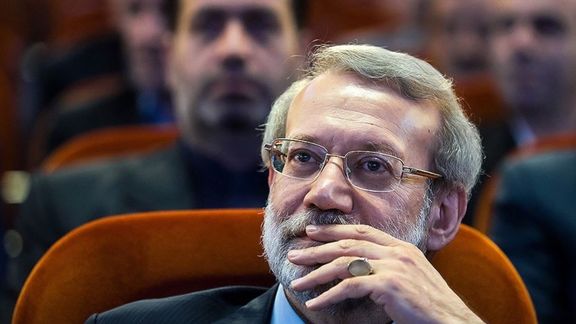
Ali Larijani, the former long-time speaker of Iran's parliament

Less than two years before Iran's next parliamentary election, moderate conservatives are preparing to reclaim the political place they were denied since 2020.

According to news website Nameh News, different conservative factions have already started to compete within their camp and apparently there are at least three main players lined up for the February 2024 elections.

Moderate conservatives (such as Ali Larijani), ultraconservatives (Paydari and pro-Ahmadinejad groups such as most of the current members of the parliament), and current Speaker Mohammad Bagher Ghalibaf with his ‘neo-cons’ are the main factions.

Hardliner politician Seyyed Hossein Naghavi Hosseini told Nameh News that some of the conservative political groups have already organized election committees for their campaigns. However, he claimed that conservatives will take part in the election as a single front.

This has been their promise since 2007, but conservatives never managed to present themselves as a consolidated front in any election. This appears to be the case for 2024.

Nameh News wrote that even now, former Majles Speaker Ali Larijani is planning for the next election independent of other conservatives, adding that he has a good chance as most people believe he is a logical and capable person who can bring about a change in the country's politics.

The Raisi factor

Naghavi said that the next parliamentary election will be deeply affected by President Ebrahim Raisi's success or failure. People will welcome hardliner conservative candidates if they believe Raisi has been successful, otherwise they will opt to vote for others. He claimed that even now Larijani and his like-minded candidates enjoy support.

President Raisi surrounded by parliament hardliners during his inauguration in August 2021.
100%
President Raisi surrounded by parliament hardliners during his inauguration in August 2021.

Larijani's political allies are also active players in the media and their main activity is criticizing the Raisi administration and the current parliament.

The politician argued that the main rivalry will take place between the Larijani camp and current Majles Speaker Ghalibaf.

Raisi, who was Supreme Leader Ali Khamenei's choice as president, so far has left a dismal record in managing the economy and the hardliner camp that has supported him might loose its value for the regime.

Reformists’ option is Larijani

Moderates and reformists may also be willing to take part in the elections, but it is still not known who will be leading them.

In another report, Nameh News pointed out that the situation has changed since Larijani was disqualified by the Guardian Council and barred from the 2021 presidential election.

The report added that Iran's moderates and reformists will also not be able to find any political ally and leader in the next election other than Ali Larijani. Meanwhile, even among the conservatives, there are many voters who would welcome the Larijani-led right-of-center faction to replace the far right "principlists" who currently control the Majles.

Even Iran's reformist analysts such as Abbas Abdi have backed the idea of Larijani becoming the leader of Iran's moderate conservatives. Nameh News quoted him as saying that "This is Ali Larijani and Iran's traditional conservatives' last chance to come back into the spotlight. Without a figurehead such as Larijani, that would be the end of the traditional conservatives who were side-lined in the 2021 presidential election partly for the same reason."

Some Conservatives might flip

Since his disqualification in June 2021, Larijani has tried hard not to create any controversy and has successfully evaded regime redlines, most importantly, turning against Supreme Leader Ali Khamenei.

In the meantime, as Nameh News has observed, what is certain, is that most current lawmakers are likely to turn against Raisi to distance themselves from his failures. They would want to make sure that increasing dissatisfaction with his performance does not ruin their chance of re-election. Some might even shift to Larijani's camp.

The fate of elections in Iran is determined by the conservative-dominated Guardian Council that can say who can and who cannot run in the fist place. But once the candidates have the Council’s and Khamenei's blessing, it is the man in the street whose votes they need.


Most Viewed

Ideology may be fading in Iran, but not in Kashmir's ‘Mini Iran'
1
INSIGHT

Ideology may be fading in Iran, but not in Kashmir's ‘Mini Iran'

2
INSIGHT

Hardliners push Hormuz ‘red line’ as US blockade tests Iran’s leverage

3
VOICES FROM IRAN

Hope and anger in Iran as fragile ceasefire persists

4

Iran International says it won’t be silenced after London arson attack

5

US sanctions oil network tied to Iranian tycoon Shamkhani

Banner
Banner

Spotlight

  • Hardliners push Hormuz ‘red line’ as US blockade tests Iran’s leverage
    INSIGHT

    Hardliners push Hormuz ‘red line’ as US blockade tests Iran’s leverage

  • Ideology may be fading in Iran, but not in Kashmir's ‘Mini Iran'
    INSIGHT

    Ideology may be fading in Iran, but not in Kashmir's ‘Mini Iran'

  • War damage amounts to $3,000 per Iranian, with blockade set to add to losses
    INSIGHT

    War damage amounts to $3,000 per Iranian, with blockade set to add to losses

  • Why the $100 billion Hormuz toll revenue is a myth
    ANALYSIS

    Why the $100 billion Hormuz toll revenue is a myth

  • US blockade targets Iran oil boom amid regional disruption
    ANALYSIS

    US blockade targets Iran oil boom amid regional disruption

  • Iran's digital economy battered by prolonged blackout
    INSIGHT

    Iran's digital economy battered by prolonged blackout

•
•
•

More Stories

As Ramadan Starts, Iran Prosecutor Wants Action Over Fast Breakers In Cars

Apr 2, 2022, 22:19 GMT+1

Iran’s prosecutor-general has called on the police to challenge those eating and drinking in their cars during daylight in the fasting month of Ramadan.

In a letter to the police commander-in-chief Hossein Ashtari, Mohammad Jafar Montazeri pointed out that vehicles are not private property, meaning that any eating and drinking inside cars in public places should not take place.

Ramadan fasting begins Sunday in Iran. It started Saturday, as expected, in Saudi Arabia, once the Ramadan crescent moon was confirmed Friday. The United Arab Emirates and Kuwait also declared Saturday as the first day of the lunar month.

Montazeri stressed that prosecutors across Iran should cooperate with, and support the police, in following holy month’s rituals and regulations. Foreign minister Hossein Amir-Abdollahian tweeted a wish that the holy month bring “mercy…to us and all peoples with goodness, tranquility and abundance.”

Fewer people have been observing the Muslim fasting period in recent years but police arrest and fine anyone who breaks the rules in public.

In addition to avoiding certain actions mentioned in the Qur'an, Muslims must abstain from food or drink of any kind from dawn to dusk, which will be about 14 hours in Iran this year.

Every year police enforce a national plan to deal with those who break Ramadan rules in public, and transgressors are sometimes sentenced to months of detention and lashes.

Official Says $400 Million Lost In Iran Pension Fund Due To Corruption

Apr 2, 2022, 16:23 GMT+1

The general director of a major government pension fund in Iran says that around $400 million was lost either through mismanagement or embezzlement.

The official government news agency, IRNA, quoted Hossein Amerian, the newly appointed general director of steel industry pension fund that there are 800 investigations taking place to identify all those who are responsible for the losses.

The fund makes retirement payments to tens of thousands of people who worked both at government-owned and privatized steel companies. When the pension fund loses money, the government must step in and fill the deficit in addition to paying pensions of millions of former government employees such as teachers.

Because of the current economic crisis, triggered mainly by US economic sanctions since 2018, the government has been unable to regularly dispense the monthly pensions or adequately increase payments amid a 40-percent annual inflation rate.

Amerian explained that fund managers in the previous government of president Hassan Rouhani invested in money-losing government companies or simply engaged in corrupt practices that cost the pension fund 100 trillion Iranian rials or $400 million.

Officials appointed by President Ebrahim Raisi in recent months have claimed many cases of corruption by former managers, but it is not clear to what extent these are politically motivated. There have also been allegations of nepotism in the new administration, where newly appointed officials want to fire thousands of managers to appoint their own friends and relatives to lucrative posts.

Cleric In Iran Fuming Over Arson Attack On Khomeini’s Statue

Apr 2, 2022, 13:35 GMT+1

A senior cleric in Qom expressed anger over unknown people setting fire to a statue of the founder of the Islamic Republic, Ruhollah Khomeini in the city.

A video of a Khomeini’s statue in flames was circulated on social media in recent days, prompting Qom Friday Prayers leader Alireza Arafi to condemn the act and threaten those behind it.

He described it as "vicious" and said security officials would definitely follow up on this issue. He called it as part of a chain of conspiracies that are aimed at undermining the Islamic Republic.

Qom – along with Mashhad, is the most religious city in Iran, home to the largest Shiite seminary and many hardliner clerics.

As poverty is soaring in Iran and the regime keeps failing to deliver on its promises, such acts of political vandalism are growing across the country.

In February, another statue of Khomeini in the city of Ardestan in the province of Esfahan was destroyed, several days before a recorded message against Khomeini and Supreme Leader Ali Khamenei was broadcast on the public announcement system in Mashhad’s bazaar.

In January, a memorial statue of Qasem Soleimani, the commander of Iran’s Revolutionary Guard Qods Force, was set on fire in the central city of Shahrekord hours after it was erected.

According to a new online survey by a Netherlands-based institute, over 60 percent of Iranians want regime change or "transition from the Islamic Republic".

Over 60% Of Iranians Want Transition From Islamic Republic

Apr 1, 2022, 19:53 GMT+1
•
Maryam Sinaiee

A new online survey by a Netherlands-based institute has found that over 60 percent of Iranians want regime change or "transition from the Islamic Republic".

The survey by Gamaan found that 41% of respondents want the overthrow of the Islamic Republic and 21% prefer "structural changes and a transition from the Islamic Republic". On the other hand, only 18% of the respondents said they were happy with the political system and wanted to preserve the principles and values of the Islamic Revolution which overthrew the Shah of Iran and his Pahlavi Dynasty in 1979.

Gamaan focuses on measuring attitudes in Iran and they shared their latest findings with Persian-speaking media abroad on Friday. The institute has published their survey results also in English in the past.

Prince Reza Pahlavi who has lived all his adult life in exile was the most popular in a list of civil and political figures mentioned in the Gamaan survey with 39% of respondents choosing him over all others including the current rulers of the country.

Over 65% of respondents said they had a positive view of the Prince's grandfather Reza Shah Pahlavi (1878-1944) who founded the Pahlavi Dynasty, while 23% evaluated him negatively. His son Mohammad Reza Pahlavi (1919-1980) who was overthrown by the Islamic Revolution of 1979 was viewed positively by 64% of respondents, while 28% judged him negatively.

Prince Reza Pahlavi was followed by hardliner President Ebrahim Raisi with 17%, and former President Mahmoud Ahmadinejad with 12% of support. Former prime minister and presidential candidate Mir-Hossein Mousavi Mousavi who has been under house arrest since 2012, former reformist President Mohammad Khatami, and former moderate Foreign Minister Mohammad Javad Zarif were favored by less than 10% of the respondents.

Only 28% of respondents had a positive view of Ruhollah Khomeini (1902-1989), the founder of the Islamic Revolution, while 64% evaluated him negatively. According to Gamaan, his successor and the current supreme leader, Ali Khamenei, was favored by only 26% of the population while 66% judged him negatively.

The survey titled “Iranians’ Attitudes toward Political Systems” was carried out between February 17-27, 2022, with a final sample population of 16,850 literate Iranians aged above 19 who live inside Iran who make up 85% of the adult population.

When asked about their preferred regime type, 34% chose a “secular republic”, 22% the “Islamic republic”, 19% a “constitutional monarchy”, and 3% an “absolute monarchy”. Also, over 21% declared that they are “not sufficiently informed to answer this question”.

According to Gamaan, the results of the survey can be generalized to the target population with a credibility level of 95 percent. The survey employed multiple chain referral to select the sample population, but there has been no peer review yet of the methodology used in selecting the target audience.

Comparison with previous surveys reveals no drastic changes occurring over the past year, Gamaan said.

About 65% of respondents said they favored “nationwide strikes”, 65% “protest campaigns in social media”, 52% “engaging in civil disobedience” to bring about political change in the current milieu of Iran.

Iran witnessed several widespread protests during 2021, including protests over water shortage in Khuzestan and Esfahan while teachers, workers, nurses, and pensioners had to resort to recurring protests demanding improvement in their livelihoods. Security forces dispersed peaceful gatherings in most cases and even resorted to using lethal force in Khuzestan in July and in Esfahan in November.

The results of the survey showed that 88% of the population favor a "democratic political system” while 67% of the population are against “having a system governed by religious law”. Only 28% evaluate favored a religious governing system.

World Cup Draw Puts Iran, US Teams In Same Group

Apr 1, 2022, 18:49 GMT+1

Iranian men’s national football (soccer) team has been drawn in Group B of Qatar FIFA World Cup along with the United States and England.

The drawing ceremony was held in Qatar on Friday, while Iran’s legendary goal scorer Ali Daei was also in attendance.

The fourth team of the group will be the winner of European playoffs that may be either Ukraine, Scotland or Wales.

The last time Iran and the US played against each other was the 1998 World Cup in France where the Iranian side beat the United States 2-1 with goals by Hamid Estili and Mehdi Mahdavikia.

According to the updated FIFA rankings, Group B is the ‘group of death’ -- the moniker that is used to describe a World Cup group that looks particularly challenging. Two teams will qualify to move up to the next round of matches.

This comes as FIFA has been urged by many people and organizations from Iran and other countries to ban Iran’s national football team from the 2022 World Cup for Iran’s recent action forcibly barring women from entering the stadium to watch a qualifying match.

A campaign on social media has seen hashtags such as #Fifabaniri (FIFA ban Islamic Republic of Iran) and others rising to the top of most-used hashtags in Persian-language Twitter.

On Tuesday, security forces denied women entry into a stadium in Mashhad, north-east Iran, to watch a FIFA World Cup qualifier between Iran and Lebanon, using pepper spray to disperse them.

A campaign inside Iran sees some former and current members of Iran's national team pledging not to enter stadiums as long as women are not allowed.





