• العربية
  • فارسی
Brand
  • Iran Insight
  • Politics
  • Economy
  • Analysis
  • Special Report
  • Opinion
  • Podcast
  • Iran Insight
  • Politics
  • Economy
  • Analysis
  • Special Report
  • Opinion
  • Podcast
  • Theme
  • Language
    • العربية
    • فارسی
  • Iran Insight
  • Politics
  • Economy
  • Analysis
  • Special Report
  • Opinion
  • Podcast
All rights reserved for Volant Media UK Limited
volant media logo

Congressman Says Iran Nuclear Deal Endangered Mid East Stability
Iran International Newsroom
Apr 2, 2022, 16:57 GMT+1Updated: 17:38 GMT+1
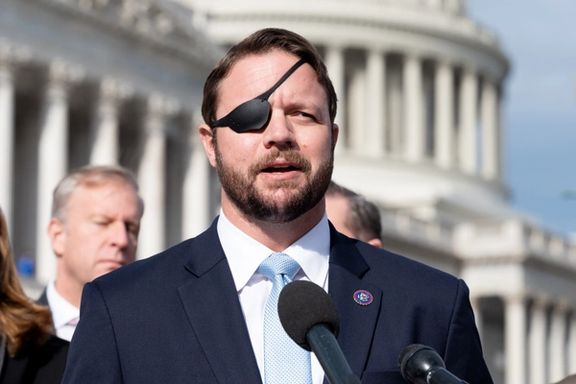
Dan Crenshaw, Republican Congressman from Texas.

Dan Crenshaw, a Republican Congressman, said Iran understands only power and leverage, and the Biden administration was not acting rationally.

Crenshaw told Iran International Friday that the 2015 Iran deal, from which Republican president Donald Trump withdrew the United States in 2018, “was a danger to the Middle East stability.”

In opposing talks in Vienna between Iran and world powers to revive the deal, Crenshaw, an Afghanistan war veteran and a SEAL force commander, said the Biden administration should not be “engaged in negotiations when Iran is sending missiles into Iraq near our consulate.” Iran March 13 fired missiles at Erbil, northern Iraq, hitting a villa it claimed was used by Israeli intelligence, apparently in response to Israeli attacks on an Iranian air base in Kermanshah province or on Iranian forces in Syria.

Missiles

Crenshaw said that Iran’s Revolutionary Guards (IRGC) accepting responsibility for the missiles had been “bold and brazen,” and that the US was projecting weakness “over and over again.” This was the “worst way to negotiate,” he argued.

Earlier in the day, the Democratic Majority Leader in the House of Representatives Steny Hoyer told Iran International’s Arash Alaei that President Joe Biden saw limiting Iran’s nuclear program, as done by the 2015 deal, as “a critically important objective” and that Washington would continue negotiations with Iran and other world powers as long as agreement was possible.

The Vienna talks over reviving the 2015 deal − the JCPOA (Joint Comprehensive Plan of Action) – have gone on for a year, struggling to resolve which US sanctions contravene the agreement and exactly how Iran’s nuclear program, expanded since 2019, be returned to JCPOA limits. Among issues reportedly remaining, the US is refusing to rescind Trump’s 2019 move adding the IRGC to the US list of ‘foreign terrorist organizations,’ the only example of a sovereign state’s armed forces being so designated.

In a Friday statement, US National Security Advisor Jake Sullivan defended this week’s new US sanctions against Iran’s procurement effortsfor its missile program. “We will continue to use all appropriate authorities to hold Iran and its proxy groups accountable for threats against our friends and partners,” he said.

Yemen’s Ansar Allah, known as the Houthis, have in recent weeks, accelerated efforts to hit Saudi energy targets in response to the Saudi war effort in Yemen. Ansar Allah, who control most of northern Yemen, have developed a missile capacity, reportedly with Iranian help, over many years although the damage caused by the strikes is limited given Saudi air defenses.


Most Viewed

Ghalibaf defends Iran-US talks amid hardline backlash
1
INSIGHT

Ghalibaf defends Iran-US talks amid hardline backlash

2
INSIGHT

Iran diplomacy wobbles as factions compete to avoid looking soft on US

3
VOICES FROM IRAN

Bread shortages, soaring prices strain households in Iran, residents say

4
ANALYSIS

The politics of pink: how Iran uses cuteness to rebrand violence

5

War-hit homeowners feel abandoned as Iran’s reconstruction aid fades

Banner
Banner

Spotlight

  • Lights out, then gunfire: Witnesses recount Mashhad protest crackdown
    VOICES FROM IRAN

    Lights out, then gunfire: Witnesses recount Mashhad protest crackdown

  • Family told missing teen was alive, then received his body 60 days later
    EXCLUSIVE

    Family told missing teen was alive, then received his body 60 days later

  • Is Iran entering its Gorbachev moment?
    INSIGHT

    Is Iran entering its Gorbachev moment?

  • Iran crackdown reaches cemeteries as graves of slain protesters defaced
    EXCLUSIVE

    Iran crackdown reaches cemeteries as graves of slain protesters defaced

  • Iran diplomacy wobbles as factions compete to avoid looking soft on US
    INSIGHT

    Iran diplomacy wobbles as factions compete to avoid looking soft on US

  • The politics of pink: how Iran uses cuteness to rebrand violence
    ANALYSIS

    The politics of pink: how Iran uses cuteness to rebrand violence

  • Bread shortages, soaring prices strain households in Iran, residents say
    VOICES FROM IRAN

    Bread shortages, soaring prices strain households in Iran, residents say

•
•
•

More Stories

Russia Supports Iran Nuclear Deal But 'No Close Ties With The West'

Apr 2, 2022, 09:05 GMT+1
•
Iran International Newsroom

Political commentator Diako Hosseini in Tehran says Russia supports the revival of the 2015 nuclear deal but wants tensions to continue between Iran and the West.

Speaking to Rouydad24 website, Hosseini said that when Russians look at the bigger picture, they see Iran as part of their geopolitical map. Just like the Americans, Russians too have shown that they do not wish to see Iran becoming a nuclear power. They are sensitive to this matter and will always obstruct Iran's path to nuclear bombs. But at the same time, a nuclear agreement should not mean Iran getting too close to the West.

While Moscow was playing an active mediation role between Tehran and Washington during the Vienna talks in recent months, after the invasion of Ukraine it made demands that were seen as a stumbling block to an agreement. Russia asked for written guarantees from the US that Western sanctions over its invasion of Ukraine would not affect its ties with Iran.

Hosseini said, it is natural that the Russians follow their own interests in the talks. With the Ukraine war, their interests have become even more complicated. "Russians know that if the nuclear deal is not revived, tensions between Tehran and the West will increase to the point of a war. If there is such a war, it will be difficult for Moscow to support any side or even to declare impartiality."

Iranian political commentator Diako Hosseini. FILE
100%
Iranian political commentator Diako Hosseini.

For the time being, Russia's interests overlap with Iran's interests but in case there is an agreement, Russia will be worried that Iran might get too close to the West. The best-case scenario for Russia is continued tensions between Iran and the West, Hosseini argued.

According to the website, the Vienna talks have reached a difficult point where there is little chance for progress. The website quoted Hosseini as defending Tehran’s position that all post-2018 sanctions are about the nuclear issue. If the 2015 nuclear agreement, JCPOA, is to be revived, all sanctions including those against the IRGC need to be lifted.

He added that some recent remarks by Iran’s Foreign Minister Hossein Amir-Abdollahian indicate that Iran might compromise over the IRGC issue. He was referring to Amir-Abdollahian’s statement last week that IRGC commanders told him to prioritize Iran's interests over the interests of the Revolutionary Guard.

Meanwhile, in an interview with Fararu website, former lawmaker Heshmatollah Falahatpisheh said that both Iran and the United States need an agreement to prevent rising tensions in the region andthe world.

He said an agreement is at hand and its final draft has been prepared but matters beyond the nuclear agreement prevent a final deal to be made. Last week Iranian Supreme Leader Ali Khamenei's adviser Kamal Kharrazi once again called for guarantees from America, lifting of all sanctions, and delisting the IRGC as requirements for a deal. This comes while several Iranian lawmakers including Ali Khezri claim they have seen a 27-page final draft of an agreement between Iran and the United States.

Falahatpishe, the former chairman of Iranian parliaments national security and foreign policy Committee said it is not known if Russia still insists on its own demands about the nuclear deal.

Nonetheless, he said that only delisting the IRGC can lead to a détente between Iran and the West. Falahatpisheh maintained that both countries should try to reduce tensions in the region as any delay will give an opportunity to “agitators such as Israel” and some “regional reactionaries” to bring about chaos in the region.

Senior Democrat Says Biden Will Continue Iran Talks As Long As Deal Possible

Apr 1, 2022, 22:40 GMT+1

The Biden administration will continue talks with Iran for as long as they think a deal is possible, Rep. Steny Hoyer (D-Md.) told Iran International Friday.

The Democratic Majority Leader in the House of Representatives added, “They believe this way, and the president is articulating that limiting the capacity of Iran producing nuclear weapon is a critically important objective. So, I think they would continue the talks as long as they think it's a possibility to get to an agreement.”

President Joe Biden launched indirect talks with Iran and other world powers one year ago to revive the 2015 nuclear agreement, abandoned by his predecessor in 2018. The talks have neared a conclusion, diplomats have said, but some sensitive issues remain to be agreed.

The key issue is Iran’s insistence that the United States should remove its Revolutionary Guard from its Foreign Terrorist Organization list. The Biden administration has not said whether it would reach a compromise with Tehran, but many politicians from both parties oppose such a move.

“IRGC is a terrorist organization. And I'm for continuing it being designated as a terrorist organization. I'm also in favor of dealing in this agreement with the non-nuclear malign activity pursued by the Iranians to destabilize the Middle East,” Hoyer told Iran International's Arash Aalaei.

Israel Won’t Face Any US Restrictions If It Acts Against Iran - Ambassador

Apr 1, 2022, 17:22 GMT+1

The US envoy to Israel says the country can do whatever it needs against Iran and would not face any restrictions from US regardless of the result of nuclear talks.

Ambassador Tom Nides told Israel’s Channel 12 news on Thursday, “Israel can do and take all the steps it needs to take to protect the state of Israel”.

He added that “If we have a deal, the Israelis’ hands are not tied. If we don’t have a deal, the Israelis’ hands are certainly not tied”, noting that “We’re not going to tell the government what to do”.

About briefing Israel on the latest developments of the Vienna nuclear talks to revive the 2015 Iran nuclear deal, the ambassador pointed out, “The Israelis know very clearly exactly what is going on. I’m not suggesting they necessarily like it always, but there are no secrets here”.

During a joint press conference with US Secretary of State Antony Blinken on Sunday, Israeli Foreign Minister Yair Lapid said, "We have disagreements about a nuclear agreement and its consequences, but open and honest dialogue is part of the strength of our friendship. Israel and the United States will continue to work together to prevent a nuclear Iran”.

There are media reports that an air defense pact between Israel and friendly regional countries is in the works to confront threats posed by Iranian drones and missiles.

US Nuclear Deal Opponents Turn Fire On Iran's Regional Proxies

Apr 1, 2022, 16:43 GMT+1
•
Iran International Newsroom

The Washington Free Beacon reports a draft law requiring the US government to explain how sanctions relief would affect Tehran’s dealings with Hamas and Hezbollah.

In the latest attack on efforts to revive the 2015 Iran nuclear deal, the JCPOA (Joint Comprehensive Plan of Action), House representatives Ronny Jackson, a Republican, and Stephanie Murphy, a Democrat, and 19 others called the Palestinian and Lebanese militant groups “Iranian proxies…waging operations against Israel.”

The Beacon reported that the “coalition of lawmakers are concerned that sanctions relief for Iran will embolden both terror groups and lead to an increase in terror strikes on Israel, which saw a wave of attacks that killed 11 citizens in the last two weeks.”

Two of these three attacks were carried out by ‘Israeli Arabs,’ Palestinians with Israeli citizenship, and one by a Palestinian from the occupied West Bank. While none was linked to the groups cited by the US legislation, Israeli has gone onto security alert fearing a repetition of last year’s ethnic clashes.

However, both Hezbollah and Hamas have praised the attacks as operations of “martyrdom” and both have long track records of organizing and carrying out attacks against Israeli civilians.

The Beacon quoted Jackson that “the United States cannot afford to ignore the threat posed by Iran-backed proxies.” It reported that AIPAC, the American Public Affairs Committee, was backing the bill, which would also require the Defense Department to report to Congress on other “Iran-backed entities,” including the Popular Front for the Liberation of Palestine, the Badr Organization (which is Iraqi), and Yemen’s Ansar Allah, widely known as the Houthis.

Unfrozen funds

The Beacon claimed that a provision in the bill that federal funds not “bolster…the listed terror groups” could “interfere with the Biden administration’s efforts to unfreeze Iranian funds that may be funneled to its proxy groups.”

Restoring the JCPOA, under discussion in Vienna for a year, would require the US lifting ‘maximum pressure’ sanctions levied by the Trump administration in 2018 on leaving the JCPOA. These threaten punitive action against third parties dealing with Iran’s financial sector or buying its oil, leaving billions owed Iran ‘frozen’ by banks wary of US action, especially in Asia.

While some argue that President Joe Biden requires Congressional support for JCPOA revival no more than Trump did for leaving it, Representative Michael McCaul, the lead Republican on the House Foreign Affairs Committee, told the Beacon he was hopeful eight Democrats would vote with the Republicans opposing the JCPOA.

State Department spokesman Ned Price on Friday repeated the administration’s arguments that Trump’s sanctions were ineffective in moderating Iran’s behavior, saying that Tehran-inspired attacks on US and its allies increased after 2018. While his claim about attacks on US interests is true, Iran was embroiled in the Syrian civil war, especially in 2015-2017, fighting to save Bashar al-Assad’s government, and entrenching itself on the Israeli border.

McCaul said that with Congressional mid-term elections due November “if Republicans take the majority, they will move to reimpose sanctions on Iran and nullify the terms of any deal Biden inks.”

The Beacon suggested that “with the ongoing war in Ukraine generating anti-Russia sentiment, provisions in the nuclear deal that empower and enrich Moscow will be a hard sell on Capitol Hill.” Russia and Iran signed an agreement in 2014 over nuclear power at Bushehr, which over the project’s life would see Tehran pay $10 billion.

US Senator Says Vienna Talks Fundamentally Flawed

Mar 30, 2022, 23:08 GMT+1

Republican Senator John Cornyn tells Iran International that he thinks the Vienna negotiations to revive the 2015 nuclear deal is “fundamentally flawed”.

He said on Wednesday that “any negotiation that stops short of preventing Iran from getting a nuclear weapon is fundamentally flawed.”

He added, "They haven't been talking to people in Israel or other allies of US that are worried about Iranian regime's threat both in terms of financing state terror as well as prospect of getting a nuke weapon and using that against our allies in Mideast".

He expressed doubt that the talks will lead to any tangible results, saying, “I don't have any confidence in the process right now”.

The nuclear talks have stalled mainly because of Iran’s demand for the US to remove the Revolutionary Guard (IRGC) from its terrorism list (FTO) and the recent missile attacks have shed more doubts whether President Joe Biden’s administration would take such a step.

The indirect US-Iran nuclear talks were close to an agreement in early March before last-minute Russian demands for sweeping guarantees that would have hollowed out sanctions imposed following its invasion of Ukraine derailed the talks.

Russia has since appeared to have narrowed its demands to cover only work linked to the nuclear deal, leaving a small number of issues to be resolved between Washington and Tehran, diplomats say.