• العربية
  • فارسی
Brand
  • Iran Insight
  • Politics
  • Economy
  • Analysis
  • Special Report
  • Opinion
  • Podcast
  • Iran Insight
  • Politics
  • Economy
  • Analysis
  • Special Report
  • Opinion
  • Podcast
  • Theme
  • Language
    • العربية
    • فارسی
  • Iran Insight
  • Politics
  • Economy
  • Analysis
  • Special Report
  • Opinion
  • Podcast
All rights reserved for Volant Media UK Limited
volant media logo

US Tries To Offer Assurances To Vexed Israelis, Arabs Over Iran Deal

Maryam Sinaiee
Maryam Sinaiee

Iran International

Mar 28, 2022, 11:20 GMT+1Updated: 17:39 GMT+1
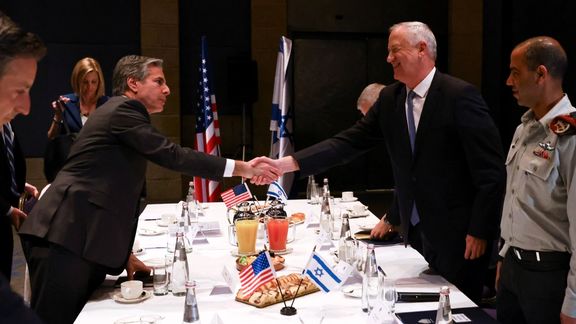
US Secretary of State Antony Blinken meeting with Israeli Defense Minister Benny Gantz. March 27, 2022

The US Secretary of State has tried to assure Israelis that Washington will work with Tel Aviv to deny Iran atomic weapons, with or without a nuclear deal.

The issue of removing Iran's elite Revolutionary Guards (IRGC) from the US list of Foreign Terrorist Organizations (FTO), which Iran now expressly says is a pre-condition to agreeing to the restoration of the 2015 nuclear deal, Joint Comprehensive Plan of Action (JCPOA) appears to be at the center of Arab foreign ministers in Tel Aviv.

The US Secretary of State, Antony Blinken, who is also participating in a two-day summit attended by foreign ministers of the United Arab Emirates, Egypt, Morocco, and Bahrain, tried to reassure Israeli and Arab partners of the United States on Sunday that Iran will not be allowed to build a nuclear bomb whether the JCPOA is restored or not.

The extraordinary summit of the Arab countries that have normalized their relations with Israel in the past eighteen months is hosted by Israel’s prime minister, Naftali Bennett.

“But whether there’s a deal or not, our commitment to the core principle of Iran never acquiring a nuclear weapon is unwavering. And one way or another, we will continue to coordinate closely with our Israeli partners on the way forward,” Blinken said at a joint press conference with Israel’s foreign minister, Yair Lapid. “We are both committed, both determined, that Iran will never acquire a nuclear weapon,” he said.

The US has also sought to reassure Israel and Arab countries that it would not surrender to Iran's demand over delisting of the IRGC whose involvement in regional politics and conflicts – including Yemen, Lebanon, Iraq, and Syria.

Us allies in the region have long been concerned over the Biden Administration policy of restoring the JCPOA in exchange for lifting crippling sanction the former US administration imposed on Iran.

“This is not a deal that is intended to resolve that issue. Many in the region view the IRGC in the same way we view them. I can tell you that the IRGC will remain sanctioned under US law, and our perceptions, our views, our policy towards the IRGC have not changed,” the US Special Representative for Iran, Robert Malley, said at the Doha Forum Saturday.

But in a meeting with the Lebanese Prime Minister, Najib Mikati, on the side-lines of the Doha Forum on Monday, Supreme Leader Ali Khamenei's advisor and former foreign minister Kamal Kharrazi insisted that the IRGC is its national army and the country's national army could not be listed as a terrorist group. “The real thing is that IRGC is very important for Iran, and they are not going to compromise on that,” he said.

Seattle-based professor and political commentator Jalil Roshandel told Iran International Monday that in his view, the US has decided to restore the JCPOA but is still not sure about Iran's demand to delist the IRGC. It appears that under the immense pressure of Congress and US allies in the Middle East, the Biden administration is now more inclined to reject the demand, he said.

Roshandel said concerns over Iran's activities in the region may incite the participants in the summit in Israel to strike a security deal. "All of this is pressure on Biden [to reject Iran's demand] … And Iran has not shown any signs to assure the West that the IRGC will not behave as before in regional conflicts and be more friendly even if it is delisted."

Most Viewed

US blockade enters murky phase as tankers spoof signals and buyers hesitate
1
ANALYSIS

US blockade enters murky phase as tankers spoof signals and buyers hesitate

2
INSIGHT

Ideology may be fading in Iran, but not in Kashmir's ‘Mini Iran'

3
INSIGHT

Hardliners push Hormuz ‘red line’ as US blockade tests Iran’s leverage

4
VOICES FROM IRAN

Hope and anger in Iran as fragile ceasefire persists

5

US sanctions oil network tied to Iranian tycoon Shamkhani

Banner
Banner

Spotlight

  • Hardliners push Hormuz ‘red line’ as US blockade tests Iran’s leverage
    INSIGHT

    Hardliners push Hormuz ‘red line’ as US blockade tests Iran’s leverage

  • Ideology may be fading in Iran, but not in Kashmir's ‘Mini Iran'
    INSIGHT

    Ideology may be fading in Iran, but not in Kashmir's ‘Mini Iran'

  • War damage amounts to $3,000 per Iranian, with blockade set to add to losses
    INSIGHT

    War damage amounts to $3,000 per Iranian, with blockade set to add to losses

  • Why the $100 billion Hormuz toll revenue is a myth
    ANALYSIS

    Why the $100 billion Hormuz toll revenue is a myth

  • US blockade targets Iran oil boom amid regional disruption
    ANALYSIS

    US blockade targets Iran oil boom amid regional disruption

  • Iran's digital economy battered by prolonged blackout
    INSIGHT

    Iran's digital economy battered by prolonged blackout

•
•
•

More Stories

French Foreign Minister Says Confident Iran Nuclear Deal Is Near

Mar 28, 2022, 10:39 GMT+1

French Foreign Minister Jean-Yves Le Drian said Monday that a nuclear deal between Iran and world powers was near even though a few items remain to be settled.

"We are near an agreement," Le Drian said at a news conference in Doha.

France is one the original signatories of the 2015 nuclear agreement with Iran known as JCPOA, along with the United Kingdom, Germany, Russia and China. The United States withdrew from the agreement in 2018.

Le Drian's comments came in contrast to a bleaker assessment of the Iran nuclear situation offered by the United States on Sunday.

On Sunday, US Special Envoy for Iran Robert Malley said he was not confident that a nuclear deal between world powers and the Islamic Republic was imminent, dampening expectations after 11 months of talks in Vienna that have stalled.

One of the last major issues remaining in the negotiations is Iran’s demand from the United States to lift terrorism sanctions imposed on the Revolutionary Guard by former president Donald Trump’s administrations. The Biden Administration is apparently trying to find a compromise on the issue, a move that has met with strong criticism domestically and by its allies in the region.

With reporting by Reuters

Former IRGC Commander Says Iran Must Remove Russia From Nuclear Talks

Mar 27, 2022, 22:01 GMT+1
•
Maryam Sinaiee

A former senior commander of IRGC has said that Iran should remove Russia from the Vienna nuclear talks "completely" and directly deal with the United States.

"The nuclear issue is a matter between Iran and the United States", said Brigadier General Hossein Alaei, the former chairman of the IRGC joint staff (1997-2000) and commander of Iranian navy (1985-1990), in an interview with Eco Iran internet TV channel Sunday.

He insisted that Iran must completely remove Russia and other "middlemen" – the European troika consisting of France, Germany, and Britain -- from the talks to restore the 2015 nuclear deal, Joint Comprehensive Plan of Action (JCPOA).

"Now, it's Russians who are responsible at least for the interruption of the talks, it's Russians who don't want issues between Iran and the US to be resolved," he said, arguing that Russia finds the resolution of hostilities between the two countries against its own interests in the same way that the United States does not want Iran to be close to Russia.

Russia tried earlier this month to extract some concessions from the US over Ukraine sanctions amid the Iran talks.

Negotiations in Vienna which started in April 2021 were paused earlier this month despite all sides suggesting that the process had reached its “final stages” and expressing optimism that a deal could be struck soon.

Russian chief envoy in Iran nuclear talks Mikhail Ulyanov meeting with US envoy Rob Malley. December 29, 2021
100%
Russian chief envoy in Iran nuclear talks Mikhail Ulyanov meeting with US envoy Rob Malley. December 29, 2021

"Why should the Russians come and go between Iran and the US in the JCPOA talks? Do we trust them more than we trust ourselves? Why don't we [directly] talk with the Americans?" Alaei accused Russia of betraying Iran "throughout history.”

Lack of direct contact between Iranian and American negotiators has complicated the talks as the two sides only communicate through the EU's deputy foreign policy chief and coordinator in talks, Enrique Mora and exchanging "non-papers".

Mora arrived in Tehran Saturday evening, apparently to resolve the current impasse, where both Iran and the US say the other side is responsible for a decision to make a deal possible. He met with the Iranian Foreign Minister Hossein Amir-Abdollahian and top negotiator Ali Bagheri-Kani Sunday and is expected to head to Washington to convey Iran's message and to discuss the situation with US officials.

"The lack of [the ability to make] a political decision on the part of the United States to remove the sanctions that are tied to economic interests of the Iranian people is the [only] existing obstacle hindering achievement of a final outcome [in the talks]," Amir-Abdollahian said in his meeting with Mora. "Political decision" supposedly refers to a decision to remove Iran's Revolutionary Guard from the US list of Foreign Terrorist Organizations.

Iran’s chief nuclear negotiator Bagheri-Kani told Mora that the US needs to act "realistically" to make a deal possible.

The EU has not yet made any comments about the outcome of Mora's talks with Iranian officials.

In a televised interview Saturday Amir-Abdollahian also hinted that Iran was not happy with Russia's recent attempts to take advantage of the nuclear talks.

Amir-Abdollahian said China and Russia "stand by a [possible] agreement" but added, without any elaboration, that he had told the Russian Foreign Minister Sergei Lavrov that Iran would not "wait for any of the sides [in the Vienna talks if they delay an agreement]."

Earlier this month, Alaei called the Russian President Vladimir Putin "a dictator" and his attack on Ukraine a “disgrace". Iran's top officials including Supreme Leader Ali Khamenei and President Ebrahim Raisi have subtly expressed support for the Russian invasion of Ukraine blaming the United States for the crisis.

EU Coordinator Meets Iran’s Top Nuclear Negotiator In Tehran

Mar 27, 2022, 11:55 GMT+1

The European Union envoy to Vienna talks Enrique Mora met with Iran’s top negotiator Ali Bagheri-Kani on Sunday in Tehran to discuss the unresolved issues of the nuclear talks.

Reiterating Tehran’s determination to revive the 2015 nuclear deal, Bagheri-Kani said, “An agreement can be reached if the American side is realistic”.

Mora, the senior EU official chairing the Vienna talks, also briefed the Iranian negotiator about his latest consultations with the other parties in the Vienna talks to revive the 2015 Iran nuclear deal. He i

Later Mora also met Iran’s Foreign Minister Hossein Amir-Abdollahian, but so far there are no details.

Mora tweeted Friday that he would travel to Tehran to work “on closing the remaining gaps…Much is at stake”.

The most important remaining issue seems to be removing Iran’s Revolutionary Guards from the US list of terrorist organizations.

More than two weeks after Iran’s nuclear talks in Vienna came to a halt, Tehran sounds more optimistic about the eventual outcome than the Biden Administration.

US Special Envoy for Iran Robert Malley attending a conference in Doha said that he is not confident a nuclear deal between Western powers and Iran is imminent, adding that Washington will not remove the IRGC from its terror list.

Iran insists that Washington should remove the foreign terrorist organization (FTO) designation on its Islamic Revolutionary Guard Corps (IRGC) but in the US bipartisan opposition is growing against the Vienna talks, especially any notion of removing the IRGC from the blacklist.

Iran FM Says He Never Suggested Giving Up IRGC Delisting Demand

Mar 27, 2022, 11:06 GMT+1
•
Maryam Sinaiee

Iran’s foreign minister says he never suggested giving up Iran’s demand from the United States to remove the Revolutionary Guard (IRGC) from its terrorist list.

Hossein Amir-Abdollahina in an interview had said that IRGC commanders do not object if the government gives up its demand from the US to remove the military organization from its Foreign Terrorist Organization (FTO) list.

"I couldn't have spoken more clearly about the pivotal role of the honorable Revolutionary Guards," Hossein Amir-Abdollahian said in an Instagram post Sunday after an uproar about his remarks in a televised interview Saturday. "The issue is not compromising or making a concession over red lines. I suggest re-examination of my interview yesterday," he wrote.

Amir-Abdollahian's remarks Saturday were widely misunderstood by some media and pundits. Some thought he was declaring that the IRGC had given the green light to the government to make a concession in Vienna nuclear talks and not demand the removal of the IRGC from the US FTO list.

Iran International did report that the Iranian foreign minister was not suggesting a retreat from Tehran's demand in his Saturday remarks.

Amir-Abdollahian did claim on Saturday that senior Revolutionary Guard officials always tell the government that it should do whatever it deems necessary to secure the country's national interests and not to prioritize the issue of the IRGC and called it "self-sacrifice on the part of the IRGC". However, he added that despite having the "permission" from the IRGC, the government continues to consider its removal from the US list of terror organizations a "major issue" in the talks.

This was the first time Amir-Abdollahian clearly referred to IRGC terror listing as a main issue in the talks.

At the Doha Forum Sunday, the US Special Representative for Iran, Robert Malley, said he could not be confident a deal to restore the 2015 nuclear deal, Joint Comprehensive Plan of Action (JCPOA), is imminent.

“We haven’t decided to delist the IRGC. The sooner we get back into the deal -- we think it’s in our interest to be back in a deal and we think Iran’s too -- the more faithfully we can implement it.”

"This is a nuclear deal, we’re lifting those sanctions. It’s not intending to address other issues like Iran’s regional policy and other sanctions," Malley said.

Former foreign minister and Supreme Leader Ali Khamenei’s senior advisor Kamal Kharrazi told the Doha Forum on Sunday that a nuclear deal between Iran and world powers was imminent but insisted that a deal was possible only if US showed "political will" and removed the IRGC from its FTO list. "IRGC is a national army, so its being listed as a terror group is not acceptable," he said.

The misinterpretation, or imprecise quotation, of Amir-Abdollahian's Saturday remarks caused scathing criticism from some hardliners in Iran. The ultra-hardliner chief editor of Kayhan newspaper, Hossein Shariatmadari, harshly attacked Amir-Abdollahian although his remarks were clear enough that the demand to delist the IRGC was still on the table. Shariatmadari, appointed by Supreme Leader Ali Khamenei, said to forgo the IRGC delisting was "surrender", not "sacrifice".

The ultra-hardliner called the foreign minister's remarks "very odd and unexpected". "These remarks could suggest that Iran's foreign minister is not blessed with the adequate and necessary command of current affairs in his domain of responsibility," he wrote and urged IRGC commanders to correct the foreign minister's remarks by offering a "candid and quick explanation.

In an editorial note in January Shariatmadari berated Amir-Abdollahian, as well as the Secretary of the Supreme National Security Council Ali Shamkhani, when they hinted at the possibility of direct talks with the United States. Shamkhani, according to Kayhan, backed down from his position but Amir-Abdollahian did not respond to the criticism.

Israel Says Will Cooperate With US To Prevent A Nuclear Iran

Mar 27, 2022, 09:53 GMT+1

Israel and the United States will cooperate in preventing a nuclear-armed Iran despite some disagreements, foreign minister Yair Lapid said on Sunday.

"We have disagreements about a nuclear agreement and its consequences, but open and honest dialogue is part of the strength of our friendship. Israel and the United States will continue to work together to prevent a nuclear Iran”, Lapid said during a joint press conference with US Secretary of State Antony Blinken.

An unnamed Israeli official has said the multilateral meeting between the US, UAE, Bahrain, Morocco and Egypt on Sunday has a clear message for the Islamic Republic.

Egypt and Jordan were not formally invited to the meeting that is described as a summit for the signatories of the Abraham Accords, the normalization pacts which US brokered between Israel and several Arab states.

On Friday, Jordan’s King Abdullah II hosted Abu Dhabi Crown Prince Sheikh Mohammed bin Zayed Al-Nahyan, Egyptian President Abdel Fattah el-Sissi, and Iraqi Prime Minister Mustafa al-Kadhemi in the Red Sea port city of Aqaba for a “consultative brotherly meeting dealt with recent international and regional developments”.

Leaders of Egypt, Israel and the United Arab Emirates also met on March 22 in the Egyptian resort town of Sharm el-Sheikh.

Except a mention of the Ukraine crisis and Iran, there is little information about what were discussed in all these meetings before Blinken’s arrival in the region but it could be part of efforts to present a united regional front on Iran issues.