• العربية
  • فارسی
Brand
  • Iran Insight
  • Politics
  • Economy
  • Analysis
  • Special Report
  • Opinion
  • Podcast
  • Iran Insight
  • Politics
  • Economy
  • Analysis
  • Special Report
  • Opinion
  • Podcast
  • Theme
  • Language
    • العربية
    • فارسی
  • Iran Insight
  • Politics
  • Economy
  • Analysis
  • Special Report
  • Opinion
  • Podcast
All rights reserved for Volant Media UK Limited
volant media logo

Some Iran Hardliners Oppose Idea Of Direct Talks With United States
Iran International Newsroom
Jan 26, 2022, 20:02 GMT+0Updated: 17:41 GMT+1
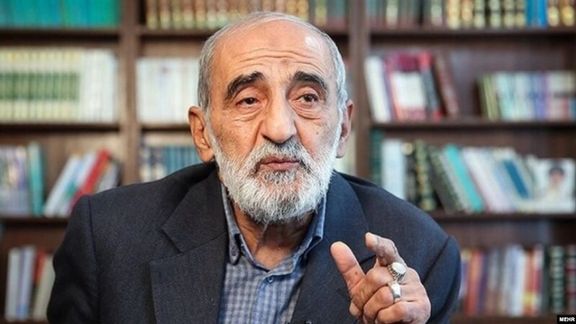
Hossein Shariatmadari, the ultra-hardliner in Tehran.

Nearly all 40 newspapers in Tehran carried welcoming reports about the idea of direct talks with the United States on Wednesday, that has grabbed the headlines.

Foreign Minister Hossein Amir-Abodllahian first hinted at the possibility on Monday and Supreme Council of National Security chief Ali Shamkhani echoed the same idea on Tuesday.

The exceptions were the hardliner Kayhan which is linked to Supreme Leader Ali Khamenei's office and ultraconservative Vatan Emrooz, a Paydari Party mouthpiece, which is the dominant hardliner group in the parliament.

The kayhan harshly criticized Amir-Abodollahian and Shamkhani for their support for direct talks with the Washington.

Last week, Kayhan and IRGC-linked Tasnim news agency had lashed out at Amir-Abdollahian for his support for a balanced foreign policy which meant having ties with the United States as well as Russia and China.

Vatan Emrooz totally had ignored the development while IRGC daily Javan avoided criticizing the foreign minister and the change was noticed by many social media activists in Iran.

The idea of direct talks was most recently brought up by US Special Envoy for Iran Robert Malley who responded to the Iranian side's call for a guarantee that future US governments will not pull out of a nuclear deal with Iran. Malley suggested that major US companies can be prompted to invest in Iran and in that case, they will prevent a US pull out from a new agreement.

Nonetheless, it was Khamenei himself who first mentioned the possibility of direct talks with the United States in a January 9 speech in which he showed the first public sign of his readiness for a compromise on the nuclear deal. His move was similar to his "heroic flexibility" speech in 2013 when he first agreed to negotiations with the United States. He said on January 9, "Negotiations with the enemy at a certain juncture does not necessarily mean surrender".

In a report that was published by Iran Diplomacy website on Wednesday, conservative commentator Jalal Khoshchehreh told the website that softening Iran's positions on holding direct talks with America was a change that followed President Ebrahim Raisi's visit to Moscow last week. Raisi himself, however, implied on live TV Tuesday night that direct talks are possible only if the United States lifts the sanctions on Iran.

As a result, Iranian newspapers came out Wednesday morning with three different messages about Tehran's approach to direct talks with Washington: The good, the bad and the ugly: Khamenei and Amir Abdollahian approving of direct talks with some hesitation, Raisi pending direct talks on the lifting of the sanctions, and Kayhan absolutely ruling out direct negotiations under any circumstances.

In a prominent headline on its frontpage on Wednesday the Kayhan said that "Direct talks is the enemy's trick to evade lifting the sanctions. Hossein Shariatmadari, the daily's firebrand editor wrote in his "brotherly advice to the foreign minister and security chief" that although they might be looking for water, they are misled to drown themselves in a mirage. Shariatmadari said he is worried that support for direct talks with the United States might disappoint the regime's devoted zealot supporters.

The anti-US editor then resorted to a piece of poetry from Iran's great poet Hafiz and quoted the 14th century mystic as saying: "This country is far from water, beware of the demons who lead you to mirage."


Most Viewed

US blockade enters murky phase as tankers spoof signals and buyers hesitate
1
ANALYSIS

US blockade enters murky phase as tankers spoof signals and buyers hesitate

2

US tightens financial squeeze on Iran, warns banks over oil money flows

3
INSIGHT

Ideology may be fading in Iran, but not in Kashmir's ‘Mini Iran'

4
INSIGHT

Hardliners push Hormuz ‘red line’ as US blockade tests Iran’s leverage

5
VOICES FROM IRAN

Hope and anger in Iran as fragile ceasefire persists

Banner
Banner

Spotlight

  • Hardliners push Hormuz ‘red line’ as US blockade tests Iran’s leverage
    INSIGHT

    Hardliners push Hormuz ‘red line’ as US blockade tests Iran’s leverage

  • Ideology may be fading in Iran, but not in Kashmir's ‘Mini Iran'
    INSIGHT

    Ideology may be fading in Iran, but not in Kashmir's ‘Mini Iran'

  • War damage amounts to $3,000 per Iranian, with blockade set to add to losses
    INSIGHT

    War damage amounts to $3,000 per Iranian, with blockade set to add to losses

  • Why the $100 billion Hormuz toll revenue is a myth
    ANALYSIS

    Why the $100 billion Hormuz toll revenue is a myth

  • US blockade targets Iran oil boom amid regional disruption
    ANALYSIS

    US blockade targets Iran oil boom amid regional disruption

  • Iran's digital economy battered by prolonged blackout
    INSIGHT

    Iran's digital economy battered by prolonged blackout

•
•
•

More Stories

Residential Rents In Tehran Jump 50% In One Year

Jan 26, 2022, 16:24 GMT+0

Rents in the capital Tehran have increased by more than 50 percent in one year amid a similar rate of inflation, surveys by the Central Bank of Iran indicate.

According to a report published on Wednesday, Tehran’s rent index in December was 50.7 percent higher in comparison with the corresponding figure for the previous year.

The average price of one square meter (11 sq feet) of a residential unit was estimated at about 330 million rials or about $1,200 in today’s exchange rate, which makes it practically impossible for an ordinary resident of the capital to earn enough money to buy any property with an average salary of less than $200 a month.

In fact, prices have remained constant since 2018 if calculated in US dollars, but Iranians earn rials, which has nosedived against other currencies. Real estate has remained a safe heaven to protect capital from devaluation.

Theannual inflation rate stood at 42.4 percent during December 21-Jaunuary 20. The annual rate is calculated based on a basket of prices for the year ending in each month compared to the previous 12 months.

Iran’s currency has fallen eightfold since early 2018, due to US sanctions while inflation has skyrocketed. Millions of working Iranian are now categorized as poor, with the middle class shrinking.

Saudi Arabia Eyes Replacing Iranian Electricity Exports To Iraq

Jan 26, 2022, 15:29 GMT+0
•
Dalga Khatinoglu

Saudi Arabia and Iraq have signed a memorandum of understanding on January 25 to connect their electricity grids, which can supply much-needed power to Iraq.

Baghdad relies heavily on Iranian electricity imports, while in addition, one third of its electricity comes from thermal power plants which use Iranian natural gas.

However, during last few years, Iran has always cut gas exports to Iraq in winters and curbs electricity deliveries in summers due to its own domestic shortages.

Iran has one of the cheapest energy prices in the world in what amounts to a huge subsidy of tens of billions of dollars for its citizens, who as a result have little incentive to save. Iran also suffers from lack of investments and technology to maintain its falling gas production. Some estimates say up to $40 billion is needed to upgrade production platforms.

Iraq says gas flows from Iran have decreased dramatically from about 50 million cubic meters per day (mcm/d) to around 8 mcm/d in recent weeks, as Iranian officials scrambled to feed power plants and prevent blackouts in the country.

Iran even cut gas exports to Turkey last week, forcing manufacturers to shut down or reduce production.

Perhaps the most important aspect of the Iraqi and Saudi deal is the fact that all Gulf Cooperation Council members (Oman, Qatar, UAE, Bahrain, Kuwait and Saudi Arabia) have already connected their electricity networks together, while Iraq completed its grid connection to Kuwait in November 2021.

This would allow Saudi Arabia to immediately deliver electricity to Iraq through Kuwait, without waiting for connection of its direct electricity grid to Iraq’s.

Saudi Arabia had also signed an electricity export memorandum of understanding with Iraq in 2018 to deliver 3,000 MW of solar power at $21 per one megawatt hour. The volume of this deal is three times larger than Iran’s electricity exports to Iraq and the price is only 30% of Iran’s rate for Baghdad.

Iraq also has other options to become independent from Iranian energy. It has signed several multi-billion contracts with international companies like Germany’s Siemens and United States’ General Electric to boost its electricity generation as well as natural gas production.

Regarding the dramatic growth in oil prices which have boosted income for Iraq’s government, it is expected that development of these projects would accelerate.

During the past 10 years, Iraq’s annual electricity generation capacity and gas production modestly increased by 12.3% and 4.8% respectively.

Iran's FM Assures Lawmakers No Direct Talks With US So Far

Jan 26, 2022, 15:21 GMT+0

Iran’s Foreign Minister Hossein Amir-Abdollahian attended parliament on Wednesday to reassure lawmakers that so far, no direct talks have taken place with the United States.

The possibility of direct talks between Washington and Tehran has been a daily subject of media reports and speculations, as Iranian officials have changed their tone from past categoric rejections.

Mahmoud Abbaszadeh Meshkini, the spokesman for the National Security and Foreign Policy Committee of the parliament, said that Hossein Amir-Abdollaian attended the committee’s meeting to reassure MPs that no direct dialogue has taken place between the Iranian and US negotiating teams so far.

According to Meshkini, the foreign minister also answered questions about the ongoing talks to revive the 2015 nuclear deal, emphasizing that Iran is focused on the issue of guarantees and verifications for the removal of sanctions.

Amir-Abdollaian told lawmakers that some progress has been made but there are still issues that need to be discussed further.

Meshkini said that the West seeks to get concessions from Iran but only a win-win agreement is acceptable by the Islamic Republic.

“Iran wants a lasting agreement, and if it is permanent, it will be better”, Meshkini added, noting that the other side wants a temporary deal so they can withdraw from it whenever they want.

Tehran says it will not consider any interim arrangement, but recent reports suggest it is mulling the idea of direct negotiations with Washington.

Raisi ‘Answer’ On Direct US Talks Feeds Confusion In Iran And Abroad

Jan 26, 2022, 13:16 GMT+0
•
Maryam Sinaiee

A Press TV misinterpretation unleashed a media storm Tuesday after President Ebrahim Raisi gave a vague reply in a TV interview to a query on direct US talks.

After noting "occasional whispers" over the United States seeking bilateral contact, Raisi, during an hour-long interview broadcast live by state television, was asked for Iran’s response should such a request be made “in a serious manner.”

Such an approach would not be unprecedented, including during times before he took office, Raisi replied. “[Officials of] many countries who meet with us here sometimes bear messages from Americans saying they want to talk with us directly…So far there have been no [direct] negotiations with the Americans. But we have announced before, and say it again, that there will be room, fully, for any kind of agreement, if the other sides are prepared to lift the unjust sanctions against us.”

The interviewer did not press the president over recent remarks by Foreign Minister Hossein Amir-Abdollahian and Ali Shamkhani, Secretary of the Supreme National Security Council, envisaging direct talks. Amir-Abdollahian said Monday that the possibility would not be "overlooked" if a "good deal with strong guarantees" was within reach as part of the Vienna talks seeking to revive the 2015 nuclear agreement, the JCPOA (Joint Comprehensive Plan of Action).

Apparently following an account of Raisi’s interview on the Press TV English-language website, however, a slew of international reports and social media posts claimed the president had made direct talks conditional on the US first lifting sanctions. These apparently prompted Press TV to amend its account of the interview.

Speculation, or tactic?

The confusion was not just abroad. Abdollah Ganji, chief editor of Javan newspaper affiliated with IRGC, tweeted Tuesday that he did not now know whether direct talks with the US were “speculation or a tactic.”

Ganji insisted that Tehran should maintain its stance that Washington should not re-enter the formal Vienna process until it rejoined the JCPOA by withdrawing sanctions introduced since 2018 in violation of the pact. “If it's been decided [that talks with the US are] to happen, [they] should be bilateral…The US presence…[in the formal Vienna talks] means its return to the JCPOA without offering a guarantee to abide by its commitments to it.”

In another tweet Tuesday, Ganji said direct negotiation was a "possibility" that the nezam (‘system’) had always considered possible whenever a positive outcome was expected, “when it was not just talking for the sake of talking." The JCPOA was proceeded by two years of direct US-Iran talks, but Tehran ruled out such bilateral contact when the US left the JCPOA in 2018.

Nezam (system) is a word often used by Iranian politicians to refer to the Supreme Leader Ali Khamenei when mentioning him directly is to be avoided.

Javan newspaper Tuesday splashed a front-page headline, with Amir-Abdollahian's photo: "Direct Talks On Condition of Good Agreement with Strong Guarantees." Many hardliners were skeptical over the JCPOA, or opposed it, and were critical of what they said was the over-reliance on outreach to western Europe and the US of the previous administration of President Hassan Rouhani.

Lebanon Seizes Large Amphetamine Shipment Destined For Gulf States

Jan 26, 2022, 10:26 GMT+0

Lebanese Interior Minister Bassam Mawlawi said Tuesday police had thwarted an attempt to smuggle large amounts of Captagon amphetamine pills around the world.

The minister said the drugs were on their way from Lebanon to the African nation of Togo, and from there they would have been sent to a Persian Gulf nation, most likely Saudi Arabia.

There have been many reports of the Lebanese Hezbollah being involved in the production and distribution of Captagon, through third countries to the Gulf Arab states. This has become a major source of income particularly after Lebanon fell into a serious economic crisis in 2019 and US sanctions put financial pressure on Iran, Hezbollah’s main financial backer.

The pills were hidden in 434 boxes, mixed in with seven tons of tea.

They were confiscated at sea after the smugglers sailed from Beirut’s port.

Captagon manufacturing thrives in Lebanon and war-torn Syria, which have become a gateway for the drug to the Middle East, particularly the Gulf.

Smuggling of Captagon pills has been at the heart of a spat between Saudi Arabia and Lebanon, after over five million pills hidden in a shipment of pomegranate from Lebanon were seized in the kingdom in April.

In retaliation, the Saudis banned Lebanese produce from going to or even transiting through the kingdom, a blow to Lebanon’s exporters.

With reporting by AP