• العربية
  • فارسی
Brand
  • Iran Insight
  • Politics
  • Economy
  • Analysis
  • Special Report
  • Opinion
  • Podcast
  • Iran Insight
  • Politics
  • Economy
  • Analysis
  • Special Report
  • Opinion
  • Podcast
  • Theme
  • Language
    • العربية
    • فارسی
  • Iran Insight
  • Politics
  • Economy
  • Analysis
  • Special Report
  • Opinion
  • Podcast
All rights reserved for Volant Media UK Limited
volant media logo

Iran FM Says Entire Region Will Benefit From Renewed Nuclear Deal
Iran International Newsroom
Mar 25, 2022, 15:53 GMT+0Updated: 17:38 GMT+1
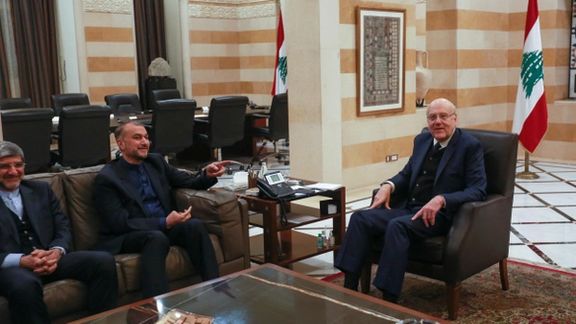
Iranian Foreign Minister Hossein Amir-Abdollahian meets with Lebanon's Prime Minister Najib Mikati in Beirut, Lebanon March 24, 2022.

Hossein Amir-Abdollahian, Iran’s foreign minister, has said the whole Middle East would benefit from a renewed nuclear deal between Tehran and world powers.

But during a meeting with Lebanese Prime Minister Najib Mikati Thursday evening, Amir-Abdollahian said “we’ve not reached the final point on lifting sanctions yet.”

Opponents of reviving the 2015 nuclear deal and lifting US sanctions say that giving Iran tens of billions of dollars will enable it to finance its allies and militant proxies in the region.

The foreign minister continuing his trip on Friday, met political leaders from all Lebanese sects, including President Michel Aoun, a Maronite Christian, and the heads of the two main Shia parties, house speaker Nabih Berri of Amal, and Hassan Nasrallah, general secretary of Hezbollah.

In a news conference after meeting with his counterpart Abdallah Bou Habib, Amir-Abdollahian said Iran wanted “a good, strong and lasting agreement, but not at the cost of crossing its red lines.” The foreign minister said United States sanctions should be removed “in the maximum way.”

A recurrent theme of Amir-Abdollahian’s visit has been the need for detente with Saudi Arabia in line with President Ebrahim Raisi’s commitment to improved relations with Iran’s neighbors.

The Lebanese foreign minister welcomed détente between Iran and Saudi Arabia, according to a readout of the meeting provided by Iran’s Foreign Ministry. Saudi-Iran tensions have often played out in Lebanon, which has a substantial population of both Sunni and Shia Muslims. Riyadh in October broke off diplomatic relations with Beirut, and its influence has also diminished with the withdrawal from politics of Saad Hariri, leader of the Sunni Mustaqbal party and a Saudi citizen, in January.

Keeping Doors Open

Bou Habib, according to a readout from the Lebanese foreign ministry, said not only Lebanon would benefit from an improvement in Tehran-Riyadh relations, which would also “provide an opportunity to help advance intra-Yemeni dialogue and resolve the crisis in that country.”

In an interview with Al Mayadeen television Friday, Amir-Abdollahian reiterated that Iran was ready for a fifth round of talks with Saudi Arabis and was “working hard to keep the doors of dialogue open between the two countries.” Earlier this month Iran suspended bilateral contacts, facilitated by Iraq, after Saudi Arabia beheaded 81 men − including 41 Shia Saudi Shia, seven Yemenis and a Syrian − for “heinous crimes.”

In a meeting with cultural and political scholars and figures Friday, the Iranian foreign minister said Tehran was “ready to help Lebanon with medical services, medicine and medical equipment and other basic needs.” Amir-Abdollahian said Thursday Iran had offered to establish two 1,000-megawatt power stations in Lebanon to help with its chronic power crisis and connect its energy grid to Lebanon through Syria and Iraq.

Much of Lebanon has zero mains electricity, following decades of corruption and a financial crisis that erupted in late 2020, plunging 80 percent of the population into poverty. The crash followed the failure of post-war governments to control a spiraling debt financed by expatriate deposits in the Lebanese banking sector.

But the Iranian foreign minister’s offer of assistance comes as Tehran has often complained about shortage of medicine and medical supplies because of US sanctions. It also suffers from chronic electricity shortages partly because the capacity of its power stations is inadequate.

Iranian government-controlled media reporting on Amir-Abdollahian's meetings did not mention his offer of assistance, possibly because of popular resentment toward Islamic Republic's long-standing policy of providing financial and military resources to allies and proxies in the region.


Most Viewed

US blockade enters murky phase as tankers spoof signals and buyers hesitate
1
ANALYSIS

US blockade enters murky phase as tankers spoof signals and buyers hesitate

2
INSIGHT

Ideology may be fading in Iran, but not in Kashmir's ‘Mini Iran'

3
INSIGHT

Hardliners push Hormuz ‘red line’ as US blockade tests Iran’s leverage

4
VOICES FROM IRAN

Hope and anger in Iran as fragile ceasefire persists

5

US sanctions oil network tied to Iranian tycoon Shamkhani

Banner
Banner

Spotlight

  • Hardliners push Hormuz ‘red line’ as US blockade tests Iran’s leverage
    INSIGHT

    Hardliners push Hormuz ‘red line’ as US blockade tests Iran’s leverage

  • Ideology may be fading in Iran, but not in Kashmir's ‘Mini Iran'
    INSIGHT

    Ideology may be fading in Iran, but not in Kashmir's ‘Mini Iran'

  • War damage amounts to $3,000 per Iranian, with blockade set to add to losses
    INSIGHT

    War damage amounts to $3,000 per Iranian, with blockade set to add to losses

  • Why the $100 billion Hormuz toll revenue is a myth
    ANALYSIS

    Why the $100 billion Hormuz toll revenue is a myth

  • US blockade targets Iran oil boom amid regional disruption
    ANALYSIS

    US blockade targets Iran oil boom amid regional disruption

  • Iran's digital economy battered by prolonged blackout
    INSIGHT

    Iran's digital economy battered by prolonged blackout

•
•
•

More Stories

Iran Police Call For More Resources To Help Personnel

Mar 25, 2022, 11:30 GMT+0

The deputy commander of Iran's police says the livelihood of their personnel is one of the main concerns of the Law Enforcement Force, amid high inflation.

Brigadier-General Qasem Rezaei told the ILNA news agency Friday that housing units and other facilities would be provided for officers to improve their living conditions. Rezaei also said that salaries paid to police were not in a par with the important services they provided.

Late in January, dozens of members of the armed forces and retirees protested in several Iranian cities over living and working conditions. Teachers, nurses, firefighters, prison guards, and employees of the judiciary have all held protest rallies or strikes to demand higher salaries.

Earlier in January, the spokesman for Iran's police said that while salaries for police officers had increased several times in the previous Iranian year (ending March 20, 2021), the government could not afford substantially higher salaries.

Akbar Shokat, head of the construction workers union, recently claimed prices had risen five to ten-fold since 2018, when the United States introduced ‘maximum pressure’ sanctions. The International Monetary Fund gives consumer price inflation of 34.6 percent in 2019, 36.4 percent in 2020, 39.3 percent in 2021 and projects 25.7 percent for 2022 – giving an overall increase to date of over 255 percent since 2018.

Iran Statistical Center and media, however, have reported higher inflation in 2021, especially for food items that increased more than 60 percent.

Ukraine, Iran Topics In Blinken Trip To Middle East, North Africa

Mar 25, 2022, 09:24 GMT+0

US Secretary of State Antony Blinken will travel to the Middle East and North Africa starting on Saturday in a trip that will be dominated by Russia's invasion of Ukraine and Iran.

Blinken is set to visit Israel, the West Bank, Morocco, and Algeria from Saturday to Wednesday, the State Department announced on Thursday, in a trip that will focus on Iran and the conflict in Ukraine.

"Both of those are going to be really at the top of the agenda," top US diplomat for Near Eastern affairs Yael Lempert told reporters.

Lempert said that Blinken will discuss Israel's role as mediator between Russia and Ukraine during his visit over the weekend.

"We appreciate Israel's role," Lempert said. Israeli Prime Minister Naftali Bennett has been trying to mediate an end to the Ukraine-Russia conflict.

She warned that the conflict will only continue to increase the price of basic staples in the Middle East and North Africa region as wheat prices rise.

Lempert said that while in Morocco, Blinken will also meet with Abu Dhabi Crown Prince Sheikh Mohammed bin Zayed Al Nahyan, during which the two will discuss a range of issues including Iran, Yemen, Syria, global energy markets and Ethiopia.

The Abraham accords, a U.S.-sponsored drive to improve relations between Israel and a range of Arab countries, will also be on the agenda, Lempert said.

"It's an opportune moment for this meeting. There's a lot to discuss," she said.

Report by Reuters

The Lives Of Iran's Shiite Clerics - Fifty Shades Of Mullahs

Mar 24, 2022, 22:20 GMT+0
•
Iran International Newsroom

This article is the third in a series about Iran’s Shiite clerics, explaining how they study, get a clerical rank, get married and what they do for a living.

----------------------------------------------------------------------------------------------------------------------------

As Iranian cleric Seyyed Ahmad Batha'i has observed, "Generally speaking, there are two types of clerics in Iran: Those who are good speakers, and those who are not, regardless of the level of their knowledge."

A good cleric should have a good voice, be a good storyteller and be capable of grabbing and keeping the attention of audiences. They should also know a little about classical Persian music, dastgahs, so that they could sing the dramatic bits of religious stories. Some clerics do it very well. Some don't.

Former President Hassan Rouhani was definitely a bad singer according to his friends and foes. Every Muharram, he used to eulogize and sing during the cabinet meetings to pay tribute to the martyrs of Karbala including Imam Hussain. But as most Iranians have seen on state TV, his singing was awful. Grand Ayatollah Hossein-Ali Montazeri reminisced in his memoires that former President Akbar Hashemi Rafsanjani was not a good singer either and while his eulogy was meant to make the listeners cry, it made them laugh. "I had to beg him to stop singing," says Montazeri.

Any good cleric knows that singing and eulogizing are the peak points of the religious performance art. Although being a cleric is not totally about singing or speaking, these are essential tools of the trade. In Qom, many clerics prefer riding motorcycles rather than driving or walking. They usually sing while riding. A motorcycle travels fast and puts a distance between them and people who like to tease clerics. And the people in Qom are really good in the art of teasing.

A large gathering of Iranian clerics. Undated
100%

The traffic department in Qom in the 1980s exempted cleric motorcyclists from putting on a helmet, arguing that a turban was enough to protect the clerics' head in case of an accident.

Mehdi Parnian, a cleric born in 1975, who has studied at the Qom Seminary and later continued his academic studies for an MA degree in communication, is now the head of the seminary's "Humor Office." Parnian has collected the forms of address and titles of Iranian clerics in a brief lexicon.

Sheikh or Shaykh as the word is pronounced in Iran, was a title and form of address in the old times for respectable elderly clerics and tribal leaders. However, in modern Persian, shaykh is the lowest rank for a cleric. These are the ones who may have even not been to a seminary. Some people call them Ashaykh, meaning Mr. Shaykh.

Seyyed, which was previously used for clerics who were the descendants of the holy prophet, is currently being used equally for all the descendant of the prophet even if they are not clerics.

Influential clerics, mostly politicians or heads of large quasi-religious entities. FILE
100%
Influential clerics, mostly high ranking officials, politicians or heads of large quasi-religious entities.

Mullah or molla, in the past meant a literate person. Later it was used for clerics. According to Parnian, nowadays, it is a word with a lot of negative connotations just one step short of a swear word. Among the traditional intellectuals, it means a well-educated person.

Akhund, literally means cleric and is the most popular Persian word that describes a cleric. In the old times, an Akhund was someone who ran a religious school or madrassah.

Seqat ul-Eslam literally means someone who is trusted by Islam. It was a highly respectful form of address in the past. In the modern world, the term has lost its true meaning. Any cleric may be called a seqat ul-Eslam regardless of his real rank.

Talabeh, is a student of divinity or religious knowledge. Although it is a plural world it is used for a single cleric, the new plural is Tollab. These are newly coined words. They did not exist in old Persian. They come from the same root as Taliban, or students of religion.

Hojjat ul-Eslam, means the reason and a guide for Islam. It was not a popular word in the past but when it was used, it was for prominent clerics, short of an Ayatollah. Nowadays, any cleric, even at the lowest level can use the title.

Hojjat ul-Eslam val Muslemin, is the same as Hojjat ul-Eslam and means a reason and a guide for Islam and Muslims.

Ayatollah, is the sign of God. The term became popular after the 13the century. These are high-ranking clerics who can make religious and Sharia interpretations by referring to the Koran or the stories about the holy prophet and the Imams.

Ayatollah ul-Uzma, is a big sign of God or a grand ayatollah. This is a new term that was used first in 1961 for Grand Ayatollah Boroujedri.

Allamah, or as it is pronounced in modern Persian Allameh, means a highly educated multi-disciplinary scholar. This title is used very rarely and is not part of the official titles used in the seminaries.

Despite all the labels and ranks, today's Iranian clerics are divided into two broad groups: A minority who are senior state or religious officials and the rest who make a living as clerics, or maybe have some regular job like a teacher or a low-ranking bureaucrat.

Iran Foreign Minister In Lebanon To Consolidate Relations

Mar 24, 2022, 19:56 GMT+0

Iran’s foreign minister has traveled to Lebanon to discuss developments in the Middle East region and bolster relations with senior Lebanese authorities.

Hossein Amir-Abdollahian said that while “mixed messages” had been received from Riyadh, Iran expected “the Saudis will act in the interest of the region.” There has been recent speculation that Saudi Arabia may restore diplomatic relations with Lebanon, broken off in October.

Saudi-Iran tensions have often played out in Lebanon, which has a substantial population of both Sunni and Shia Muslims. Earlier this month Iran suspended bilateral talks after Saudi Arabia beheaded 81 men, including seven Yemenis and a Syrian, for “heinous crimes.” Forty-one were Saudi Shiites, Human Rights Watch reported, apparently sentenced over protests.

On arrival at the airport, Amir-Abdollahian told reporters he had met Lebanese Prime Minister Najib Mikati on the side-lines of the 58th Munich Security Conference a month ago, and expressed “Iran's readiness to establish two 1,000-megawatt power stations in Lebanon and to fully develop trade and economic cooperation...”

Lebanon suffers from chronic power shortage, one consequence of a financial crisis that erupted in late 2020, plunging 80 percent of the population into poverty, following the failure of post-war governments to control a spiraling debt financed by Lebanese banks.

Amir-Abdollahian is due to meet President Michel Aoun, Parliament Speaker Nabih Berri, Prime Minister Najib Mikati, and Foreign Minister Abdallah Bou Habib. The foreign minister called consultations with Lebanon, where officials hail from a range of sects, “regular and constructive.”

Tehran, Moscow Mull Adoption Of Russia’s MIR Payment System

Mar 24, 2022, 18:03 GMT+0
•
Maryam Sinaiee

Iran’s envoy to Russia has said the two countries are in talks over the possible recognition of the Russian payment system MIR, according to Iranian media.

The reports that quoted Ambassador Kazem Jalali as making the announcement have not provided further details.

MIR is a payment system for electronic fund transfers that was established by the Central Bank of Russia in 2017 following the imposition of international sanctions on the country starting in 2014.

MIR does not itself issue cards, extend credit or set rates and fees for consumers. Instead, it provides financial institutions with MIR-branded payment products that they can use to offer services to their customers. The system is currently operational in Russia, Armenia, Turkey, and the United Arab Emirates.

The Central Bank of Russia has also developed a domestic financial-communications platform, the System for Transfer of Financial Messages (SPFS), as an alternative to the global Society for Worldwide Interbank Financial Telecommunication (SWIFT) network.

Following Russia’s invasion of Ukraine, several major Russian banks have been cut from the SWIFT system.

According to Iran's Fars News Agency, more than half of Russians are said to have at least one bank card using MIR and over 25 percent of their financial transactions are done through the system.

Iran and Russia are both under US economic sanctions that are causing major problems for their banking sectors. It is not clear if adopting Russia’s MIR and SPFS platforms could help Iran become less dependent on the international banking system.

Tehran is also keen to sign a long-term cooperation agreement with Moscow. During a visit to Moscow in January, Iranian President Ebrahim Raisi presented the draft of a 20-year cooperation deal to his Russian counterpart, Vladimir Putin, that would update a 2001 version.

Tehran claims it is not taking anyone's side in the four-week war between Russia and Ukraine and has called for a peaceful settlement. However, Iran’s state media and hardliner outlets carefully avoid describing Russia’s military offensive in Ukraine as an “invasion.”

In a commentary on Thursday, the official news agency IRNA said that Iran “is against both the expansion of NATO and interferences of the West in the relations between the two neighbors.”

“It also does not consider war to be a solution for problems that exist between countries and urges all sides to refrain from violence. On the other hand, Iran believes that the Western countries' insistence on using sanctions as a tool [against Russia] is unconstructive and will cause further problems,” the agency said.

“Iran's emphasis on dialogue between the sides can resolve the existing issues and prevent problems in the future," according to IRNA.

Iranian officials, including Raisi and Supreme Leader Ali Khamenei, have consistently supported Russia's invasion of Ukraine, blaming the United States and NATO for provoking Moscow.

Khamenei has also claimed that Ukrainians were not resisting strongly to the Russian invasion "because they did not agree with [their] government." The hardline Kayhan newspaper made a similar allegation this week, referring to Ukraine’s “scarecrow” defense, while international media and experts are impressed with the strong Ukrainian resistance.

In February, Iran was among 35 countries that abstained on a UN General Assembly resolution deploring Russia’s action in Ukraine and calling for an immediate withdrawal of its forces from the country.





