• العربية
  • فارسی
Brand
  • Iran Insight
  • Politics
  • Economy
  • Analysis
  • Special Report
  • Opinion
  • Podcast
  • Iran Insight
  • Politics
  • Economy
  • Analysis
  • Special Report
  • Opinion
  • Podcast
  • Theme
  • Language
    • العربية
    • فارسی
  • Iran Insight
  • Politics
  • Economy
  • Analysis
  • Special Report
  • Opinion
  • Podcast
All rights reserved for Volant Media UK Limited
volant media logo

Tehran's Moscow Envoy Says NATO Expansion Not In Iran's Interest
Iran International Newsroom
Feb 28, 2022, 20:17 GMT+0Updated: 17:40 GMT+1
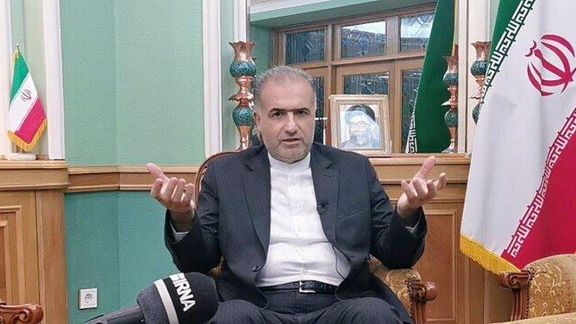
Kazem Jalali, Iran's ambassador in Moscow. Undated photo

Iran's envoy to Russia has said NATO's expansion is not in the interest of Tehran and Moscow, and there is a global synergy against Western “unilateralism.”

The comments came as Iran has supported Russia’s invasion of Ukraine by blaming the United States and NATO for the ensuing crisis.

During a webinar about bilateral relations and regional developments, Kazem Jalali urged closer cooperation with Moscow under President Vladimir Putin, saying, “We are working with Russia on regional issues, and have a successful experience in Syria’s case”, Jamaran News in Tehran reported on Monday.

"Obviously, neither we nor the Russians see NATO expanding to our borders in our interest," said Tehran’s ambassador in Moscow.

Turkey, a NATO member borders Iran in the northwest but has followed a neutral policy between the Washington and Tehran.

Jalali added that Russia has stood up to American unilateralism, noting that this is the same approach that the Islamic Republic has taken since the 1979 revolution.

Jalali noted that Iran did not have good relations with the Tsarist Russia, the Soviet Union, and in the post-Soviet period, adding, “The fourth era is the Putin era, which I think should be paid more attention to”.

Judging by the history of Iran-Russia relations, “some people ask why we should have relations with the Russians when we have such a history with them. We should know that during the Soviet era 25 million people were killed in the war with Germany” but that didn’t stop them to cooperate on the Nord Stream --the system of offshore natural gas pipelines in Europe that runs under the Baltic Sea from Russia to Germany.

He added that “we should look at the realities of today”, underlining that Iran’s new government prioritizes relations and strengthening cooperation with neighboring countries, and “Russia is a large economy.”

Jalali went on to say that “our foreign policy should serve Iran’s national interests”, urging to keep a balance between the West and the East.

In fact, in the past 30 years under Supreme Leader Ali Khamenei Iran’s foreign policy has increasingly tilted toward Russia and China. In the 1980s, when the founder of the Islamic Republic Ayatollah Ruhollah Khomeini was Supreme Leader, the country followed his dictum of “Neither West Nor the East.”

During the same event, former member of the parliament Elaheh Koulai described ties between Iran and Russia as one of the most important issues in Eurasia.

“There are bitter events in the history of Iran-Russia relations that have caused pessimism and Russophobia in Iranian society” she added.

She called for a balancing approach with Russia, Europe and the United States, saying, “we must try to use Russia to our advantage”.

Referring to the Russian invasion of Ukraine, Koulai said, “Iran must condemn Russia's military action against Ukraine and demand that the two sides sit down at the negotiating table”.

As debate about Russia’s invasion of Ukraine continues in Iran, divisions reflect the political dispositions of various factions over Tehran’s foreign policy.

Hardliners close to the core of the regime fiercely defend a pro-Russia policy, while their rivals within the regime argue for more balanced relations between the West and the East, meaning Moscow and Beijing.

Many ordinary Iranians and opponents of the Islamic Republic invariably support Ukraine and condemn the government pro-Russia policies on social media.


Most Viewed

State media slam Araghchi's Hormuz tweet, say it let Trump claim victory
1

State media slam Araghchi's Hormuz tweet, say it let Trump claim victory

2
OPINION

The Hormuz get out of jail card turned to a grave

3
INSIGHT

How Tehran bends its own red lines to boost state rallies

4

Iran International says it won’t be silenced after London arson attack

5
VOICES FROM IRAN

Iran blackout cripples freelancer, small business incomes

Banner
Banner

Spotlight

  • Too early to tell who is winning Iran war, experts say
    PODCAST

    Too early to tell who is winning Iran war, experts say

  • How Tehran bends its own red lines to boost state rallies
    INSIGHT

    How Tehran bends its own red lines to boost state rallies

  • Iran blackout cripples freelancer, small business incomes
    VOICES FROM IRAN

    Iran blackout cripples freelancer, small business incomes

  • Ideology may be fading in Iran, but not in Kashmir's ‘Mini Iran'
    INSIGHT

    Ideology may be fading in Iran, but not in Kashmir's ‘Mini Iran'

  • US blockade enters murky phase as tankers spoof signals and buyers hesitate
    ANALYSIS

    US blockade enters murky phase as tankers spoof signals and buyers hesitate

  • Why the $100 billion Hormuz toll revenue is a myth
    ANALYSIS

    Why the $100 billion Hormuz toll revenue is a myth

•
•
•

More Stories

Iran Armed Forces Personnel Hold Protests For Higher Salaries

Feb 28, 2022, 17:12 GMT+0

Dozens of active personnel and retirees of the armed forces have held protests in several Iranian cities to protest their poor living and working conditions.

According to videos posted on social media, the Monday rallies were held in front of the governor's offices in cities across the country such as Mashhad, Shahrekord, and Kermanshah while protesters in Tehran gathered in front of the parliament.

The demonstrations took place following a call circulated on the internet by the personnel and retirees of the armed forces to protest their low salaries.

Some former and current personnel received text messages from security agencies warning them against participating in the planned protests.

People from different walks of life, including teachers, nurses, and firefighters, have been holding regular protest rallies or strikes to demand higher salaries but such protests by the personnel of the armed forces are unprecedented.

In some other rare moves, staff members of the hardliner judiciary department and prison guards took to the streets in several cities across the country to protest their low salaries.

Earlier in January, the spokesman for Iran's police said salaries of police officers have increased several times in the previous nine monts, describing their living conditions as a major concern. However, the government cannot afford to pay substantially higher salaries in par with the rising food prices on top of high inflation in the previous few years.

Khamenei’s Website Denies Infiltration By French-Jewish Journalist

Feb 28, 2022, 10:46 GMT+0

Iranian Supreme Leader Ali Khamenei's website has denied any relations with an “Israeli” journalist who allegedly “infiltrated” Khamenei’s official website.

Fars news agency, affiliated with Iran’s Revolutionary Guard, published a statement on Sunday to reject reports about Catherine Perez Shakdam contributing to the English version of Khamenei’s website.

The statement added that Khamenei.ir doesn’t have any columnist and Shakdam has no direct connection with the website.

However, it confirmed that Shakdam sent articles and opinion pieces on issues related to Islam and the Islamic Revolution to the website from about 2015 to 2017 that were published on the site.

The website had no communication with the writer since then and removed its articles, the statement said.

The articles Shakdam wrote for Khamenei's website had been removed but many of them can be accessed via internet archive websites.

A scandal broke in major state-affiliated news outlet after supporters of former president Mahmoud Ahmadinejad claimed that she had been an Israeli “infiltrator”.

Over a period of several years, Iranian state-run media such as the English-language Press TV and the national broadcaster (IRIB) interviewed Shakdam, introduced as "political analyst and author based in London," while the Tasnim and Mehr news agencies published her articles.

Shakdam is a French-born Jew, a UK resident, and was a convert to Shiism. She boasted that her holding a French passport and former marriage to a Yemeni Muslim gave her "a free pass to many Islamic countries."

Elon Musk's Internet Offer To Ukraine Puts Iran On Notice

Feb 27, 2022, 22:11 GMT+0

A former Iranian minister has warned parliament against plans to restrict Internet access, pointing out Elon Musk’s Starlink satellite access offered to Ukrainians.

Addressing the hardliner lawmakers who are pushing for a bill to limit the internet in Iran, former communication minister Mohammad-Javad Azari-Jahromi said on Sunday that "The consequences of wrong policies are heavy. Wrong governance destroys the instruments of governance and regulation forever”.

He made the remarks in reaction to the activation of satellite internet constellation Starlink for the Ukrainians. Operated by Elon Musk’s company SpaceX, it provides internet access coverage to most of the Earth.

As Ukraine's internet service has been disrupted by Russia's invasion, Musk made the internet service available in Ukraine, saying that more terminals to use it are also on the way.

The SpaceX CEO made the move after being asked by a Ukrainian government official if SpaceX could provide more Starlink services to the country after Russian troops invaded Ukraine last week.

Azari-Jahromi added that “all the unusual limitations [by Iran] on Internet [access] are direct marketing for the next generation of satellite Internet”, quipping that “if you do not provide people with the right service, others will”.

Iranians were outraged after an ad hoc parliamentary committee approved the outlines of the controversial bill -- ironically entitled 'Legislation to Protect Cyberspace Users -- to restrict freedom of access to global Internet and popular social media platforms.

Debate Over Ukraine Reflects Divisions Among Political Elite In Iran

Feb 27, 2022, 20:11 GMT+0

As debate about Russia’s invasion of Ukraine continues in Iran, divisions reflect the political dispositions of various factions over Tehran’s foreign policy.

Pro-Moscow positions are abundant in hardliner media outlets close to the core of the regime, such as Kayhan and Iran newspapers, while reformist daily Arman on Saturday and Sunday reflected anti-Russia views that normally do not find their way into the media.

Many ordinary Iranians and opponents of the Islamic Republic invariably support Ukraine and condemn the government pro-Russia policies on social media.

Other reformist media such as Sharq and Etemad newspapers carve out a position in between the two extremes. They often harshly criticize Moscow for its violation of international law, but invariably remind that the United States is no better when you look at its track record in places such as Afghanistan and the Middle east.

Reformists criticize President Ebrahim Raisi’s administration for tacitly blaming NATO and the United States for Russia’s actions, while also criticizing the US to remain politically correct given the regimes animosity toward Washington.

A good example of a reformist approach to the issue was reflected in an article in the Etemad daily by commentator Abbas Abdi who tried to strike a balance by blaming both Russia and the United States for the crisis in Ukraine. He said: "In the agreement about the nuclear disarmament of Ukraine and guaranteeing its territorial integrity in the 1990s, Russia undertook not to invade Ukraine and the agreement was also guaranteed by the United States. How responsible should a guarantor be?"

Abdi wrote in another part of the article: "Iranian hardliners say we should learn a lesson from this crisis in which the United States has not stood by its commitment [to Ukraine]. That is right. But don't Iran's hardliners want to take a lesson from Russia's behavior? Russia had guaranteed that no country would be allowed to invade Ukraine. I wish you take this lesson and rely on the people's support rather than relying on foreigners."

Abdi further wrote that Iran's position about Russia's invasion of Ukraine leaves the impression that it is not an independent state. He argued that Iran behaved in a way as if it had no other choice but to support Moscow. He hinted that Raisi’s supportive phone call to Vladimir Putin did not portray Iran as an independent country.

Abdi asked, "Why are we in such a position? We are in this position because of the same reason that Ukraine's president counted on the West in his confrontation with Russia. In the same way, Iran should not count on Russia or China in its confrontation with the West as they follow their own interests. And interests will push ethics and international commitments to the margins."

On the pro-Moscow front, Hossein Abbaszadeh Meshkini, the spokesman for the Iranian parliament's National Security and Foreign Relations Committee opined in an interview with Didban Iran that "Russia's attack on Ukraine was a deterrent measure to prevent an extensive war in Europe at the same scale as World War II."

Abbaszadeh further claimed that Moscow's “preventative” measure has been taken within the frameworks of the UN Charter. He claimed that the West's occupation of Afghanistan and Syria as well as everyday developments in the Middle East follow the same logic. He stressed that Russia is concerned about the expansion of NATO toward the Russian borders, adding that no independent country would tolerate NATO's presence at its borders.

He said Russia has been repeatedly sanctioned by the EU and the United States and it cannot tolerate NATO's presence at its borders. Abbaszadeh reiterated the regime’s position by saying that "We believe Russia and Ukraine can solve their problems through diplomacy which offers a less costly solution."

Arrest Of Iranian Internet Activist Leads To Social Media Storm

Feb 27, 2022, 18:31 GMT+0

The brother of Iranian dissident blogger and internet freedom activist Hossein Ronaghi says he has been on a dry hunger strike since his arrest four days ago.

Hassan Ronaghi, also an activist, said in a tweet on Sunday that his brother contacted the family earlier in the day, adding that he is not feeling well because he has also stopped drinking water and fluids.

He said he asked his brother to end the hunger strike but Hossein Ronaghi responded that he would not do that until he is freed.

Iranian social media users have launched an internet campaign since Saturday, and hashtags #Hossein_Ronaghi (in Persian) and #ReleaseRonaghi in English are currently among the most trending on twitter.

According to his family and friends, security forces have 'abducted' him at around 11:00 AM Wednesday near his house after leaving for work.

Ronaghi's father Reza Ronaghi has said Supreme Leader Ali Khamenei was directly responsible for his son's life, threatening to set himself on fire in public if his son is not freed.

Ronaghi was first arrested, along with his brother Hassan, in the aftermath of the disputed presidential elections in 2009 for issuing proxies that allowed journalists and political activists to circumvent internet censorship. He was also charged with insulting Khamenei in his blog posts.

According to Amnesty International, Ronaghi was badly tortured in prison after his arrest in 2009 and underwent at least four operations to fix his damaged kidney which could not be saved and had to be removed.




