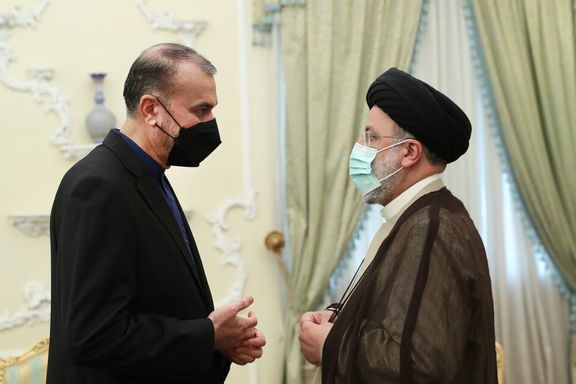
Foreign Minister Amir-Abdollahian and President Ebrahim Raisi
Iran's president and foreign minister have reiterated that for an agreement in nuclear talks Washington must remove all sanctions and guarantee the deal.
In a phone conversation with his French counterpart Emmanuel Macron on Saturday, the Iranian President Ebrahim Raisi reiterated that any deal for the restoration of the deal, Joint Comprehensive Plan of Action (JCPOA), must include the lifting of sanctions, convincing guarantees that Washington will not renege on the deal in the future as former US President Donald Trump did in 2018, and "an end to political issues and claims".
In his hour and half-long phone talk with Macron, Raisi also said Iran is under certain "political pressures or claims aimed at maintaining the leverage of pressure" that "undermine the prospect of reaching an agreement in Vienna".
It is not clear what pressures Raisi was referring to, but Iran has made advances in its nuclear program that must be addressed by any agreement if JCPOA is to be restored. One issue is advanced uranium enrichment machines it has deployed since 2020 and the stockpile of highly enriched uranium these centrifuges have produced. Beyond nuclear issues, the US is demanding the release of American and possibly other Western citizens held in Iran on trumped-up charges, Iran’s ballistic missiles and its aggressive regional policies.
"President Macron stressed the need to conclude an agreement while there was still time for this. He also expressed his conviction that the discussions, which are being conducted with the active participation of France and its partners, make it possible to arrive at a solution that takes into account the fundamental interests of all parties,” the Elysee Palace said in a short communiqué according to France 24. “This would help avoid a major nuclear crisis,” the statement said.
“What we are considering seems absolutely reasonable and fair: the removal of all sanctions inconsistent with the JCPOA, verification of sanctions removal, and presentation of absolutely necessary objective guarantees for the fulfilment of commitments,” Foreign Minister Hossein Amir-Abdollahian said in an address at the Munich Security Conference Saturday evening and added that Western powers will be responsible if the nuclear talks in Vienna fail because Tehran wants "a good deal".
Iran's Supreme Leader Ali Khamenei on Thursday accused Western powers of seeking to deprive Iranians of peaceful nuclear energy and reiterated that Iran has never sought nuclear weapons but gave no indication in his speech as to whether he thought a revived deal, restoring limits on Tehran’s nuclear program, was likely.
‘Tangible good will’
Amir-Abdollahian also reiterated that Tehran wants the US to show “tangible steps of goodwill," in a possible reference to freeing Iran's blocked funds abroad.
When asked about prospects of direct negotiations between Tehran and Washington at a panel at the Munich Security Conference Saturday, the Iranian foreign minister did not rule out the possibility but said Washington should show tangible goodwill gestures including the release of Iran's assets frozen in other countries under the US sanctions before even considering to directly negotiate with the US in Vienna.
European powers have in the past few days warned that time for reaching an agreement with Tehran was quickly drawing to an end, but Tehran continues to blame the other parties and says the deadlines set by them are "fake".
Iran's Foreign Ministry spokesman Saeed Khatibzadeh said Saturday that Tehran has already made its "serious decisions" and demonstrated its seriousness all along during the talks. "To reach the final agreement, it is now up to the E3 and the US to do the same, urgently," he tweeted.
Amir-Abdollahian on Saturday also said Tehran is ready for an "immediate" prisoner swap with the US. “We believe prisoner swap is a humanitarian issue ... unrelated to the nuclear accord. We can do it immediately,” he told the panel at the Munich Security Conference.
Tehran has refuted a Reuters report Friday that claimed a prisoner swap was part of the talks.
Tehran is holding at least four Iranian-American nationals as well as several with citizenship of European countries including France, Britain, Germany, and Sweden who were arrested by the Revolutionary Guards (IRGC) and sentenced by Revolutionary Courts to prison terms.
The US Special Envoy for Iran Robert Malley said on January 24 that a nuclear agreement with Tehran was unlikely without the release of Americans detained in Iran.
Iranian President Ebrahim Raisi has told his French counterpart that any agreement between Tehran and world powers must involve removal of all sanctions and provision for credible guarantees.
During a phone conversation with French President Emmanuel Macron on Saturday, Raisi discussed the latest developments of the ongoing talks in Vienna to revive the 2015 Iran deal, officially known as the Joint Comprehensive Plan of Action (JCPOA).
Raisi insisted on Iran’s demands that any deal in Vienna should be the cessation to all political issues and claims and should include the lifting of all maximum pressure sanctions imposed on the Islamic Republic since 2018, when former president Donald Trump withdrew from the deal.
He added that certain "political pressures or claims have been made with the aim of maintaining the leverage of pressure on the Iranian nation which undermine the prospect of reaching an agreement."
‘Maximum pressure’ refers to around 1,500 sanctions, a majority of which are designation of Iranian officials, individuals and companies for reasons other than the nuclear program.
Sanctions were imposedfor human rights violations, support for terror groups, violation of banking and export laws, money laundering and similar offences.
Raisi noted that Iran’s negotiating team in Vienna has put forth constructive proposals and has studied offers by the other sides to see if they are in line with the interests of the Iranian people.
A European diplomat told Iran International Saturday that agreement on restoring the 2015 Iran nuclear deal would be announced next week, with almost all issues now resolved.
Others were not so sure. Chancellor Olaf Scholz told the 58th Munich Security Conference(MSC) in southern Germany on Saturday that while all elements for concluding negotiations “are on the table…it’s the case that if we don’t succeed very quickly in this, the negotiations threaten to fail.”
Scholz said talks were at “the moment of truth” and that “the Iranian leadership now has a choice.”
In Tehran, the official news agency IRNA reported foreign minister Hossein Amir-Abdollahian that further clarifications were needed before any agreement in Vienna on the reviving the 2015 agreement, the JCPOA (Joint Comprehensive Plan of Action).
Scholz told participants at the annual security conference that the Vienna talks had come a long way over ten months. He criticized Tehran for increasing the level to which it enriches uranium and for restricting access of United Nations inspectors.
Iran began extending its nuclear program in 2019, a year after United States President Donald Trump withdrew the US from the JCPOA. Last year Tehran reached enrichment of 60 percent, far above the JCPOA cap of 3.67 percent. It also last year reduced UN inspectors’ access to that required under the Nuclear Non-Proliferation treaty.
Iran's foreign minister Amir-Abdollahian meeting UN Secretary General Antonio Guterres. February 19, 2022
The Iranian foreign minister has said continuing talks are needed to clarify international commitments in restoring the 2015 Iran nuclear deal.
In remarks quoted by the official news agency IRNA, Hossein Amir-Abdollahian told United Nations Secretary-General António Guterres Saturday that talks were needed “with different countries to be prepared for…implementing the agreements reached under the 2015 deal.”
The meeting, on the side-lines of the 58th Munich Security Conference (MSC) in southern Germany, came with growing speculation that broad agreement had been reached in Vienna in Iran’s talks with world powers over reviving the 2015 agreement, the JCPOA (Joint Comprehensive Plan of Action).
A report this week from the Reuters news agency, which hinted at interim arrangements, was dismissed in Tehran. Tasnim news agency, which is linked to Iran’s Revolutionary Guards, noted Saturday that often-anonymous quotes from “western diplomats” in Vienna were speculative or designed to mislead.
"Progress is significant in the negotiation process, but the other side still has to secure Iran's legitimate rights and interests in some key issues," Amir-Abdollahian said. Further talks, he continued, should cover “international cooperation” and Tehran’s foreign policy.
The remarks as reported in IRNA did not clarify whether Amir-Abdollahian was talking about the nitty-gritty of restoring the JCPOA, referencing Iran’s search for European guarantees of open trade with Iran once the JCPOA is restored, or suggesting possible ‘follow-on’ talks as demanded by the United States.
The Reuters report, which the agency said was based on a draft agreement, said a sequence of steps in restoring the JCPOA would begin with a phase in which Iran suspended uranium enrichment above 5 percent and the United States lifted its threat to sanction South Korean banks over repatriating $7 billion Iranian assets. In this phase, Reuters said, the US would not lift ‘maximum pressure’ sanctions on Iran’s oil exports. The report also suggested a prisoner swap between Washington and Tehran could be included.
The IRNA report suggested agreement on restoring the JCPOA was not to be assumed. It quoted Amir-Abdollahian, in meeting German foreign minister Annalena Baerbock, that she should “carefully consider Iran’s red lines…[and] play an effective role in securing the legitimate rights of Iran as a party that was affected by the United States’ unilateral and illegal withdrawal” from the JCPOA.
Amir-Abdollahian further underlined the need for no-one to make a miscalculation in the Vienna discussions by creating media hype. “Tehran is taking heed of both the quality of an agreement and the element of time,” he said. “If Iran’s legitimate demands are taken into account today, an agreement can be reached in Vienna.”
German Chancellor Olaf Scholz told the Munich Security Conference Saturday that time for reviving the JCPOA was running out. "We now have the chance to reach an agreement that will allow sanctions to be lifted,” he said. “But if we do not succeed very quickly, the negotiations risk failing. The Iranian leadership has a choice. Now is the moment of truth."
Iran's chief nuclear negotiator Ali Bagheri-Kani heading to a session of nuclear talks in Vienna.
Tasnim news agency in Tehran has dismissed reports about the imminent signing of a nuclear agreement between Iran and world power in the coming days.
Tasnim, affiliated with the Revolutionary Guard, said on Saturday that direct and indirect quotes from Western diplomats in Vienna to the effect that a draft agreement is ready and will be signed next week, “are simply speculations and are not true.”
The agency went on to say that there are still important issues over which no agreement has been reached and talks continue to breach the gaps. These are demands that Iran has been insisting on, it said, and until there is agreement on these issues, talks will go on.
Tehran has been demanding the lifting of all United States’ sanctions and a legal guarantee by Washington that it would not renege on its commitments once a deal is reached. The US has said it will only lift ‘nuclear sanctions’.
Tasnim blamed Western states for putting out false reports to serve their political ends.
Reuters on Thursday reported some details about what it said was a draft agreement reached in Vienna in to pave the way for the restoration of the 2015 Iran nuclear agreement. It said that the 20-page document still needs agreement on some issues and nothing is final until everything is agreed upon.
While Washington reiterated Friday that “substantial progress” is being made in nuclear talks with Iran, critics continued to express concern over a "bad deal."
“We feel substantial progress has been made in the last week and is continuing to be made,” White House press secretary Jen Psaki told reporters on Friday. She repeated the administration’s position that “If Iran shows seriousness, we can and should reach an understanding on mutual return to full implementation of the JCPOA within days.”
Asked about a letter sent to President Joe Biden by 170 Republican members of Congress questioning the administration’s effort to revive the 2015 agreement, Psaki claimed she does not “have any information on the letter.”
One critic of the policy said, “Biden better start marshaling a strategy because merely being on defense over a mutual JCPOA return is not going to cut it.”
Senate Foreign Relations Committee chairman Bob Menendez (D-NJ), on Friday repeated his serious concerns about the handling of the talks with Iran he had first voiced on the Senate floor earlier this month.
In a meeting with supporters of AIPAC, a powerful advocacy group for Israel, Menendez said he made his Senate speech because he felt “his colleagues had been focused on other issues in recent weeks … and we are not paying attention to the direction the [JCPOA] talks were taking.”
“The challenges of Iran are clear and present. And so, I wanted to revert the attention of my colleagues … and also send a message to the administration and our allies abroad, for which I’ve had discussions, about what is and is not going to ultimately pass muster here. What can get support and what cannot get support,” he said.
Menendez who opposed the original nuclear deal called, the Joint Comprehensive Plan of Action, JCPOA, told the AIPAC meeting that “no deal is better than a bad deal,” a refrain that the opponents of the Biden strategy have often declared.
If a new agreement leaves Iran with most of its capability in enriching uranium and its ballistic missiles in place, while lifting economic sanctions, critics say, Tehran would be able to resume its activities in the future and quickly reach a nuclear weapons capability. In the meantime, it will use the financial resources at its disposal to continue its interventionist policies in the region, hinged on supporting militant groups and undermining Western allies.
Israel strongly lobbied the Biden Administration against reviving the JCPOA, which it considers a weak agreement, but has now concluded that “a bad deal” might be inevitable.
The Israeli Channel 13 television quoted an unnamed security officialon Friday that if Israel considered the original deal as a bad one, the revived version taking shape is “spectacularly bad.”
The main reason behind this judgement is that Iran has made a lot of progress in the last few years and has deployed advanced enrichment machines that it can resurrect even if the new agreement puts some sort of limitation on them. Reuters reported on some of the details of the draft agreement under consideration in Vienna, which makes no mention of destroying Iran’s advanced centrifuge machines.
The Biden Administration insists that stopping Iran’s fast advancing uranium enrichment efforts is a priority and the JCPOA is better that having no agreement, which would leave Iran free to pursue nuclear weapons. Critics say the deal from the beginning had sunset clauses that would expire and not restrain Tehran.
“In essence, it is an agreement that leaves Iran as a nuclear threshold state,” Channel 13 said, citing the security source.