• العربية
  • فارسی
Brand
  • Iran Insight
  • Politics
  • Economy
  • Analysis
  • Special Report
  • Opinion
  • Podcast
  • Iran Insight
  • Politics
  • Economy
  • Analysis
  • Special Report
  • Opinion
  • Podcast
  • Theme
  • Language
    • العربية
    • فارسی
  • Iran Insight
  • Politics
  • Economy
  • Analysis
  • Special Report
  • Opinion
  • Podcast
All rights reserved for Volant Media UK Limited
volant media logo

Iran's Currency Rises On Optimism Over A Nuclear Deal

Maryam Sinaiee
Maryam Sinaiee

Iran International

Feb 20, 2022, 21:19 GMT+0Updated: 17:45 GMT+1
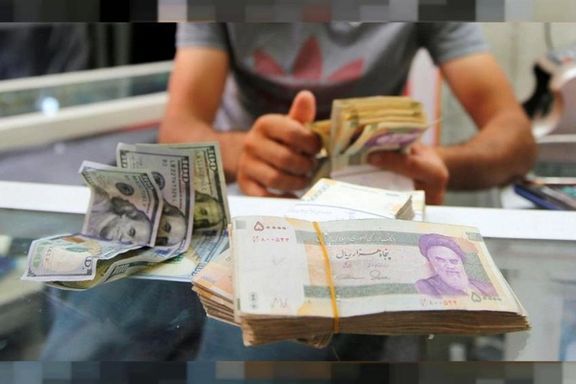
A currency exchange outlet in Tehran, Iran

Optimism over the possibility of a nuclear deal with the United States has strengthened Iran's battered currency for a second time in the past two weeks.

The rial rose to 259,000 on Saturday and to 253,000 rials on Sunday against the US dollar in Tehran’s unofficial currency exchange market. In December, at the height of uncertainty over nuclear talks in Vienna, the rial had dropped to nearly 310,000 rials against the US dollar.

The strengthening of the national currency has also pushed down the price of gold, particularly coins which many Iranians buy as investment to protect their savings.

Etemad newspaper on Sunday attributed the strengthening of the rial to a Reuters report on Thursday which claimed Iran and world powers negotiating for the restoration of the 2015 nuclear deal (JCPOA), had drafted an agreement which among other things included the release of around $7 billion of Iran’s assets frozen in South Korean banks since 2018. A nuclear agreement would lift many US economic sanctions and allow Iran to freely export oil, the main source of revenue for the country.

Iran’s Foreign Minister Hossein Amir-Abdollahian, and the US State Department said during the week that substantial progress has been made. Unnamed Western diplomats told the media that a deal could potentially be reached very soon. An agreement in Vienna could provide the cash strapped Central Bank of Iran (CBI) with resources which it can inject into the currency market to support the rial and finance imports.

Last week the Iranian delegation, including officials of the Central Bank of Iran (CBI) and the National Iranian Oil Company (NIOC), visited Seoul to discuss the release of Iran's frozen assets and resumption of oil trade when and if US sanctions are lifted.

Japanese oil and energy corporation ENEOS has also announced its readiness to resume Iranian oil imports within two to three months of any revival of the JCPOA.

A trade source last week told Argus, a London-based media organization, that in anticipation of the lifting of sanctions, the NIOC is reaching out to key customers to discuss resumption of crude sales, particularly the condensate Iran has placed in floating storage.

The rial began to lose value against the dollar and other major currencies in late 2017 when former US President Donald Trump made clear he was serious in his plans to withdraw from the 2015 deal and subject Iran to draconian sanctions which would hugely limit the country's access to petrodollars.

The rial fell by eightfold since 2017 and in the closing weeks of 2021 even dropped to 310,000 but in the past six weeks despite the uncertainty over the restoration of the deal it has regained some of its value due to rising optimism over a nuclear deal and lifting of US sanctions.

Much higher oil exports to China in recent months might have injected more hard currency into the market.

China has apparently imported an average of 850,000 barrels of Iran's sanctioned crude oil and oil petroleum products worth over $20 billion in 2021. Despite US sanctions, China has continued buying Iranian larger and larger amounts of Iranian crude.


Most Viewed

Ghalibaf defends Iran-US talks amid hardline backlash
1
INSIGHT

Ghalibaf defends Iran-US talks amid hardline backlash

2
VOICES FROM IRAN

Bread shortages, soaring prices strain households in Iran, residents say

3
ANALYSIS

From instability to influence: Pakistan’s pivotal role in US-Iran diplomacy

4
ANALYSIS

100 days on: why Iran’s January protests spread across social classes

5

War-hit homeowners feel abandoned as Iran’s reconstruction aid fades

Banner
Banner

Spotlight

  • Iran crackdown reaches cemeteries as graves of slain protesters defaced
    EXCLUSIVE

    Iran crackdown reaches cemeteries as graves of slain protesters defaced

  • Iran diplomacy wobbles as factions compete to avoid looking soft on US
    INSIGHT

    Iran diplomacy wobbles as factions compete to avoid looking soft on US

  • The politics of pink: how Iran uses cuteness to rebrand violence
    ANALYSIS

    The politics of pink: how Iran uses cuteness to rebrand violence

  • Bread shortages, soaring prices strain households in Iran, residents say
    VOICES FROM IRAN

    Bread shortages, soaring prices strain households in Iran, residents say

  • 100 days on: the anatomy of Iran’s January crackdown
    INSIGHT

    100 days on: the anatomy of Iran’s January crackdown

  • Ghalibaf defends Iran-US talks amid hardline backlash
    INSIGHT

    Ghalibaf defends Iran-US talks amid hardline backlash

•
•
•

More Stories

China Grossly Underreported Oil And Other Imports From Iran

Feb 20, 2022, 15:57 GMT+0
•
Dalga Khatinoglu

China has reported just $6.5 billion of imports from Iran in 2021, while other data show it imported more than $20 billion of Iranian crude and oil biproducts.

Firms such as TankerTrackers that monitor shipments and vessel movements worldwide, and the advocacy group United Against Nuclear Iran have reported that China imported a daily average of 850,000 barrels of oil and biproducts from Iran in 2021, much higher than in the previous year.

Data released by China’s Customs Administration, however, shows there was no increase year-on-year in Iranian imports. (We cannot use the link to the figures because China's Customs website indicates it is 'insecure'.)

The average price of Iranian oil is believed to have been $70 per barrel in 2021 and China bought more than 300 million barrels, which would make the total more than $20 billion.

When the United States imposed full sanctions on Iran’s oil exports in May 2019, China continued to buy 100,000-200,000 bpd until the third quarter of 2020. But before the US presidential elections, reports emerged that Iran was shipping more crude to China and the volume steadily increased, reaching the current levels.

Throughout last year, major American business publications such as The Wall Street Journal and Bloomberg were reporting that China had substantially increased its oil imports from Iran, which could undercut Washington’s leverage in the nuclear talks.

A report issued this week by Iran’s Customs Organization puts the country’s non-oil exports to China in 2021 at more than $13 billion, which is twice what China claims it imported from Iran. If this figure is correct, it means Iran’s total exports, including oil, reached $35 billion versus $6.5 billion announced by Beijing.

The figure for non-oil exports to China announced by Iranian customs must have included petrochemicals and minerals, since its overall figure for exports in these sectors in 2021 was more than $20 billion. China is the biggest customer for Iran’s petrochemicals and minerals.

United States has also sanctioned many of Iran’s petrochemical companies for their ties with the Revolutionary Guards, which is designated as a terrorist organization by Washington. There are also sanctions on many Iranian mining companies, especially dealing in metals.

This could be the reason why China has not disclosed the real monetary value of imports from Iran.

Critics say the Biden Administration has failed to enforce sanctions imposed by former president Donald Trump on Tehran, as it has been trying to revive the 2015 nuclear agreement (JCPOA) with Iran. China seems to have taken advantage of this.

In 2018, Iran’s Supreme Leader Ali Khamenei signaled a new emphasis in Iran’s foreign policy dubbed ‘Looking East’ and in March 2021 Tehran and Beijing signed a 25-year strategic cooperation agreement with details kept secret. Iran expects China to invest up to $400 billion, which would include what many fear privileges for Chinese companies, particularly in oil and gas.

Tanker Carrying Iranian Oil Caught Fire Near China’s Shores

Feb 20, 2022, 13:50 GMT+0

A tanker carrying half a million barrels of oil originating in Iran caught fire near China’s shores on Friday but the crew controlled the blaze.

One day after the incident, Iran’s official IRNA news agency denied there was any link between the country and the oil tanker.

The IRNA report tried to use vague wording in its denial, suggesting that the cargo had been sold by Iran to an intermediary for delivery to a final customer, saying, “IRNA has learned from informed sources that this oil tanker does not belong to Iran and the only possibility is that its cargo belongs to one of Iran’s customers.”

Tanker tracking firm TankerTrackers confirmed the news in a tweet on Saturday, saying that “an old uninsured foreign-flagged tanker carrying half a million barrels of Iranian oil caught fire in the Far East”.

TankerTrackers added that they informed clients of the vessel’s identity and location.

According to reports, Iran normally transfers oil to different tankers in the sea to get round US sanctions since 2018 and send oil to China.

Fars news agency affiliated with the Revolutionary Guard said earlier in February that Iran’s oil export income grew by 494 percent in the first 5 months of the Raisi administration.

Earlier in January, a report detailed Iran’s large diesel smuggling network, revealing the role of the Revolutionary Guard and private shipping companies in the illicit trade.

Cargo Ship Reportedly Owned By Iran Security Chief Impounded In India

Feb 19, 2022, 10:24 GMT+0

A cargo ship reportedly belonging to the sons of Iran's top security official Ali Shamkhani has been impounded in one of India’s ports.

The container vessel, named Kabul, belongs to the Admiral Shipping Company that Iranian media said is owned by Hassan and Hossein Shamkhani, the sons of the secretary of Iran’s Supreme National Security Council.

ILNA news agency reported on Friday that an Indian court has ordered the seizure of the ship and cargos originating or destined to Iran about 10 days ago.

The container ship is impounded on charges of possessing false documents, and has been anchored at Kandla, officially Deendayal Port -- a seaport and town in Kutch district of Gujarat state in Western India -- for 10 days ago.

According to Marine Traffic, KABUL is a container ship that was built in 2001 and is sailing under the flag of Saint Kitts and Nevis.

In recent years, the economic activities of Shamkhani’s family, including his brother and son-in-law, have been widely criticized and made headlines in Iran. Shamkhani was an admiral in Iran’s navy and a former IRGC commander.

He has recently been an outspoken critic of the Vienna talks to revive the Iran nuclear deal. After news about the impounded ship broke, critics quipped that continuation of United States’ sanctions are apparently good for Shamkhani family’s business interests.

This week, the publication of an audio recording implicated top commanders of the Revolutionary Guards in a massive corruption scheme in mid-2010s.

Iran Impounds Smuggled Rare Antiques At Turkish Border

Feb 18, 2022, 21:35 GMT+0

Iran has seized a cargo of antique goods and ancient artifacts smugglers planned to take out through Turkey.

Rouhollah Latifi, spokesperson for the Customs Administration office, said Friday that 570 items confiscated included old coins and books.

The shipment was found in a truck loaded with second-hand home furniture in transit to Canada at the Bazargan border crossing, West Azarbaijan province, the spokesman said. The coins were worth several billion rials, Latifi added.

Within the haul were 18 bronze pieces dating from the first millennium BC, antique daggers, seven glass chandeliers, 322 silver coins, a one-dollar coin minted in 1845, some Qajar-era (1795-1925) plates, and a handwritten gold-gilded Qur'an.

Under Iranian law, such artifacts are deemed part of "national heritage" and illegal to export unless expressly authorized by the relevant authorities. Smuggling antiques can lead to years of imprisonment and fine equal to twice the value of the smuggled items.

Iranian items legitimately for sale in western auction houses or by dealers – including carpets, manuscripts, painting, ceramics, and woodcrafts – can fetch from a few hundred dollars to hundreds of thousands, or more. London’s Victoria and Albert Museum bought the 16th-century ‘Ardabil carpet’ in 1893 for £2,000.

Rights Groups Say Iran’s Raisi Must Stay On US Sanctions List

Feb 18, 2022, 13:16 GMT+0

Nine human rights organizations have called on world powers negotiating with Iran in Vienna “not to lift human rights sanctions on the Islamic Republic of Iran.”

The group, including the Netherlands-based Center for Human Rights in Iran, issued a statement Friday told world power trying to revive the 2015 Iran nuclear deal they should be “maintaining” sanctions against Iran’s President Ebrahim Raisi.

Raisi was designated by the United States in 2019under an executive order signed by President Donald Trump allowing sanctions against anyone linked to the office of Iran Supreme Leader Ali Khamenei. The rights’ groups’ statement attributed Raisi’s listing to his role 31 years earlier in the 1988 prison executions, which the US Treasury cited in its press release announcing the designation.

Iran, backed by other participants, has argued that talks in Vienna should stick to the original logic of the 2015 deal, the JCPOA (Joint Comprehensive Plan of Action), in isolating the nuclear from other issues.

The rights groups statement said US “human rights sanctions” were imposed due to “the Iranian government’s egregious rights violations and abuses,” and that Raisi had “personally participated in ‘Death Commissions’” in 1988.

Hadi Ghaemi, executive director of the Center for Human Rights in Iran, said: “We cannot sacrifice human rights at the mantle of the nuclear negotiations with the Islamic Republic.”

as/ms