• العربية
  • فارسی
Brand
  • Iran Insight
  • Politics
  • Economy
  • Analysis
  • Special Report
  • Opinion
  • Podcast
  • Iran Insight
  • Politics
  • Economy
  • Analysis
  • Special Report
  • Opinion
  • Podcast
  • Theme
  • Language
    • العربية
    • فارسی
  • Iran Insight
  • Politics
  • Economy
  • Analysis
  • Special Report
  • Opinion
  • Podcast
All rights reserved for Volant Media UK Limited
volant media logo

Iran-Pakistan Meetings Reflect Concerns Over Border Security
Feb 14, 2022, 19:41 GMT+0
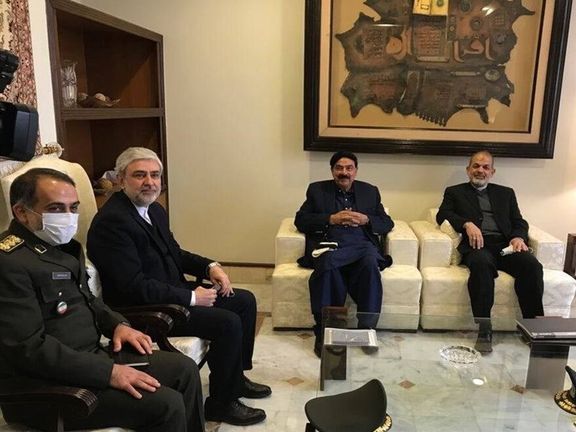
Ahmad Vahidi (far right) meeting with Pakistani security officials. February 14, 2022

Iran and Pakistan have established a taskforce to promote cooperation in border security and the exchange of prisoners.

Iranian Interior Minister Ahmad Vahidi arrived in Islamabad for a one-day visit at the head of a nine-member delegation Monday and was welcomed by Pakistani counterpart Sheikh Rasheed Ahmad at the Noor Khan airbase, Rawalpindi.

Vahidi also met with Prime Minister Imran Khan, army chief General Qamar Javed Bajwa, and Interior Ministry Secretary Yousaf Naseem Khokhar. Vahidi and Khan reportedly backed the construction of border markets and improved transport infrastructure – including roads and rail – to boost trade.

Vahid’s meeting with Bajwa, the army chief, and Pakistani security officials was joined by Iranian ambassador Mohammad Ali Hosseini, General Ahmad Ali Goudarzi, commander of the Iranian Border Guards.

Tehran and Islamabad last October agreed to arrangements for exchanging prisoners, apparently to allow repatriation of those serving sentences abroad. But the high-level attendees at the meetings may reflect concern over the Iran-Pakistan border sitting on growing human and drug trafficking out of Afghanistan.

Co-operation between the two sides has been stymied by Iran’s suspicion that Pakistan, either deliberately or though neglect, has served as a refuge for Baluchi groups that have carried out violent attacks inside Iran and by Tehran’s suspicion of Pakistan’s relationship with militant Sunni factions including the Taliban in Afghanistan. Vahidi's visit took place a week after Saudi Interior Minister Prince Abdulaziz bin Saud bin Nayef visited Pakistan.


Most Viewed

State media slam Araghchi's Hormuz tweet, say it let Trump claim victory
1

State media slam Araghchi's Hormuz tweet, say it let Trump claim victory

2
OPINION

The Hormuz get out of jail card turned to a grave

3
INSIGHT

How Tehran bends its own red lines to boost state rallies

4

Iran International says it won’t be silenced after London arson attack

5
VOICES FROM IRAN

Iran blackout cripples freelancer, small business incomes

Banner
Banner

Spotlight

  • Too early to tell who is winning Iran war, experts say
    PODCAST

    Too early to tell who is winning Iran war, experts say

  • How Tehran bends its own red lines to boost state rallies
    INSIGHT

    How Tehran bends its own red lines to boost state rallies

  • Iran blackout cripples freelancer, small business incomes
    VOICES FROM IRAN

    Iran blackout cripples freelancer, small business incomes

  • Ideology may be fading in Iran, but not in Kashmir's ‘Mini Iran'
    INSIGHT

    Ideology may be fading in Iran, but not in Kashmir's ‘Mini Iran'

  • US blockade enters murky phase as tankers spoof signals and buyers hesitate
    ANALYSIS

    US blockade enters murky phase as tankers spoof signals and buyers hesitate

  • Why the $100 billion Hormuz toll revenue is a myth
    ANALYSIS

    Why the $100 billion Hormuz toll revenue is a myth

•
•
•

More Stories

Activists Urge Germany To Act To Prevent Execution Of Iran Dissident

Feb 14, 2022, 16:11 GMT+0

Several rights activists have called on Germany to act to prevent the imminent execution of Iranian-German political activist Jamshid Sharmahd.

His daughter Ghazaleh Sharmahd, along with several other rights activists, wrote a letter to German Foreign Minister Annalena Baerbock asking her to form a crisis management team and put pressure on the Islamic Republic to stop his killing.

Journalists and civil society activists Masih Alinejad, Jamshid Barzegar, Nazanin Bonyadi, Barry Rosen and Richard Ratcliffe were among the other signatories of the letter.

“It is of the utmost importance that the German federal government act immediately to prevent the planned state assassination of Mr Sharmahd…We urge you to take immediate, serious and sustained action to save the life of the 66-year-old German citizen and his family from this horrific act”, read the letter.

He appeared in a court in Tehran earlier this month and was charged with “spreading corruption on earth”. He could face execution if convicted on this charge, which campaigners say is often used against opponents of the government.

Sharmahd, the director of Tondar opposition group, has been held in solitary confinement for 555 days, and during this time, he has been denied an independent attorney and fair legal procedures.

The news of the Sharmehd’s kidnapping in Dubai and his transfer to Tehran by Islamic Republic agents was first released in August 2020. The Islamic Republic has alleged that Sharmahd was involved in a 2008 bombing on a mosque in Shiraz that killed 14 people and wounded 200 more, something he and his family vehemently deny.

Israel's Bennett To Make First Visit To Bahrain On Monday

Feb 14, 2022, 13:26 GMT+0

Israeli Prime Minister Naftali Bennett will travel to Bahrain Monday in the highest-level visit since the countries established relations in 2020 in part on shared worries about Iran.

Bennett will meet with Bahraini Crown Prince and Prime Minister Salman bin Hamad al-Khalifa, his office said.

"The leaders will discuss additional ways to strengthen bilateral ties...especially the advancement of diplomatic and economic issues, with an emphasis on technology and innovation," it said in a statement.

The two-day trip to Bahrain, home to the US Navy's Gulf headquarters, comes amid heightened tensions after missile attacks on neighboring United Arab Emirates by Yemen's Iran-aligned Houthis. Israel also normalized ties with UAE in 2020.

Israel has stepped up cooperation with the Gulf states. Manama hosted Israel's defense minister on Feb. 2 and has said an Israeli military officer will be posted in Bahrain as part of an international coalition.

On the commercial front, Israel has reported rising trade with Bahrain that reached $6.5 billion last year. There are direct flights between the countries.

The outreach by Bahrain's Sunni Muslim monarch has been criticized by an opposition led by the Shi’ite majority. The country has seen protests in solidarity with the Palestinians.

Report by Reuters

Fire Breaks Out At IRGC Military Base In Western Iran

Feb 14, 2022, 09:32 GMT+0

A fire broke out in a Revolutionary Guard (IRGC) military base in western Iran, local media reported, but the cause of the blaze was not immediately clear.

The fire started in a stockroom where motor oil and other flammable materials were stored in the Mahidasht district of Kermanshah province Monday morning, according to what government-controlled media said.

Initial reports said an industrial shed was damaged in the fire, which was put out by firefighters.

Teams have been dispatched to the base to investigate the cause of the incident.

Earlier in mid-January, social media reports by journalists and citizens said a series of loud explosions were heard in Western Iran, around the cities of Hamedan and Kermanshah. Some reports quoted Iran's Revolutionary Guard as saying that they launched air defense drills in the region, but residents reported anti-aircraft activity in the area.

Also in January, a large fire sparked by a rupture of an underwater pipeline interrupted production at one of the transmission pipelines of phase 16 of Iran’s South Pars gas field in the Persian Gulf.

Iran has been the scene of mysterious attacks since July 2020 that twice caused explosions in its high-security Natanz uranium enrichment facility, causing major damage.

The frequency of accidents in Iran’s energy facilities is increasing with some blaming lack of proper maintenance of the aging infrastructures and some suspecting sabotage by other countries, presumably Israel.

Iran Says Talks Over A Prisoner Swap 'On The Agenda In Vienna'

Feb 14, 2022, 08:57 GMT+0

Iran's foreign ministry spokesman said on Monday that a prisoner swap with the United States was on the agenda in parallel with the nuclear talks in Vienna.

"This issue is currently on the agenda in parallel with the Vienna talks.... But it seems that the US has not made a decision on it. Perhaps it is waiting for the results of the talks," said Saeed Khatibzadeh.

This is the first time that an Iranian official says official talks over foreigners and dual nationals detained in Iran with the United States have been on the agenda in Vienna. Tehran has refused to directly negotiate with Washington since nuclear talks began last April in Vienna.

Iran is holding several Western prisoners in what human rights organizations have dubbed hostage diplomacy. As in past instances, Tehran is demanding the release of Iranian detained in the US for breaking sanctions laws and related offenses.

European powers, the European Union and Russia are shuttling between the two sides, while there have been more calls in Iran to negotiate directly with the US.

Khatibzadeh also said that the nuclear talks have not “reached a dead end.” Ten months after negotiations began still major issues of which US sanctions should be lifted and how Iran should return to its obligations under the 2015 nuclear agreement remain unresolved.

More Than 100 Academics Condemn Firing Of Professors In Iran

Feb 13, 2022, 22:13 GMT+0
•
Iran International Newsroom

More than one hundred Iranian academics from around the world have condemned recent firings of professors in Iran, calling it an intensification of suppression.

In an open letter, 105 academics, mostly from American universities said that recent layoffs of professors from Iranian universities were political in nature and cannot be justified on scientific or professional grounds.

The letter followed news in January that at least three professors were fired from their jobs. Sociologist Mohammad Fazeli, professor of philosophy Arash Abazari and social science lecturer Reza Omidi got the pink slip without a clear explanation. Each had excelled in their field. Abazari is well-known for his book Hegel's Ontology of Power: The Structure of Social Domination in Capitalism, which was published by Cambridge University Press. Fazeli’s works focus on sociology of politics and science, especially in the energy sector.

On Saturday, news emerged that Islamic Azad University in Iran has fired more than 300 professors and lecturers and is planning to fire 1,500 more from its campuses around the country. It is not clear whether this is related to financial pressure amid Iran’s economic crisis or a way to politically “cleanse” the academia.

The academics residing outside Iran said in their letter that based on the academic credentials of the professors in Iran, “it is clear that the firings cannot be justified.” The quality of their scientific research was not the reason for the decisions. The policy to fire professors is the result of “intolerance and lack of respect for academic freedom.”

The letter demanded the “unconditional return” of the professors to their posts, so that they can continue to serve the society and their students.

Among the academics who signed the letter there are Professors of Emeritus from Yale University (Abbas Amanat), Pace University (Reza Afshari), City University of New York (Ervand Abrahamian), Bennington College (Mansour Farhang) and many others.

Other academics of Iranian descent from the United Kingdom, France, Denmark, Sweden Holland, Switzerland and other countries have also signed the open letter.

The letter does not name any of the professors fired in Iran, not to endanger their security. The Islamic Republic will probably retaliate against them if their name comes up in a context of criticizing the clerical government. Universities in Iran are controlled by the government and decisions to fire professors are suggested or approved by bureaucrats.

Dr Kazem Alamdari of California State University, Northridge told Center for Human Rights in Iran that “We did not want to endanger the professors in Iran, but we wanted to speak out about this, because we believe that putting authorities under the pressure of public opinion is most impactful approach.”






