• العربية
  • فارسی
Brand
  • Iran Insight
  • Politics
  • Economy
  • Analysis
  • Special Report
  • Opinion
  • Podcast
  • Iran Insight
  • Politics
  • Economy
  • Analysis
  • Special Report
  • Opinion
  • Podcast
  • Theme
  • Language
    • العربية
    • فارسی
  • Iran Insight
  • Politics
  • Economy
  • Analysis
  • Special Report
  • Opinion
  • Podcast
All rights reserved for Volant Media UK Limited
volant media logo

Iran Police Deploy 250 New Anti-Riot Armored Vehicles
Feb 6, 2022, 14:47 GMT+0
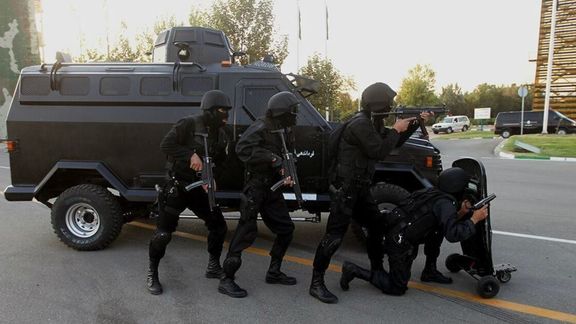
An anti-riot "tactical vehicle" used by Iran's special security forces.

Iran’s police have distributed thousands of new cars, anti-riot “tactical vehicles”, motorcycles and boats to units, costing tens of millions of dollars.

The commander of the police, General Hossein Ashtari, a senior Revolutionary Guard officer, said Sunday that 1,800 cars, 700 motorcycles, 250 “tactical vehicles” and 85 boats were procured and distributed.

Fars news that published the report gave no details about the kind of cars purchased by the police, but Iran uses a mix of domestically assembled cars as well as imported models, such as Toyota SUVs and Mercedes cars in the past. But 1,800 cars alone would cost tens of millions of dollars.

Different types of anti-riot vehicles used by Iran's police units
100%
Different types of anti-riot vehicles used by Iran's police units

Motorcycles are mainly used to disperse protesters when special anti-riot personnel, two per motorcycle, show up in groups of 20 or more and drive toward small or large crowds. The men sitting in the back use sticks or even chains to attack civilians.

Tactical vehicles are a variety of heavy, armored semi-trucks and trucks, designed to confront and disperse protesters. They are assembled in Iran, but engines and other parts are imported. Some are used as powerful water trucks and others have special devices to fire tear gas.

An armored vehicle tagged as 'Special Police" used against protesters. FILE PHOTO
100%
An armored vehicle tagged as 'Special Police" used against protesters.

The special anti-riot forces have been instrumental in the past to stop nationwide protests. Civilians have no way to protect themselves against swarming motorcycles or armored vehicles, while often these forces have permission to open fire on protesters.

In November 2019, a variety of forces were used to put down nationwide protests, including armed vigilante-type groups, riot police and according to some accounts, even Iraqi and Afghan militiamen. As a result, hundreds were killed in the streets. Reuters put the figure at 1,500, while Amnesty International has conformed 304 deaths.

Anti-riot police forces during drills. Undated
100%
Anti-riot police forces during drills

The news of the large procurements comes as the Islamic Republic leadership call for more support for the police after an officer was stabbed to death by an alleged criminal this week. Iran’s parliament has vowed to relax current laws on use of firearms by the police, although during protests security forces have felt to inhibition on opening fire on civilians.

Police chief Ashtari presented the news of procurements as giving more mobility to security forces that are under the umbrella of the armed forces, with the leadership of the Revolutionary Guard, IRGC. He said the move will strengthen security on borders and for ordinary people.

He called on political leaders to support police requests for more support in next year’s budget. Already this year, security forces have received several raises amid high double-digit inflation, while other government employees receive half of what is needed for minimum expenses, estimated to be more than $400 a month for a family of 3.3.

Teachers and even court workers and prison guards have been protesting for pay raises to partially redress the impact of inflation that has seen food prices rise by 60 percent in the past year.


Most Viewed

Ideology may be fading in Iran, but not in Kashmir's ‘Mini Iran'
1
INSIGHT

Ideology may be fading in Iran, but not in Kashmir's ‘Mini Iran'

2
INSIGHT

Hardliners push Hormuz ‘red line’ as US blockade tests Iran’s leverage

3
VOICES FROM IRAN

Hope and anger in Iran as fragile ceasefire persists

4

Iran International says it won’t be silenced after London arson attack

5

US sanctions oil network tied to Iranian tycoon Shamkhani

Banner
Banner

Spotlight

  • Hardliners push Hormuz ‘red line’ as US blockade tests Iran’s leverage
    INSIGHT

    Hardliners push Hormuz ‘red line’ as US blockade tests Iran’s leverage

  • Ideology may be fading in Iran, but not in Kashmir's ‘Mini Iran'
    INSIGHT

    Ideology may be fading in Iran, but not in Kashmir's ‘Mini Iran'

  • War damage amounts to $3,000 per Iranian, with blockade set to add to losses
    INSIGHT

    War damage amounts to $3,000 per Iranian, with blockade set to add to losses

  • Why the $100 billion Hormuz toll revenue is a myth
    ANALYSIS

    Why the $100 billion Hormuz toll revenue is a myth

  • US blockade targets Iran oil boom amid regional disruption
    ANALYSIS

    US blockade targets Iran oil boom amid regional disruption

  • Iran's digital economy battered by prolonged blackout
    INSIGHT

    Iran's digital economy battered by prolonged blackout

•
•
•

More Stories

IRGC Officer Says 850 Killed In Two Iranian Provinces Alone In 2019 Protests

Feb 6, 2022, 14:36 GMT+0

An officer of Iran’s Revolutionary Guards says about 850 people were killed in two provinces alone in the first two days of the bloody November 2019 protests.

During the Sunday session of the Iran Atrocities Tribunal, underway behind closed doors in London, “witness 600”, who identified himself as a former senior IRGC officer, claimed that 427 people were killed in Khuzestan province and 420 in Tehran during the crackdown, adding that about 8,000 people were also arrested in the capital.

Earlier estimates ranged from 300-1,500 civilians killed nationwide. The new figure offered by the witness would mean that overall death toll was much higher.

“We were losing Tehran and Vahid Haghanian (supreme leader’s chief personal aide) from Khamenei's office ordered us to do whatever is necessary to end the chaos”, he said. Reuters had reported in December 2019 that the order to end protests at any cost had come from Khamenei.

He added that Basij paramilitary forces were also allowed to fire directly at people, noting they “fired the most and killed the most".

He said this crackdown was the only case in which military forces were not required to report on how many times or where they fired.

The tribunal − also known as Aban Tribunal after the Iranian calendar month of Aban − was established on the first anniversary of the 2019 protests by several human rights groups.

Iranian Man Beheads 17-Year-Old Wife In Another 'Honor Killing'

Feb 6, 2022, 10:34 GMT+0

In another case of 'honor killing' in Iran, an unnamed young man has beheaded his 17-year-old wife, Mona Heydari, and displayed her head around the streets.

The murder happened in the southwestern city of Ahvaz on Saturday when the young wife was brought back from Turkey, where she had traveled for unknown reasons.

Her father helped the husband, who is his nephew, to bring the woman back to the country.

The husband and his brother, who apparently committed the murder together have been arrested.

Iran's media watchdog responded quickly and banned Rokna news agency that first released the footage of the killer carrying her wife’s head.

The husband who beheaded his wife smiling in a video, holding her head in one hand and a large knife in another.
100%
The husband who beheaded his wife smiling in a video, holding her head in one hand and a large knife in another.

Honor killings are prevalent in some parts of Iran, mostly due to societal beliefs and the Islamic Republic’s lax laws and light sentences that encourage the behavior.

Article 630 of the Constitution exempts a husband from punishment if he kills if he witnesses adultery.

According to a women’s right NGO in Ahvaz, about 60 women have fallen victim to honor killings in the past two years, including some who were 10 or 15 years old. None of the perpetrators have been brought to justice as most of the families haven’t even filed a lawsuit.

The medical journal the Lancet published an article in October 2020, saying at least 8,000 honor killings took place in Iran between 2010 and 2014, but only a few were reported.

According to Sharia law, only the “blood owners” (the immediate family members) are allowed to demand execution for the murder of their loved one, therefore most honor killings go unpunished since families do not demand heavy punishment for another family member.

Influential Iran Politician Asks Khamenei For Constitutional Change

Feb 6, 2022, 07:32 GMT+0
•
Iran International Newsroom

An influential politician, Mohammad Reza Bahonar, has called for convincing Supreme Leader Ali Khamenei to consent to changing Iran's rigid Constitutional Law.

Bahonar, who is a former deputy speaker of the Iranian parliament and the leader of the Islamic Association of Iranian Engineers, is known for his influence in conservative political circles and his ability to organize political moves at times of crisis.

In his interview with Etemad Online published on Saturday, Bahonar said that Iran needs structural changes and Khamenei should be convinced to accept the changes.

Meanwhile, Bahonar put forward his idea of "the Second Republic" and stressed that Iran needs to facilitate the rotation of elites to materialize this idea.

Bahonar has a proven track record of organizing and mobilizing conservative groups. He did that following the landslide victory of Iran's reformists in the 1997 presidential election and the 2000 parliamentary election and consolidated the conservative groups. Nonetheless, he had remained conspicuously silent in recent years.

Bahonar’s political re-emergence

His high-profile re-emergence into the political scene took place last week as his name was among one of those who formed an alliance of reformists and moderate conservatives in a bid to bring about "a fundamental change in the country's political landscape." He is now suggesting the ideas of a second republic and good governance to facilitate the political comeback of moderates. 

Former presidents Khatami (L) and Hassan Rouhani with Nategh-Nouri. FILE PHOTO
100%
Former presidents Khatami (L) and Hassan Rouhani with Nategh-Nouri.

Bahonar has suggested in his interview with Etemad that Khamenei should approve the forming of at least four political parties ranging from the far left to reformists, moderates and conservatives with election candidates in each party who would have true plans for the future of Iran and form a parliament in 2024 that would think of national interests as its foremost concern.

He said that in the absence of real and powerful political parties, the lawmakers do not really know each other during their four years in parliament, let alone working together to solve the country's problems.

But how can his ideas be put into practice in a country where discussing a change in the constitution is part of the regime's red lines? That is probably why the seasoned politician seeks Khamenei's consent. Meanwhile, Bahonar said that he is not alone in his call for change, adding that there are other politicians who agree with him although they might differ on the details of what needs to be done.

By "others" Bahonar possibly means politicians such as former President Hassan Rouhani, former Majles Speakers Ali Larijani, Ali Akbar Nategh Nouri and former vice-president Es'haq Jahangiri who are part of a newly formed alliance. One of the signs that indicate the alliance is serious is the strong opposition expressed by the Raisi administration official mouthpiece, the Iran newspaper.

A new Republic

Bahonar explained the need for a new republic by enumerating the flaws in the current political system where instead of national interests, various institutions are mainly preoccupied with serving group interests based on ethnic, vocational and economic interests.

He added that other than at least four true political parties, Iran needs a second legislature like a senate. Bahonar said in Iran governments wrongly take pride in the fact that they are not backed by any political party.

He said since the French Revolution, France has changed the structure of its republic five times. Bahonar then called on Khamenei to use Article 177 of the constitution to allow a revision of the Constitutional Law through a special assembly or via a referendum.

He also called for the rotation of elites and criticized officials who depart from their seats only when death comes. He blamed them for the low turnout in recent elections in Iran and warned that this is a sign of a decline in the government's social base. Bahonar said experts in the intelligence agencies should probe into the causes of this decline.

Iran Says Ready For Talks With Saudi Arabia In Atmosphere Of 'Respect'

Feb 5, 2022, 23:10 GMT+0

Iran is ready for more talks with Saudi Arabia if Riyadh is willing to hold the talks in an atmosphere of mutual understanding and respect, the semi-official news agency Fars quoted Iranian President Ebrahim Raisi as saying on Saturday.

Regional rivals Iran and Saudi Arabia, which severed diplomatic ties in 2016, launched direct talks hosted by Iraq last year at a time when global powers are trying to salvage a 2015 nuclear pact with Tehran, and as U.N.-led efforts to end a war in Yemen stall.

"Iran is ready to continue these negotiations until reaching an outcome, provided that the Saudis are willing to continue the negotiations in an atmosphere of mutual understanding and respect," Fars quoted Raisi as saying in a phone call with Iraqi Prime Minister Mustafa al-Kadhimi.

Iran had said earlier that its meetings with Saudi Arabia had been positive and had not complained about Riyadh’s attitude.

Saudi Arabia has described the talks as cordial but exploratory, while Tehran says they had gone a "good distance".

Recent missile and drone attacks by Iran-backed Houthis on targets in the United Arab Emirates might have affected the chances of more talks between Riyadh and Tehran.

With reporting by Reuters

Iranians Renew Rumpus Over Raisi Kremlin Reception

Feb 5, 2022, 22:25 GMT+0
•
Maryam Sinaiee

Vladimir Putin’s warm reception of the Argentinian president recently was in stark contrast to the way Kremlin treated Iran's president, many Iranians say.

Photos and videos emerged Thursday of Alberto Fernandez being warmly embraced by Putin, who sat very close to the Argentinian president in contrast to his greeting Raisi, a cleric, from a distance before the two men sat at opposite ends of a long table. This led to social-media comments claiming confirmation that Putin had not shown the respect due to the Iranian president.

Critics widely shared photos and videos of the two meetings alongside each other on various social media platforms on Friday and commented that they proved earlier claims that Putin had not shown due respect to the Iranian President.

Morteza Kazemian, journalist, told Iran International TV Friday that Putin’s reception of Fernandez proved that Raisi's treatment had been “out of the ordinary.” Clearly this showed the Russian president considered Raisi "a second-rate official” and "an executive officer" of Iran's Supreme Leader Ali Khamenei, Kazemian opined.

The Putin-Raisi January 21 meeting fed speculation over the table’s placement – for some as an intentional act to imply "distance" – over Putin apparently chewing gum, and over the absence of the two countries’ flags in the hall. A video released by Russian media after the visit apparently showed Raisi leaving the Kremlin without being seen off by Russian officials.

A conservative journalist, Mohammad Mohahjeri, called for Foreign Minister Hossein Amir-Abdollahian's resignation for failing to ensure that diplomatic protocols had been observed. The arrangements were "disgraceful," he said.

Various officials, government media, politicians, and Friday imams disagreed, insisting that Raisi had been respectfully received. They praised Raisi for praying in the Kremlin, a building seen for decades under Communism as the bastion of world atheism, and rejected criticism of Raisi’s government's efforts to expand relations with Russia and China in the face of continuing US ‘maximum pressure’ sanctions.

Some argued that Putin had kept a ‘social distance’ because Raisi had refused to abide by Covid protocols required by the Kremlin, including vaccination with the Russian Sputnik V vaccine and being tested before the meeting. They also said this was a "working visit" which did not require the ceremonial display of flags.

Fars news agency said the whole show, including the placement of the table, conformed with diplomatic protocols and suggested that Putin had been so impressed with the Iranian president that he fidgeted with his tie.